
On this page
- 01Quick Answer: Tandem vs AFF — Which Should You Choose?
- 02What Is a Tandem Skydive?
- 03What Is AFF Skydiving?
- 04The Biggest Emotional Difference Between Tandem & AFF
- 05What the Actual Experience Feels Like
- 06Which One Is More Scary?
- 07Which One Is Safer?
- 08Cost Comparison: Tandem vs AFF
- 09Who Should Choose Tandem?
- 10Who Should Choose AFF?
- 11Can You Do Tandem First and AFF Later?
- 12Common Beginner Misconceptions
- 13The Honest Pros & Cons of Each
- 14What We'd Recommend for Most First-Time Travellers
- 15Where You Can Actually Do AFF in Asia
- 16The Honest Conclusion
There's a moment, somewhere around 9,000 feet, when the engine note flattens out and the door of the plane stops being a door. It becomes a decision. The instructor next to you is calm — almost bored — checking a strap, glancing at the altimeter on his wrist. You can feel your own pulse in your throat. The aircraft is full of people, but nobody is really speaking. And the question that has been sitting in your chest for weeks finally surfaces, sharp and physical: am I doing this attached to someone, or am I doing this alone?
That single question — tandem or AFF — is one of the most misunderstood choices in skydiving. People research it the night before. People argue about it on Reddit. People make their decision based on a friend's story, a YouTube video, or a price they saw on a booking page. Almost nobody talks about what actually matters: how each one feels, who each one is for, and what you're really committing to.
This guide exists because we kept watching first-time travellers across Asia choose poorly — booking AFF when they wanted a bucket-list experience, or booking tandem and then quietly regretting that they didn't "do the real one." Both choices are valid. Both choices are great skydives. But they are not the same product, and pretending they are has been costing people money and confidence for years.
What follows is the most honest comparison we know how to write. It's written for the person who has never jumped before. It does not assume you are fearless, mechanically minded, or a thrill-seeker. It does assume you want a real answer.
If you only read one paragraph: tandem is the experience of skydiving; AFF is the beginning of becoming a skydiver. The first is a once-in-a-lifetime sky-tour with a professional strapped to your back. The second is a structured course where you exit the plane next to instructors, fall on your own, and pull your own parachute. Both are safe. Both are extraordinary. They answer different questions.
Quick Answer: Tandem vs AFF — Which Should You Choose?
Most first-time travellers should choose tandem. It is shorter, simpler, dramatically less mentally demanding, and produces the same canonical skydive memory: door, freefall, canopy, landing, adrenaline. AFF is the right answer for a smaller, specific group of people: those who want to learn to skydive solo, who are emotionally ready to manage their own equipment, and who plan to keep jumping after the holiday ends.
Use the table below as a fast triage. The rest of the article exists to explain why.
| Decision factor | Tandem | AFF |
|---|---|---|
| Best for | First-timers, travellers, couples, bucket-list jumpers | Aspiring sport skydivers, future licence-holders |
| Training before the jump | 20–30 minutes | 4–6 hours of ground school per level |
| Time on the day | 1.5–3 hours total | Half a day per level; full course usually 5–10 days |
| You are attached to an instructor? | Yes — harnessed to the front of an instructor | No — you exit on your own with two instructors flying beside you |
| Who pulls the parachute? | The instructor | You do |
| Who lands the canopy? | The instructor | You do, with radio guidance from the ground |
| Mental load | Surrender + sensory experience | Active learning under pressure |
| Typical cost in Asia (USD equivalent) | ~$240–$680 per jump | ~$400–$700 per level; full course ~$2,500–$4,500 |
| Easiest option | Tandem | — |
| Most intense option | — | AFF |
| Safest-feeling option psychologically | Tandem | — |
| Best for future skydivers | — | AFF |
If you are reading this on the flight to Bangkok, on the bus to Pokhara, or in a hotel lobby in Dubai because you want to jump tomorrow — the answer is tandem. AFF is not a holiday activity in the same way; it's a small course.
What Is a Tandem Skydive?
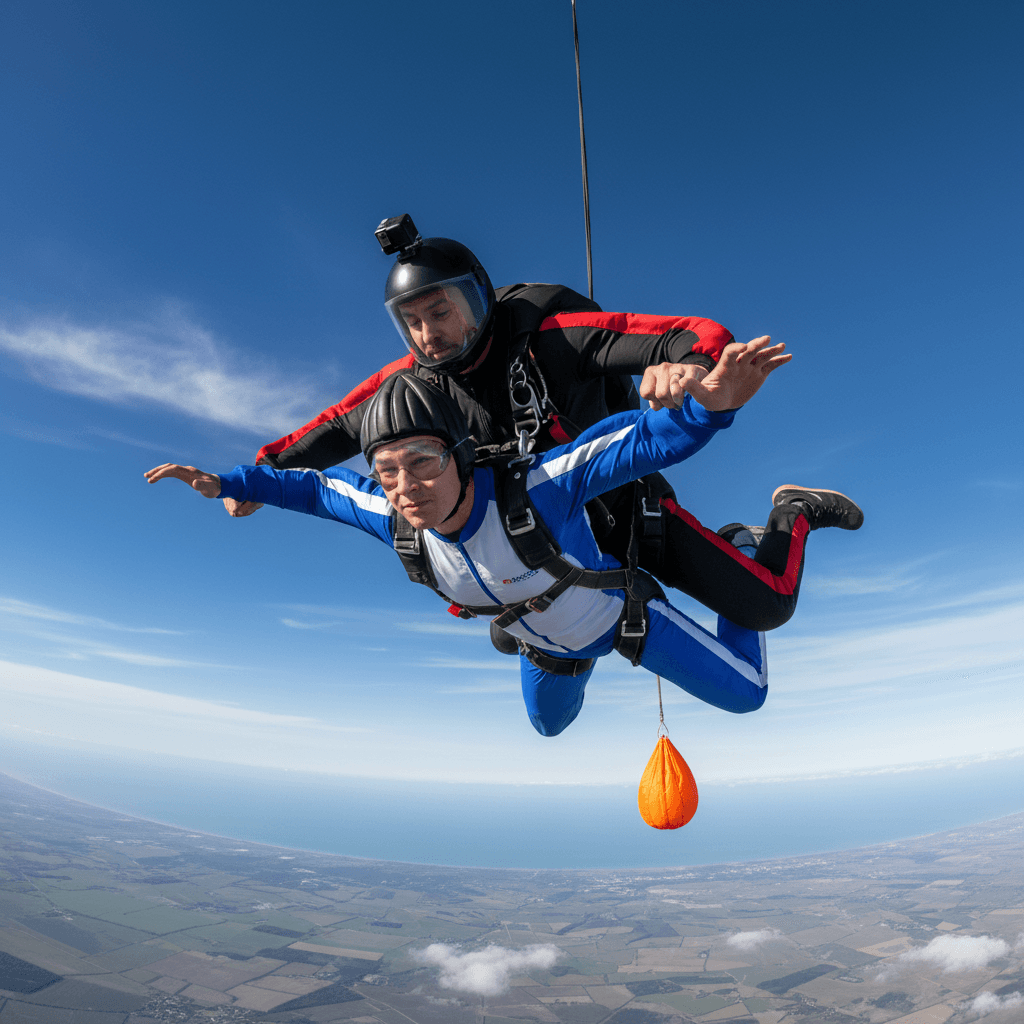
A tandem skydive is a jump where you are physically attached to a licensed tandem instructor by a four-point harness on your back. You wear a jumpsuit, a helmet, and goggles. The instructor wears the parachute system — the main canopy, the reserve canopy, and the automatic activation device that will deploy the reserve if anything goes wrong. From the moment you walk to the plane until the moment you stand on the ground, you are clipped to a person whose entire job is to land you safely.
This is the version of skydiving most people picture when they imagine "skydiving." It is also the version most people actually do. Across the global industry, tandem jumps make up the overwhelming majority of all civilian skydives — for reasons that become obvious once you understand how little the passenger has to do, and how much the instructor handles.
The instructor's job
Tandem instructors are the most experienced jumpers at any dropzone. To get rated, they need a minimum of around 500 jumps and three years in the sport, plus a separate instructor course on tandem-specific equipment. Many of the people you will meet at established Asian dropzones — Thai Sky Adventures, Skydive Dubai, Skydive Cebu — have several thousand jumps and have been instructing for a decade or more. The tandem you do is, for them, a tuesday.
On the jump, the instructor checks every strap before you board, controls the body position on exit, monitors altitude, deploys the parachute at the correct height, flies the canopy, and lands. Your role, in order: smile at the camera, lift your legs on landing, try to breathe.
How much training you actually do
The pre-jump briefing for tandem is short on purpose. You will spend roughly twenty to thirty minutes learning four things: how to arch your body on exit, how to lift your legs on landing, what to do with your arms in freefall, and what the canopy ride is going to feel like. That's it. There is no test. There is no exam. You are not expected to remember anything complex under pressure, because you do not need to.
What it feels like, in one sentence
Tandem feels like surrender — like sitting in the front car of a roller coaster you didn't have to design, with the calmest person you've ever met humming somewhere behind your right ear.
Why tandem exists: it lets a complete beginner experience the full sensory arc of a skydive — the climb, the door, freefall, canopy, landing — without first building the technical and emotional skill required to do it alone. It is the bridge between curiosity and the sport. For many people, the bridge is the whole journey, and that is fine.
What Is AFF Skydiving?
AFF stands for Accelerated Freefall. It is the most common modern path to becoming a licensed sport skydiver. The word "accelerated" is misleading — it doesn't mean fast in a fall sense. It means your training is accelerated relative to the older method (static line), where you had to do many low-altitude jumps before progressing to freefall. With AFF, you're in real freefall from your very first jump.
Here is the part that surprises most people: on an AFF Level 1 jump, you exit the aircraft completely on your own. You are not attached to anyone. You wear your own parachute system. Two instructors exit beside you, holding onto the harness with their hands so they can fly with you and signal corrections. They let go before the parachute deploys. You pull your own ripcord. You fly your own canopy under your own decisions, with a coach on a ground-to-air radio talking you through the landing pattern.
The structure of an AFF course
Most operators worldwide teach the United States Parachute Association (USPA) syllabus or a close national equivalent (the British BPA, the Australian APF, the New Zealand NZPF). These all run on a similar logic: you complete a series of categorised jumps, each one introducing a new skill, each one signed off by an instructor before you can progress.
On a typical USPA-style AFF course you will progress through eight categories — sometimes labelled Level 1 through Level 8 in operator marketing — covering body position, turns, forward movement, exits, recovery from instability, and tracking. The full path to a USPA "A" licence (the first solo licence, recognised at most dropzones globally) requires 25 jumps total: the AFF progression plus a small number of solo "coach jumps" to reinforce skills.
How much training before the first jump
Ground school for AFF Level 1 typically runs four to six hours. You will learn the entire equipment system — main parachute, reserve, three-ring release, handles, the automatic activation device. You will rehearse the exit on a mock-up of the aircraft door. You will practise emergency procedures by sight memory: what a malfunction looks like, when to cut away, when to deploy reserve. Then you will sit through a written and practical check that you understood it.
Independent canopy control
From your first jump, you fly your own parachute. The canopy is a forgiving student-pattern wing — large, slow, easy to steer. A coach on the ground talks you through a landing pattern on a radio attached to your chest strap. Most students land softly on their first attempt. A small number do a classic student stand-and-stumble. Almost nobody gets hurt.
Why AFF is fundamentally different
Tandem is a sensory event. AFF is a learning event that happens to take place at terminal velocity. The difference isn't the freefall — both produce the same airflow, the same view, the same drop. The difference is the mental model. In AFF you are working: checking altitude every few seconds, watching for instructor signals, executing planned manoeuvres, tracking your own progress through the dive. By the time you land, you will be tired in a way tandem doesn't tire you.
The Biggest Emotional Difference Between Tandem & AFF
If you ask experienced skydivers what the biggest gap between a tandem and an AFF Level 1 actually is, very few will say altitude or freefall time. They'll say responsibility.
On tandem, your job is to be present. Notice the climb. Look at the horizon. Feel the cold. Trust the human attached to you. Whatever fear arrives is a reaction to a situation you have surrendered, not to one you are managing. Surrender is its own intense experience — but it is psychologically simple. There is one decision (to jump), and it gets made in the door.
On AFF, your job is to perform under stress. From the moment the door opens you have a checklist: arch, count, check altimeter, find horizon, check instructors, check altimeter, locate handle, pull at deployment altitude, check canopy, identify field, fly pattern, land. Every step is something you have to actively do. Forgetting one of them is not catastrophic — your instructors will signal you, the AAD is your final backstop — but the cognitive load is real, and it is happening at 120 mph.
| Dimension | Tandem | AFF |
|---|---|---|
| Primary mode | Surrender to the experience | Active learning under pressure |
| Decision-making during freefall | None required | Continuous |
| Risk of forgetting something | Low — instructor handles everything | Moderate — but with two instructors and an AAD as backstops |
| Adrenaline shape | Sharp peak, fast resolution | Sustained — adrenaline + concentration through the whole skydive |
| Confidence after the jump | "I did something brave." | "I am learning a skill." |
| Most common post-jump emotion | Euphoria, relief, gratitude | Pride, fatigue, hunger to do it again |
If you have read this and felt yourself drawn to one or the other, trust that instinct. It is usually correct. People who want to surrender already know it. People who want to learn already know it.
What the Actual Experience Feels Like
Beginners tend to imagine the skydive as one moment — the jump itself. The reality is a sequence of distinct emotional zones, each with its own texture. Here is the honest version of both, side by side.
Gearing up
Tandem: someone hands you a jumpsuit, harness, and goggles. The harness is tightened in front of an instructor whose hands are practised and unhurried. You sign a waiver. You're done in fifteen minutes. The fear hasn't really started yet — at this stage it still feels like an admin queue at a theme park.
AFF: you've just spent four hours in a classroom. You're putting on your own rig — a fitted, single-skydive-sized parachute system that you now know the names of every component of. You'll do an equipment check, your instructor will do an equipment check, and a third person (the dropzone safety officer, in many dropzones) will do another one. The seriousness is intentional. It's the first place AFF starts to feel like the beginning of a real sport.
The aircraft ride
Tandem: about ten to twenty minutes climbing to altitude. You sit in front of your instructor on a bench. The plane is loud. There's usually a videographer if you bought the package. You'll be asked to smile at the camera once or twice. Time slows down between 9,000 and exit.
AFF: same plane, same climb. But you're in your own seat with your own rig, one instructor in front of you and one beside you, both reviewing the dive plan with hand signals you rehearsed on the ground. There's a focus to the cabin that tandems don't have. Other students may be on the load. The joke that goes around AFF schools — "if you stop being scared, you should stop jumping" — is funnier on the ground than at 11,000 feet.
The door opens
Tandem: this is, for most people, the single sharpest moment of fear in the entire experience. Cold air, the obvious height, the realisation that you are about to leave. It lasts about three seconds. You don't get a vote — the instructor moves you forward, gets you in the door, and exits. The fear ends almost immediately because the situation has resolved itself.
AFF: you walk to the door yourself. You set up your own grip on the doorframe. You look at the camera mount, you check the spotting, you look back at your instructors, and on a count of three you initiate the exit. The moment is longer because you are conducting it. People who do AFF often say this is the single moment in the sport they will remember for the rest of their lives.
Freefall
Tandem: about 45–60 seconds of freefall, depending on exit altitude. The first three seconds are loud and disorienting. After that the feeling stabilises — you are not falling, you are floating in a wall of cold air. You can breathe. You can scream if you want. You will probably forget to. The instructor steers your body through gentle turns. You will stare at the horizon, the curve of the earth, the colour of the sea. Most tandem passengers describe this section as the calmest minute of their adult lives.
AFF: same physical sensation. Different cognitive experience. You're checking altitude. You're holding a body position you learned ninety minutes ago. You're looking at your instructor for hand signals — circle of awareness, altimeter check, locate handle. You'll do small turns or simulated pulls depending on your level. It feels less like floating and more like flying. The minute is shorter because you're working.
The parachute opens
Tandem: at around 5,500 feet the instructor deploys the canopy. There is a sharp, clean deceleration — closer to a firm tap on a car brake than a yank — and then sudden silence. The roar of freefall stops. You hear the instructor's voice for the first time in clear, conversational English. The world is quiet.
AFF: at around 5,500 feet you locate your own deployment handle, look at it, and pull. The same deceleration happens. The same silence arrives. But the canopy now belongs to you. You'll do a controllability check (turns left and right, flare practice), pick a landing field, and start flying a pattern. Your instructor is a small dot somewhere below. The radio is on your chest.
The canopy ride
Tandem: 4–7 minutes under a fully deployed parachute. The instructor will steer, often hand you the toggles for a turn or two if conditions allow, and bring the canopy in for landing. This is the part most tandem passengers don't expect — they pictured the freefall, not the long quiet glide back to earth.
AFF: same duration, but you fly. You'll use the time to rehearse landing pattern legs — downwind, base, final — and do practice flares. The radio coach will guide you if you drift off pattern. The first canopy ride you fly alone is, for most people, the most surprising part of AFF: it is not just "the parachute bit." It is a flying lesson in slow motion.
Landing
Tandem: legs up, instructor lands the canopy in a slide-and-stand. You will probably end up on your bottom. You will laugh. Someone will hand you a beer or a bottle of water depending on the country. The video will be ready before you've finished the bottle.
AFF: you flare on radio command and step onto the grass. The first time anyone successfully lands their first AFF jump, they walk in a slightly stunned circle for about thirty seconds. They keep apologising to the radio. They didn't realise they were going to actually do it.
After
Tandem: you're done in the early afternoon. Most people feel a euphoric, slightly emotional high for several hours. Many cry a little, often without realising it. You go for lunch. You retell the story to anyone who will listen for the next two weeks.
AFF: you debrief for thirty to forty-five minutes — what worked, what didn't, what to fix on Level 2. You pack your own parachute (or watch a packer do it) and write the jump in your own logbook. You go home and sleep harder than you have slept in years. Tomorrow you do it again.
Which One Is More Scary?
Honest answer: it depends on the kind of fear you're carrying.
If your fear is anticipation — the building dread of the unknown, of losing control of your own body, of heights generally — tandem is meaningfully easier. You don't have to perform. You don't have to remember anything. Most of your fear gets vaporised by the door opening, because the situation resolves itself within seconds and your nervous system runs out of things to fear.
If your fear is responsibility — being the person who gets it wrong, freezing in a moment that matters, panicking under pressure — AFF presents it more directly. The training is designed to keep you safe even if you make a mistake (that is what the second instructor and the AAD are for), but the mental experience is one of being asked to perform under stress for the first time. Many AFF Level 1 students describe the morning of the jump, not the jump itself, as the hardest part.
There is a third kind of fear worth naming: sensory overload. Cold, wind, noise, speed, brightness, low blood sugar, time dilation. This kind of fear is identical for both tandem and AFF — it's a function of being a human at terminal velocity, not a function of which kind of skydive you booked. It tends to peak in the first ten seconds of freefall and then resolve as the body adapts.
What we tell nervous first-timers: pick the version where your fear is smaller in advance. Tandem fear is mostly fear of the unknown, which collapses on contact with the experience. AFF fear is fear of responsibility, which builds with anticipation and only resolves when you've executed a successful jump. If anticipation is your weak point, do AFF on a tight schedule. If unknown-territory dread is your weak point, do tandem and don't overthink it.
One thing worth saying out loud: skydiving fear is not a sign that you shouldn't jump. It is the correct response of a healthy nervous system to a real situation. Almost nobody gets to the door without feeling it. The instructors you'll meet have done thousands of jumps and many of them still feel some version of it. Fear is not the enemy of a good skydive. Pretending you don't feel it is.
Which One Is Safer?
This is the question every first-timer asks, and the only honest framing is statistical.
Modern civilian skydiving — at established, federation-affiliated dropzones, with current equipment, in good conditions — is one of the safer adventure sports per participant per outing. According to USPA-published industry data (the most rigorous global data set, even though it covers US operations), the fatality rate across all skydives in recent years runs at approximately one per several hundred thousand jumps. Tandem fatality rates have historically been even lower than the all-jumps average — around one per several hundred thousand tandem jumps, depending on year. Numbers move year to year, but the order of magnitude has been stable for over a decade.
Both tandem and AFF jumps in Asia at SIA-listed dropzones use the same modern equipment design philosophy:
- A main parachute (the one you fly down on, deployed at altitude).
- A reserve parachute (a fully independent system designed and packed to international standards, repacked by a certified rigger every 180 days).
- An automatic activation device (AAD) — a small computer mounted on the rig that will fire the reserve if it detects you below a safe altitude still in freefall. Modern AADs (Cypres, Vigil, Mars) are extraordinarily reliable.
- A three-ring release system on the main canopy that allows it to be cut away in seconds if anything goes wrong.
- Twin-engine or single-turbine aircraft maintained to commercial aviation standards, flown by professional pilots.
The main day-to-day variable is weather. Both tandem and AFF jumps are cancelled or delayed for low cloud, high winds, and storms — and the cancellation decision is made by the dropzone's safety officer, not the customer. "Soft cancellations" because of weather are extremely common across Asia, especially in monsoon season. They are the system working.
Where the comparison is genuinely different
On a tandem, your equipment decisions are made for you. The instructor pulls. The instructor flies. Your job is to not interfere. The number of moving parts a beginner is responsible for is, effectively, zero.
On an AFF Level 1, you pull your own parachute. You make your own canopy decisions. You land yourself. This is, from a beginner's perspective, more risk to manage — but the system is built around the assumption that you will make a small mistake at some point, which is what the second instructor, the AAD, and the radio coach exist to handle. Modern AFF is more conservative about altitude budgets and emergency margins than the tandems your parents did in the 90s.
If safety is your single biggest filter, choose any USPA-affiliated dropzone (or the equivalent national federation: APF, BPA, SLAF, FASI, KPA) and either format will be safe. The decision between tandem and AFF should be a decision about what you want to feel — not about whether one is safer than the other. They are both very safe relative to other adventure sports, and the difference between them is smaller than the difference between any properly run dropzone and a sketchy one.
Cost Comparison: Tandem vs AFF
A clean tandem in Asia costs less than most travellers expect, and a full AFF course costs more than most travellers expect. Here is what the actual numbers look like at SIA-listed dropzones in 2026.
| Operator | Tandem (one jump, no video) | AFF (per level) | AFF full course (Level 1–8) |
|---|---|---|---|
| Skydive Dubai (Desert) | AED 1,899 ≈ $517 | AED 2,500 per level (~$680) | AED 18,000–22,000 (~$4,900–$6,000) |
| Skydive Dubai (Palm) | AED 2,199 ≈ $599 | Not offered at Palm | — |
| Thai Sky Adventures (Pattaya) | THB 9,450 ≈ $281 | ฿14,500 per level (~$405) | ฿115,000–135,000 (~$3,200–$3,800) |
| Skydive Thailand (Chiang Mai) | ฿8,850 (~$250) | ฿14,500 per level (~$405) | ฿110,000–130,000 (~$3,100–$3,650) |
| Dropzone Thailand (Rayong) | ฿13,900 (~$390) | ฿15,500 per level (~$435) | ฿120,000–140,000 (~$3,400–$3,950) |
| Hawk's Sports (Malaysia) | RM 2,800 (~$615) | RM 3,200 per level (~$700) | RM 25,000–30,000 (~$5,500–$6,600) |
| Skyhigh India (Narnaul) | ₹27,500 (~$330) | ₹30,000 per level (~$360) | ₹230,000–260,000 (~$2,750–$3,100) |
| Unique Clouds (Saudi Arabia) | SAR 1,800 (~$480) | SAR 2,400 per level (~$640) | Course pricing on request |
USD conversions are indicative and based on May 2026 rates — pay in local currency, and assume operator pricing has shifted slightly. Always confirm the latest at the dropzone. Add roughly $50–$120 for the standard tandem video/photo package at most operators.
Why AFF costs more — and what you actually pay for
An AFF level is more expensive than a tandem because you are paying for two instructors instead of one (one is required by USPA standards, two is the safer industry default and the configuration most Asian dropzones run), plus your own complete parachute system rental, plus ground school time, plus the right to "fail" a level and re-do it without paying full price.
A useful frame: a tandem is a one-time experience. An AFF course is the first downpayment on a sport. After your A-licence (25 jumps), you stop being a student and start being a sport jumper, and your per-jump cost drops dramatically — typically $25–$45 per fun jump at most Asian dropzones, vs. $400+ per AFF level. If you plan to do 50+ jumps in your lifetime, the per-jump cost of skydiving on an A-licence is far lower than tandem-jumping for the rest of your life.
What we'd actually budget
- If you want one skydive: a tandem with photos and video, ~$300–$700 all-in depending on country. That's the whole budget. You're done.
- If you want to learn to skydive: a full AFF course plus the post-course coach jumps to A-licence, around $3,000–$5,500 across 5–10 days. Then a few hundred dollars per weekend after that for the rest of the sport.
- If you're not sure: do tandem first. The cost of a tandem is small relative to the cost of starting AFF and discovering, after Level 2, that the sport isn't for you. We talk about this more in the next section.
Who Should Choose Tandem?
If you fall into any of these groups, tandem is almost certainly the right answer:
Bucket-list travellers
You're in Asia for two or three weeks. You want to do the thing you've imagined doing since you were a teenager. You want a clean, complete memory: the door, the freefall, the sea below, the photos. You don't want homework. Tandem is the format the whole experience was designed around.
Nervous first-timers
If you're someone who has been afraid of this for a long time, tandem is meaningfully kinder to your nervous system. The decision is small (jump or don't), the prep is short, and the experience resolves itself before your fear has time to escalate. Many of the people we hear from describe their tandem as the single bravest thing they've done — and they did it because the format let them.
Couples
Doing a tandem with a partner (separate jumps, same load) is one of the most popular bucket-list activities in adventure travel. AFF doesn't pair the same way — both partners are in their own ground school, their own dive plans. Tandem is built for a shared moment.
Tourists with a tight day
A tandem fits inside a half-day on holiday. AFF Level 1 will eat a full day and leaves you mentally exhausted. If you want to skydive in the morning and still go to dinner, choose tandem.
People who want the experience without becoming skydivers
This is the most honest reason of all, and it deserves saying without judgement: most people don't want to be skydivers. They want the memory, the sky, the photo, the story. Tandem gives them all four without committing them to a sport. There is nothing lesser about that. Tandem is not the kids' menu.
Who Should Choose AFF?
AFF is the right answer for a specific subset of beginners. If most of these statements feel true, you are probably in that subset:
Aspiring skydivers
You suspect — or know — that you want to keep jumping. You like the idea of having a logbook. You're attracted to the long arc of progression: A-licence, B-licence, formation skydiving, wingsuit, the sport. AFF is not the start of a holiday memory; it's the start of a sport.
Adrenaline enthusiasts who want skill, not just thrill
You don't just want to do something dangerous-feeling — you want to be good at something dangerous. You climb. You ride motorbikes. You scuba dive. The thing you enjoy isn't fear, it's the intersection of fear and skill. AFF is built for you.
People who want independence
Being attached to another human for the most intense minute of your life is, for some people, the wrong shape. Some people specifically want to do it alone. AFF respects that preference.
People who plan ahead
AFF is not a same-day activity. You'll need 5–10 days at the dropzone, weather windows, mental energy. If you can plan a week of your trip around it, the rest of this list applies. If you can't, you'll get a much better skydive memory from a tandem.
People with a clear path beyond the first jump
An AFF Level 1 in isolation is mostly a more expensive, more demanding tandem. The format only really pays off if you complete the course, get your A-licence, and keep jumping. If you're not sure you want that — that's fine, we'd just steer you toward tandem instead, because it's a better single-jump format.
Can You Do Tandem First and AFF Later?
Yes, and many people do — including a meaningful share of professional skydivers. Most operators worldwide will count a tandem as your first "observer" jump if you go on to AFF later (although this varies by federation), and several will discount your AFF course price if you've done a tandem with them first.
There's a quieter benefit, too. Tandem-first lets you find out whether the airframe noise, the door, the freefall, the canopy ride, the landing zone all feel like things you want more of. Some people discover, on their tandem, that the experience was everything they hoped for — and they're done. Other people land and immediately ask the dropzone how to sign up for AFF. Both are useful answers.
How to use a tandem as a real test
- Pay attention on the climb — was the cabin time interesting, or did you spend it counting down to be done?
- Notice the door — did fear collapse on contact, or did you wish you'd had more control over the moment?
- Notice the freefall — was the sensory experience enough, or did the part where the instructor was making the decisions feel like a missed opportunity?
- Notice the canopy ride — were you bored, or did you wish you were flying it?
- Notice the landing — was the relief enough, or did you immediately want to do it again?
If your honest answers cluster toward "I wanted more agency," you're an AFF student. If they cluster toward "the experience itself was the whole thing," you're a tandem person, and one tandem may be your whole skydiving career — and that is a perfectly good answer.
We do not know any operator in Asia that will refuse to sell you both. Doing a tandem first and AFF Level 1 a few days later (or a few months later) is a totally normal sequence.
Common Beginner Misconceptions
Most of what beginners are nervous about isn't true. Most of what beginners are confident about isn't true either. Here's the cleanup.
"AFF is just tandem without the attachment."
False. The exit is genuinely different. The training is dramatically more substantial. The mental load is in a different category. They share an aircraft, an altitude, and a parachute design lineage; everything else is different.
"I'll panic and forget everything."
On tandem: there is nothing to forget. The instructor handles every decision. Your job is to be there. On AFF: forgetting is anticipated and engineered around. Your two instructors will signal corrections by hand. If you freeze in freefall and don't pull, the AAD will fire your reserve at 750 feet. The system is not optimised for perfect students. It is optimised for nervous, adrenaline-flooded, first-time students who do most things right and one or two things wrong.
"You can't breathe in freefall."
You can. Plenty of people forget to for a few seconds out of surprise — that is real, and almost universal. But there is more than enough oxygen at 13,000 feet, and the air pressure on your face does not seal your nose or mouth. Once you remember to exhale, you'll breathe fine for the rest of the freefall. This is one of the most reliably reported beginner-fear-vs-reality gaps in the sport.
"AFF is only for fearless people."
Spend a day at a dropzone. Watch the AFF Level 1 students walk to the plane. Most of them are visibly afraid. Many of them have been afraid of this exact moment for years. The course is built for normal-fear humans, not fearless ones. The trait AFF rewards is not the absence of fear; it's the willingness to act inside fear.
"Tandem isn't real skydiving."
Real skydiving is the moment a human body leaves a flying aircraft above safe altitude under a properly packed parachute. By that definition, both formats are real skydiving. The sport-skydiver community sometimes uses "real" to mean "licensed solo work," and they're entitled to that frame, but it's a community phrase, not a fact about the experience. Tandem is a genuine skydive. Treat it that way and you'll get more out of it.
"I'm too heavy / too tall / too old."
Most operators in Asia run a maximum tandem weight in the 100–115 kg / 220–253 lb range, dictated by canopy size and harness fit. AFF weight limits are similar. Age is rarely a hard limit — most operators will jump anyone from 18 to mid-70s in good cardiovascular health. If you're outside the typical envelope, ask the dropzone directly before you book; many will accommodate with adjusted equipment, and refusing politely is something they're used to doing.
The Honest Pros & Cons of Each
| Pros | Cons |
|---|---|
| Short, simple, accessible — no technical homework | You don't get to make any of the in-air decisions |
| Excellent first-timer fit — fear collapses on contact | Less of a "learning" experience; more of an "event" experience |
| Cost is a single, finished number | Per-jump cost is much higher than sport-jumping post-licence |
| Fits inside a half-day on holiday | Repeating tandems can plateau — many people want more agency by the second one |
| Almost guaranteed clean memory and clean photo/video | It's the version most people do, so the story is less unusual |
| Couples and groups can pair the experience | The instructor sees the view from behind your shoulder, which means your camera frame is theirs |
| Pros | Cons |
|---|---|
| You actually learn to skydive — the start of a real skill | Significantly more demanding mentally and emotionally |
| The progression is genuinely transformative | 5–10 days of dropzone time + weather contingency |
| Per-jump cost drops to ~$30 once you have an A-licence | Up-front cost is meaningfully higher than tandem |
| You exit on your own — a singular moment most people remember forever | If you don't continue past Level 1, you've spent more for a more stressful experience than tandem |
| Builds genuine confidence (the kind that carries into the rest of life) | Failing a level and re-doing it is normal — costs more time and a bit more money |
| Opens the door to formation skydiving, wingsuit, the rest of the sport | Landing yourself on Level 1 is statistically fine but emotionally heavy |
What We'd Recommend for Most First-Time Travellers
If we could make this recommendation in person — sitting across from you in a coffee shop in Bangkok, Bali, or Dubai — here is what we'd actually say. We'd ask five questions, in this order.
- Have you been afraid of this for a long time? → Tandem. The format is built to be kind to long-running anticipatory fear.
- Are you here for one weekend, on holiday, with a partner? → Tandem. AFF doesn't fit a holiday; it fits a small chapter of your life.
- Do you have any reason to believe you'll keep jumping? → AFF, but only if the rest of the answers line up.
- Are you the kind of person who climbs, dives, rides, or otherwise enjoys high-skill physical sport? → Lean AFF.
- Do you have 5–10 days to give the dropzone in one block? → If yes, AFF is on the table. If no, tandem.
If most of your answers point one way, that is your answer. If they're split, default to tandem — partly because it's a better single-jump format, partly because it's a clean test of whether you want to come back for AFF later. We have not yet met someone who regretted starting with a tandem. We have met several people who regretted starting with AFF Level 1 when what they actually wanted was a tandem with photos.
The summary, plain: most people should do tandem. Some people should do AFF. Almost everyone who does either will be fine. The decision is not life-or-death — it's a decision about what shape of memory you want, and what kind of relationship with the sky you're trying to build.
Where You Can Actually Do AFF in Asia
AFF is significantly less common in Asia than tandem. Of the ~30 active dropzones we list across the continent, only a subset run a full AFF programme — partly because AFF requires a deeper instructor pool, partly because student-jump volume needs to justify the dedicated training infrastructure. As of May 2026, here are the dropzones on the SIA platform where you can complete AFF training in Asia.
Currently closed. Phusanfah Airfield in Mae Taeng — the only skydiving dropzone near Chiang Mai, used by both Skydive Thailand and Skydive Chiang Mai — was ordered to halt operations by the Civil Aviation Authority of Thailand from 1 June 2026, and no reopening date had been announced as of 17 August 2026. The listing below is kept live so the status stays findable, and any prices shown are historic. Thai Sky Adventures near Pattaya and Dropzone Thailand in Rayong are both still flying.
Currently closed. Skydive Thailand is not taking bookings. Its listing is kept live so the status stays findable, and any prices shown are historic.
Currently closed. Hawk's Sports Skydiving Club is not taking bookings. Its listing is kept live so the status stays findable, and any prices shown are historic.
Currently closed. Unique Clouds Skydiving is not taking bookings. Its listing is kept live so the status stays findable, and any prices shown are historic.
If you're committing to AFF in Asia, we'd push you toward Thai Sky Adventures or Skydive Thailand (closed since June 2026) for a thoughtful, well-resourced student programme on a flexible weather window, or Skydive Dubai Desert if you want the most intense student-volume environment in the region. The Thai operators are also where most international AFF students we hear about end up — partly because of cost, partly because of weather predictability outside monsoon, partly because the instructor pool is deep and English-fluent.
For tandem, your options are much wider — see the full list of 26 active tandem dropzones across the platform, from Sri Lanka and the Maldives to Korea and Japan.
Looking for the right dropzone?
Browse every active skydive operator in Asia, with verified prices, altitudes, and safety credentials.
Yes — meaningfully harder. AFF requires four to six hours of ground school, an exit you conduct yourself, in-air checks and corrections, your own parachute deployment, and your own canopy landing. Tandem requires you to remember to lift your legs and breathe. The difficulty difference is intentional — AFF is the start of a sport, tandem is a complete experience.
It's optional, but many people benefit from it. A tandem lets you experience the sensory arc of a skydive — door, freefall, canopy, landing — without the cognitive load of doing it on your own, which makes the AFF Level 1 experience meaningfully less overwhelming. Some operators discount your AFF course price if you've completed a tandem with them first. It's not required, but it's a useful low-cost test of whether the sport is for you.
It is honestly scary, especially the morning of the jump. The fear shape is anticipation-and-responsibility — different from tandem fear, which is fear of the unknown. Almost every AFF Level 1 student is visibly nervous at the door. The course is designed for normal-fear humans, not fearless ones, and the safety system (two instructors, an automatic activation device, a radio coach for landing) is built around the assumption you will make small mistakes.
Yes — AFF is a beginner course by design. The "A" in AFF stands for accelerated, not advanced. The prerequisites are an age of 18+, sufficient cardiovascular health to manage moderate physical exertion, and a body weight under the operator's stated limit (typically 95–105 kg / 210–230 lb depending on equipment). No prior skydiving experience is required.
For most travellers — yes. Tandem produces the canonical skydive memory (door, freefall, canopy, landing) with minimal cognitive load and a high probability of clean photos and video. It's the right shape for bucket-list jumpers, couples, nervous first-timers, and anyone who wants the experience without committing to a sport. The value-per-dollar is high if you treat it as a single experience rather than the start of a skydiving career.
Both are safe at properly run, federation-affiliated dropzones. Tandem fatality rates are slightly lower than the all-skydives average historically, partly because the rig is large and conservative and the operator is the most experienced jumper at the dropzone. AFF fatality rates are higher than tandem because the student is making more decisions, but the system (two instructors, AAD, radio guidance) is built around that. The difference between the two is much smaller than the difference between any properly run dropzone and a sketchy one — pick a USPA-affiliated or federation-affiliated operator and either format is safe.
Yes. There is plenty of oxygen at typical exit altitudes (10,000–14,000 feet — this is roughly the same as standing in some mountain villages). The air pressure on your face does not seal your airway. Many first-time jumpers forget to breathe for a few seconds in the initial shock of exit — this is universal and resolves itself within ten to fifteen seconds as the body adapts.
Modern skydiving rigs include a fully independent reserve parachute, packed by a certified rigger to international standards, plus an automatic activation device (AAD) that will fire the reserve if it detects you below safe altitude still in freefall. On a tandem, the instructor handles malfunction recognition and reserve deployment. On AFF, you have been trained to recognise and resolve malfunctions yourself, with two instructors flying beside you for the first several levels. Total system failure (both main and reserve failing) is statistically extremely rare.
On Level 1 through Level 3, two instructors exit the aircraft beside you and fly with you, holding onto your harness so they can give you stability and signal corrections. They release before parachute deployment. From Level 4 onwards, you progress to one instructor; by the later levels you're flying solo. So the answer is yes, but with substantial support on the early jumps.
Most students complete the eight-level AFF progression in 5–10 dropzone days, depending on weather, instructor availability, and how many levels they pass on the first attempt. Adding the post-AFF coach jumps to reach a USPA A-licence (25 jumps total) typically requires another 2–4 days. Many travellers spread this across two trips to the same dropzone, especially if monsoon weather interferes.
Most operators in Asia accept tandem students up to roughly 75–80 years old, contingent on cardiovascular health and the absence of certain medical conditions (uncontrolled high blood pressure, recent surgeries, certain heart conditions). AFF age limits are similar. There is no hard upper age limit set by the federations — it's a fitness-and-medical conversation, not a birthday one.
Surprisingly, yes — and many AFF students are. Skydiving height-fear is different from balcony-or-bridge height-fear; the visual cues at altitude are flatter and more abstract, and the fear that does arrive resolves itself within seconds of leaving the aircraft. Most height-anxious students report the door is the worst moment, the freefall is the best moment, and the canopy ride is unexpectedly peaceful.
The Honest Conclusion
Skydiving — both versions of it — is one of the most disproportionately rewarding things a normal human can do. The fear is real. The training is real. The thirty seconds before the door opens are real. And then the door opens, and you do something that most people never do, and the rest of your life has a small bright edge in it that wasn't there before.
If you've read this far and you are still uncertain, take that uncertainty seriously — it usually means you're paying real attention to a real decision. Tandem is the right answer for most people, most of the time. AFF is the right answer for a smaller number of people who already, somewhere quietly, know who they are. Neither one is the lesser choice. They are different answers to different questions.
Skydive In Asia exists to help you find the right dropzone for whichever answer you choose. We list every active skydive and AFF operator across the continent, with verified pricing, altitudes, federation affiliations, and operating-day windows. If you have a country in mind — Thailand, the UAE, the Philippines, Sri Lanka, Japan, India — we have a dropzone there. If you don't yet, we have a country guide for that too.
Whatever you choose, choose it because you want to. The sky is patient. It will be there when you're ready.
Find your dropzone
Browse verified skydiving operators across Asia — tandem, AFF, indoor and helicopter — with real pricing and 2026-current details.
Skydive In Asia is the discovery and learning platform for skydiving across Asia — covering every active dropzone, every learning pathway, and the operational specifics that matter when you're trusting an aircraft and a parachute.
