On this page
- 01A Door Opens, and Asia Falls Away
- 02How We Ranked the Most Scenic Skydives in Asia
- 03Quick Overview: The Top 10 Most Scenic Skydives in Asia
- 04The 10 Most Scenic Skydives in Asia
- 05Island Skydives vs Mountain Skydives vs City Skydives
- 06Which Scenic Skydive Is Best for You?
- 07What Makes a Skydive Feel Scenic, Emotionally?
- 08The Best Seasons for Scenic Visibility
- 09How Much Do Scenic Skydives Cost Across Asia?
- 10Scenic Skydives Worth Traveling For vs Add-On Experiences
- 11Conclusion: The Sky Is the Ticket
A cinematic, expert-curated ranking of where freefall meets the most extraordinary scenery on Earth. From the Annapurna massif to the Palm Jumeirah, with honest takes on what each jump actually feels like from twelve thousand feet.
Reading time roughly 24 minutes. Last verified 2026.
A Door Opens, and Asia Falls Away
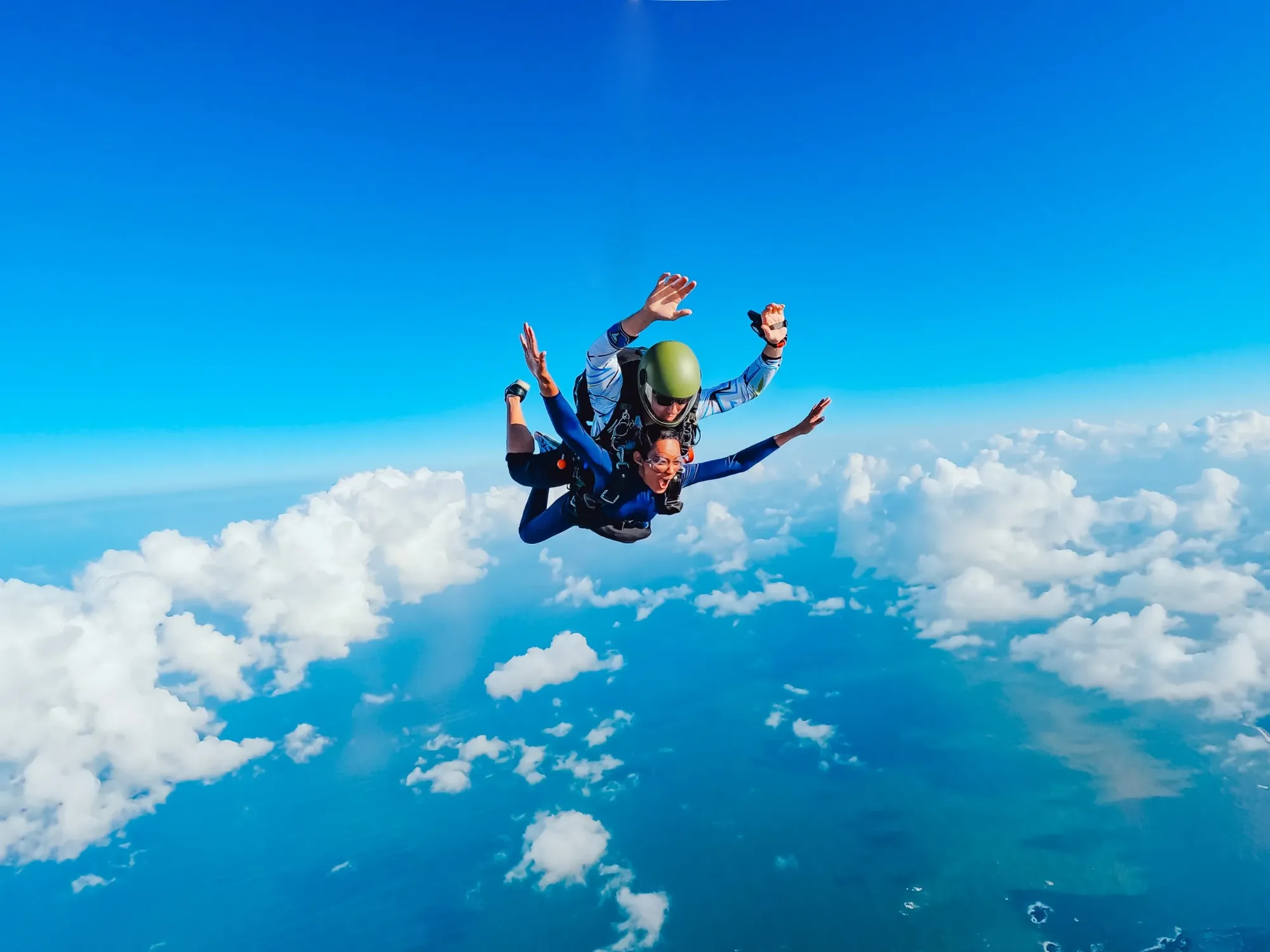
There is a particular silence that settles over you in the seconds before an aircraft door slides open at 13,000 feet. The engines have softened to a vibration in your sternum. The instructor's hand is on your harness. Outside the plexiglass, the landscape that drew you here, the one you spent months imagining, has flattened into something almost abstract, as if cartographers had drawn it for you in pastels.
Then the door opens, and Asia rushes in.
For a few breath-held moments, you are no longer a traveler. You are a satellite. The Annapurna range rakes its white teeth across half the horizon. A turquoise sandbar curls into the Visayan Sea like a comma in a love letter. Dubai's Palm spreads its perfect fronds beneath you while the Persian Gulf glitters past where geometry ends. Mount Fuji, that impossible cone, stands so symmetrical it looks fictional even from above.
And then you fall.
This is what makes Asia the most thrilling continent on Earth to skydive. Nowhere else does the terrain shift so dramatically across such manageable distances: Himalayan summits and tropical atolls and engineered megacities and volcanic coastlines, all reachable on the same trip if you plan it right. A skydive in Switzerland is a skydive in Switzerland. A skydive in Asia is a different kind of memory every time you climb back into the plane.
This guide is the result of years of attention to that fact. We have spent significant time inside the operators behind these jumps, interviewing instructors, comparing jump altitudes, verifying which dropzones are licensed and which are aspirational, watching weather windows close and reopen. The ranking that follows is the most honest, scenery-first take we know how to write. There is no ranking on Earth that is genuinely objective when scenery is the metric. But there is a ranking that is honestly opinionated, internally consistent, and built on what experienced skydivers and adventure travelers tend to agree on once the canopy is open and they are floating down.
That is the ranking you are about to read.
Quick answer for the impatient reader. The most scenic skydive in Asia, when conditions cooperate, is the Annapurna jump out of Pokhara, Nepal. Nothing else on the continent puts an 8,000-meter mountain wall in your peripheral vision during freefall. The most reliable scenic skydive, meaning the one most likely to deliver postcard conditions on any given day, is Skydive Dubai's Palm Drop Zone. The most photogenic for social-media-driven travelers is Bantayan Island in the Philippines.
How We Ranked the Most Scenic Skydives in Asia
"Most scenic" is the kind of phrase that invites lazy ranking. The sort where everyone gets a participation trophy and the writer hedges every claim. We did the opposite. We picked a set of criteria, weighted them, and let the destinations sort themselves out.
Here is what went into the ranking, in the rough order of how heavily we weighted each.
Scenery diversity from altitude
Some landscapes look magnificent from the ground and disappointingly flat from a plane. Others (geometric coastlines, mountain ranges with sharp altitude relief, archipelagos with high contrast between water and land) actually gain from being seen from above. We weighted scenery that holds up at altitude over scenery that is famous on the ground.
Emotional impact during freefall
The first 60 seconds, the freefall, is the part most travelers replay in their memory for years. We asked: when you are falling at terminal velocity, what does this destination do to you? Awe? Disbelief? Spiritual stillness? Cinematic exhilaration? Each of these is a different kind of skydive, and the most-scenic ranking respects the difference.
Canopy ride quality
Once the parachute opens, you have somewhere between four and seven minutes (sometimes more, depending on conditions) to sightsee from a glider. This is the underrated half of a skydive. A great canopy ride lets you see the destination from multiple angles, lets your instructor turn into the wind so you can take in a full coastline, and lets you actually talk about what you are seeing. We weighted destinations where the canopy ride is itself worth flying around the world for.
Uniqueness of view
Some scenic skydives are spectacular but resemble other scenic skydives. A turquoise tropical dropzone in the Philippines and a turquoise tropical dropzone in the Maldives are not the same experience, but they are the same kind of experience. We ranked uniqueness as its own factor: destinations whose scenery is genuinely unrepeatable elsewhere on the planet rose.
Atmosphere on the ground
The ten minutes before you board the plane and the twenty minutes after you land are part of the experience. A dropzone with a tin-roof bar and instructors who have jumped together for fifteen years feels different from one that runs you through a corporate funnel. We rewarded atmosphere: the cumulative sense that you have arrived somewhere, not merely visited an airfield.
Travel-pairing value
Many skydivers travel for the jump but leave with a holiday. We considered how easily each destination pairs with the kind of trip travelers actually take (beach time, mountain trekking, cultural exploration, food tourism) and rewarded destinations where the skydive sits naturally inside a larger week.
Photographic and video appeal
This is honestly secondary, but it matters. A skydive where the helmet camera is going to deliver footage you will rewatch on long flights for the rest of your life is, in the end, a more valuable skydive. We considered visual texture, color contrast, and the sort of frame composition the destination naturally provides.
Beginner accessibility
The most scenic skydive in the world is worth nothing if it is only available to licensed jumpers. We prioritized destinations that run regular tandem operations and welcome first-timers, because the bulk of bucket-list scenic jumps are made by people doing exactly one skydive in their life.
Operational legitimacy
This was a hard floor, not a tier. If a destination's scenery is unmatched but its operator runs without proper licensing, regulatory backing, or a track record of safe operations, we either ranked it lower or moved it into the emerging category. Scenic awe is not worth dying for.
A note on subjectivity
You can construct a defensible argument for a different number one. Skydive Dubai loyalists will tell you that the Palm Drop Zone is the most spectacular skydive on Earth, and they are not wrong from any rational angle. The engineered coastline is impossible elsewhere, the operation is world-class, the weather is reliable. Mount Fuji devotees will argue that no skydive captures the spiritual register of jumping near Japan's most sacred mountain. We have ranked Pokhara at number one because nothing else on the continent puts a Himalayan wall the size of Annapurna into your visual field during a 60-second freefall. But the top three are close enough that on a given day, with a given sky, any of them could be the best skydive of your life.
That is the honesty we owe you before we get to the list.
Quick Overview: The Top 10 Most Scenic Skydives in Asia
Below is the ranking at a glance. The full long-form treatment for each destination follows in the next section.
| # | Destination | Country | Scenery Type | Best For |
|---|---|---|---|---|
| 1 | Pokhara (Annapurna) | Nepal | Himalayan mountain | The bucket-list jump of a lifetime |
| 2 | Bantayan Island | Philippines | Turquoise tropical island | Photography, honeymoon, social media |
| 3 | Palm Jumeirah | UAE (Dubai) | Engineered coastline | Reliability and visual drama |
| 4 | Mount Fuji area | Japan | Sacred mountain | Spiritual and aesthetic register |
| 5 | Siquijor Island | Philippines | Mystic tropical island | Off-the-grid adventure travelers |
| 6 | Pattaya (TSA) | Thailand | Coastal Gulf of Thailand | First-timers and ease of access |
| 7 | Phusanfah, Chiang Mai | Thailand | Northern Thai mountains | Mountain scenery without the Himalayas |
| 8 | Desert Campus, Dubai | UAE | Endless desert horizon | The second-Dubai jump that changes the picture |
| 9 | Zambales | Philippines | South China Sea coast | Backpackers, low-fi authenticity |
| 10 | Bali (anticipated) | Indonesia | Tropical-volcanic icon | The most-anticipated scenic skydive in Asia |
Editor's note. Number 10 reflects an honest reality of the Asian skydiving map. Bali is the destination most-asked-about by every traveler we have ever spoken to about scenic skydiving in Asia, and it does not currently host a licensed commercial tandem operator. Its inclusion here is an editorial flag, not a misdirection. See section 9 for the full discussion of why the most photogenic island in Asia has no skydive yet.
The 10 Most Scenic Skydives in Asia
What follows is the long-form treatment of each ranked destination. We have written each entry as if you were planning the trip: what the scenery will actually feel like from altitude, what the canopy ride looks at, what kind of traveler this jump suits, and where it sits inside a larger Asia itinerary.
1. Pokhara, Nepal — Freefall Beneath the Annapurna Range
Quick answer. Pokhara is the most scenic skydive in Asia because it is the only one in the world where an 8,000-meter mountain wall sits inside your peripheral vision during the entire freefall. There is no analogue.
The flight up is itself part of the experience. The aircraft climbs out of Pokhara, a lakeside town that already sits at 2,700 feet of elevation, and from the moment the wheels leave the runway you understand that altitude has a different meaning here than it does anywhere else in Asia. By the time you reach jump altitude, the Annapurna massif fills the entire northern horizon: Annapurna I, Annapurna South, Machapuchare's elegant fishtail summit, Dhaulagiri behind it. The peaks are not in the distance. They are here, sharing your altitude band, brushing against the same clouds.
When the door opens, the wind that hits you is colder than tropical Asia has prepared you for. This is the Himalayan thermal, the great chimney of dry, thin air that rises off the snowfields and drops you, in turn, into a column of breath-stripping cold. For the first second of freefall, your body registers temperature before it registers anything else. Then you tip over the threshold and the world turns vertical, and Annapurna is no longer in front of you. It is with you, an immense and patient presence that seems to have agreed to accompany you down.
There is a reason Himalayan locals call these mountains by name and not by number. From freefall, you understand it.
The canopy ride drifts you back toward Phewa Lake, the long mirror-flat body of water that defines Pokhara's south side. The town's brick rooftops and prayer flags clarify into recognizable patterns. The mountains rise behind you, vast and unhurried. By the time your feet touch the dropzone, you are no longer a tourist. You are a person who has been to a place very few people will ever go.
What the scenery feels like at altitude. Vast in a way no photograph prepares you for. The Annapurna range is not a backdrop. It is a wall that occupies one entire half of your visual field. The mountains feel close enough that you instinctively want to glide toward them, and the instructor will gently steer you the other way.
Best season for visibility. Generally October through early December, and again February into early April: the post-monsoon and pre-monsoon clearing windows when the Himalayan sky is its most stable. Verify operator schedules well in advance. This is a seasonal jump, not a year-round one.
Beginner friendliness. Tandems are available for first-timers, but Pokhara is a higher-stakes scenic jump than most. The elevation, the cold, the seasonal weather, the travel logistics. Recommended for travelers who are taking their skydive seriously, not casually.
Travel pairing. Pokhara is the launchpad for the Annapurna Circuit, the Annapurna Base Camp trek, paragliding (Pokhara is one of the world's top paragliding destinations), and lake-and-cafe culture that ranks with anywhere in Asia. Skydiving here belongs inside a 10 to 14 day Nepal trip, not a 48-hour layover.
Photographic appeal. Off the chart. The dynamic range (snow peaks above, dark forests below, lake reflection ahead) is unrepeatable. Helmet-cam footage from Pokhara is the kind that gets framed in a living room twenty years later.
Suits best. The bucket-list traveler. The traveler who has saved up for a single transformative experience. The mountaineer-turned-tourist. The honeymoon couple who do not want a beach.
2. Bantayan Island, Cebu, Philippines — The Turquoise Sandbar Drop
Quick answer. Bantayan is what most travelers actually picture when they imagine tropical island skydiving. White sandbars curling into clear water. Coral atolls inked across the sea like calligraphy. Verified, licensed operations from a serious dropzone.
If Pokhara is the most awe-inducing scenic skydive in Asia, Bantayan is the most photogenic. There is a particular shade of turquoise (the shade you only get when shallow tropical water meets a white sand bottom under a midday sun) that exists in a handful of places on Earth. Bantayan, on Cebu's northwestern tip, is one of them.
From the aircraft door, the geometry is what you notice first. Sandbars do not occur randomly. They follow current patterns and tidal rhythms that, from altitude, look like the work of an unhurried artist. Long curves, hooks, lozenges. White against the deep blue of the Visayan Sea. Reefs glow brown-green where the water shallows over coral. The dropzone itself, a strip of flat ground inland from the beach, is barely visible. What you see is water, in every register.
The freefall here is luxurious. The horizon is so flat that you feel as though you are falling toward a single, infinite plane. Air temperature is forgiving (Bantayan operates in tropical warmth nearly year-round) and the visibility is often perfect. The instructor's hand will tap your shoulder, you will arch back into freefall position, and for a full minute you will be a body falling through a flawless tropical sky onto an island so beautiful it seems almost rude.
The canopy ride is where Bantayan reveals its secret weapon: time. Tandem canopy rides over Bantayan are, in our experience, among the most peaceful in Asia. The wind is gentle. The instructor will swing you out over the water and back. You will see the sandbars from three different angles, and each one will look different. By the time your feet hit the ground, you will already know that you will be back.
Best season for visibility. Generally late January through May, when the dry-season trade winds clear the air and the water reaches peak transparency. June onward sees more cloud cover, though local conditions vary.
Beginner friendliness. Excellent. The dropzone caters extensively to first-time tandem skydivers, and the conditions (flat horizon, warm air, gentle winds) are forgiving for the body and the nerves.
Travel pairing. Bantayan slots beautifully into a Visayas island-hopping itinerary. Pair with Malapascua (thresher shark dives), Kalanggaman, and the broader Cebu food and beach scene. Most travelers reach Bantayan by domestic flight to Cebu plus a ferry.
Photographic appeal. Among the highest in Asia. This is the destination for travelers whose social-media instinct is part of the trip's purpose, and we say that without judgment. Some scenery deserves to be shared.
Suits best. The tropical-honeymoon traveler. The first-timer who wants the postcard memory. The couple in their twenties or thirties for whom this jump is the centerpiece of a Philippines trip.
3. Palm Jumeirah, Dubai — The Engineered Coastline
Quick answer. Palm Jumeirah is the most reliably scenic skydive in Asia. The geometry of the engineered island is unmistakable from altitude, the operator runs to global standards, and Dubai's weather delivers postcard conditions on a majority of days.
There is something deeply strange and deeply beautiful about flying over a coastline that human beings drew. The Palm Jumeirah, the artificial island that fans out from Dubai's coast in the shape of a date palm, is one of the largest acts of geographic intent on the planet, and it is best understood from the air. Maps do not do it justice. Helicopter tours do not do it justice. Falling toward it at 200 kilometers an hour does.
The Skydive Dubai operation at the Palm Drop Zone is, in technical terms, among the best-resourced commercial skydiving operations in the world. The aircraft are modern, the instructors are heavily experienced, and the safety culture is heavily invested. Dubai's infrastructure means that the entire experience (the booking, the briefing, the gearing up, the boarding) feels like a polished consumer product. There is none of the dusty-airfield charm of, say, Phusanfah or Pokhara. What you get instead is competence, scale, and a guarantee that, if the weather is on, the experience will be flawless.
When the door opens at 13,000 feet, the geometry resolves. The Palm's fronds spread out beneath you. The Atlantis hotel sits like a punctuation mark at the far tip. The Burj Al Arab tilts in the middle distance. The Persian Gulf glitters into haze. Dubai's high-rise skyline (Burj Khalifa visible on a clear day) defines the inland horizon. The contrast between engineered geometry below and open desert beyond is the visual signature of this jump, and nowhere else on Earth provides it.
The freefall here is fast and bright. Air temperature is warm year-round, though winter mornings can surprise. Visibility is often exceptional. The canopy ride drifts you over the Palm itself: a slow, unhurried tour of a coastline you will never forget. You land back at the Skydive Dubai facility, and the whole thing has the polished feel of a modern thrill-experience economy at its best.
Best season for visibility. November through March is Dubai's window of clear, mild conditions. Summer (June through September) is hot enough that schedules adjust around the heat, though the operator runs year-round.
Beginner friendliness. Excellent and arguably the best in Asia for first-timers. The operation is built around a high tandem volume, the briefings are professional, the pace is calm.
Travel pairing. Dubai itself is the trip: desert safaris, the Burj Khalifa, the souks, the food scene. Skydiving here can be the centerpiece of a long weekend or a half-day inside a longer UAE itinerary.
Photographic appeal. Iconic. The Palm is one of the most-recognizable shapes on Earth. Helmet-cam footage with the Palm as backdrop is instantly identifiable to anyone who has ever opened Google Earth.
Suits best. The traveler who values reliability and visual drama equally. The honeymoon couple who pair the skydive with a luxury Dubai weekend. The first-timer who wants a world-class operator.
4. Mount Fuji, Japan — The Sacred Cone
Quick answer. Skydiving in the shadow of Mount Fuji delivers a register of emotional experience no other Asian jump matches: quiet, sacred, and aesthetically perfect, particularly in winter when Fuji's snowcap is at its most photogenic.
There is no mountain on Earth like Mount Fuji. The reason is geometry: Fuji rises in near-perfect symmetry from a flat plain, with no neighboring peaks to clutter its silhouette. From any angle, including the air, Fuji looks like the Platonic ideal of a mountain. The version a child would draw if you asked them to draw mountain.
Tandem skydiving operations near Fuji exist, though they sit inside Japan's relatively tight regulatory environment and run on weather-dependent schedules. When they do run, they offer one of the most aesthetically perfect skydives on the continent. The aircraft climbs from a regional airfield, banks toward Fuji's flank, and you exit into a sky in which the mountain is almost too symmetrical to look real.
The Japanese sky has a particular clarity in the cold months that does not exist in tropical Asia. Air at altitude is dry and crisp. Color saturation is high: Fuji's snowcap brilliant white, the cone darker beneath, the rural plain below patterned with rice fields and lakes. The Five Lakes (Fuji-go-ko) region resolves clearly during the canopy ride, and you may catch glimpses of Lake Kawaguchi, Lake Yamanaka, the small towns and shrine roofs.
The emotional register here is different from any other Asian skydive. There is a sense, for many travelers, of jumping in proximity to something sacred. Fuji is a religious mountain, not just a beautiful one, and its presence has weight even from the air.
Best season for visibility. Late autumn through early spring, when the air is clear and Fuji's snowcap is at peak. Summer is Fuji's hiking season, but visibility is often poor due to haze.
Beginner friendliness. Tandem-friendly when operations run. Booking windows are tighter than in tropical Asia, and English-language briefings vary by operator.
Travel pairing. A Fuji-area skydive pairs with the Five Lakes, hot-spring towns (Hakone, Yamanaka), Tokyo (two hours by train), and Japan's broader cultural travel. This is a skydive that earns a place inside a Japan trip, not the centerpiece of one.
Photographic appeal. High but specific. The Fuji silhouette is the entire frame. Helmet-cam footage taken on a clear winter morning is, in our experience, among the most this-is-unrepeatable-elsewhere footage in Asian skydiving.
Suits best. The aesthetically-minded traveler. The Japan-loving photographer. The traveler for whom the sacred-feeling of a place matters.
5. Siquijor Island, Philippines — The Mystic Island Below
Quick answer. Siquijor is the secret of this list. A small, mystical island in the Visayas with reef-clear water, a saw-toothed coastline of cliffs and white-sand bays, and a folkloric reputation that gives the jump a register all its own.
If Bantayan is the postcard tropical skydive, Siquijor is the cult favorite. This small, lozenge-shaped island sits in the Bohol Sea between Negros and Mindanao, and it has historically had a reputation in Philippine folklore as a place of mananambal: traditional healers and white-magic practitioners. It is a sleepy island with an unusual atmospheric weight, and from the air, you understand why it captured local imagination.
The coastline is more textured than Bantayan's. Cliffs drop into the sea on the south and east. The northern shore opens into long beaches. Inland, the small mountainous spine is dense with old-growth forest. The famous balete tree, hundreds of years old, sits as a quiet landmark from above. The reefs that ring the island are visible as bright bands of green-and-turquoise inside the deep blue sea.
Tandem skydiving operations from Siquijor have grown carefully alongside the island's broader rise as an off-the-beaten-track Philippines destination. Operations are smaller-scale and more intimate than Cebu's. The pace is slower. The flight up is a tour of the Bohol Sea: Siquijor below, Negros to the west, Bohol to the north, on the clearest days the Mindanao coastline as a smudge to the south.
The freefall is pure tropical clarity. The canopy ride drifts you across a coastline that, from this altitude, looks almost untouched. The kind of view that does not quite exist in places with more development.
Best season for visibility. Dry season, broadly January through May. Same window as Bantayan with similar trade-wind clarity.
Beginner friendliness. Tandem-friendly, though scale of operations is smaller and booking is best done well in advance.
Travel pairing. Siquijor pairs with Bohol, Cebu, Apo Island (sea turtles), and the broader Visayas island-hopping circuit.
Photographic appeal. Strong. Less obviously Instagram-postcard than Bantayan, more atmospheric. The footage rewards travelers who appreciate texture over saturation.
Suits best. The Philippines repeat traveler. The off-the-beaten-track adventure tourist. The couple looking for somewhere quieter than Bantayan.
6. Pattaya, Thailand — The Gulf From 13,500 Feet
Quick answer. Pattaya, jumped from Thai Sky Adventures, is the most accessible scenic skydive in Asia. A two-hour drive from Bangkok puts you over the Gulf of Thailand at 13,500 feet, with a coastline that delivers more visual range than its reputation suggests.
Pattaya is underrated as a scenic skydive, and we will defend the ranking. The reputation of Pattaya as a destination is, fairly or unfairly, dominated by its nightlife. But the airfield where Thai Sky Adventures operates sits well outside the city's commercial center, and the view from altitude has nothing to do with Walking Street and everything to do with the long, lovely curve of the Gulf coast.
The flight up climbs out of a rural Thai airfield. The patchwork of rice paddies and palm plantations resolves into geometry below: a kind of agricultural mosaic that travelers do not anticipate. By the time you reach jump altitude, the Gulf of Thailand fills the eastern horizon, and the coast curves north toward the Bangkok region in a long arc. Visibility on a clear morning extends well over a hundred kilometers.
Thai Sky Adventures runs a serious operation. The aircraft, instructors, and procedures are aligned to international tandem standards. The dropzone has a particular charm: informal in the way the best Thai businesses are informal, but tightly run on safety. Your jump is professional. The post-jump beer is real.
The freefall delivers a horizon that is long. The canopy ride drifts you over the rural-to-coastal transition, and you will see palm plantations, rural road geometry, the small towns inland from the coast, and the long flat sweep of the Gulf.
Best season for visibility. November through February is Thailand's dry season: clearer air, lower humidity, more reliable jumps. Operations run year-round.
Beginner friendliness. Excellent. TSA is one of the most beginner-friendly scenic operators in Asia, and the conditions (warm air, generally calm winds) forgive nervous bodies.
Travel pairing. Pattaya pairs with Bangkok, Koh Samet, Koh Chang, and the broader Eastern Seaboard. A Bangkok long-weekend can comfortably fit the skydive plus a beach night.
Photographic appeal. Underrated. The Gulf coastline has a long-curve elegance that travelers do not expect, and the rural mosaic surprises in helmet-cam footage.
Suits best. The first-time skydiver. The Bangkok-based traveler who wants a weekend adventure. The traveler who wants scenic skydiving without the cost or logistics of Pokhara, Bantayan, or Dubai.
7. Phusanfah, Chiang Mai, Thailand — Mountain Thailand
Quick answer. Skydive Thailand (closed since June 2026) at Phusanfah Airfield delivers Thailand's most underrated scenic experience: northern mountain freefall with the ridges of Doi Inthanon's broader range visible to the west, jumped from a serious 13,000-foot platform.
Most travelers do not associate Thailand with mountains until they have spent time in the north. The country's spine of forested ridges runs from Chiang Mai up toward the Myanmar border, and the Phusanfah Airfield (where Skydive Thailand (closed since June 2026) runs its tandem operations) sits inside that landscape.
The aircraft climbs out of Phusanfah using a New Zealand-built turbine platform that makes serious altitude possible. By the time you reach jump altitude, the perspective is different from anywhere else in Thailand: you are looking down on forested ridges rather than coastal plains. The scale relief is real: peaks and valleys, river systems, the soft greens of teak forest broken by the harder greens of cultivated rice.
This is northern Thailand's particular flavor of skydive. Cooler air than the south. A landscape that is recognizably not tropical-coastal. The freefall has texture below it, not flat water: terrain that draws the eye into details rather than long horizons.
The canopy ride is among Thailand's most unusual: long, quiet, with mountains visible on the western horizon and rural Chiang Mai farmland resolving below. The dropzone has the unhurried atmosphere of northern Thailand more broadly: friendly, rural, quietly skilled.
Best season for visibility. November through February for the cool, dry, clear-air window. March through May has visibility issues in northern Thailand due to seasonal burning haze. Check operator advisories.
Beginner friendliness. Strong. Operations cater to first-timers, English briefings are professional, conditions in the cool season are forgiving.
Travel pairing. Chiang Mai itself is one of Asia's great cultural destinations: old city, food, festivals, hill-tribe culture, Doi Inthanon National Park, elephant sanctuaries. The skydive sits naturally inside a 4 to 7 day Chiang Mai trip.
Photographic appeal. Different from the coastal skydives in this list (texture rather than turquoise) but underrated for travelers who appreciate landscape variety.
Suits best. The cultural-traveler-first who is adding adventure. The skydiver who has done a tropical-island jump and wants something different. The Chiang Mai repeat visitor.
Currently closed. Phusanfah Airfield in Mae Taeng — the only skydiving dropzone near Chiang Mai, used by both Skydive Thailand and Skydive Chiang Mai — was ordered to halt operations by the Civil Aviation Authority of Thailand from 1 June 2026, and no reopening date had been announced as of 17 August 2026. The listing below is kept live so the status stays findable, and any prices shown are historic. Thai Sky Adventures near Pattaya and Dropzone Thailand in Rayong are both still flying.
Currently closed. Skydive Thailand is not taking bookings. Its listing is kept live so the status stays findable, and any prices shown are historic.
8. Desert Campus, Dubai — The Empty Quarter From Above
Quick answer. Skydive Dubai's Desert Campus, about 35 minutes inland from the Palm, is a fundamentally different scenic experience from its coastal sibling: endless dune fields, no engineered geometry, and a horizon that disappears into a beige-and-rose haze. Worth a separate ranking because it is a separate scenic register.
The Desert Campus is the second venue in Skydive Dubai's portfolio, and rather than ranking the operator twice, we have given it a separate slot because the scenery is genuinely different. The Palm Drop Zone is about engineered geometry against open sea. The Desert Campus is about endless natural emptiness, the kind of landscape that resets your sense of horizontal scale entirely.
From altitude, the desert reads as pattern. Dunes ripple in long parallel lines, sculpted by prevailing winds. Vehicle tracks of dune-bashing tour groups thread through the terrain like calligraphy. There are no roads, no buildings, no shoreline to anchor your eye. The Empty Quarter (the great sand sea of the Arabian Peninsula) extends to a horizon that does not entirely resolve into a line. Above a certain altitude, sand and sky meet in a beige haze that is its own visual register.
The freefall here is intense in a quieter way than the Palm. There is less to look at, but what is there is overwhelming in its scale. The canopy ride drifts you over dune fields that look identical at first and reveal their differences slowly.
Best season for visibility. November through March, like the Palm DZ. Summer operations adjust around the heat.
Beginner friendliness. Excellent, with the same world-class operational standard as the Palm.
Travel pairing. Pair with desert safari overnight camps, dune-bashing, or as a contrast jump for travelers who already have the Palm jump in their helmet-cam archive.
Photographic appeal. Strong but tonally different from the Palm: warm color palette, infinite horizon, minimalist composition.
Suits best. The repeat Skydive Dubai customer. The traveler doing a longer UAE itinerary. The skydiver collecting visual variety.
9. Zambales, Philippines — The Outlaw Coast
Quick answer. The Zambales jump is the loosest, most informal scenic skydive on this list: a Subic Bay-area operation with South China Sea coastline, low-fi atmosphere, and an authentic backpacker register that rewards travelers who do not need polished infrastructure.
We had to think carefully about whether to rank Zambales at all. It is the least formally infrastructured operator on this list, with much of its booking and communication happening through informal channels rather than a polished website. But the scenery (the long South China Sea coastline, the green-on-green Zambales mountains inland, the surf-friendly bays of San Felipe and San Antonio) is genuinely beautiful from altitude, and the experience has a register no other operation in Asia matches.
Zambales province sits north of Subic Bay on Luzon's western coast. The Pacific surf scene that has built up around Crystal Beach, San Narciso, and Liwliwa is one of the Philippines' under-the-radar travel stories, and the broader area has the slightly outlaw, frontier-tourism atmosphere that some travelers actively seek out. Skydiving operations here have historically run in coordination with the Subic Bay Freeport area, with the jump itself offering long western-coast views.
The freefall is bright and tropical, with the South China Sea filling the horizon to the west and the Zambales range to the east. The canopy ride drifts you over surf-bay coastline, and the dropzone atmosphere is informal in the way you either love or do not.
Best season for visibility. Dry season (broadly January through May). The wet season brings heavy weather to this coast.
Beginner friendliness. Available, but the operational scale and informal infrastructure mean travelers should set expectations accordingly. Verify operator status close to your travel dates.
Travel pairing. Surf weekend at Liwliwa, Subic Bay diving, Pundaquit boat trips to Anawangin and Capones Island, the broader Manila-North Luzon road trip.
Photographic appeal. Distinct. Atmospheric. The footage does not look like Cebu, and that is the point.
Suits best. The Philippines backpacker. The traveler who has done Bantayan and wants something different. The risk-tolerant adventurer who values authenticity over infrastructure.
Editor's note. Verify operator status well in advance of any Zambales-area booking. The informal infrastructure means schedules and availability shift more than they do at larger operations.
Currently closed. Skydive Zambales is not taking bookings. Its listing is kept live so the status stays findable, and any prices shown are historic.
10. Bali, Indonesia — The Anticipated Scenic Skydive
Quick answer. Bali is the most-anticipated scenic skydive in Asia and currently does not exist as a licensed commercial tandem operation. We have ranked it number 10 to flag this honest gap on the Asian skydiving map and to set realistic expectations for travelers planning bucket-list trips.
This is the entry that breaks the rules of the ranking, and we have broken them on purpose.
Bali is the destination most-asked-about whenever travelers think about scenic skydiving in Asia. The reasons are obvious. Bali combines volcanic mountains (Agung, Batur), a deeply photogenic coastline (the south's surf cliffs, the east's black-sand beaches, the north's coral reefs), tropical weather, and the kind of brand recognition that makes skydive Bali one of the most-searched skydiving phrases in Asia. From the air, Bali would be one of the most photogenic skydives in the world.
It does not currently exist as a commercial tandem operation.
This is a genuinely unusual fact about the Asian skydiving map. Indonesia hosts only one currently-operating skydive (on Java, far from Bali), and it is not a major-tourism operation. Travelers searching online for skydive Bali will encounter a mixture of historical references, indoor wind-tunnel content from elsewhere in Asia, paragliding offerings, and aspirational promotional material. But no licensed commercial tandem operator running scheduled jumps over Bali.
We expect this to change. Bali's tourism scale, demand, and aviation infrastructure all point toward eventual scenic skydive operations on the island, and several developments suggest 2026 or beyond may see an established operator. When it happens, Bali is a strong candidate for the number one position on this list, possibly higher in commercial impact than Pokhara, given the volume of travelers who pass through Bali annually.
Until then, the honest answer to where can I skydive in Bali is: nowhere, currently. Travelers building bucket-list trips around Bali should consider the broader Indonesia option (Java's south coast) or the alternative Asian destinations on this list.
What this means for trip planning. Do not book a Bali holiday primarily for the skydive. The skydive is not there. Book Bali for Bali, and add a scenic skydive elsewhere.
Why we ranked it number 10. Because pretending the most-anticipated scenic skydive in Asia does not sit on the map is the kind of editorial dishonesty that travelers spot immediately. Including Bali, honestly, is more useful than omitting it.
When this entry will get rewritten. When a licensed commercial tandem operator establishes regular operations over Bali. We will update this guide accordingly.
Island Skydives vs Mountain Skydives vs City Skydives
The list above mixes three fundamentally different kinds of scenic skydive, and one of the most useful exercises a traveler can do, before booking, is to figure out which kind you actually want.
Island skydives
Bantayan, Siquijor, eventually Bali. The emotional register is exhilaration with calm underneath. Tropical air is forgiving. The visual frame is dominated by water, which the brain registers as openness rather than threat. Photographically, island jumps deliver the highest color saturation of the three categories. The turquoise palette is unrepeatable inland.
The downside: island skydives are weather-volatile. Tropical clouds gather quickly. Wet seasons can shut down operations for weeks. And the aesthetic, while extraordinary, can feel similar across destinations. The postcard register is not unique to any one island.
Suits best: first-timers, photo-driven travelers, honeymooners, beach-circuit holidaymakers.
Mountain skydives
Pokhara, Mount Fuji, Phusanfah. The emotional register is awe with stillness. Mountain air at altitude is colder, drier, and clearer than tropical air, and the visual frame contains vertical scale in a way no island can. Pokhara is the apex of this: the only Asian skydive where an 8,000-meter wall is part of your visual field. But Phusanfah and Fuji each deliver a milder version of the same register.
The downside: mountain skydives are seasonal in a hard way. Visibility windows are narrower than tropical Asia. Booking flexibility is lower. And the cold can surprise travelers who have not dressed for it.
Suits best: repeat skydivers, mountaineers, photographers, travelers seeking emotional weight rather than postcard imagery.
City and engineered skydives
Palm Jumeirah, Desert Campus Dubai. The emotional register is spectacle. City and engineered-landscape skydives are the most reliable category. Weather is generally cooperative, infrastructure is polished, scheduling is professional. And the visual frame contains engineered geometry that no natural landscape provides. Dubai's Palm is the best example of this: a coastline drawn by humans, visible from altitude in a way maps cannot capture.
The downside: engineered skydives can feel less natural than the other two categories. The footage looks like a luxury commercial, which is a feature for some travelers and a downside for others.
Suits best: reliability-seekers, time-pressed travelers, luxury-leaning honeymoons, travelers stacking the skydive inside a city break.
Choosing your category
If you can do only one scenic skydive in Asia in your life, the question to ask yourself is: do I want awe, calm, or spectacle? Awe lives in the mountains. Calm lives over the islands. Spectacle lives over the engineered coastlines. The category determines the memory you will carry.
Which Scenic Skydive Is Best for You?
This is the section where we get specific. Below, recommendation lists for the most-asked traveler profiles.
Best for first-time tandem skydivers
Pattaya (Thailand) is the strongest first-time scenic skydive in Asia. The combination of professional operations at TSA, forgiving conditions, and easy logistical access (two hours from Bangkok) makes it the lowest-friction entry into bucket-list scenic skydiving. Runners-up: Palm Jumeirah, Dubai for travelers who want a more polished experience and do not mind the cost; Bantayan Island, Cebu for travelers who want a tropical-postcard memory.
Best luxury experience
Palm Jumeirah, Dubai is the only scenic skydive in Asia that pairs naturally with a luxury weekend. The operation is global-standard, the destination delivers world-class hospitality, and the experience can be stacked into a Burj-and-beach itinerary without any rough edges. Runner-up: Mount Fuji area for travelers prioritizing aesthetic-luxury over hospitality-luxury.
Best island views
Bantayan Island, Cebu is the answer for travelers prioritizing tropical-island visual register. Siquijor is a strong runner-up for travelers who want the same category with a quieter atmosphere and more authentic island-life ground experience.
Best mountain scenery
Pokhara, Nepal. There is no second answer to this question on the Asian continent. Runners-up: Mount Fuji, Japan for aesthetic and emotional register; Phusanfah, Chiang Mai for accessible mountain scenery.
Best for social-media-driven travelers
Bantayan Island for color saturation. Palm Jumeirah for unmistakable destination recognition (every viewer of your reel will know exactly where you are). Pokhara for the once-in-a-lifetime cinematic register.
Best for budget travelers
Pattaya (TSA) offers strong scenic-quality-to-cost ratio in Asia. Bantayan Island is similarly priced for the visual you receive. Phusanfah, Chiang Mai rounds out the budget-scenic shortlist for travelers wanting mountain scenery without the Pokhara logistics.
Best honeymoon experience
Palm Jumeirah, Dubai for couples who want polished hospitality alongside the jump. Bantayan Island for couples who want a tropical-island honeymoon centered on water and white sand. Pokhara for couples whose honeymoon is itself an adventure.
Best overall emotional experience
Pokhara if you can do it. The combination of scale, altitude, cold air, and the Annapurna massif in your visual field is unrepeatable on the continent.
Best for repeat skydivers
The mountain-and-engineered category (Pokhara, Mount Fuji, Phusanfah, Desert Campus Dubai) rewards travelers who have already done a tropical-island scenic jump. The emotional register is different, the scenery is different, and the memory will not duplicate the one you already have.
What Makes a Skydive Feel Scenic, Emotionally?
This is the section the topic deserves and that almost no skydive guide actually writes well. Why does scenery change a skydive emotionally? What is happening in your brain at 13,000 feet that turns a good jump into a best-day-of-my-life jump?
Scale perception
The human brain has limited tools for processing genuine scale. From the ground, even a tall mountain reads as big, but the brain compresses the difference between big and incomprehensibly enormous. From altitude, this compression breaks down. You see scale at eye level, and the brain registers something it cannot normally register: that the world is, in fact, immense. This is why mountain skydives (particularly Pokhara) produce emotional reactions that linger for years. The brain has been shown the truth about scale.
Coastline geometry
The brain is a pattern-matching machine, and coastlines are one of nature's richest pattern languages. Sandbars, reefs, river deltas, peninsulas: these geometries are legible from altitude in a way they are not from sea level. Your brain reads a coastline from the air and recognizes a pattern. The recognition is itself emotionally rewarding. This is why island skydives feel meditative even when they are physically intense.
Altitude perspective
There is a phenomenon photographers call eye-of-god view: the perspective from which the entire pattern of a place becomes visible. Maps approximate this, but maps are abstract. The experience of seeing your destination in eye-of-god view while you are physically present in it is qualitatively different. Scenic skydives are one of the few legal civilian experiences that produce this perspective in real-time.
The fear-and-beauty paradox
This is the secret of why scenery matters more in a skydive than in, say, a helicopter tour. Scenic context changes the fear. A skydive over flat farmland is scary in a kind of pure, adrenaline-only way. A skydive over the Annapurna massif is scary in the presence of beauty so overwhelming that the fear softens into awe. The mind cannot hold I am terrified and I am witnessing the most beautiful thing I have ever seen with equal weight, and the awe wins. This is the secret of why bucket-list travelers chase scenic skydives specifically. The fear is the price of the awe, and the awe is what you will remember.
Memory consolidation
Neuroscience research on emotionally intense experiences suggests that strong sensory and emotional inputs during a memory-formation event produce more durable memories. A scenic skydive (high adrenaline, high beauty, high novelty) is, in this sense, a memory-formation engine. Travelers report scenic skydives as among their most-detailed lifetime memories, often with sensory specificity (the cold of Himalayan air, the saturation of turquoise water) that ordinary travel memories lack. You do not just do a scenic skydive. You acquire a permanent piece of memory architecture.
The Best Seasons for Scenic Visibility
Scenic skydiving is, more than any other category of skydiving, about visibility. A jump in low cloud over the Annapurna massif is not a Pokhara skydive in any meaningful sense. It is just a skydive in low cloud. Below, a general orientation to seasonal visibility across the destinations on this list.
Tropical Asia (Philippines, Thailand, Indonesia)
The dominant pattern is the dry-season-versus-wet-season divide. Most of the destinations on this list (Bantayan, Siquijor, Pattaya, Phusanfah, Zambales) peak in clarity from roughly November through April or May, with regional variation. The wet season brings cloud cover, monsoonal weather, and operational shutdowns. Northern Thailand has an additional consideration: seasonal agricultural burning (broadly March through April) produces haze that can affect visibility for jumps at Phusanfah. Check operator advisories during this window.
Himalayan Asia (Nepal)
The Pokhara window is narrow and bimodal: late September through early December, and late February through early April, are the post-monsoon and pre-monsoon clearing windows. The Himalayan sky is at its cleanest in these windows, and the cold is real. Winter morning jumps require thermal layers. Outside these windows, expect cloud cover, monsoon rains, or visibility loss to dust haze.
Japan
Mount Fuji visibility is best in the cold months: November through early March, when dry air and clean sky combine to produce the iconic snow-cap-and-clear-blue postcard. Summer is poor for Fuji visibility due to haze.
Dubai (UAE)
Dubai's window of best clarity is November through March, when temperatures are mild and visibility is generally excellent. The shoulder seasons (April, October) are workable. Peak summer (June through August) is hot enough that schedules adjust around heat, though operations continue.
General principle
For any of these destinations, do not book the skydive on the first or last day of your trip. A scenic skydive depends on weather windows, and the smart traveler builds two or three potential jump days into the itinerary. The disappointment of a weather-grounded skydive on a non-flexible day is worse than the inconvenience of building a buffer.
How Much Do Scenic Skydives Cost Across Asia?
Pricing varies significantly across the destinations on this list. Below, the general orientation as of recent operator-verified data, in approximate terms. Exact pricing should be confirmed with each operator at booking.
The cheapest scenic skydives in Asia tend to be in Thailand and the Philippines. TSA Pattaya, Skydive Cebu (Bantayan), Skydive Thailand (closed since June 2026) (Phusanfah). Tandem prices generally sit in a range that is accessible for backpacker and mid-budget travelers. The Philippines and Thailand both deliver strong scenery-to-cost ratio, which is why they dominate the bookings of first-time scenic skydivers in the region.
The middle tier (Mount Fuji area, Siquijor, Zambales) sits in a similar pricing band, with adjustments for logistical access and operational scale.
The premium-price tier is Skydive Dubai, which is meaningfully more expensive than the Southeast Asian operations. The Dubai premium reflects the polished operational standard, the world-class infrastructure, and the engineered-coastline scenic value. Travelers who want the most reliable, most polished, most globally-recognized scenic skydive in Asia pay for it.
The outlier is Pokhara. The skydive itself is in a similar pricing band to the premium destinations, but the trip cost (flying to Nepal, the trekking-context travel, the seasonal logistics) makes Pokhara, in practice, the most expensive scenic skydive on this list when fully accounted for. It is also, by our ranking, the most extraordinary, and the cost-to-memory ratio is favorable for travelers who can afford the trip.
For dedicated cost-to-scenery analysis, our cost pillar breaks down operator-level pricing for the verified destinations.
A note on value perception
The best-value scenic skydive in Asia depends heavily on what you weight. If you weight visual saturation per dollar, Bantayan is the answer. If you weight reliability per dollar, Palm Jumeirah is the answer. If you weight transformative-experience per dollar, Pokhara is the answer despite the higher cost. Do not pick the cheapest. Pick the one that matches the memory you are trying to acquire.
Scenic Skydives Worth Traveling For vs Add-On Experiences
One of the most useful planning frames for a scenic skydive is this question: is this jump a centerpiece of the trip, or an add-on inside a trip planned for other reasons?
Centerpiece skydives
These are jumps that are extraordinary enough to organize an entire trip around. Pokhara is the clearest example. A traveler can build a 10 to 14 day Nepal itinerary in which the skydive is the gravitational center, with the surrounding days devoted to acclimatization, anticipation, and the post-jump emotional aftermath that a Pokhara skydive deserves. Mount Fuji has a similar register, particularly for Japan-focused trips where the skydive becomes a symbolic high point inside a culturally rich week. Bantayan can be a centerpiece skydive for Philippines-bound photographers and honeymooners, particularly when paired with a longer Visayas circuit.
Add-on skydives
These are jumps that fit beautifully inside trips planned for other reasons. Palm Jumeirah is the cleanest example. Dubai trips planned for shopping, food, business, or layovers can absorb a skydive without restructuring. Pattaya is the same proposition for Bangkok-area trips: a half-day adventure that adds dimension to a city break. Phusanfah sits inside a Chiang Mai cultural trip naturally. Siquijor sits inside a Visayas island-hopping trip naturally. These are not jumps you fly to Asia for. They are jumps that become part of an Asia trip.
Why the distinction matters
Travelers who treat a scenic skydive as an add-on when it should be a centerpiece often end up disappointed. Pokhara cannot be done as a 24-hour visit. The seasonal weather, the elevation acclimatization, the gravity of the experience all demand more space. Conversely, travelers who treat an add-on as a centerpiece (flying to Dubai purely for the skydive) often feel that they have over-invested in something that would have sat naturally inside a broader trip. The smart frame is to match the scale of the skydive to the scale of the trip. A bucket-list Himalayan skydive deserves a bucket-list Himalayan trip around it. A polished urban skydive deserves a polished urban weekend.
By our ranking, the most scenic skydive in Asia is the Annapurna jump from Pokhara, Nepal. The combination of an 8,000-meter mountain wall in the visual frame, the Himalayan altitude perspective, the cold-clear sky of the post-monsoon window, and the spiritual gravity of jumping in the Annapurna massif puts it at number one on the continent. Reasonable arguments exist for Skydive Dubai's Palm Drop Zone or Mount Fuji as alternative number ones, and on a given day with given weather, any of the top three could be the best skydive of your life.
Currently, Dubai is the only one of the two that hosts a licensed commercial tandem skydive. Bali, despite its scenic potential, does not currently have a licensed commercial operator running scheduled tandem jumps. This may change in coming years. For travelers planning a trip now, Dubai is the answer. For travelers planning further ahead, Bali may eventually be the more visually extraordinary option.
Nepal, Indonesia, and the Philippines all have legitimate claims, depending on what you weight. Nepal has the most extraordinary single skydive on the continent (Pokhara). The Philippines has the most consistently photogenic island-skydive options (Bantayan, Siquijor). Indonesia has the most under-the-radar destinations and the most-anticipated future option (Bali). Thailand has the most accessible scenic skydive options (Pattaya, Phusanfah). Dubai has the most reliable single scenic skydive (Palm Jumeirah). There is no single best country. There is a best country for the kind of trip you want.
Bantayan Island in the Philippines, by our ranking. The combination of turquoise-water saturation, white-sand sandbar geometry, professional operator (Skydive Cebu), and broader Philippines island-hopping pairing puts it at the top of the island category. Siquijor is a strong, quieter alternative for travelers seeking less developed atmospherics.
Pattaya (Thai Sky Adventures, Thailand) for accessibility and professional first-timer operations. Palm Jumeirah (Dubai) for travelers who want a polished, globally-recognized experience. Bantayan Island for travelers who want a tropical-postcard first jump.
Generally yes, with significant variation. The Asian scenic skydive premium reflects the destination logistics, the higher tandem demand, and in some cases the operator's investment in polished operations (Dubai is the clearest example). However, many of the scenic skydives on this list (Pattaya, Bantayan, Phusanfah) are priced in ranges that compare favorably to non-scenic operations elsewhere in the world. The real cost premium tends to come from the trip surrounding the skydive (Pokhara is the example), not the jump itself.
All operators on this list with verified, licensed operations adhere to internationally recognized safety standards. Skydive Dubai is the most heavily resourced and corporate-grade in operational terms. TSA (Pattaya), Skydive Cebu (Bantayan), and Skydive Thailand (Phusanfah) are the most-established operators in Southeast Asia. Mount Fuji-area operations run inside Japan's tight regulatory environment. Smaller operators (Siquijor, Zambales) have less formal infrastructure. Verify operational status close to your travel dates. Skydiving is an inherently risk-bearing activity, and any tandem skydive carries non-zero risk regardless of operator.
The honest answer depends on what you weight. Pokhara for mountain scale. Bantayan for tropical color. Palm Jumeirah for engineered coastline. Mount Fuji for aesthetic register. There is no objectively best view. There is a best view for the memory you want.
Currently, no. There is no licensed commercial tandem skydive operating regularly over Bali. Travelers planning Bali-centered trips should adjust their expectations accordingly, or pair Bali with a scenic skydive elsewhere in Asia. This may change in future as Bali's tourism infrastructure matures around adventure aviation.
The skydive itself, exit through landing, is typically four to seven minutes, with roughly 60 seconds of freefall and the remainder under canopy. The full experience, including check-in, briefing, gear-up, the flight up, the jump, the ride down, and the post-jump video review, is generally a half-day commitment at most operators on this list. Pokhara and Mount Fuji require additional travel-day buffers given seasonal weather and logistics.
No prior experience is required for tandem skydives at any of the operators on this list. You will be physically harnessed to a licensed instructor who controls the freefall, parachute deployment, and landing. The briefing typically takes 20 to 45 minutes and covers everything you need to know. Health and weight requirements vary by operator and should be verified at booking.
For seasonal destinations (Pokhara, Mount Fuji), book well in advance. Months ahead is reasonable. For year-round destinations (Pattaya, Bantayan, Palm Jumeirah), 1 to 4 weeks ahead is generally workable, though peak holiday seasons (December through January, April Easter) tighten availability. For all destinations, build at least one buffer day into your trip to allow for weather rescheduling. The most common reason a traveler does not get to skydive is that they booked it on the last day of the trip and the weather did not cooperate.
Status note: the two Mae Taeng operators outside Chiang Mai, Skydive Thailand and Skydive Chiang Mai, have been closed since the Civil Aviation Authority of Thailand halted operations at Phusanfah Airfield on 1 June 2026. Any prices shown for them are historic. Thai Sky Adventures (Pattaya) and Dropzone Thailand (Rayong) are still flying.
Conclusion: The Sky Is the Ticket
Most adventure-travel articles, when they reach their conclusion, hedge. They tell you that adventure is what you make of it. They invite you to discover yourself. They wrap the reader in soft language and step away.
We are going to do something different.
We are going to tell you, plainly, that the ten skydives in this guide are among the most memory-forming experiences available to a civilian human being on the continent of Asia. Each of them (the Annapurna wall over Pokhara, the turquoise sandbar drop into Bantayan, the Palm geometry over Dubai, the symmetrical cone of Mount Fuji, the mystic green of Siquijor, the long Gulf horizon over Pattaya, the forested Northern Thailand ridges below Phusanfah, the dune fields outside Dubai, the surf-bay South China Sea at Zambales, the anticipated future of Bali) represents a kind of memory you cannot acquire any other way.
The aircraft door opens. The wind comes in. The instructor's hand is on your harness. And then, for sixty seconds of freefall and four to seven minutes of canopy ride, you become someone who has been somewhere extraordinary, in a way no photograph or article or guide can ever fully capture.
That is what these skydives offer. Not a thrill. A memory. The kind of memory that travels with you for the rest of your life, surfacing on long flights and quiet evenings, anchoring your sense of what is possible.
The sky over Asia is not a backdrop. It is a destination. The continent below is not flat. It is a richly textured map of mountains and coastlines and engineered geometry and tropical archipelagos, and there are exactly ten places on it where stepping into the sky becomes a way of seeing the place properly.
Go to one of them. Or go to all of them.
Find your scenic skydive in Asia
Skydive In Asia is the regional authority on skydiving across the continent. Browse the destination listings, read the operator-level reviews, and find the dropzone that matches the memory you want to make.
The door is opening.
The editorial team behind Asia's dedicated skydiving discovery platform — working directly with dropzones and federations across the region to keep listings accurate.