
On this page
- 01The moment before the door opens
- 021. Quick Answer: Is Skydiving Safe?
- 032. Why Skydiving Feels More Dangerous Than It Often Is
- 043. Real Skydiving Statistics, Properly Framed
- 054. What Actually Makes Skydiving Safer Today
- 065. The Biggest Safety Factor: The Operator You Choose
- 076. How Tandem Skydiving Actually Works
- 087. What Happens If the Parachute Fails?
- 098. The Most Common Beginner Fears — And What Reality Feels Like
- 109. Are Some Skydiving Destinations Safer Than Others?
- 1110. What a Good Skydiving Operator Looks Like
- 1211. Red Flags Travellers Should Never Ignore
- 1312. Is Skydiving Worth the Risk?
- 1413. What We'd Recommend to Nervous First-Time Jumpers
- 1515. The Calmer Version of the Question
A calm, evidence-led guide for nervous first-time jumpers — written by the team behind Skydive In Asia. Reading time: about the length of the climb to altitude on most tandem aircraft.
The moment before the door opens
You've felt nervous before, somewhere — but never quite like this.
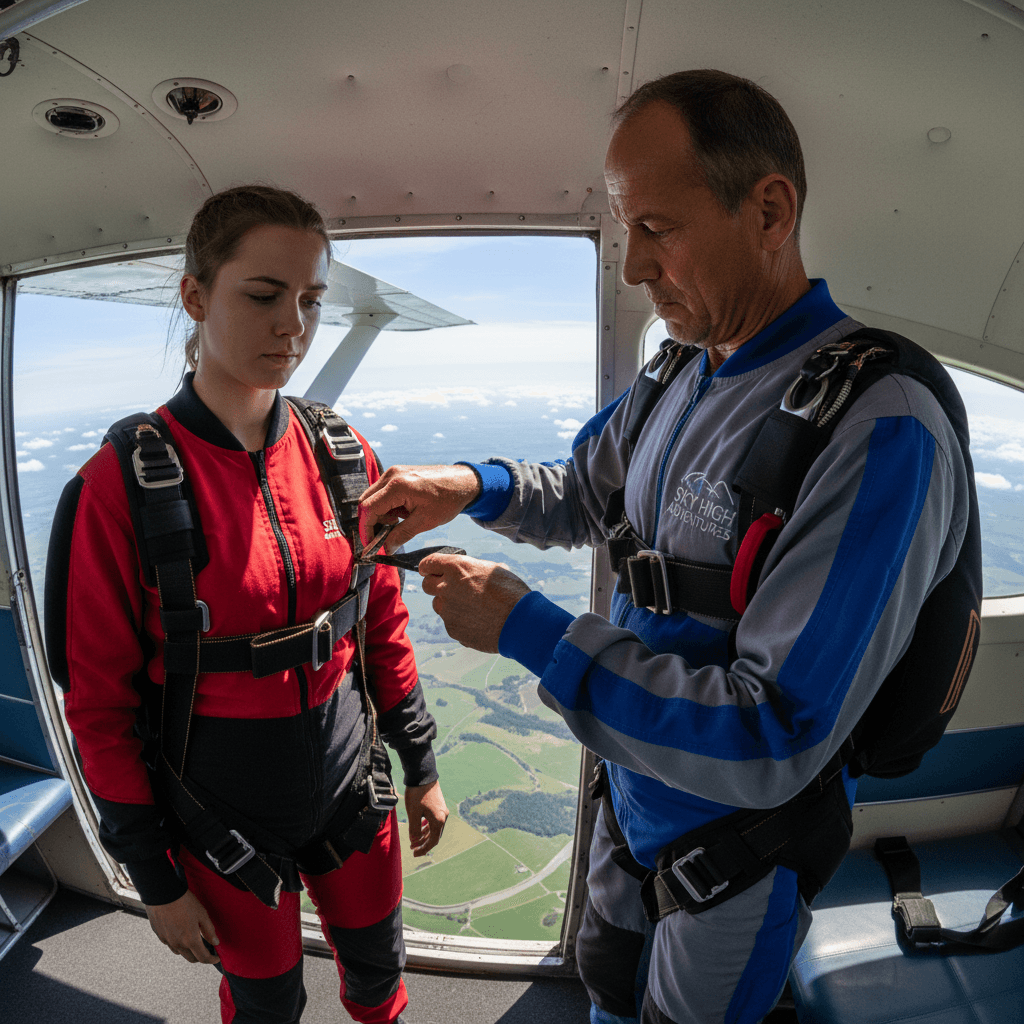
The aircraft is small, louder than you expected, and the smell is something between aviation fuel and warm aluminium. Your harness is already tightened. The instructor behind you is calm in the way only people who have done this thousands of times can be calm — checking carabiners, glancing at the altimeter on his wrist, occasionally pointing at the horizon. Through the perspex you can see the coastline retreating, and an ocean that looks much wider from up here than it ever did from the beach.
Twelve thousand feet, someone says.
You feel everything at once: a thudding heart, slightly cold hands, the strange comedy of realising you've spent forty years on a planet you've never actually fallen through. Adrenaline is doing what adrenaline does. And underneath all of it, in the quiet, you ask yourself the only question that really matters: is this actually safe?
If you've reached this page, you're already doing the right thing. Most people who jump don't ask. They book on a whim, see a video on Instagram, and discover their nerves only on the morning of. You're doing the more useful thing — the thing the most thoughtful jumpers we know all do — which is to slow down, look at the actual numbers, understand what the sport really is, and make an informed decision before you commit.
This guide will not pretend skydiving is risk-free. It is, by any honest definition, an extreme sport. But it will give you the calm, full-context answer that most safety pages skip entirely: how the modern sport works, what the real risk profile looks like, why the operator you choose matters more than almost anything else, and how to tell — within ten minutes of arriving — whether the dropzone you booked is actually the kind of place you want to entrust your life to.
We've spent the last two years getting to know skydiving operations across Asia in detail. Some of them are extraordinary: long-running, professionally run, with safety cultures you can feel the moment you walk in. Some are not. The difference matters more than the brochure ever will.
This is what we wish every nervous first-timer knew before they booked.
1. Quick Answer: Is Skydiving Safe?
The short version, for skimmers and for featured-snippet readers.
Modern tandem skydiving — the kind almost every first-timer does — is, by the numbers, one of the safer extreme sports a tourist can choose. It is not as safe as a commercial flight. It is also not as dangerous as the way it's portrayed in films. Catastrophic outcomes are rare; serious injury is rare; minor sprains, knocks, and bruises happen but are usually associated with landings, not the jump itself.
What changes the risk profile most is not the sport. It's the operator.
A few framing points to hold in your head as you read on:
- Tandem skydiving carries a meaningfully lower risk profile than solo (sport) skydiving. You are attached to a professional whose job is, literally, to keep you alive.
- Modern equipment is highly redundant. Every tandem rig carries two parachutes — a main and a reserve — plus an electronic backup that will deploy the reserve automatically if the system detects the jump has gone wrong.
- Operator quality is the single biggest variable. Two dropzones in the same country can have radically different safety cultures. The reputable ones are very, very good at what they do. The careless ones are not.
- Risk can never be zero. Anyone who tells you skydiving is completely safe is either being careless with words or trying to sell you something.
If you take nothing else from this article: don't compare skydiving to driving, or to crossing a street, or to any of the lazy analogies that get repeated online. Compare this operator to that operator, ask the right questions, choose well, and the rest takes care of itself.
The variance in safety culture between dropzones is bigger than the variance in safety culture between sports.
— SKYDIVE IN ASIA EDITORIAL TEAM
2. Why Skydiving Feels More Dangerous Than It Often Is
Human risk perception is famously bad.
We are, as a species, calm about risks we choose, are familiar with, and feel in control of (driving), and disproportionately afraid of risks that are unfamiliar, vivid, dramatic, and out of our hands (flying, sharks, skydiving). This is well-studied behavioural psychology — what researchers call the availability heuristic. We don't estimate risk from data; we estimate it from the most emotionally vivid example we can recall. And the most emotionally vivid example of skydiving is almost always something a film or news cycle put there.
A few specific reasons the sport triggers an outsized fear response:
The fall is the oldest fear humans have
Long before we evolved the capacity to worry about traffic accidents or pension funds, we evolved a hard-wired fear of falling. It is one of the only fears infants are born with. Skydiving doesn't ask you to manage that fear — it asks you to override it deliberately, in cold daylight, with full awareness. Of course it feels dangerous. It is asking for something your body was specifically designed to refuse.
Heights are abstract until they aren't
Looking at a building from the ground feels very different from looking out of an open aircraft door at the same building. Most people have no intuition for what 12,000 feet feels like, because most people have never been there with the door open.
Media coverage selects for the rarest outcomes
Every fatal skydiving incident, anywhere in the world, generates a headline. The hundreds of thousands of clean, uneventful jumps that happen the same week generate nothing — because they aren't news. The media isn't lying; it's doing what media does. But the cumulative effect on your risk perception is real, and it is wildly out of proportion to the underlying numbers.
You can't see the safety system
When you board a commercial flight, you don't see the maintenance checks, the dual-pilot protocols, the redundant hydraulic systems, or the air-traffic-control infrastructure. You see a clean cabin and a smiling crew. Skydiving's safety system is similarly elaborate — instructor training pipelines, gear inspections, weather protocols, currency requirements for tandem masters, equipment redundancy, AAD calibration — but very little of it is visible to a tourist on jump day. So the risk feels uncontained, even when it is heavily contained.
Pop culture frames it as recklessness
Film and television almost always frame skydiving the way they frame motorcycle stunts and free-climbing — as a thing reckless people do. The reality, when you walk into a serious dropzone, is closer to the opposite: a deeply procedural, checklist-driven culture run by people who, by and large, are unusually safety-conscious. The visual is dramatic. The actual operation is methodical.
None of this means your fear is irrational. It means your fear is human — and worth taking seriously, but not worth letting drive your decision without context.
The fear in the days before is almost always larger than the fear during. Once you're at the door, your brain runs out of room for it. Once you're in the air, there's nothing left to be afraid of.
— TANDEM INSTRUCTORS WE'VE SPOKEN WITH ACROSS ASIA
3. Real Skydiving Statistics, Properly Framed
We're going to be deliberately careful here.
There are two ways a safety article can get this section wrong. The first is to invent confident-sounding numbers ("only 1 in 500,000 jumps results in…") that aren't sourced or are years out of date. The second is to be so vague that the section gives the reader nothing useful. We'll try to thread between the two by being clear about what kinds of risk exist, what the rough proportions look like, and where you should go to verify the most current figures yourself.
Tandem vs. solo
Across every reputable dataset we've seen — and across every honest conversation with instructors — tandem skydiving consistently shows a meaningfully lower fatality rate than solo (licensed, sport) skydiving. This makes intuitive sense. Tandems are flown by some of the most experienced jumpers in the sport. The student doesn't make decisions. The risk surface is smaller.
Sport jumpers carry more of the risk
Most of the incidents you read about online are not tandem incidents. They involve experienced licensed jumpers, often during higher-performance manoeuvres — high-speed canopy turns near the ground (so-called swooping), wingsuit flying, complex formation work. These are not the jumps tourists do, and they are not the population that determines tandem risk.
Equipment-only failures are extremely rare
Modern tandem rigs are engineered with extraordinary redundancy. The cases where every system fails outright — main, reserve, and AAD all together — are vanishingly rare in the modern record. Most fatalities, when they do occur, involve human factors (decision-making, currency, judgement) rather than gear simply breaking.
The trend has been downward
Long-arc, the sport has steadily become safer over decades — better gear, better training, better culture. Compare a tandem rig from 1985 to one from 2025 and you are essentially looking at two different machines.
Where to verify the current numbers
National skydiving federations are the most reliable sources, and they publish annual safety summaries. British Skydiving (formerly the British Parachute Association), the United States Parachute Association (USPA), and the Australian Parachute Federation (APF) all publish data you can check directly. Anywhere a number is quoted online without a federation citation, treat it with appropriate suspicion.
A note on the comparison nobody asks for properly
You'll often see "skydiving is safer than driving" framed as a one-line claim. This is a comparison that depends entirely on how you measure: per hour of activity, per individual exposure, per lifetime, per kilometre travelled. Some framings make skydiving look very safe; others don't. The honest answer is: it's a different kind of risk than driving, taken voluntarily, in a small number of high-intensity exposures rather than spread across a lifetime. The comparison is more rhetorical than statistical, and we'd rather you didn't lean on it as your reason to jump.
What matters more than the exact number — and we'll keep coming back to this — is which dropzone you choose. The variance between operators is far larger than the variance the headline statistic captures.
4. What Actually Makes Skydiving Safer Today
If you compared a typical 1980s skydive to a typical 2025 tandem skydive, you would barely recognise them as the same activity. Almost everything has changed, and almost all of it has changed in the direction of safety.
Tandem systems
A tandem rig is a single, very large parachute system designed to carry two people, with the instructor's harness mounted on the student's back. The main canopy is significantly larger than a sport canopy, descent is slower, the system is more stable, and the procedural margin is wider. Tandem jumps were specifically engineered, in the early 1980s, to allow non-skydivers to jump with minimal risk and zero training. They are arguably the single most important safety innovation in the sport's history.
Reserve parachutes
Every tandem rig carries a fully independent reserve parachute, packed to a stricter standard than the main canopy and inspected by certified riggers on a regulated cycle. The reserve isn't a spare in any casual sense; it is an entire second flight system, capable of bringing the pair to the ground safely on its own.
Automatic Activation Devices (AADs)
This is the one most beginners don't know about. An AAD is a small electronic computer attached to the reserve. It monitors altitude and rate of descent. If it detects that the system is descending too fast, too low — i.e. that the main parachute hasn't opened, or that the instructor is incapacitated — it will automatically fire the reserve. It does this whether or not the instructor pulls anything. The best-known unit, the Cypres, has been in continuous service for decades and has a remarkably strong field record; the broader category of modern AADs is, on its own, one of the quieter but most significant safety improvements over earlier eras of the sport.
Instructor training
Tandem masters aren't just experienced sport jumpers. They have to hold specific tandem ratings issued by their national federation, with minimum jump-number prerequisites, recurrent currency requirements, gear-specific certifications, and documented training. A well-run dropzone keeps records on all of this and updates them.
Gear inspections
Reserves are repacked on a regulated cycle (commonly every six months in most jurisdictions, sometimes more frequently), by certified riggers, on documented tickets. Mains are inspected continually by the people packing them — a process you can often watch happening in the packing area at a serious operation.
Weather protocols
A serious dropzone has explicit go/no-go criteria for wind speed, cloud cover, visibility, and turbulence. They will scrub your jump if conditions don't meet them. This is the single most common reason a tandem gets postponed, and it is — paradoxically — one of the most reassuring signs of a competent operation. The dropzones you should be wary of are the ones that don't postpone.
Operational procedures
Briefings, harness checks, gear-up checklists, aircraft loading procedures, exit protocols, emergency procedures: all of this exists, all of it is documented at competent operations, and all of it is rehearsed.
When people ask why modern tandem skydiving is as safe as it is, the answer isn't any single innovation. It's that the sport has accumulated layers — gear, training, regulation, culture, redundancy — and any one layer would need to fail for an incident to reach the student. Most of the time, multiple layers would have to fail simultaneously. The system is designed that way deliberately.
Modern tandem skydiving isn't safe because of any single innovation. It's safe because every layer would have to fail at once.
— SKYDIVE IN ASIA EDITORIAL TEAM
5. The Biggest Safety Factor: The Operator You Choose
Here is the single most useful thing in this article.
The variance in safety culture between dropzones is bigger than the variance in safety culture between sports.
A serious operator and a careless operator can be jumping in the same country, using nominally similar equipment, on the same weather day — and the actual risk you take is different. This is the part of the conversation most safety articles avoid because it's harder to write. We're going to lean into it, because it's where you actually have control.
What separates a serious dropzone from a careless one tends to come down to several converging signals. None of them are individually decisive; together, they paint a clear picture.
Instructor experience and credentials
A reputable operator can tell you exactly how many jumps each instructor has, what tandem ratings they hold, how recent their currency is, and what their training pipeline looks like. They will be relaxed about the question. The answer will come quickly. A careless operator gets vague.
Operational professionalism
Walk into the packing area. Walk into the briefing room. Look at how gear is stored, how briefings are conducted, how customers are checked in. A well-run operation has a feeling — quiet, methodical, slightly understated. A poorly-run one has a feeling too: louder, looser, more improvisational. You will know the difference within ten minutes.
Safety culture
Ask an instructor what the most recent incident on the dropzone was. Not because you want to hear something bad — but because the way they answer tells you a lot. A serious operator will tell you, calmly and specifically, often citing the date and what was learned from it. A careless one will deflect, change the subject, or claim never to have had one. The first answer is much more reassuring than the second, even though it sounds counterintuitive.
Aircraft maintenance
This is harder for a tourist to evaluate directly, but you can ask. Reputable operators have documented aircraft maintenance schedules and will discuss them. The aircraft itself — usually a Cessna Caravan, Twin Otter, NZ Aero 750XL, or similar turbine — should look maintained. Cleanliness isn't the point; the point is whether the aircraft looks like a piece of professional kit or a piece of neglected equipment.
Weather decisions
This is the single most underrated signal. Operators who are willing to scrub a jump for marginal weather, even at financial cost to themselves, are operators who put safety ahead of revenue. Operators who push jumps in conditions other dropzones would scrub are telling you something important about their priorities. If the weather looks marginal and your operator is enthusiastic about jumping anyway, that should slow you down.
Transparency
A reputable operator answers questions like "what's your incident history?", "what equipment are you using?", "what are your weather minima?" without flinching. They have the answers because they take the questions seriously. A non-transparent operator is a red flag regardless of how nice the website looks.
Customer communication
A serious operator confirms your booking, sends you clear pre-jump instructions, has someone reachable when you have questions, and meets you at check-in with paperwork that actually exists. A casual operation wings the booking process, and the casual feeling around the booking is usually a fair preview of how casual things will feel around the actual jump.
The cheapest option in the country is rarely the best one
This is a hard rule with very few exceptions. Skydiving has real fixed costs — aircraft, fuel, insurance, instructor wages, gear-inspection cycles, regulatory fees. An operator pricing significantly below market is, almost by definition, taking the cost cut from somewhere — and that somewhere is almost never the marketing budget.
This isn't fearmongering. It's the simple truth of the sport. The Asia region has dropzones that are world-class in their professionalism, run by people who would be respected at any DZ on the planet. It also has weaker operations. Knowing how to tell them apart is, frankly, more valuable than the headline statistic.
Browse Asia's verified dropzones
Country-by-country listings of skydive operators across Asia — with verified pricing, aircraft, altitudes, and accreditation.
6. How Tandem Skydiving Actually Works
If you've never done one, the mechanics of a tandem are worth understanding, because most beginner anxiety comes from imagining the wrong version of the experience.
Before the jump
You arrive, check in, sign waivers, watch a short briefing video, meet your instructor, and get fitted into your harness. The harness has four attachment points — two at the shoulders, two at the hips — that connect to the front of your instructor's rig. You'll go through hand signals and body position with your instructor. The whole pre-jump process at a well-run dropzone is calm, methodical, and rarely rushed.
Boarding the aircraft
You sit on the floor of the aircraft, usually on benches or straddling the floor itself, with your instructor seated directly behind you. The aircraft climbs to altitude — typically 10,000 to 14,000 feet, depending on the dropzone. Climb takes 15 to 25 minutes. You'll have time to feel everything.
At altitude
The instructor connects the four harness points, double-checks them, and may add a third visual check. The door opens. The cabin gets very loud. People are usually grinning and giving thumbs up. Your instructor will guide you to the door — feet hanging out into the slipstream, head back against their shoulder, hands crossed on the harness. This is the exit position.
The exit
This is the part most people remember as the hardest emotionally and the easiest physically. The instructor commits the exit, not you. Your job is to maintain body position. Within about three seconds, you are in stable freefall, and the strange thing — the thing tandem first-timers all say afterwards — is that it doesn't feel like falling. It feels like an enormous wind. You can breathe normally. You can see the horizon. You can hear, just barely, the sound of the air rushing past.
Freefall
You'll be in freefall for roughly 45 to 60 seconds, depending on exit altitude. Your instructor controls everything — body position, stability, heading. You have almost nothing to do except enjoy it, smile for the camera if you've added video, and breathe. Most beginners report freefall feeling shorter than they expected.
Parachute deployment
At a pre-planned altitude — typically around 5,000 feet — the instructor deploys the main parachute. There's a very brief, soft deceleration. The noise stops. Suddenly, you're in silence, hanging under canopy, with five or six minutes of slow, quiet descent ahead of you. Most jumpers describe this as the most beautiful part — the freefall is an adrenaline rush, but the canopy ride is genuinely peaceful.
The canopy ride
Your instructor will fly the parachute, often inviting you to take the controls briefly. You'll see the dropzone below. You'll see the surrounding landscape. You'll have time to settle.
Landing
This is the part beginners worry about most and the part instructors handle entirely. As you approach the ground, the instructor will instruct you to lift your legs out in front of you. They flare the canopy at the right moment, and the pair of you slide in to a stand-up or seated landing, depending on conditions. Modern tandems use large, slow canopies specifically so landings are gentle. Most are uneventful.
Off the dropzone
Adrenaline dump, slight shaking, a very specific kind of grin people only seem to wear after a first jump.
That is the whole of it. The mechanics are simple. The system is designed so that the student doesn't have to make any critical decisions, and the instructor's job is to remove every variable they can.
7. What Happens If the Parachute Fails?
This is the question every nervous first-timer wants to ask and feels too embarrassed to.
Ask it. The answer is reassuring.
There are two parachutes, not one
Every tandem rig carries a main canopy and a reserve canopy. They are packed and inspected separately. The reserve is, in most jurisdictions, packed by a certified rigger to a stricter standard, on a regulated repack cycle. The reserve is not a spare. It is a fully capable independent system.
There is also an electronic backup
The Automatic Activation Device we mentioned earlier sits on the reserve and is constantly watching altitude and descent rate. If it sees a descent rate consistent with an unopened main, at an altitude consistent with an emergency, it deploys the reserve automatically. This system is independent of the instructor — it would fire even if the instructor were somehow incapacitated.
The instructor is trained for it
Tandem instructors run emergency procedures regularly. Cutting away a malfunctioning main and deploying the reserve is something they have practised, drilled, and in many cases performed in real conditions. It is not a hypothetical — it is a procedure.
Malfunctions are usually partial, not total
When something does go wrong with a main canopy — which is rare on tandem gear — it's usually a partial malfunction (a line twist, a slow opening, a non-square canopy) rather than the parachute failing to deploy at all. Many of these the instructor can resolve in flight without ever needing the reserve. When the reserve is needed, the instructor can recognise a malfunction and respond in seconds.
Layered redundancy is the real story
For a tandem skydive to fail catastrophically, you need: the main canopy to malfunction, and the instructor to be unable to deploy the reserve, and the AAD to fail. Each of those is rare on its own. The combination is exceptionally rare. The system was, very deliberately, engineered that way.
This isn't a guarantee. Nothing is. But the question "what happens if the parachute fails?" is one the sport answered, in engineering terms, decades ago — and the answer is more reassuring than most people realise before they ask.
8. The Most Common Beginner Fears — And What Reality Feels Like
Some of the most common pre-jump fears we hear from first-timers, and what people who've actually jumped report afterwards.
"I'll panic at the door."
Almost nobody does. The honest reason is biological: at 12,000 feet, in an aircraft, with an instructor strapped to your back and a clear procedure in front of you, your brain runs out of room for full-blown panic. Most first-timers describe a brief, intense moment of fear at the door, followed by — the moment they're in freefall — a kind of quiet astonishment. The exit is the hardest emotional moment. Once you're falling, there is nothing left to be afraid of.
"I won't be able to breathe."
You will. Freefall feels like an enormous wind, but you can breathe normally. People sometimes report that the first inhalation after exit feels strange — partly because the wind is so loud, partly because adrenaline is doing what adrenaline does — but breathing is not impaired. Many first-timers actually find themselves laughing in freefall. You can't laugh if you can't breathe.
"I'll black out."
Extremely unlikely. Tandem skydiving has none of the high g-forces of aerobatic flying or fighter aviation. Freefall is roughly 1g — the same as standing on the ground. The deceleration when the parachute opens is brief and gentle by design. The sport simply isn't structured to produce blackouts.
"I'll lose control."
You don't have control to lose. The instructor is responsible for stability, heading, deployment, canopy flight, and landing. Your job is to maintain body position and enjoy the experience. The cognitive relief of not being in charge — of being in the hands of a professional who has done this thousands of times — is something many first-timers report as unexpectedly calming once they're in the air.
"I'll regret it."
Of every fear in this list, this is the rarest one to actually materialise. The vast majority of first-time jumpers describe their tandem as either the best experience of their life or one of the best. A small minority say it was "fine but I wouldn't do it again." A truly tiny minority regret jumping. We've never met anyone who regretted choosing a good operator.
"What if I freeze and don't jump?"
It happens. Not often, but it happens. Reputable operators are calm and respectful about it. You will not be shamed, pushed, or pressured. You'll have your refund discussed (policies vary by operator), your harness will come off, and you'll go home. It is a recoverable decision. Many people who froze the first time go back and jump successfully later.
The pattern across all of these is the same: the fears are real and human, and the reality, once you're in the system, is almost always less intense than the imagined version. Bodies are good at confronting things that are actually in front of them. They are bad at confronting things that are imagined.
Most first-timers say the fear before the jump was bigger than the fear during it. The exit is the hardest moment. After that, surprise replaces fear.
9. Are Some Skydiving Destinations Safer Than Others?
Yes — but not in the way most people assume.
The country is rarely the variable that matters. The operator inside the country almost always is. A world-class dropzone in a developing-tourism country is safer than a careless one in a wealthy country. The flag on the website tells you very little.
That said, there are factors that vary by region and worth being honest about.
Weather reliability
Some destinations have steady, jumpable weather most of the year (Dubai's desert dropzones are an obvious example). Others have monsoon seasons and shorter operating windows. Steadier weather doesn't make the jump itself safer — but it does mean operators are flying more, instructors are more current, and equipment is in continuous service. Activity tends to correlate with operational sharpness.
Regulatory environment
Some Asian countries have a long, well-established civil aviation framework around sport parachuting; others have a thinner regulatory environment. The reputable operators tend to comply with international federation standards (USPA, APF, British Skydiving, FAI) regardless of local minimums. The careless ones tend to do the legal minimum, which in some jurisdictions is very little.
Tourism infrastructure
Mature tourist destinations attract operators who depend on reputation and reviews, which creates strong commercial incentives for good safety culture. Frontier tourism markets sometimes attract operators who depend less on reviews — and the discipline that reviews enforce isn't there.
Density of choice
Where there are several dropzones in one region competing for the same tourists, the floor is usually higher. Where there is only one operator within a long drive, with no competition, the floor depends almost entirely on the integrity of the people running it.
The honest summary
Asia has a wide range of operators across a wide range of countries. A handful are excellent by any global standard. Most are competent and professional. A small number are weaker. Geography is a coarse signal; operator-level due diligence is the real one.
10. What a Good Skydiving Operator Looks Like
A practical checklist you can use when you arrive on the morning of your jump. None of these are individually decisive. Together, they paint a picture you can trust.
| Signal | What you want to see |
|---|---|
| Pre-jump communication | Clear booking confirmation. Pre-jump instructions arrive without you chasing. Someone replies when you ask a question. |
| On-arrival paperwork | A real waiver, medical questions taken seriously, ID checked, emergency contact recorded. |
| Visible packing area | You can see canopies being packed. The packing area is organised. The riggers look like they've done this thousands of times. |
| Briefings | Calm, structured, the same briefing every customer hears. Hand signals demonstrated. Questions welcomed. |
| Instructor presence | Your instructor introduces themselves. They look at you while they're talking. They check your harness multiple times before exit. They look unhurried. |
| Equipment | Harnesses clean and intact. Helmets fit. Goggles unscratched. Aircraft visibly cared for. Nothing improvised. |
| Weather decisions | If conditions are marginal, the operator discusses it openly. They tell you what their cut-off is and what they're watching. |
| Reviews aged 12+ months | Negative reviews mention weather scrubs (good — operator scrubs). They do not mention pressure to jump in poor conditions. |
| Atmosphere | Calm. People are working. Conversations are happening but not chaotic. Other customers look comfortable. So do the instructors. |
| The door | A reputable operator will ask you, at the door, if you're ready. They will read your face. They will not pressure you. They will respect a no. |
If your dropzone hits most of these, you are almost certainly in good hands.
11. Red Flags Travellers Should Never Ignore
The other side of the same coin. If any of these are present, slow down. If several are, walk away. There are other dropzones in Asia, and your jump is not worth a careless one.
Rushed briefings
A 90-second briefing is not a briefing. The pre-jump briefing should be unhurried and thorough, even if it makes the schedule slip. Hurry, especially around safety-critical material, is a red flag.
Pressure to jump in marginal weather
If conditions look obviously poor and the operator is enthusiastic about jumping anyway, that is information. Reputable operators lose money on weather scrubs; they do it because they have to. Operators who don't, won't.
Vague or defensive answers about safety
"Don't worry about it" is not an acceptable answer to a real safety question. If you ask about incident history, equipment, instructor credentials, or weather minima, and the answer is evasive, take that seriously.
Visible disorganisation
Gear strewn around. People shouting across the hangar. Customers being processed in a queue that doesn't seem to know where it's going. Disorganisation in the pre-jump environment is a fair predictor of disorganisation in the operational one.
Suspiciously low pricing
As we said earlier — skydiving has fixed costs. Aircraft, fuel, insurance, instructor wages, gear-inspection cycles. The cheapest option in a country is usually the cheapest for a reason that isn't in your favour.
Instructor swap at the last minute, with no explanation
Things happen — instructors get sick, schedules change. But a competent operator will tell you who you're jumping with, why, and what their credentials are. A casual one will swap your instructor without comment.
No paperwork
Real waivers exist. Real medical questions get asked. If you're being sent up in an aircraft and onto the harness of a stranger without anyone confirming your name, that is unusual.
Pressure to commit at the door
A reputable operator will give you a final out at the door. A poor one might not. Watch the dynamic in the aircraft if you can.
If something feels off, listen to it. Skydiving culture, contrary to its reputation, deeply respects the right to walk away.
12. Is Skydiving Worth the Risk?
This is, in the end, the only question that matters. Everything else is preamble.
We can't answer it for you. Anyone who tries to is being either dishonest or salesy. What we can do is share the way most thoughtful first-time jumpers we know have framed it, in their own words, after their first jump.
Most describe a kind of recalibration. The fear in the days before the jump is nearly always greater than the fear during it. The actual jump is shorter than the imagined one. And the part that lasts isn't the freefall or the canopy ride or the landing — it's the way you carry yourself afterwards. People talk about feeling slightly braver in unrelated parts of their lives for months afterwards. They talk about the shift in perspective that comes from having voluntarily done something their evolutionary wiring spent forty years telling them not to do. They talk about it, often, as one of the cleaner emotional moments of their adult life — a thing they chose, said yes to, and walked away from changed.
This is not unique to skydiving. People describe similar shifts after long solo travel, public-speaking debuts, marathon finishes, surgery recoveries. What skydiving offers, specifically, is a short version of that — a few minutes that compress the whole arc of fear, commitment, surrender, and emerging-on-the-other-side into one continuous experience. That's why so many first-timers describe it as more emotional than they expected. It's not the height. It's the structure of the experience.
So is it worth the risk? It depends on whether the kind of recalibration we just described is something you want or need in your life right now. For some people, the answer is yes — clearly. For others, the math doesn't work, and that's a perfectly reasonable place to land. Skydiving is not a moral test. It is, at most, an opportunity. You're allowed to take it. You're also allowed not to.
What we'd say, gently, is: if you're going to do it, do it well. Choose a serious operator. Show up rested. Ask the questions you want to ask. Don't rush the decision. The version of skydiving that is worth doing — and the version most jumpers describe so warmly — is the unhurried, well-operated, properly-briefed version. The other version isn't worth doing.
13. What We'd Recommend to Nervous First-Time Jumpers
A short, calm checklist of the things we'd say to a friend before their first jump.
Choose your operator before you choose your destination
It's tempting to pick a beautiful coastline and then book whatever dropzone is nearby. Better the other way around: find a serious operator first, and let the destination follow. The view is forty seconds; the operator is everything.
Read the negative reviews more carefully than the positive ones
As we said earlier — what people complain about tells you more than what they praise. A pattern of complaints about pressure to jump in bad weather is much more important than a thousand reviews calling the experience "amazing."
Don't book the cheapest jump in the country
Especially in Asia, where the gap between the most professional operators and the most casual ones is wide. The right price will be in the middle of the market, not the bottom.
Ask the questions you want to ask
A reputable operator will welcome them. The questions worth asking: how many tandem jumps your instructor has done; what your operator's weather minima are; when their reserves were last repacked; what their incident history is. The asking itself is not rude. It is exactly the conversation a serious operation expects to have.
Eat properly that morning
Not a heavy meal — but not a skipped one either. An empty stomach plus adrenaline plus altitude is unkind. Most first-timer nausea complaints come from people who didn't eat.
Avoid the panic spirals online
YouTube and forum threads full of accident reconstructions are not useful preparation. They are addictive but they don't make you safer; they only make you more frightened. Read one or two reputable safety guides — like this one — and then close the laptop.
Sleep
Nervous people don't, and then they show up at the dropzone tired. Tired people make bad decisions. Sleep matters more than you think.
Trust the people on the ground
The single best decision you can make on the morning of is to find your instructor early, ask whatever you need to ask, and then actually believe their answers. You picked a serious operator for a reason. Let them do their job.
It's okay to say no
At any point. Even at the door. A reputable operator will respect it. We've never heard of anyone who said no at the door regretting it forever; we have heard of people who didn't, and wished they had.
Tandem skydiving is, by the numbers, one of the safer extreme sports a first-timer can choose. It carries a meaningfully lower fatality rate than solo (sport) skydiving, modern equipment is heavily redundant, and the actual variable that determines your risk is the operator you choose, not the activity itself. It is not as safe as a commercial flight; it is safer than its public reputation suggests.
The odds vary by jurisdiction, by year, and crucially by whether you're looking at tandem or sport jumping. Tandem fatalities are rare events; sport-jumper fatalities are more common but still represent a tiny fraction of jumps. The most reliable current numbers are published annually by national federations such as British Skydiving, the USPA, and the APF. We'd encourage you to verify directly with those sources rather than rely on second-hand quotes.
Every tandem rig carries two parachutes — a main and a fully independent reserve — plus an electronic Automatic Activation Device that will fire the reserve automatically if it detects the system has failed. Tandem instructors are also trained and current on emergency procedures. For a catastrophic failure to reach the student, multiple independent layers would have to fail simultaneously, which is by deliberate engineering design exceptionally rare.
This depends entirely on how you measure. Per hour of activity, driving is generally lower-risk; per individual exposure, framings get more complicated; per lifetime, driving accumulates more risk simply because we drive more. The honest answer is that they are different kinds of risk, and the comparison is more rhetorical than statistical. Pick a serious operator and the comparison stops mattering.
Yes — that is exactly what tandem skydiving was engineered for. Tandem jumps require no prior training, no licensing, and no athletic background. The instructor handles every safety-critical decision. The system is specifically designed so a complete beginner can jump with minimal added risk.
Yes, for most people, especially in the moments before exit. That fear is normal, evolutionarily appropriate, and not a reason not to jump. Almost every first-timer reports that the imagined fear is greater than the actual fear, and that the experience itself is closer to astonishment than terror.
Yes. The wind is loud and the sensation is intense, but breathing is not impaired. Most first-timers find themselves laughing or grinning in freefall, which would not be possible if they couldn't breathe.
Through layered systems: licensed and current instructors, equipment that is regularly inspected and repacked by certified riggers, defined weather minima, written emergency procedures, federation-aligned operating standards, and a documented incident-review culture. A good operator can describe each of these in detail without flinching.
Calm communication, transparent answers to safety questions, visible packing and gear-care, structured briefings, instructors with documented experience, weather decisions made openly, and a price that sits in the middle of the market rather than at the bottom of it. Read the negative reviews more carefully than the positive ones.
Most first-time jumpers describe their tandem as one of the more emotionally significant experiences of their adult life — not because of the height, but because of the structure of the experience. That doesn't mean it's right for everyone. But for people who've considered it carefully and chosen a serious operator, the regret rate is remarkably low.
Prices vary widely by country and operator — typically USD $250–$700 for a standard tandem, with Dubai and Everest jumps at the premium end. Our country-by-country pricing breakdown covers operator-verified rates and what's included.
15. The Calmer Version of the Question
There is a quieter version of "is skydiving safe" that nobody asks online but almost everyone is really asking. It is: can I do this without it going badly?
The answer, with the kind of honesty we hope you've felt throughout this article, is: yes — almost always — if you choose well.
Skydiving is an extreme sport. It will never be as safe as not skydiving. But the modern tandem version of it, run by a serious operator, is not the wild, reckless thing the imagination paints. It is a carefully engineered, deeply procedural, layered experience designed to remove as much risk as honestly possible while leaving enough of the fall intact to mean something. The numbers reflect that. The people who run good dropzones reflect that. And the millions of first-timers who have come back to the ground unharmed and quietly transformed reflect that.
If you decide to jump, do the small amount of homework that matters. Pick a serious operator. Ask the real questions. Show up rested, fed, and on time. Let the people on the ground do their job. Allow yourself the door.
If you decide not to jump, that is a valid answer too. You don't owe a single bucket-list item to anyone. The question is whether the experience matters to you, not whether you can be talked into it.
Either way, we hope this guide gave you the information you needed to decide on your own terms — calmly, with full context, and without anyone trying to sell you anything.
The editorial team behind Asia's dedicated skydiving discovery platform — working directly with dropzones and federations across the region to keep listings accurate.