On this page
- 01Quick verdict
- 02What is Skydive Cebu?
- 03Why Bantayan Island feels different from other skydiving destinations
- 04Getting to Bantayan Island
- 05What the tandem experience is actually like
- 06How scenic is the jump?
- 07Is Skydive Cebu safe?
- 08How much does Skydive Cebu cost?
- 09What we loved about the experience
- 10Things travellers should know before booking
- 11Who should skydive in Cebu?
- 12Skydive Cebu vs Bali vs Thailand vs Dubai
- 13Tips before you go
- 14Frequently asked questions
- 15The conclusion you didn't know you needed
The aircraft is climbing.
The cabin smells like sun-warmed aluminium and salt. Outside the open door, the Visayan Sea is laid out like hammered glass — turquoise where the reef shallows breathe, indigo where the channels deepen, then a thin white curve you slowly recognise as the western coastline of Bantayan Island.
You can see fishing boats the size of grains of rice. You can see the wake of a ferry crossing toward Hagnaya. You can see your own knees, shaking, strapped to a stranger who is now your closest friend on Earth.
The instructor leans into your ear. Three. Two. One.
The world tilts. For three or four seconds you forget every word in every language you've ever spoken. Then the air finds you — a warm tropical wall pressing into your chest — and Bantayan unrolls beneath your feet like a postcard someone has just unfolded.
You are skydiving in the Philippines. And nothing about this moment will ever be ordinary again.
Quick verdict
Skydive Cebu — operating as Skydive Santa Fe – Cebu out of Bantayan Island — is the only USPA International Affiliate dropzone in the Philippines. Tandem jumps run from up to 10,000 ft over reef, sandbar, and white-sand beach, with 30–40 seconds of freefall and a 5–7 minute parachute ride. Three packages: ₱28,350 ≈ $452 Standard, ₱41,475 ≈ $661 Premium (adds outside camera flyer), and ₱25,200 ≈ $401 per person Group of two or more. It is, in our view, the most scenically gifted tandem skydive in South-East Asia — and one of the best places in Asia to do your first jump.
What is Skydive Cebu?
Skydive Cebu is a tandem skydiving operation based in Santa Fe Town on Bantayan Island, off the north-western tip of Cebu in the central Visayas. It is operated by Skydive Santa Fe OPC and is, by its own carefully chosen wording, the only United States Parachute Association International Affiliate dropzone in the Philippines.
That detail matters more than first-time jumpers usually realise. USPA affiliation aligns the operation with one of the most rigorous tandem-skydiving safety frameworks in the world — recurring instructor recertification, equipment standards, and operating procedures benchmarked against the same body that governs commercial dropzones across the United States. The dropzone publicly states that its parachute systems are FAA-approved and inspected by an FAA-certified parachute rigger.
The set-up is small by international standards, and that is almost entirely a virtue. There is no industrial-scale 'next, please' energy here. No twelve-deep manifest queue. No corporate gloss. Travellers who have jumped at Skydive Dubai or Skydive Pattaya regularly describe Cebu as 'the more personal one' — the dropzone where the staff actually remembers your name between gear-up and landing.
If you are searching for a flashy mega-dropzone with three aircraft turning every fifteen minutes, this is not it. If you are searching for a cinematic, intimate, emotionally rich tandem above water you will be talking about for the rest of your life, this is exactly it.
Why Bantayan Island feels different from other skydiving destinations
Most commercial dropzones in Asia sit on the edge of a city or near an airport. You arrive in traffic. You jump. You leave. The landscape below is functional — roads, hangars, parking lots, the suggestion of a runway.
Bantayan is something else entirely.
It is a small, low-lying island ringed by reefs and sandbars. The pace is famously slow. Roosters wake guesthouses before alarms do. Tricycles outnumber cars. Coconut palms lean toward beaches that the rest of the Philippines somehow forgot to over-develop. There is no mall. There are no traffic lights of consequence. There is, instead, the kind of stillness that travellers chase across continents.
When the aircraft climbs out of this stillness, the contrast is the entire point. You are not jumping over a city. You are not jumping over an industrial park dressed up as a runway. You are jumping over an island that has felt, for the past three days, like a quiet conspiracy between you and the sea.
That emotional contrast — the calm of Bantayan, the sudden vertical intensity of freefall, the impossible blue underneath the canopy — is the texture that makes Skydive Cebu different from Bali, different from Pattaya, different from Dubai. It is a travel skydive, not a city skydive. The destination earns its place in the experience.
The best skydives in Asia are the ones where the destination matters as much as the jump. Bantayan is one of the few places in the region where that's truly the case.
— SKYDIVE IN ASIA EDITORIAL
Getting to Bantayan Island
Skydive Cebu is not a one-hour Uber from Mactan. Travellers who underestimate the journey are the same travellers who write disappointed reviews. Plan it properly and the trip becomes part of the magic.
The route, in plain terms
Most travellers fly into Mactan-Cebu International Airport (CEB), a short bridge crossing from Cebu City. From there you cross the island northward by road to Hagnaya Port in San Remigio, then take a passenger ferry across the channel to Santa Fe on Bantayan Island.
Realistic timing expectations
- Cebu City to Hagnaya Port: roughly 3 to 4 hours by van or private transfer, depending on traffic and weather on the northern road
- Hagnaya to Santa Fe ferry: approximately 60 to 90 minutes on the water
- Santa Fe to your accommodation: 5 to 30 minutes by tricycle or hotel transfer
That puts the realistic door-to-door journey from Mactan airport to a Bantayan guesthouse at 5 to 6 hours in the most optimistic conditions, longer if the ferry schedule isn't aligned with your arrival.
The smarter way to plan it
Treat Bantayan as a multi-day destination, not a side-quest. Book at least two nights on the island. That gives you a weather buffer (essential for skydiving — see the section on weather below), time to actually enjoy the beaches before or after the jump, and a calmer pre-jump morning instead of arriving sweaty and rattled from a 5am van transfer.
The journey itself
The northern Cebu road threads past sugarcane fields and small fishing barangays. The ferry is open-sided, breezy, and almost always full of a mix of locals carrying market goods and travellers staring at the water. By the time you step off the boat in Santa Fe, your nervous system has already started downshifting. This is, quietly, the beginning of the experience.
If you want to skip the road portion, fly into Cebu early, take a domestic transfer to Hagnaya, and pre-book the ferry. Some travellers also charter private boats from northern Cebu directly to Santa Fe — more expensive, but a beautiful option if you're travelling as a couple or small group.
What the tandem experience is actually like
This is the section that matters. Strap in.
Arrival and the slow drip of nerves
You wake up earlier than your body wants. The light over Bantayan in the morning is soft and pink — the kind of light that feels engineered for honeymoon photos. You eat a small breakfast you barely taste. Your travel partner is too cheerful. You hate them, briefly, and lovingly.
When you arrive at the dropzone, the nerves have begun to organise themselves into something specific: a low electric hum at the base of your spine, a slight extra awareness of your own breathing. This is normal. Every tandem jumper, in every country, every continent, walks in feeling something like this. The trick is not to fight it. The trick is to notice it and let it sit beside you.
Check-in and the waiver
You'll fill out paperwork. You'll sign a waiver. Read it — actually read it — even though everyone tells you not to bother. Knowing precisely what you're consenting to is, paradoxically, one of the best ways to dissolve anxiety. Adults make decisions. Decisions feel safer than mysteries.
The briefing
A tandem briefing is short. The reason it is short is that you, the passenger, do almost nothing. Your instructor — the certified USPA tandem master you're physically attached to — handles the parachute, the freefall body position, the deployment, the canopy navigation, and the landing.
You will be taught body position at exit (head back, arms across your chest until the instructor taps you), freefall posture (arms out in a relaxed arch, legs bent backward at the knees), and the landing position (legs lifted forward, toes up, signaled by your instructor in the final seconds before touchdown). That is the entire pilot's licence. You'll be drilled on it in less than fifteen minutes, because that's all it takes.
Gearing up
The harness goes on like a backpack with too many straps. You'll be tightened, double-checked, then triple-checked. Goggles, a soft cap or helmet depending on the rig, and possibly a handcam set-up — Skydive Cebu's Standard package includes handcam photos and an edited video; the Premium package adds an outside camera flyer who exits with you.
The harness will feel awkward. It is not designed for walking. It is designed to keep two human beings cinched into a single aerodynamic unit at terminal velocity. The brief discomfort on the ground is the trade for the precise comfort in the air.
Meeting your instructor
This is the moment that quietly does the most psychological work of the day. A tandem master is not a stranger; they are, very briefly, the most important person in your life. USPA-certified tandem instructors carry a substantial logged-jump record before they earn the rating, plus recurring currency requirements after. Their calm is professional, not performative. They will joke. They will check your harness three more times. They will tell you exactly what's about to happen, and that telling is the single biggest reason your fear will start to recede.
Boarding the aircraft
The walk to the aircraft is its own quiet ceremony. The plane is small — that is normal for tropical island operations. Inside, you'll sit on a bench, often straddling it, with your instructor behind you. The door slides shut. The engine spools up. The vibration travels up through the floor of your sandals and into your jaw.
The 20-minute climb
Skydive Cebu's published flight is roughly a 20-minute sightseeing climb to jump altitude. This is, for most jumpers, the longest part of the jump and the part where the fear peaks and then breaks. The aircraft spirals slowly upward over the western reef shelf. The horizon gets bigger. The water below stops looking like water and starts looking like a topographic map of itself — pale jade over the reefs, deep ink over the trenches, white pinpricks where boats are throwing wakes.
Somewhere around the halfway point of the climb, you'll have a strange thought: this is actually happening. And then, almost immediately afterward: I want this to actually happen. That moment — the second thought — is the moment fear becomes excitement.
The door opens
The door slides back at up to 10,000 ft. The cabin fills with wind. The horizon, which until two seconds ago was framed by aluminium and Plexiglas, is now a wall of unbroken blue with no edges. The instructor pivots you toward the door. Your feet are on the lip. Your toes are over nothing.
There is no time, here, for second thoughts. The system is designed that way on purpose. The instructor counts. You arch. You go.
30 to 40 seconds of freefall
The first second is not what you expect. You don't feel like you're falling. You feel like you're flying — pinned to a column of warm air that is suddenly, generously, holding you up. Your stomach does something funny for half a second, then settles. Then the noise arrives. Wind, rushing past your ears at terminal velocity, sounds nothing like the wind in a car or on a motorbike. It is louder, denser, more textured. It feels like the air itself is alive.
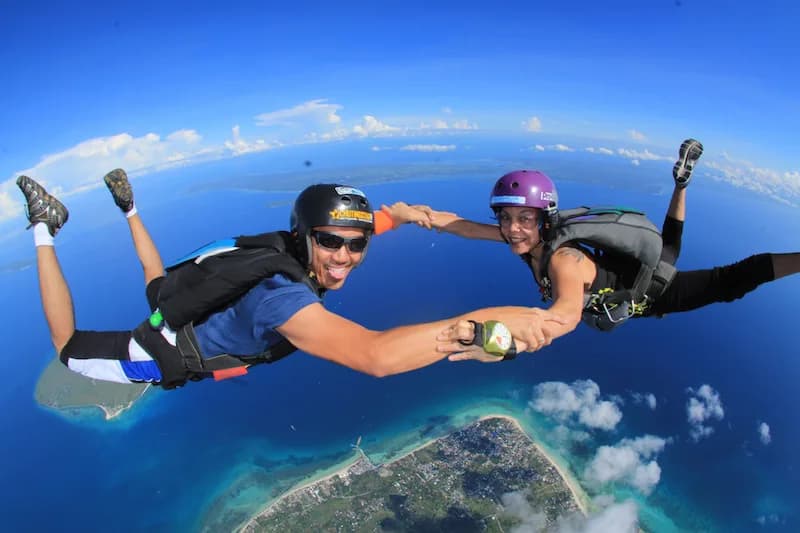
For 30 to 40 seconds — that's Skydive Cebu's published freefall window — Bantayan is doing its full performance: reef shadows, sandbars, the long curl of beach on the western shore, the green of the interior, the impossible turquoise of the shallow water near Virgin Island. It is one of the few places in Asia where you can genuinely stop thinking about the skydive itself and just stare at the geography.
The 5-7 minute canopy ride
The parachute opens with a firm, clean tug. Suddenly the noise stops. The wind drops to a whisper. You are upright, suspended, drifting.
This is the section nobody warns you about. The freefall is the headline. The canopy ride is the part that actually changes you.
For 5 to 7 minutes — Skydive Cebu's quoted canopy duration — you and your instructor will glide above Bantayan, slowly carving down toward the landing zone. The instructor may let you steer briefly. They may spin the canopy gently to let you see the island from every angle. The wind is warm. The light is tropical. The sound is your own breathing.
People cry, here. A lot of people cry, here. It is not the falling that does it. It is the floating.
The landing
The Skydive Cebu landing is one of the rare beach landings in Asian commercial tandem skydiving — onto white sand, on the western coast of Bantayan. The landing is choreographed; your instructor will brief you on the lift-your-legs cue moments before touchdown. Done correctly, a tandem beach landing feels like sliding off a stool — undramatic, almost gentle.
You stand up. You breathe. The harness comes off in stages.
The aftermath
The first sixty seconds on the ground are euphoric and slightly disorganised. You will probably hug your instructor. You will probably hug your travel partner. You will say 'oh my God' approximately seventeen times in three minutes, and none of those repetitions will feel embarrassing.
The next hour, in our experience, is one of the cleanest emotional highs in adventure travel. Your hands shake mildly. Your jaw aches from grinning. Your phone holds a video — Skydive Cebu includes both handcam footage and a social-ready edited reel in every package — that, for the rest of your life, you'll show people in bars when the conversation slows.
This is what people mean when they say a skydive changes you. The change is small. It is permanent.
How scenic is the jump?
Honestly, it is one of the most beautiful tandem experiences in Asia — and we say that having reviewed dropzones across Thailand, the UAE, Indonesia, and beyond.
What you'll see from canopy:
- Turquoise reef shelves — the western waters of Bantayan run shallow over coral, producing the kind of jade-green tones you typically only see in Maldives photography
- Sandbars — long ribbons of white emerging from the sea at low tide, geometrically perfect from above
- Virgin Island and surrounding islets — small green dots in pale water, often photographed from canopy on clear days
- The Bantayan coastline — a near-continuous curve of beach broken only by fishing villages and palm clusters
- Open sea — beyond the reefs, the deep blue of the Visayan Sea, dotted with bangka outriggers and inter-island ferries
Visibility on Bantayan is generally excellent during the dry months (roughly January through May), with calmer winds and cleaner skies. Tropical weather is dynamic by nature — afternoon clouds can build quickly in any month — which is part of why Skydive Cebu, like every responsible operator, runs weather-dependent schedules.
For photography lovers: the difference between Skydive Cebu's Standard and Premium packages is the camera flyer. Standard gives you handcam footage from your instructor's wrist; Premium adds a dedicated camera-flying skydiver who exits with you. If Bantayan from altitude is the visual you want to remember properly, Premium is the upgrade you'll thank yourself for.
Is Skydive Cebu safe?
The honest answer: tandem skydiving, performed by a qualified operator, is one of the most procedurally controlled adventure activities in the world — and Skydive Cebu's specific accreditation profile is unusually strong for the region.
USPA International Affiliation
Skydive Cebu is the only USPA International Affiliate dropzone in the Philippines. United States Parachute Association affiliation aligns the operation with the most widely benchmarked tandem-skydiving safety framework in the world: recurring instructor recertification, equipment service intervals, manifest standards, and operating procedures all evaluated against USPA's published requirements.
FAA-approved equipment
The dropzone publicly states that its parachute systems are FAA-approved and that gear is inspected by an FAA-certified parachute rigger. Tandem rigs carry both a main canopy and a fully independent reserve, with the reserve packed and certified by a licensed rigger on a strict re-pack cycle. Modern tandem rigs are typically also fitted with an automatic activation device (AAD) — an electronic backstop that will deploy the reserve automatically if certain altitude and descent-rate conditions are met.
The instructor
Tandem masters are not casual hobbyists. They've completed several hundred to several thousand prior jumps as a solo skydiver and earned a specific tandem rating through an internationally recognised body. Their job, in the air, is your job too. They are responsible for the deployment, the canopy ride, and the landing. They are also responsible — and this is the part most travellers don't know — for assessing weather, winds, and aircraft conditions before you ever leave the ground.
Weather
Skydiving is famously weather-flexible. Operators monitor wind speed, gust patterns, cloud ceiling, and visibility before every load. If the weather doesn't meet jump-safe parameters, the load is delayed or cancelled — and a cancelled jump is always the right call. Travellers who arrive on Bantayan with one tightly-scheduled jump window are the travellers most likely to be disappointed. Travellers who build in flexibility almost always jump.
A calm word about fear
Fear of skydiving is rational. It is a high-altitude activity involving an open aircraft and a parachute. But the actual statistical risk profile of a tandem jump is significantly lower than most people assume — and significantly lower than the comparison many first-timers reach for ('more dangerous than driving'). For most travellers, the larger risk on a Bantayan trip is the motorbike to dinner, not the skydive.
Tandem skydiving is, fundamentally, an activity in which a trained professional does the dangerous part for you while you hold on. That's it. That's the whole game.
How much does Skydive Cebu cost?
Skydive Cebu publishes its 2026 prices openly on the operator website — three packages, all over a 10,000 ft tandem.
| Package | Price (per person) | What's included |
|---|---|---|
| Standard | ₱28,350 ≈ $452 | 10,000 ft tandem, 20-min sightseeing flight, 30–40 sec freefall, 5–7 min canopy, handcam photos and video, edited reel, skydiving certificate |
| Premium | ₱41,475 ≈ $661 | Everything in Standard plus a dedicated outside camera flyer (third-person photos and video) |
| Group Jump | ₱25,200 ≈ $401 | Standard package per person, minimum 2 jumpers in the same flight (most affordable per-head option) |
In context: Skydive Cebu's Standard at ₱28,350 ≈ $452 sits broadly in line with mid-range tandem pricing across South-East Asia, and its Group rate of ₱25,200 ≈ $401 per person is one of the more accessible per-head prices in the region for a USPA-affiliated operation. For comparison, Thai Sky Adventures in Pattaya ranges from THB 9,450 ≈ $281 to ฿15,250 (roughly ₱17,400 to ₱28,100 at current exchange) and Skydive Dubai's Palm tandem with full media climbs into the AED 4,800+ range (roughly ₱79,500+).
The honest value framing
The skydive itself is rarely the largest cost in your Bantayan trip. Travellers tend to underestimate domestic flights to Cebu, land transfer to Hagnaya, ferry tickets, two to three nights of accommodation, and food and incidentals. Treat the total trip as the experience, not just the jump. When you do, the per-day cost looks more like a holiday than an adrenaline tax.
Should you pay for Premium?
If photographs from canopy altitude over the reefs of Bantayan matter to you — and they will, in a way you can't fully predict from the ground — yes. The marginal cost between Standard and Premium (₱13,125 ≈ $209) buys a dedicated camera flyer exiting with you. That third-person footage is the artefact that survives the holiday. Standard's handcam is a perfectly good safety net; Premium is the upgrade most travellers don't regret.
If you're travelling as a pair, the Group Jump rate of ₱25,200 ≈ $401 per person is the smartest math in the price list — same skydive, in the same flight, ₱3,150 ≈ $50 cheaper each.
What we loved about the experience
The scenery, full stop. There is no other tandem in Asia where the geography is this generous from canopy altitude. Bali has volcanoes; Pattaya has coastline; Dubai has the Palm. Bantayan has reefs, sandbars, and water that does the impossible turquoise thing for the entire descent.
The pacing. Skydive Cebu is not a high-volume operation, and it shows. Your jump feels like a jump, not a logistics queue. The instructors talk to you as a person.
The accreditation. USPA affiliation in a region where many operators are governed by national bodies of varying maturity is a meaningful signal — and Skydive Cebu's public commitment to FAA-approved gear and certified rigger inspections is the kind of detail that quietly does most of the trust-building.
The travel pairing. Few skydives in the world fold so naturally into the rest of a holiday. Bantayan is a destination first, a dropzone second — which means your skydive sits inside a beach week, rather than being a one-off detour from a city itinerary.
The beach landing. Most commercial tandem operations land in fields, on grass strips, or in wide open paddocks. Skydive Cebu lands you on white sand, on Bantayan's western coast. It is a small detail. It is also the kind of detail you will remember for the rest of your life.
The unforgettable moments. The exit door opening over the reef. The first thirty seconds of freefall over the sandbars. The canopy ride at golden-hour light, when the water shifts from jade to gold. The ground hug. The moment, two days later, on a different beach, when you suddenly remember you skydived.
Things travellers should know before booking
We are not going to pretend the experience is frictionless. Here is the honest version.
Weather is the boss
Skydiving is a weather-dependent activity. If conditions don't meet jump-safe thresholds, your load will be delayed or rolled to the next day. That is not a failure of the operator — it is the operator doing exactly what a responsible operator should do. Build at least one buffer day into your Bantayan itinerary. Two if you can.
Bantayan logistics are not a city skydive
Compared to a Bali or Dubai skydive, Cebu requires more logistical care. The combined road and ferry transfer is not optional. The dropzone is not a 20-minute taxi from your hotel. Treat the trip as a mini-expedition.
Tropical heat
Bantayan is hot. Real hot. The kind of hot where you regret your hoodie. Pre-jump waiting time on the ground will involve sun, humidity, and the temptation to drink too much coffee. Hydrate. Wear light layers. Don't show up dehydrated and over-caffeinated.
Waiting is part of the day
Skydiving days are not airline-precise. Loads run on the rhythm of weather, wind, and aircraft. You may be on the ground for an hour or two before your slot. Bring a book. Bring patience. The wait is part of the experience, not an interruption of it.
Booking ahead
Skydive Cebu's website lists both direct booking and gift certificate options, and the operating phone is +63 917 167 3226. Manifest can fill quickly during dry-season weekends and around Philippines public holidays — book ahead if your travel window is tight.
Nerves will visit. Let them.
You will be nervous. That nervousness will peak at one of two moments: in the climb, or in the doorway. Both peaks pass quickly. Your job is not to be unafraid. Your job is to step through fear once. The reward is a lifetime of stories.
Who should skydive in Cebu?
A skydive is not the right experience for every traveller, and not every dropzone is the right fit for every skydiver. Here's the honest fit map for Cebu.
Best for first-time skydivers. The combination of small-operation calm, USPA-aligned safety culture, and absurdly photogenic geography makes Bantayan one of Asia's best places to do your first jump. The sheer beauty of the descent distracts you, in the best way, from the nerves.
Best for couples and honeymooners. The tandem-then-canopy-then-beach-sunset combination is a stupidly romantic day. The ₱25,200 ≈ $401 Group rate makes the math even kinder. Couples regularly describe their Bantayan jump as the highlight of multi-week South-East Asia trips.
Best for island travellers. If you're already on a Visayas itinerary — Cebu, Bohol, Siquijor, Malapascua — Bantayan slots in cleanly. The skydive becomes a chapter, not a detour. (Note: Skydive Siquijor is run by the same operating team and offers a parallel experience over the Mindanao Sea, if your trip is heading further south.)
Best for backpackers. Bantayan has long been part of the backpacker circuit in the Philippines. Affordable accommodation, easy social scene, and the bragging-rights skydive at the centre.
Best for scenery-first jumpers. If you've already jumped Pattaya or Dubai and want a different kind of beauty — softer, more tropical, more emotional — Cebu is the answer.
Who may prefer somewhere else. Travellers on a 24-hour stopover in Cebu City; travellers who want a polished mega-dropzone with three loads an hour; travellers chasing higher-altitude HALO experiences (better suited to Dubai, which jumps from up to 13,000 ft). These are real audiences. Cebu is not built for them.
Skydive Cebu vs Bali vs Thailand vs Dubai
Asia's four major tandem destinations each offer something genuinely different. Here is the honest comparison.
| Dimension | Skydive Cebu | Bali | Thailand (Pattaya) | Skydive Dubai |
|---|---|---|---|---|
| Scenery type | Reefs, sandbars, tropical island | Volcanic, rural Bali | Long coastline, Gulf of Thailand | Palm Jumeirah, city skyline |
| Exit altitude | Up to 10,000 ft | Up to 10,000 ft | 13,000 ft | Up to 13,000 ft |
| Tandem from | ₱28,350–41,475 ≈ $452–661 | Mid-range | THB 9,450 ≈ $281–฿15,250 | AED 2,499–4,800+ |
| Atmosphere | Slow island, intimate | Boutique, emerging | Established, high-volume | World-class, polished |
| Accessibility | Multi-leg from Cebu City | Direct from Bali airport | Easy from Pattaya/Bangkok | Easy from Dubai city |
| Best paired with | Bantayan beach week | Bali holiday | Pattaya/Bangkok trip | Dubai city break |
If you want scenery you'll stare at for the entire canopy ride, choose Cebu.
If you want iconic skyline-and-Palm photography that everyone will recognise, choose Dubai.
If you want a reliable, well-oiled tandem on a classic Asia beach holiday with the cheapest published 2026 prices in the region, choose Pattaya.
If you want the emerging boutique scene paired with a full Bali itinerary, choose Bali.
There is no wrong answer. There is only the trip you actually take.
Tips before you go
- What to wear: athletic wear or shorts and a t-shirt; closed-toe shoes (sneakers are perfect; sandals are not); avoid loose pockets and heavy jewellery
- Eat something small: skipping breakfast tends to make nerves worse, not better; a light, normal meal is exactly right
- Hydrate, but don't over-caffeinate: tropical heat plus jet-fuel adrenaline plus three espressos is a recipe for shaky hands
- Sun and heat preparation: sunscreen before you arrive at the dropzone, sunglasses for the ground waiting time, a cap, a water bottle
- Build in weather flexibility: two-night minimum on the island; three is better — tightly-scheduled jump windows are the windows that get cancelled
- Consider Premium for the camera flyer: handcam is fine; outside-camera footage is what survives in your camera roll for years
- Book the Group rate if you're travelling as a pair: ₱25,200 ≈ $401 per person beats ₱28,350 ≈ $452, same package, same flight
- Bring cash: tipping your instructor in cash after a clean jump is a nice gesture and culturally welcomed
Frequently asked questions
Skydive Cebu is the only USPA International Affiliate dropzone in the Philippines, operates FAA-approved parachute systems, and has its gear inspected by an FAA-certified parachute rigger. Every tandem rig carries a main and fully independent reserve, and modern tandem rigs are typically equipped with an automatic activation device as a final electronic backstop. Weather is monitored before every load.
Three published packages: Standard ₱28,350 per person (handcam photos + edited video), Premium ₱41,475 per person (adds a dedicated outside camera flyer), and Group Jump ₱25,200 per person with a minimum of two jumpers in the same flight. All packages include the 10,000 ft tandem, 20-minute sightseeing climb, 30–40 second freefall, 5–7 minute parachute, edited social-ready reel, and a skydiving certificate.
Skydive Cebu jumps from up to 10,000 ft, with 30 to 40 seconds of freefall and a 5 to 7 minute parachute ride before a beach landing on Bantayan's western coast.
Yes. The vast majority of jumps run at Skydive Cebu are first-time tandem jumps. No prior experience is required. The briefing is short and beginner-focused, and your USPA-rated tandem instructor handles all technical aspects of the jump.
Fly into Mactan-Cebu International Airport, transfer overland to Hagnaya Port in northern Cebu (3–4 hours), then take a passenger ferry to Santa Fe on Bantayan (60–90 minutes). Total door-to-door travel is realistically 5–6 hours. Most travellers spend at least two nights on the island.
Skydive Cebu is operated by Skydive Santa Fe OPC out of Santa Fe Town on Bantayan Island, off the north-western tip of Cebu. The dropzone lands tandem jumpers on white-sand beach on Bantayan's western coast.
Bantayan is, in our view, one of the most scenically gifted tandem locations in Asia. The combination of turquoise reefs, white sandbars, tropical coastline, and a USPA-affiliated, beginner-friendly operation makes it especially well suited for first-time skydivers and travellers who want the destination to matter as much as the jump.
It's intense, especially in the climb and at the moment the door opens. But fear during a tandem is short-lived and well-managed. Most jumpers describe the actual freefall as exhilarating rather than frightening, and the canopy ride as deeply calming. The fear is real. The reward is bigger.
Tandem rigs are equipped with a fully independent reserve parachute and, in most modern rigs, an automatic activation device as a final electronic backstop. In the rare event of a main canopy malfunction, the procedure is to deploy the reserve — a process trained tandem masters execute many times in their careers without incident. Skydive Cebu's gear is FAA-approved and inspected by an FAA-certified rigger.
Athletic wear or comfortable shorts and a t-shirt, plus closed-toe shoes (sneakers ideal). Avoid sandals, heavy jewellery, and loose pockets. Bring a light layer for the morning climb and sun protection for ground waiting time.
For travellers who want a scenically rich, emotionally textured tandem experience as part of a longer beach or island holiday, the Philippines — and Bantayan specifically — is one of Asia's most rewarding skydive destinations. It is not the easiest jump in the region, but it may be the most beautiful.
Plan for a half-day. Briefing, gear-up, weather checks, manifest, climb, jump, debrief, and a moment to sit in the post-jump euphoria. Add buffer for weather. Don't schedule a 4pm ferry off the island the same day if you can avoid it.
The conclusion you didn't know you needed
There is a moment, on the canopy ride above Bantayan, that almost no first-time jumper anticipates correctly.
The freefall is the part you will tell people about. The exit door is the part that will live in your dreams for a week. But the moment that quietly does the most damage to your nervous system, in the best possible way, is the 5 to 7 minutes of canopy descent — the silent stretch when the wind drops, the harness goes calm, and you are simply suspended above one of the most beautiful islands on Earth, watching the reefs slide beneath your feet.
It is the closest most people will ever come to flying.
It is also, strangely, the closest most people will ever come to being still. The world, briefly, has nothing for you to do. Nothing to scroll, nothing to plan, nowhere to be. Just turquoise water, soft tropical wind, and the weight of your own body finally, fully, present.
Bantayan does this to people. It is part of why the island has been quietly magnetising travellers for two decades. It is part of why the skydive, here, feels less like an adrenaline product and more like a memory you choose to make.
If you are reading this and wondering whether to do it — book the trip. Build in two nights. Bring someone you love, or come alone if your trip is the kind of trip that wants you alone. Eat the breakfast. Sign the waiver. Step through the door. The rest of your life is on the other side of those four seconds.
Skydive In Asia exists to make the experience of finding, comparing, and one day booking the best skydiving experiences across Asia feel as considered, trustworthy, and emotionally honest as the jump itself. The sky is enormous. The islands are waiting. We'll see you in the doorway.
Ready to skydive Bantayan?
Skydive Cebu is the only USPA International Affiliate dropzone in the Philippines, with published 2026 prices and a beach landing on white sand. Open the dropzone profile to see the full operator details, photos, and what's included with every package.
Skydive In Asia is the regional discovery and booking platform for tandem skydiving experiences across Asia, working directly with vetted dropzone operators and tracking conditions, equipment standards, and traveller feedback in real time.