On this page
- 01Quick Verdict: Is Skydiving in Chiang Mai Worth It?
- 02Why Chiang Mai Feels Different From Other Thailand Skydives
- 03What Is Skydive Thailand (Chiang Mai)? (Currently closed)
- 04Getting There & Travel Logistics
- 05The Full Tandem Experience: A Cinematic Walk-Through
- 06How Scenic Is the Jump?
- 07Is Skydiving in Chiang Mai Safe?
- 08How Much Does It Cost? (Verified 2026 Pricing)
- 09What We Loved About the Chiang Mai Experience
- 10Things Travellers Should Know Before Booking
- 11Who Should Choose Chiang Mai for Skydiving?
- 12Chiang Mai vs. Pattaya vs. Bali vs. Dubai
- 13Tips Before You Go
- 14The Last Word
- 15Where to Go Next
Status update, 18 August 2026: the dropzone described here is currently closed. Phusanfah Airfield in Mae Taeng — the single airfield near Chiang Mai, used by both Skydive Thailand and Skydive Chiang Mai — was ordered to halt operations by the Civil Aviation Authority of Thailand from 1 June 2026. Skydive Thailand said at the time that it was unsure how long the closure would last, and neither brand had announced a reopening date as of 17 August 2026. Everything below describes the jump as it ran before the closure, and the prices quoted are historic. If you want to jump in Thailand now, Thai Sky Adventures near Pattaya and Dropzone Thailand in Rayong are both flying, each about two hours from Bangkok.
The morning starts before Chiang Mai is fully awake.
Mist hangs low over the rice paddies on the city's edge — the kind of soft, layered fog that doesn't burn off so much as drift. The air is cool, twenty-one degrees and falling toward the foothills, and it carries the scent of woodsmoke from a temple courtyard, a clay-pot kitchen, a farmer's morning fire. Somewhere in the distance a rooster is doing its slow, unconvincing audition. You're in the back of a quiet pickup heading north out of the city, and the longer you ride, the more the urban grid loosens and the mountains take over.
This is not the Thailand most travellers see.
It isn't Phuket's wet sunlight or Pattaya's neon hum. This is the *other* Thailand — the one with valleys folded into valleys, jungle dripping down hillsides, hill-tribe villages tucked behind ridge lines, and an entire emotional register tuned to slowness, depth, and breath. It's the Thailand adventure travellers chase for months and digital nomads accidentally settle into for years.
And somewhere above all of it, on a clear morning, a small turbine aircraft is climbing out of Phusanfah Airfield.
Inside the cabin, harnesses are tightening. A first-time tandem passenger is laughing in the nervous, half-disbelieving way people laugh when they've finally crossed the line between *thinking about it* and *doing it*. The pilot banks. The mountains tilt. Two minutes from now, the door will open. Two minutes after that, this person — who thirty hours ago was eating khao soi at a night market — will be falling at terminal velocity through some of the most cinematic terrain in Southeast Asia, with a view that takes in the spine of Doi Suthep, the Mae Taeng valley, and on the clearest days the soft folded distance toward Myanmar.
That is the moment this guide is about.
This is the definitive walk-through for skydiving in Chiang Mai — what it feels like, how it differs from Pattaya, Bali, or Dubai, and what every first-time jumper deserves to know before they say yes. Verified pricing, verified altitude, verified aircraft. We've written it for the nervous beginner, the seasoned adventure traveller, the couple looking for a story, and the long-term Chiang Mai resident who's been staring at the ridge line for years wondering what it would look like from above.
Let's go.
Quick Verdict: Is Skydiving in Chiang Mai Worth It?
Currently closed: Phusanfah Airfield has not flown since the Civil Aviation Authority of Thailand halted operations there on 1 June 2026, and no reopening date has been announced. The detail below describes the jump as it ran, and the prices are historic. The short version. For a first tandem skydive in Asia, Chiang Mai is the most scenic option in Thailand and one of the most cinematic on the continent. Skydive Thailand operates from Phusanfah Airfield, roughly 50 minutes from Chiang Mai International Airport, flying an NZ Aero 750XL turbine to a 13,000-foot exit altitude. It's a USPA International Affiliate dropzone running ~55,000 skydives annually, open year-round. The base tandem (skydive only) is THB 8,850 ≈ $263; the Silver package with handcam video and screenshots is THB 12,750 ≈ $379; the Gold package with a dedicated outside-camera flyer is THB 15,550 ≈ $463. A second operator, Skydive Chiang Mai, runs from Mae Taeng with overlapping THB 12,750 ≈ $379 / THB 15,550 ≈ $463 tiers plus transport-included variants, but is not currently taking bookings. Both are USPA-aligned and fly the same northern Thailand airspace. This guide focuses on Skydive Thailand.
| Detail | Verified specifics |
|---|---|
| Location | Phusanfah Airfield, ~50 min from Chiang Mai International Airport (CNX) |
| Exit altitude | 13,000 ft MSL |
| Freefall duration | Up to 60 seconds at ~200 km/h |
| Canopy ride | 4–5 minutes |
| Aircraft | NZ Aero 750XL turbine — purpose-built for skydiving |
| Operator status | USPA International Affiliate; ~55,000 skydives annually |
| Tandem entry price | THB 8,850 ≈ $263 (skydive only) |
| Silver package | THB 12,750 ≈ $379 (handcam video + screenshots) |
| Gold package | THB 15,550 ≈ $463 (dedicated outside-camera flyer + HD photos & video) |
| AFF licence course | From THB 88,000 ≈ $2,618 |
| Operating days | 7 days a week, year-round |
| Languages | Thai, English |
That's the operational summary. The rest of this article is what those numbers actually feel like at 13,000 feet.
Why Chiang Mai Feels Different From Other Thailand Skydives
Most international travellers picture Thai skydiving as a coastal experience — drop zones near Pattaya, beaches receding below, the Gulf of Thailand stretching out flat and turquoise to the horizon. That experience is real, and it's beautiful in its own way. But it isn't this.
Chiang Mai is a mountain skydive. Mountain skydives are emotionally different.
The terrain does most of the work
Where coastal jumps give you a flat blue plane that reads as *open*, Chiang Mai gives you geometry. Ridges, valleys, cloud shadow, terraced fields, ribbons of river. The eye keeps finding new structure all the way down. Pilots talk about 'scale shock' — when you're falling through layered terrain rather than over featureless water, you actually *register* how fast you're moving. The mountain reads as a ruler. The ruler reads as gravity.
The air is cooler
Northern Thailand sits noticeably above coastal humidity. Mornings are crisp; the climb to altitude is genuinely cold once you cross 10,000 feet. That cold is part of the experience — it sharpens everything, snaps you into your body, and makes the moment the door opens feel less like a tropical novelty and more like a real, oxygen-thin adventure.
The pace around it is slower
Coastal skydiving plugs into a high-tempo holiday — beach club at noon, dinner cruise by sunset. Chiang Mai is the opposite. The day before your jump might be a temple wander or a slow afternoon in a Nimman café. The day after might be a long-tail boat on the Mae Ping. The skydive lives inside a softer rhythm, and that rhythm changes how the memory imprints.
The audience is different
Pattaya and Phuket pull more party travel and more fly-in adventure tourism. Chiang Mai pulls nature lovers, slow travellers, couples, digital nomads on three-month visa runs, and the small but stubborn cohort of people who came for two weeks in 2018 and never quite left. That audience changes the texture of the dropzone itself — quieter mornings, fewer crowds, more reverence for the view.
Quick answer: Chiang Mai skydiving differs from coastal Thailand skydives because of the mountainous terrain, cooler climate, slower travel pace, and dramatic ridge-and-valley scenery. Coastal jumps are wide and blue; Chiang Mai jumps are layered, green, and emotionally cinematic.
What Is Skydive Thailand (Chiang Mai)? (Currently closed)
Skydive Thailand is the country's top-rated tandem skydiving operation, now based in Chiang Mai after relocating its operation from coastal Thailand. The dropzone sits at Phusanfah Airfield, approximately 50 minutes by road from Chiang Mai International Airport, set in what the operator describes as 'the most scenic mountainous region in the country.' That's not marketing puffery — Northern Thailand's terrain genuinely is among the most photogenic skydiving environments in mainland Asia.
At its simplest, the experience is this: you arrive, you're briefed, you're harnessed to a USPA-licensed tandem instructor, you board the NZ Aero 750XL turbine, you climb to 13,000 feet, you exit, you freefall for up to 60 seconds, your instructor deploys the canopy, and you ride a softly steered parachute back down to the dropzone for 4–5 minutes. The whole experience — from arrival to feet on the ground — typically takes a half-day, with the actual airborne portion compressed into roughly fifteen to twenty minutes.
But that's the mechanics. What travellers actually come for is the *feel*.
Skydive Thailand pulls in a particular kind of customer: first-timers who want a mountain skydive rather than a coastal one, digital nomads who've been based in Chiang Mai long enough that 'I jumped over Doi Suthep' has become an answer they want to give, couples folding the experience into a Northern Thailand itinerary, and seasoned jumpers passing through on Asia trips who want to log a turbine lift over genuinely beautiful terrain. Status: Skydive Thailand and Skydive Chiang Mai share Phusanfah Airfield, which has been closed by order of the Civil Aviation Authority of Thailand since 1 June 2026. Prices and logistics here are historic until it reopens.
The operation itself is USPA-affiliated, runs ~55,000 skydives annually, and operates seven days a week year-round. Reviews on Google sit at 4.9 stars across more than 440 reviews — a number that's hard to fake at that volume.
What it is not: Chiang Mai is not a high-throughput, all-day-running operation in the mould of Skydive Dubai's Palm dropzone. Capacity is more constrained, weather is more variable, and the whole experience is built around fewer jumps per day rather than a constant carousel. Treat that as a feature, not a bug — it's part of why the day feels personal.
Getting There & Travel Logistics
Phusanfah Airfield is not a five-minute taxi from your hostel. The dropzone sits in rural country roughly 50 minutes from Chiang Mai International Airport (CNX) and a similar distance from the city's old town. That distance is part of why the experience feels the way it does. Plan for it.
Travel from Chiang Mai city
Most travellers leave their accommodation between 6:30 and 8:30 AM depending on their booking slot. Morning slots win for two reasons: thermal stability and visibility. Mountain weather in Northern Thailand sharpens midday and grows more variable as the sun heats the valleys, so a 9:00 AM jump will reliably look different from a 2:00 PM one. If your booking has flexibility, take the early slot.
Transport
Skydive Thailand's standard tandem booking does not include transport — the package starts at THB 8,850 ≈ $263 for the skydive alone. Most travellers either rent a car or scooter for the morning, arrange a Grab from the city, or coordinate a private transfer. Skydive Chiang Mai (the second Chiang Mai operator) prices a transport-included package at +฿1,500–1,300 over the equivalent skydive-only tier; if you want apples-to-apples bundled transport, that's worth knowing. If you're driving yourself, give yourself a generous buffer — rural Chiang Mai roads are easy in dry season and meaningfully slower in wet season, and the route winds through villages where you should not be in a hurry. Status: Skydive Thailand and Skydive Chiang Mai share Phusanfah Airfield, which has been closed by order of the Civil Aviation Authority of Thailand since 1 June 2026. Prices and logistics here are historic until it reopens.
Travel timing expectations
Block the entire morning. A 'two-hour activity' can stretch into a four–five hour day once you factor in travel out, briefing, weather holds (very common in mountain operations), the actual jump, the post-jump debrief and footage collection, and travel back. If you've scheduled a Doi Suthep visit for the afternoon, give yourself a comfortable margin.
Rural atmosphere
The moment you cross out of Chiang Mai's outer ring road, the texture of the trip changes. You'll pass small temples, roadside fruit stands, banana groves, and stretches of road where cattle have right of way. This is the warm-up, and it matters. By the time you arrive at the dropzone, your nervous system has already started downshifting.
What to realistically expect
Mountain operations are weather-sensitive. Some days the jump goes off exactly as planned; other days you sit, drink tea, and wait for cloud base to lift; occasionally, the day reschedules entirely. This is not a flaw in the operation — it's a sign that the operation is being run responsibly. Build flexibility into your travel calendar. If your jump is on the last day of your Chiang Mai trip, you've designed your itinerary against you.
Travel-planning callout: Build at least one buffer day. Mountain weather in Northern Thailand can shift a confirmed booking by 24–48 hours. Travellers who arrive with a rigid schedule are the ones most likely to leave disappointed. The single most reliable booking pattern is: arrive Chiang Mai → spend a day acclimating → jump on day 2 → keep day 3 open as a weather buffer.
The Full Tandem Experience: A Cinematic Walk-Through
This is the section the rest of the article exists for. Read it slowly.
Arrival
You step out of the vehicle and the first thing that hits you is the air — colder than the city, cleaner, with the faint vegetal smell of cut grass and damp soil. The dropzone sits in open country. There's a hangar, a debrief area, a windsock somewhere visible. A light wind moves through the field. Other jumpers are already there, mostly first-timers, mostly the same shade of nervous-cheerful.
You realise, somewhere between the car door closing and your feet touching the gravel, that you're committed.
Check-in & paperwork
The administrative part is unromantic but important. You sign the standard liability documentation, your weight is verified (this matters — tandem rigs are weight-rated), and you're photographed for the operator's records. Paperwork takes longer than people expect. Use the time to drink water and stop checking your phone.
The briefing
A USPA-licensed instructor walks the group through what's about to happen. Body position. Exit posture. The moment of separation. The arch. The deployment. The canopy ride. The landing — feet up, lift your legs, let the instructor do the work.
The briefing is the moment most first-timers stop being scared in the abstract and start being scared in the specific. That's normal. That's actually a good sign — it means the brain is finally engaging with the reality. The instructors know this. The pacing is calm.
Gearing up & meeting your instructor
You're handed a jumpsuit, then fitted into a harness. The harness is uncomfortable on the ground; it will feel like the most reassuring object you've ever worn the moment the door opens.
You meet the person who is about to take you skydiving.
This part matters. Tandem instructors at a high-volume operation like Skydive Thailand do this hundreds of times a year. Their calm is calibrated. They will read your face, name your fear out loud, and turn your nervous system down by about forty percent in roughly ninety seconds. You are not the first scared person they've met today. Trust the calibration. Status: Skydive Thailand and Skydive Chiang Mai share Phusanfah Airfield, which has been closed by order of the Civil Aviation Authority of Thailand since 1 June 2026. Prices and logistics here are historic until it reopens.
Boarding the NZ Aero 750XL
The aircraft is purpose-built for skydiving — a single-engine turbine with a wide door, designed around fast climbs and clean exits. The cabin is loud. There are no seats in the conventional sense; you sit on the floor, one in front of the next, knees up. The door slides shut. The propeller noise lifts a register. The aircraft taxis.
And then — quietly, almost casually — you're flying.
The climb to 13,000 feet
This is the part nobody warns you about properly. The climb to altitude takes between ten and fifteen minutes, and most of it is breathtaking in a way that has nothing to do with adrenaline.
You watch Chiang Mai's outskirts shrink. Rice fields become geometry. Roads become handwriting. The first big ridge passes underneath you. The temperature drops. Your instructor checks your harness one more time, attaching their rig to yours at four anchor points. You feel them settle behind you. There's a strange comfort in being physically tethered to a person who has done this hundreds of times.
You can see the spine of Doi Suthep. You can see, on a clear day, the soft folded distance toward the Myanmar border. You think — and this is the part you'll remember for years — *I am about to jump out of an airplane over Northern Thailand.* It will not feel real until it does.
The door opens
Cold rushes in.
The sound changes — engine noise plus a vast, structural wind-roar that seems to come from the world itself.
Your instructor moves you to the door. Your feet swing into open air. You see the ground from a new angle.
Then you exit.
Freefall
For the first second, the brain refuses to process what is happening. By the second second, it has decided to process it as joy.
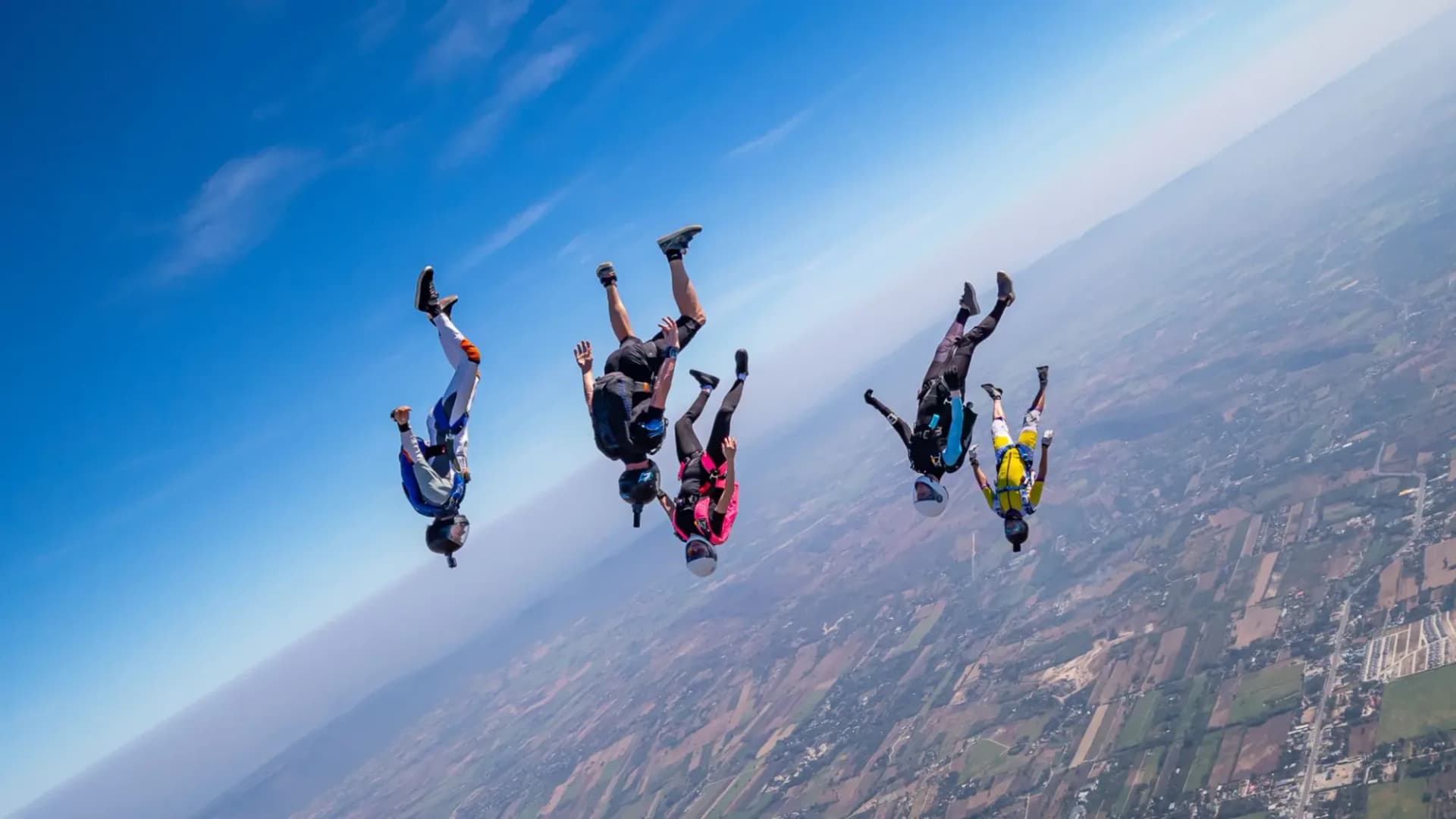
You fall at terminal velocity — roughly 200 km/h — for up to 60 seconds from 13,000 feet. The air is loud. Your jumpsuit is loud. Your own heartbeat is, somehow, the quietest thing you can hear.
The mountains do not look real. They look painted. Ridges layer behind ridges. The valley below has texture you didn't know terrain could have. Cloud shadow drifts across a far hillside. You see a river. You see a small village. You see the curve of the horizon.
You are, very briefly, not a tourist anymore. You are a person flying.
Canopy deployment
The parachute opens with a firm, decisive tug at around 5,000 feet. You go from horizontal to vertical in a moment. The roar stops. The wind quiets. Your jumpsuit settles. Your legs swing down.
Now you can hear birds.
The canopy ride
The canopy ride is the part most first-timers don't prepare for emotionally and end up loving most. You float for 4–5 minutes under a steerable canopy, your instructor guiding turns, sometimes letting you take the toggles. The view is no longer rushing — it's just *there*, slow and enormous and yours.
The mountains feel close enough to talk to.
Landing
You bring your legs up. Your instructor flares the canopy. You touch down on grass, the canopy collapses behind you, and your instructor is unclipping you before your nervous system has finished re-entering ordinary time.
You stand up. Your legs are shaking. Your face is doing something it hasn't done in years.
The aftermath
You will not be normal for the next two hours.
You'll laugh at the wrong things. You'll re-tell the story to your travel partner three times. You'll watch the footage with a stranger's curiosity, like *who is that person*. You'll be hungrier than you've been in days. You'll want, very badly, to do it again.
This is the part of the experience the brochures never describe. It's also the part you came for.
The single most useful thing a first-time tandem passenger can do is breathe normally during the climb and trust the briefing. Everything we've trained you for happens on autopilot. Your only job is to enjoy the view.
— SKYDIVE INSTRUCTOR — USPA TANDEM RATING
How Scenic Is the Jump?
Honestly? It's one of the most scenic tandem jumps in Asia.
The visual signature of Chiang Mai skydiving is *layering*. Coastal jumps are spectacular but visually flat — sky, water, sand, horizon. Chiang Mai gives you something almost impossible to fake in a photograph: depth.
- **Mountains.** The northern range that frames Chiang Mai is jungle-thick and weatherworn — not jagged like the Himalaya, not rolling like the English Lakes, but soft, deep, and emotionally green. From altitude, the ridges read as a series of waves moving away from you.
- **Jungle.** The forest cover changes texture as you fall. From 12,000 feet it looks like felt; from 5,000 feet you start picking out canopy gaps; from 2,000 feet you can see individual trees move.
- **Valleys.** The Mae Taeng valley is agricultural in the lowlands — tessellated rice fields, banana groves, fish ponds catching the morning light — and wild in the highlands. The transition is visible from the air in a way ground-level travel never quite reveals.
- **Rivers.** The Mae Ping and its tributaries thread through the lowlands like silver wiring. From altitude, they reveal the geography you're standing in.
- **Rice fields.** Depending on the season, the lowlands range from emerald (planting) to gold (pre-harvest) to brown (post-harvest). Each version has its own light.
Seasonal visibility
Dry-season mornings (late November through February) are the visual gold standard — clean air, sharp ridges, distant mountains visible in detail. Hot season (March–May) produces softer, hazier light, sometimes affected by regional agricultural smoke. Wet season (June–October) is more dramatic but more weather-dependent — when the visibility breaks through, the green is at its most saturated.
Sunrise and golden light
Early-morning slots catch the light at its most flattering. The mountains are still cool-blue in the shadowed faces and warm-gold on the eastern flanks. If your booking allows it, take the first jump of the day.
Compared to Pattaya — which gives you that flat, gleaming Gulf-of-Thailand blue — Chiang Mai gives you something more painterly. Both are beautiful. They are not the same kind of beautiful.
Quick answer: Chiang Mai skydiving is among the most scenic tandem experiences in Asia thanks to its layered mountain ridges, jungle-covered valleys, terraced rice fields, and visible river systems. Dry-season mornings (December–February) offer the cleanest visibility.
Is Skydiving in Chiang Mai Safe?
Skydiving sounds dangerous. In modern tandem operations, it isn't *most of* what people imagine.
The honest framing is this: tandem skydiving is one of the most rigorously systemised adventure activities in the world. Every piece of the experience — from the rig you're harnessed into to the aircraft you board to the licensing of the instructor on your back — sits inside a multi-layered safety architecture that exists specifically because the activity has zero tolerance for sloppiness.
Skydive Thailand's specific credentials (operation currently closed)
Skydive Thailand is a USPA International Affiliate dropzone — meaning it operates under the safety and training standards of the United States Parachute Association, the largest and most regulated skydiving body in the world. The aircraft is a purpose-built NZ Aero 750XL turbine, not a converted general-aviation airframe. The operation runs ~55,000 skydives annually — that volume of repetition is itself a safety system, because errors get caught, processes get refined, and instructors stay sharp.
Tandem systems generally
A tandem rig is, in essence, two parachutes worn by a licensed professional, with the passenger anchored in front. The instructor controls the entire experience: exit, freefall posture, deployment, canopy, landing. The passenger is, in safety-engineering terms, a payload — the system is designed so that the passenger's job is to enjoy the view.
Reserve parachutes & AAD
Every tandem rig carries a reserve parachute — a fully redundant, separately packed second canopy. In modern operations, an automatic activation device (AAD) is also standard — a small computer that monitors altitude and rate of descent, and which will deploy the reserve automatically if certain thresholds are crossed. The system is not relying on a single point of failure. It's not relying on two. It's relying on three or four, depending on configuration.
Equipment maintenance
Reserves are repacked at regulated intervals by certified riggers. Main parachutes are inspected before every jump. Tandem rigs in a USPA-affiliated operation are subject to documented maintenance schedules.
Weather checks — where mountain operations earn their reputation
Reputable Chiang Mai operators will *cancel* before they will compromise. Cloud base, wind speed at altitude, surface wind at the landing area, and visibility are all evaluated before every load. A morning that doesn't fly is a sign of discipline, not a sign of weakness.
Northern Thailand's terrain produces more localised weather variability than coastal operations. That variability is part of why mountain operations cancel more often than, say, Dubai's Palm Drop Zone — and it's also why the operations that *do* go off, go off in conditions that are genuinely safe.
Common fears, calmly addressed
- *"What if I freeze in the door?"* You're attached to your instructor at four anchor points. The exit happens with you, not from you.
- *"What if the parachute doesn't open?"* There are two. There's also an AAD.
- *"What if I forget what I'm supposed to do?"* You're not supposed to do much. The instructor is doing it.
- *"What if I'm scared?"* You will be. Scared is the correct response to a brand-new experience. Scared is not a reason not to jump. Scared is the reason the jump is worth something.
Realistic risk framing: Modern tandem skydiving has a fatality rate measured in the low single digits per million jumps in operations with strong regulatory oversight. It is meaningfully safer than many activities adventure travellers do without thinking — including riding a scooter through Chiang Mai's old town in monsoon season.
How Much Does It Cost? (Verified 2026 Pricing)
Tandem skydiving is one of the great priced-once, remembered-forever adventure investments. In Thailand, costs sit comfortably in the mid-range of global pricing — significantly less than Switzerland or New Zealand, broadly in line with Dubai's standard packages, slightly higher than some Bali experiences depending on currency movement.
Here's the verified Chiang Mai pricing as of May 2026, pulled directly from each operator's published rates.
| Package | Price (THB) | What's included |
|---|---|---|
| Skydive Only | THB 8,850 ≈ $263 | 13,000 ft tandem with USPA-rated instructor — no media |
| Silver | THB 12,750 ≈ $379 | Tandem + handcam video + screenshots |
| Gold | THB 15,550 ≈ $463 | Tandem + dedicated outside-camera flyer + HD photos & video |
| AFF (Learn-to-Skydive) course | From THB 88,000 ≈ $2,618 | Multi-jump licence pathway for solo skydiving |
| Sport jump (licensed) | From THB 950 ≈ $28 | Licensed jumper rate per jump |
| Package | Price (THB) | What's included |
|---|---|---|
| Silver | THB 12,750 ≈ $379 | Tandem + media (Silver-tier) |
| Premium Silver | THB 14,250 ≈ $424 | Silver + round-trip transport from Chiang Mai city |
| Gold | THB 15,550 ≈ $463 | Tandem + premium media (Gold-tier) |
| Premium Gold | THB 16,850 ≈ $501 | Gold + round-trip transport from Chiang Mai city |
| Diamond (2-person package) | THB 34,400 ≈ $1,023 | Two Gold-tier tandems bundled |
| AFF deposit | THB 88,000 ≈ $2,618 | Licence-track deposit |
Video and photo packages
Almost every operator offers add-on documentation. The honest advice: get the footage. People who skip it almost universally regret it. People who buy it almost universally watch it more than they expect to. The handcam (Silver) packages are the budget-friendly default; the outside-camera (Gold) packages produce significantly better cinematic footage because a dedicated flyer is filming you from a better angle.
Value vs. comparable destinations
A Thailand tandem typically lands at a meaningfully lower price than a Switzerland Alps jump or a New Zealand Queenstown jump while delivering scenery that is — if not equivalent — certainly in the same conversation. Compared to Dubai's premium Palm offering (AED 2,499 ≈ $680), Chiang Mai's THB 8,850 ≈ $263 entry tandem is well under half the price for a comparable airborne experience over arguably more dramatic terrain.
Currently closed: Phusanfah Airfield has not flown since the Civil Aviation Authority of Thailand halted operations there on 1 June 2026, and no reopening date has been announced. The detail below describes the jump as it ran, and the prices are historic. Featured snippet hook: A tandem skydive at Skydive Thailand in Chiang Mai costs THB 8,850 ≈ $263 (skydive only), THB 12,750 ≈ $379 (Silver — handcam video and screenshots), or THB 15,550 ≈ $463 (Gold — dedicated outside-camera flyer with HD photos and video). The licensed AFF course starts from THB 88,000 ≈ $2,618. Pricing verified May 2026.
What We Loved About the Chiang Mai Experience
Some adventure activities are great because of *what they are*. Skydiving in Chiang Mai is great because of what it sits inside.
- **The scenery.** The view from 13,000 feet over Northern Thailand is, in the literal and the figurative sense, unrepeatable. There is no other tandem experience in Asia that offers this exact composition of jungle, valley, ridge line, and river.
- **The atmosphere.** Mountain dropzones run quieter than coastal ones. The morning has more silence in it. The day around the jump has more breath in it. That changes how the experience lands.
- **The emotional uniqueness.** A skydive over a beach is exhilarating. A skydive over mountains feels *narrative*. The terrain reads like a story you're falling through. People who've done both report that the mountain version stays vivid for longer.
- **Beginner friendliness.** The Chiang Mai operation is smaller and more conversational than high-volume resort dropzones. For a first-time tandem passenger, that's an enormous tonal advantage. You're not jump number eighty-seven of the day.
- **Travel pairing.** This is the single most underrated point in the entire article. The Chiang Mai skydive can be the punctuation mark in a beautifully composed Northern Thailand week — temples, food, mountain treks, slow mornings, hill-tribe villages, a long-tail boat ride, an elephant sanctuary. The skydive becomes a peak moment within a *journey*, not a stand-alone activity.
- **The mountain vibe.** Some of the best moments aren't airborne. They're the cup of tea you drink during a weather hold while a soft fog drifts past the hangar. They're the conversation with the instructor about the dropzone's history. They're the slow drive back into the city with everyone in the truck quiet because something has shifted.
- **The aircraft.** The NZ Aero 750XL is purpose-built for skydiving. The cabin is wide, the door is large, the climb is fast, and the exit is clean. After your jump you'll appreciate it. During your jump you'll forget it exists, which is the point.
Things Travellers Should Know Before Booking
This is the honesty section. Skip the brochure language for ninety seconds.
Weather flexibility is non-negotiable
Mountain operations cancel and reschedule. This is good. It is also, occasionally, frustrating. If you book your jump on the day of your flight out, you will discover the limits of your travel insurance.
Travel timing
The first morning slot is the most reliable for both visibility and weather stability. Afternoon slots in hot or wet season carry meaningfully more cancellation risk. If you're travelling from outside Chiang Mai for the jump, build the schedule around an early call.
Nerves are part of the package
First-time skydivers underestimate how *insistent* fear can be in the hour before the jump. This is normal. It does not mean you should reschedule. The fear evaporates within seconds of the door opening, and the experience is better *because* of the fear, not in spite of it.
Seasonal visibility differences
Dry-season mornings (December–February) offer the most reliable mountain views. Hot season can be hazy. Wet season can be either dramatic or unflyable depending on the morning.
Rural logistics
You're not booking an experience in central Chiang Mai. You're booking an experience in rural Northern Thailand. Restrooms, food, and amenities at and around the dropzone are simple. This is part of the charm. Bring water, snacks, and patience.
Waiting periods
Even on a flying day, expect to wait. The check-in, paperwork, briefing, and aircraft staging are not designed around your impatience. Bring something to read, and lower your tempo to match the morning. Rushing doesn't make the jump come faster.
Cooler mornings
Layer. The drive out is colder than the city. The dropzone is colder than the drive. The aircraft cabin is cold. The climb to 13,000 feet is *very* cold. The freefall is the coldest part of the entire day. Then you land, and the morning warms up again. Plan accordingly.
Health and weight considerations
Tandem rigs have weight limits. Reputable operators enforce them. If you have back, neck, knee, or recent surgical history, raise it at booking — most concerns are accommodatable, but not always.
Transport is not bundled into Skydive Thailand's base price (historic — currently closed)
Worth flagging because it surprises some travellers. The THB 8,850 ≈ $263 base tandem at Skydive Thailand does not include transport from Chiang Mai city; you'll need a Grab, rental, or private transfer. Skydive Chiang Mai's Premium tiers (THB 14,250 ≈ $424 / THB 16,850 ≈ $501) include transport as a bundled extra. If transport simplicity matters, factor that in.
Trust callout: No reputable Chiang Mai operator will fly you in conditions they wouldn't fly themselves. A cancelled jump is a sign that the operator is making the right call, not a sign that they have failed you. Build a buffer day into your trip.
Who Should Choose Chiang Mai for Skydiving?
Not every traveller should jump in Chiang Mai. Most should. Here's the honest sort.
- **Best for first-time skydivers.** The smaller operation size, calmer atmosphere, and slower pace make Chiang Mai an excellent first-jump environment. You won't feel rushed, and the briefing won't feel mass-produced.
- **Best for scenery seekers.** If your single most important criterion is *the view*, Chiang Mai is the strongest scenery candidate in mainland Southeast Asia. Layered mountain terrain, jungle, valleys, and rivers compose into something genuinely cinematic.
- **Best for nature lovers.** Travellers whose Thailand trip is built around national parks, mountain treks, hill-tribe villages, or wildlife will find Chiang Mai a more emotionally coherent choice than a coastal jump.
- **Best for couples.** The pacing of the day — early morning, slow drive, shared anticipation, shared adrenaline — makes a Chiang Mai jump unusually well-suited to couples travelling together. Two tandem slots back to back, then breakfast on the way back into the city. Hard to beat. (Skydive Chiang Mai's Diamond 2-person package at THB 34,400 ≈ $1,023 is built for exactly this pairing.)
- **Best for digital nomads.** If you're already living in Chiang Mai for a stretch, there is no excuse for not jumping over the city you've made home. Long-term residents who finally book often describe it as the moment Chiang Mai stopped feeling like a place they were staying and started feeling like a place they understood.
- **Who may prefer Pattaya instead.** Travellers prioritising convenience over scenery, travellers based on the eastern seaboard, travellers who want a higher-volume operation with more flexible scheduling, and travellers who specifically want a coastal aesthetic should consider Pattaya as the alternative.
- **Who may prefer Dubai or Bali.** Travellers who want an internationally certified, brand-luxury operation with consistent year-round weather might lean Dubai. Travellers who want volcanic-coastal scenery and an Indonesian travel pairing might lean Bali. Both are excellent. Neither is Chiang Mai.
- Status: Skydive Thailand and Skydive Chiang Mai share Phusanfah Airfield, which has been closed by order of the Civil Aviation Authority of Thailand since 1 June 2026. Prices and logistics here are historic until it reopens.
Chiang Mai vs. Pattaya vs. Bali vs. Dubai
This is the strategic comparison most readers actually want. We've kept it honest and used verified pricing where possible.
| Dimension | Chiang Mai (Skydive Thailand) | Pattaya (Thai Sky Adventures) | Bali (Indonesia) | Dubai (Skydive Dubai Palm) |
|---|---|---|---|---|
| Scenery | Mountain ridges, jungle, river valleys — layered and cinematic | Gulf of Thailand, beaches, coastal islands | Volcanic coastline, ocean, distant island silhouettes | Iconic Palm Jumeirah skyline + desert option |
| Atmosphere | Slow, intimate, mountain-cool | Coastal-resort energy, warmer pace | Tropical-island, surf-adjacent | Premium-luxury, high-volume |
| Exit altitude | 13,000 ft | 13,000 ft | 10,000–13,000 ft typical | 13,000 ft |
| Aircraft | NZ Aero 750XL turbine | Pilatus PC-6 Porter turbine | Varies by operator | Twin-engine turbines |
| Entry tandem price | THB 8,850 ≈ $263 | THB 9,450 ≈ $281 | Varies, ~USD 200–280 | AED 2,499 ≈ $680 |
| Accessibility | Rural — ~50 min from CNX airport | 25 km north of Pattaya, 96 km south of Bangkok | Easy from Bali tourist zones | Extremely easy, central Dubai |
| Best paired with | Northern Thailand mountain travel | Beach holiday, Bangkok extension | Bali itinerary, surf trip | Dubai luxury weekend, Gulf stopover |
| Beginner friendliness | Excellent — calm pacing | Excellent — high-volume, well-established | Good — established tourism around it | Excellent — internationally certified |
The right answer depends entirely on the trip you're already taking. A Northern Thailand traveller should jump in Chiang Mai. A Gulf-coast traveller should jump in Pattaya. A Bali traveller should jump in Bali. A Dubai stopover traveller should jump in Dubai. The mistake is treating any of these as interchangeable — they are emotionally different experiences, and the *trip around them* shapes the memory more than the jump itself does.
Quick answer: Chiang Mai is the most scenic skydive in Thailand and one of the most cinematic in Asia, suited to travellers prioritising nature, slow pace, and mountain scenery. Dubai offers the most polished luxury experience, Bali offers tropical-island scenery, and Pattaya offers the most accessible coastal Thailand option.
Tips Before You Go
Practical, no-fluff. Read once, internalise, forget.
What to wear
Athletic clothing — leggings, joggers, or fitted athletic pants on the bottom; a fitted T-shirt or athletic top on top. A light, fitted layer for the climb is worth bringing because the cabin and freefall are genuinely cold at altitude. Avoid loose clothing, scarves, or anything that flutters. Closed-toe athletic shoes only — running shoes are fine, hiking shoes are fine, sandals are not. No jewellery. No watches. Long hair tied back, securely.
Weather preparation
Layer for the morning drive (cool), the dropzone wait (variable), the climb (cold), the freefall (very cold), and the post-landing return (warm). It sounds excessive. It isn't.
Dealing with nerves
- **Sleep.** A rested nervous system handles fear better than a tired one.
- **Breathe.** Long exhales activate the parasympathetic system; shallow chest breathing amplifies fear.
- **Trust the briefing.** Your instructor has done this hundreds of times. The system is designed for your body to be terrified and your day to still go fine.
Eating beforehand
A light, balanced breakfast roughly 90 minutes before your jump is the sweet spot. Not heavy. Not empty. If you're prone to motion sickness, skip greasy food.
Hydration
Drink water. Not coffee bombs. Mountain mornings are dehydrating, and dehydration amplifies anxiety symptoms.
Photography expectations
Hand-cam packages (Silver, THB 12,750 ≈ $379) are excellent. Outside-camera packages (Gold, THB 15,550 ≈ $463) produce significantly better cinematic footage because a dedicated flyer films you from a better angle. Phones do not come on the jump — even in a pocket, they're a safety risk to people on the ground if they fall. If you want documentation, buy the operator's media package.
Timing recommendations
Take the first slot of the day. Always. Take the buffer day. Always. Don't book your jump on travel day. Ever.
Post-jump
Block the rest of the morning for *nothing*. You'll want to debrief with your travel partner, watch the footage twice, and eat. Don't schedule a temple climb at 1 PM the same day. Let the experience land.
Skydive Thailand is a USPA International Affiliate dropzone running approximately 55,000 skydives annually with a fleet centred on a purpose-built NZ Aero 750XL turbine aircraft. Tandem skydiving sits inside modern safety architecture — licensed instructors, dual-canopy rigs, automatic activation devices, regulated equipment maintenance, and pre-jump weather checks. Mountain operations in Northern Thailand are weather-sensitive, which means cancellations are more common than in coastal operations; reputable operators cancel before they compromise. That conservatism is the safety system working as designed.
At Skydive Thailand: ฿8,850 for the skydive only, ฿12,750 for the Silver package (handcam video and screenshots), and ฿15,550 for the Gold package (dedicated outside-camera flyer with HD photos and video). The licensed AFF course starts from ฿88,000. Skydive Chiang Mai (the second Chiang Mai operator) prices Silver at ฿12,750 and Gold at ฿15,550, with transport-included Premium variants at ฿14,250 and ฿16,850. Pricing verified May 2026.
Skydive Thailand operates from Phusanfah Airfield, approximately 50 minutes from Chiang Mai International Airport (CNX). The airfield sits in mountainous country north of the city. Skydive Chiang Mai (the second operator) is at 444 Moo 7 Tambon Inthakin, Amphoe Mae Taeng, Chiang Mai 50150.
13,000 feet exit altitude (MSL) at Skydive Thailand, with up to 60 seconds of freefall at roughly 200 km/h. Canopy deployment is at approximately 5,000 feet, followed by a 4–5 minute parachute ride to the landing area.
The NZ Aero 750XL — a single-engine turbine purpose-built for skydiving operations, with a wide door for clean exits and a fast climb to altitude.
Yes. The smaller operation size, calmer pacing, and emphasis on briefing-led preparation make Chiang Mai an unusually friendly environment for a first jump. First-time skydivers often report that the slower morning rhythm helped them manage nerves better than they would have at a higher-volume resort dropzone.
Visually and emotionally, yes. Mountain skydives offer layered, depth-rich scenery — ridges, valleys, jungle, rivers — while coastal skydives offer wider, flatter, ocean-and-beach compositions. Both are spectacular. The experience differs more in *texture* than in *thrill*.
Fitted athletic clothing, closed-toe athletic shoes, and a light layer for the climb. No loose garments, no scarves, no jewellery, no watches. Long hair tied back. The operator provides a jumpsuit over your clothing.
Yes — and that's part of why it works. Most first-time tandem passengers report that the fear peaks during the briefing and the climb, vanishes within seconds of the door opening, and is replaced by something closer to euphoria during freefall. Scared in the door is the correct response. Scared after the canopy opens is no longer a thing.
Tandem rigs carry a fully redundant reserve parachute, separately packed by a certified rigger. Modern operations also use an automatic activation device (AAD) — a small computer that monitors altitude and rate of descent and will deploy the reserve automatically under defined conditions. The system does not rely on a single parachute. A 'main canopy malfunction' is a contingency the system is designed to handle.
Yes. Tandem skydiving exists specifically so that beginners — including people who have never been in a small aircraft — can experience a skydive safely. No prior training is required beyond the pre-jump briefing.
Dry season — late November through February — typically offers the most reliable mountain visibility, the most stable mornings, and the cleanest air. Hot season can be hazy. Wet season is more weather-variable but produces dramatic, saturated greens when the visibility cooperates.
The full day at the dropzone typically takes 4–5 hours including travel, briefing, and any weather waits. The airborne portion runs around 15–20 minutes total — climb to 13,000 ft, exit, freefall (up to 60 seconds), canopy ride (4–5 minutes), and landing.
No — the ฿8,850 base tandem at Skydive Thailand does not include transport. You'll need to arrange a Grab, rental car or scooter, or a private transfer for the ~50-minute drive to Phusanfah Airfield. The alternative operator, Skydive Chiang Mai, bundles round-trip transport into its Premium Silver (฿14,250) and Premium Gold (฿16,850) packages.
Yes — Skydive Thailand operates 7 days a week, year-round. Day-of cancellations due to weather are more common during wet season (June–October) and during periods of heavy regional haze. Booking with a flexible date or buffer day is strongly recommended.
The Last Word
Most travellers will spend years thinking about doing this and never quite booking it.
If that's you — if you've watched a friend's footage and felt your stomach turn over, if you've stared at Doi Suthep on your morning walk and thought *I wonder what that looks like from above*, if you've told yourself you'll do it next trip and the trip has come and gone and gone again — read this last paragraph slowly.
The fear is not the obstacle. The fear is the experience.
Chiang Mai is one of the great skydiving environments in Asia not because the dropzone is the loudest or the operator is the most famous, but because the *terrain underneath you* tells a better story than almost anywhere else on the continent. Layered mountains. Green valleys. A river system you can read like a map. The cool morning air of Northern Thailand. The slow pace of the day around the jump. The cup of tea during the weather hold. The thirty seconds of freefall that rewrite, very briefly, what you think your nervous system is capable of.
You will remember this for the rest of your life.
You'll remember the cold of the climb. You'll remember the moment the door opened. You'll remember the first second of freefall, and the second second, and the moment the canopy filled and the world went silent. You'll remember the way your legs felt when you stood up on the grass. You'll remember the drive back into the city, quiet, with the mountains receding in the rear window.
You will not regret this.
Skydive In Asia exists to help travellers find, compare, and trust skydiving experiences across Asia — from Chiang Mai's mountain dropzones to Pattaya's coastal jumps, Bali's volcanic-island operators, and Dubai's iconic Palm dropzone. We're building the platform we wish had existed when we started planning our own jumps. If Chiang Mai is on your list, start there. If it isn't yet — read the rest of our destination guides, and let the right experience find you.
The ridge line is waiting. The aircraft is climbing. The door is about to open.
Step out.
Where to Go Next
Currently closed. Phusanfah Airfield in Mae Taeng — the only skydiving dropzone near Chiang Mai, used by both Skydive Thailand and Skydive Chiang Mai — was ordered to halt operations by the Civil Aviation Authority of Thailand from 1 June 2026, and no reopening date had been announced as of 17 August 2026. The listing below is kept live so the status stays findable, and any prices shown are historic. Thai Sky Adventures near Pattaya and Dropzone Thailand in Rayong are both still flying.
Currently closed. Skydive Thailand is not taking bookings. Its listing is kept live so the status stays findable, and any prices shown are historic.
Currently closed. Phusanfah Airfield in Mae Taeng — the only skydiving dropzone near Chiang Mai, used by both Skydive Thailand and Skydive Chiang Mai — was ordered to halt operations by the Civil Aviation Authority of Thailand from 1 June 2026, and no reopening date had been announced as of 17 August 2026. The listing below is kept live so the status stays findable, and any prices shown are historic. Thai Sky Adventures near Pattaya and Dropzone Thailand in Rayong are both still flying.
Currently closed. Skydive Chiang Mai is not taking bookings. Its listing is kept live so the status stays findable, and any prices shown are historic.
Ready to plan your Chiang Mai skydive?
See verified Chiang Mai dropzones on Skydive In Asia — packages, services, and how to book.
The Chiang Mai listing — currently closed, kept live for status and reopening updates.
The editorial team behind Asia's dedicated skydiving discovery platform — working directly with dropzones and federations across the region to keep listings accurate.