On this page
- 01A 60-Second Quick Answer
- 02A Cinematic Welcome
- 031. What Is Indoor Skydiving — And Why People Love It
- 042. What Is AltitudeX Singapore?
- 053. Getting to Sentosa & Planning Your Visit
- 064. What the Indoor Flying Experience Is Actually Like
- 075. Is Indoor Skydiving Scary?
- 086. Is Indoor Skydiving Safe?
- 097. How Much Does AltitudeX Singapore Cost?
- 108. What Makes Indoor Skydiving Different From a Real Skydive?
- 119. What Stands Out About the Experience
- 1210. Things Visitors Should Know Before Booking
- 1311. Who Should Try Indoor Tunnel Flying?
- 1412. AltitudeX Singapore vs Real Skydiving in Thailand, Bali, or Dubai
- 1513. Tips Before You Go
- 1614. The Conclusion
A 60-Second Quick Answer
If you only have a minute: AltitudeX (formerly iFly Singapore) is the world's largest themed indoor skydiving wind tunnel, sitting on Sentosa Island a short walk from Siloso Beach. It is the easiest, safest, most weather-proof way to experience the actual physical sensation of freefall anywhere in Asia — no aircraft, no parachute, no jump, no second-guessing yourself in the door of a plane at 13,000 feet. You step into a transparent column of vertical wind moving fast enough to lift a human body, and for sixty seconds at a time you fly. Sessions start from SGD 59 ≈ $46 for a one-flight Teaser, climb to SGD 89 ≈ $69 for the standard two-flight Challenge, and reach SGD 250 ≈ $195 for a six-flight coaching package designed for people who suspect, somewhere quietly, that they might want to do this again. Minimum age is 7. Total time on site, including check-in, briefing, gearing up, flying, and recovery, is roughly 90 minutes. It is one of the most beginner-friendly adventure activities in Singapore, and one of the most under-explained.
This is the long version of that answer.
A Cinematic Welcome
You can hear it before you see it.
There is a low, oceanic roar coming from somewhere inside the building — not loud exactly, but constant, like standing too close to a passing jet that never finishes passing. The lobby smells faintly of fresh nylon and air-conditioning. A digital screen runs a loop of someone's daughter, maybe seven or eight years old, suspended motionless three metres above a steel grate, arms out, mouth open in a wide round laugh that the silent video does not need to translate. Behind the glass at the back of the room, the tunnel is alive. A column of vertical air, calibrated to match the terminal velocity of a human body in freefall, is rushing upward through a transparent acrylic chamber the height of a five-storey building. Inside it, a man in a red flight suit is doing something that looks impossible. He is hovering. Then spinning. Then sliding diagonally across the column like a swimmer crossing a current. He is, in every sensory way that matters to your nervous system, flying.
Outside the glass, the South China Sea pushes against Siloso Beach, the cable cars slide overhead between Mount Faber and Sentosa, and the skyline of mainland Singapore glitters somewhere behind a row of palm trees. You are about to do this. You did not actually believe, when you booked, that you would actually do this.
The next ninety minutes are going to rearrange your understanding of what your body is capable of in the air.
1. What Is Indoor Skydiving — And Why People Love It
Indoor skydiving — sometimes called bodyflight, tunnel flying, or wind tunnel flying — is the discipline of suspending and controlling the human body inside a column of vertical, upward-moving air. The technology was originally developed for military parachute training in the United States in the 1960s. The sport version, with civilians paying for sessions in commercial tunnels, took off in the 2000s. There are now competitive bodyflight world championships, formation flying teams, and a small but obsessive global community of people who have never jumped out of a plane in their lives but who can fly upside-down in a wind column more skilfully than most experienced skydivers.
The physics is simple and elegant. A massive electric or diesel-driven fan generates a vertical airflow inside a sealed chamber. The speed of the air is calibrated, in real time, to match the surface area and weight of your body in the falling position. When the airflow speed equals your terminal velocity — the speed you would naturally fall at in freefall, somewhere between 180 and 220 km/h depending on body size — you stop falling relative to the air and you simply float. From the wind's perspective, you are still falling. From your perspective, the wind is simply holding you up.
This is the part that surprises every first-time flyer. It does not feel like a fan blowing on you. It feels like flying. The airflow is laminar, smooth, evenly distributed across your whole body. Once you find the neutral body position — slight arch, arms out, legs out, chin up — the column simply carries you. No straining. No clenching. No effort. The instructor's job, mostly, is to get you to stop trying so hard.
People love indoor skydiving for the same reason people love floating in zero gravity, swimming in a coral reef, or driving down a long empty road at sunset. It is one of those rare physical experiences that the body has no comparable reference for. Your nervous system, given no precedent to file the sensation under, simply lights up. People come out of their first ninety-second flight grinning the way you grin after a first dive on a fresh reef, or after watching the sun rise from a peak you weren't sure you could climb.
It is also, importantly, one of the most accessible adventure sports on Earth. There is no minimum fitness level. There is no harness pulling on your shoulders. There is no plane to be afraid of. The minimum age at AltitudeX is seven years old, and there is no upper age limit. AltitudeX's published position on accessibility is that where a disability is physical, flying is almost always possible; they ask that you book on a weekday where possible so the team can allow extra preparation time.
And — this is the part that matters for travellers — it is the only way in Asia to actually experience the body sensation of freefall without committing to a tandem skydive at altitude. Which is why we keep telling nervous first-timers, before you book your jump in Pattaya or Bali or Dubai, fly the tunnel first.
2. What Is AltitudeX Singapore?
AltitudeX is the rebranded identity of what was, for over a decade, known as iFly Singapore — the country's first commercial vertical wind tunnel and quietly the largest themed tunnel of its kind in the world. The recent rebrand to AltitudeX brought a refresh of the interior, the brand language, and the booking platform. The tunnel itself is the same world-record chamber it has always been: 16.5 feet wide, 56.5 feet tall, with 18-foot acrylic glass viewing walls that look directly out over Siloso Beach and the South China Sea. It accommodates up to twenty flyers at once and runs sessions throughout the day, every day, from late morning to late evening.
What sets it apart, beyond the size, is the location. Most indoor skydiving tunnels in the world are tucked into business parks, suburban retail centres, or repurposed industrial buildings. AltitudeX sits on a beach island. Walk out of the lobby in your flight suit and you are five minutes from the sand, ten minutes from a beach bar, fifteen minutes from a luxury resort spa. The whole site is engineered for the specific subset of human happiness that involves doing one extraordinary thing in the morning and lying under a palm tree by lunchtime.
The atmosphere inside is unmistakably premium. The lobby reads more like a contemporary attraction at a major theme park than the slightly utilitarian feel of a traditional dropzone. There is a viewing gallery where families and friends watch you fly through the glass, and a gear-up area where instructors fit your flight suit, helmet, and goggles. The instructor team is internationally certified and includes flyers who have competed at the FAI World Cup of Indoor Skydiving — Singapore hosted the 6th FAI World Cup at this facility, and several of the instructors have podium credentials.
Who is it for? Honestly, almost everyone. First-timers who have never thought about skydiving make up the majority of flyers on any given day. So do families with young children, couples on date afternoons, corporate teams on offsites, traveller couples with one nervous partner, and serious bodyflight athletes who train here several times a month. The single defining characteristic of an AltitudeX visitor is curiosity.
3. Getting to Sentosa & Planning Your Visit
Sentosa is one of the most accessible resort islands on the planet. From central Singapore, you have four straightforward options.
The fastest is the Sentosa Express monorail from VivoCity shopping mall, which is itself directly above HarbourFront MRT station on the Circle and North-East lines. The monorail drops you at Beach Station — a five-minute walk from AltitudeX. Total transit time from Marina Bay or Orchard Road is roughly thirty minutes door to door.
The most scenic is the Singapore Cable Car from Mount Faber, which crosses the harbour with panoramic views of the city and the cargo ports. It is a longer journey and meaningfully more expensive than the monorail, but if you have never been to Sentosa, it is the arrival the island deserves.
There is also the Sentosa Boardwalk, a ten-minute walk from VivoCity across the harbour with shaded seating along the way — pleasant in the cooler months, less so in midday humidity. And of course taxis and ride-hailing drop directly into the island for a small Sentosa entry fee. The address to drop at: 43 Siloso Beach Walk, Sentosa, Singapore 099010.
Once on Sentosa, the internal beach tram is free, runs in a continuous loop, and stops at all three of the main beaches (Siloso, Palawan, Tanjong) plus the major attractions. AltitudeX is a short walk from Beach Station and a marked stop on the tram loop.
Booking timing matters. Weekend and public holiday slots fill quickly, and Sentosa itself gets busy during Singapore school holidays, so booking online ahead of your visit is sensible. Check the current booking window on AltitudeX's own site — note that their Trial Training package specifically must be booked online in advance and is limited to Singapore residents who have not flown before.
On time of day: AltitudeX updated its opening hours with effect from 1 June 2026. The tunnel now runs 10am to 9pm daily, with the first flight at 11am every day and the last weekday flight at 8.30pm. Late-afternoon and early-evening slots tend to be the most photogenic, with golden-hour light through the glass viewing walls. Weekday mornings are quieter.
Pair it with: Universal Studios Singapore is a ten-minute walk away. SEA Aquarium and Adventure Cove Waterpark are within the same Resorts World complex. Skyline Luge and the Mega Adventure zip line round out the adrenaline cluster. Most visitors who plan a full Sentosa day combine AltitudeX with one or two of these and a beach lunch in between.
| Approach | Time from city | Cost | Vibe |
|---|---|---|---|
| Sentosa Express | ~30 min | Low | Fast, efficient, locals' choice |
| Singapore Cable Car | ~45 min | Premium | Scenic, photogenic arrival |
| Sentosa Boardwalk | ~30 min walk | Free entry | Calm, shaded, cooler weather only |
| Taxi / ride-hailing | ~25 min | Mid | Comfortable in groups |
4. What the Indoor Flying Experience Is Actually Like
This is the part you actually came here to read.
You arrive at AltitudeX one hour before your flight slot — that is their published requirement, not a suggestion, because the safety briefing and training are built into the session. The lobby is bright, air-conditioned, and busier than you expect. Children are pressed against the viewing glass watching whichever group is currently in the chamber. There is a digital queue board calling names. You check in at the front desk, sign a liability waiver, and are handed a coloured wristband for your group.
The first thing you notice is that everyone in the lobby is at slightly different stages of nervous. A teenage girl is making jokes with her father at a frequency that suggests they are not jokes. A couple in matching shoes are taking selfies in front of the tunnel glass. A group of corporate colleagues in matching shirts are filming each other with the kind of forced enthusiasm that says it was someone else's idea and I cannot back out now. You are part of a tribe of people who all booked this thinking it would be no big deal, and who are now realising that it might be.
About fifteen minutes before your flight, an instructor calls your group into the briefing room. The briefing is short, structured, and reassuringly unpatronising. You are taught two things. First, the body position. Slight arch in the back, chest forward, hips loose, arms out at shoulder height with elbows at ninety degrees, fingers relaxed, legs out behind you with knees slightly bent. Second, the hand signals. Because the airflow is loud enough that voices do not carry inside the chamber, instructors use a small set of gestures to communicate with you mid-flight. Straighten your legs. Bend your legs. Relax your chin. Look up. Push your hips down. None of it is complicated. All of it is essential.
Then you gear up. A nylon flight suit goes on over your clothes. A hard helmet goes over your head. Goggles seal across your eyes. Foam earplugs muffle the noise. You feel, suddenly, like an astronaut. Several of you in your group laugh at each other in the gear-up mirrors. The instructor lines you up in flight order and walks you towards the chamber.
There is a small antechamber between the lobby and the tunnel itself. The door behind you closes. The roar gets louder. You step up onto a small ledge at the edge of the wind column.
The instructor, standing inside the chamber on a small platform on the wall, signals you forward. You lean. You fall.
And then, instead of falling, you are flying.
The first second is not what you expected. The wind hits your full body weight at once, and your nervous system tries, briefly, to fight it. Your shoulders tense. Your knees lock. You get pushed toward one wall of the chamber, then corrected by the instructor's grip. You feel slightly out of control and slightly exhilarated and slightly silly all at once. You can hear nothing but airflow. You can see the glass walls and, blurred behind them, the faces of your group on the other side, watching, filming, laughing, doing thumbs-up.
Then, somewhere around the fifteenth or twentieth second, something releases. Your body remembers what the instructor told you. You lengthen out. You let your hips drop. Your arms find the right angle. The wind catches your suit cleanly and lifts you, weightless and centred, into the middle of the chamber. The instructor backs off. You are flying alone.
You are flying alone.
This is the part that does not make sense in advance and that lands all at once when it happens. You are not falling. You are not strapped to anything. You are not being held up by a harness. You are floating in mid-air, three metres above a steel grate, suspended by nothing but the upward force of compressed wind, and you are completely in control of how you move. You shift your shoulders forward and you slide forward across the chamber. You shift them back and you slide back. You arch slightly more and you rise. You de-arch and you sink. The chamber is large enough — at this size, it is one of the largest in the world — that you genuinely have room to move, to drift, to play. There is no rope. There is no instructor's hand. There is just you and the wind and the blurred ring of faces watching from outside the glass.
This is the moment people remember.
The instructor signals you back to the entry ledge. You step out, dazed, grinning, slightly unsteady on your legs. The next person in your group steps in. While you wait for your second flight, you stand at the glass and watch the others, and you are struck by how natural they look already. You realise the version of you that was nervous in the lobby twenty minutes ago is no longer accessible. That person no longer exists.
Your second flight goes deeper. You are calmer. The instructor lets you stay in the column longer, work on shifting your position, try a small turn. You feel the wind respond to micro-adjustments in your shoulders and hips that you could not have made on the first flight. If you have booked the Challenge Ultimate or the Trial Training package, this is where the experience starts to bend toward something more like a sport — something you can imagine getting better at. Something you could see yourself coming back to.
When you finally walk out of the chamber for the last time, peel off the suit, hand back the helmet, and step into the lobby in your normal clothes, the feeling that stays with you is not the adrenaline. It is the disorientation of having done something your body was not previously capable of doing. Your shoulders feel loose. Your forearms are slightly sore. Your face hurts faintly from grinning into the airflow. You walk out of the lobby into the Sentosa afternoon, blink at the sun off the South China Sea, and you laugh.
That is the experience. That is what you are buying.
5. Is Indoor Skydiving Scary?
Honestly? For about ninety seconds, yes. Then no.
The fear is almost entirely anticipatory. It lives in the lobby. It lives in the briefing room. It lives in the moment you are gearing up and your friends are filming you and the noise from the chamber is getting louder. The fear builds because your nervous system has no precedent for what is about to happen and is trying to extrapolate from things it does know — falling, drowning, being trapped — none of which are remotely accurate.
The actual experience of being in the wind column is almost the opposite of frightening. The instructor is in the chamber with you the entire time. The airflow is smooth, not turbulent. The tunnel is enclosed, with padded walls and a steel mesh floor below the airflow. There is no sudden drop. There is no equipment to fail. You are not strapped to anything because you do not need to be — the wind alone is more than capable of holding your full body weight up. The worst-case scenario inside the tunnel is that you drift gently into a padded wall and the instructor steers you back to centre. That is the worst case. Flyers at this tunnel range from seven-year-olds to people well into their eighties.
The thing first-timers consistently report being most surprised by is how quickly the fear evaporates. By the second flight, it is replaced almost entirely by focus. You are no longer thinking about whether this is safe. You are thinking about whether your shoulders are forward enough.
If the anticipatory anxiety is significant, two things help. First, bring people who are also flying. The shared nervousness becomes shared excitement, and the lobby is meaningfully easier to wait in with company. Second, start with the Challenge package (two flights), not the Teaser. The first flight is largely about your nervous system catching up to reality. The second is where you actually start to enjoy yourself. People who book the Teaser sometimes leave wishing they had given themselves the second flight to settle in.
Expert tip — the second-flight rule. The consistent pattern reported by first-time flyers is that flight two is when the experience becomes fun. If your budget allows only one flight, you will get the bragging rights. If your budget allows two, you will get the memory.
6. Is Indoor Skydiving Safe?
Indoor skydiving is one of the safest adventure activities in the world. Not safe in the marketing-language sense. Safe in the actual statistical sense.
Three structural factors make this true.
First, you are never not supervised. Every flight, without exception, takes place with a trained instructor inside the chamber with you. The instructor is there for the full duration of your flight. They control your body position when you cannot. They steer you back to centre. They signal you to adjust. They are between you and any wall you might drift toward. AltitudeX's instructors are internationally certified, and the senior team includes flyers with FAI World Cup competition experience.
Second, the tunnel is a fully enclosed, controlled environment. The wind speed is calibrated continuously and adjustable in real time by an external operator who can see you at all times. There is no weather to deal with. No aircraft to malfunction. No parachute to deploy. No altitude. The chamber walls are padded and the floor below the airflow is a steel mesh you cannot fall through. You are wearing a flight suit, hard helmet, goggles, and earplugs throughout the flight.
Third, the equipment is built for redundancy. The tunnel itself has a long operational history under both its iFly Singapore and AltitudeX identities, with extensive maintenance protocols and regulatory oversight as a Singapore-licensed attraction.
The honest health caveats apply. AltitudeX's official flight criteria require flyers to be at least seven years old and in reasonable general health. There are weight limits — under 1.8 m tall, you must be no heavier than 120 kg; over 1.8 m tall, no heavier than 140 kg. You must fit comfortably into the flight gear and helmet. The activity involves sustained physical exertion against the wind, and previous shoulder dislocations, back or neck injuries, or heart problems are disqualifying. Pregnancy is a contraindication. Hard casts are not permitted. Flyers under 18 require parent or guardian permission on the waiver. If you have any uncertainty, declare it at booking and check with the instructor team before flying. The facility is wheelchair accessible and has worked with flyers across a wide range of mobility levels — this is one of the activities in Singapore where accessibility is genuinely operational, not just architectural. AltitudeX requests that flyers with physical disabilities book on weekdays where possible so the team can offer additional preparation time.
7. How Much Does AltitudeX Singapore Cost?
There are four standard packages on the AltitudeX menu, and the pricing structure is clean and transparent. All packages cover roughly 90 minutes on site (briefing, gearing up, flight time, debrief) and include flight gear and training. All packages are open to first-timers from age 7.
| Package | Flights | What you get | From | Usual price |
|---|---|---|---|---|
| Teaser | 1 | One flight, full briefing, full gear | SGD 59 ≈ $46 | SGD 99 ≈ $77 |
| Challenge | 2 | Two flights — the standard experience | SGD 89 ≈ $69 | SGD 109 ≈ $85 |
| Challenge Ultimate | 2 | Two flights, second flight at altitude (you fly higher in the chamber with hands-off instructor) | SGD 119 ≈ $93 | SGD 139 ≈ $109 |
| Trial Training | 6 | Six flights with structured coaching — for people who want to learn | SGD 250 ≈ $195 | SGD 467 ≈ $365 |
A few notes on how to think about value.
The Teaser is a souvenir. One flight is enough to say you did it, and to feel the airflow, but it is over before your nervous system has fully caught up. We do not generally recommend it as the first port of call unless budget is the binding constraint or you are sampling Sentosa attractions back-to-back.
The Challenge is the default. Two flights is the right number for first-timers. The first flight is for your body to learn the position. The second is for the experience to land emotionally. This is what most visitors should book.
The Challenge Ultimate adds a high-flight element to your second skydive — the instructor takes you up the chamber with the airflow at a higher speed, hands-off, so you experience genuine vertical altitude inside the tunnel. The price differential is small, the experiential differential is large, and if you are travelling specifically for this and have the budget, this is the most photogenic option.
The Trial Training is an unusual offering — six flights with structured coaching, designed for people who suspect they might want this to become a hobby. The economics are strong: the per-flight price drops dramatically. If you walked out of the lobby thinking I want to do this again, the Trial Training package is the answer. Many of the Singaporeans you see in the lobby flying repeatedly began with this package.
Add-ons: AltitudeX also offers a high-flight top-up on standard packages (the same vertical altitude element packaged separately) and a digital photo and video bundle. We recommend the photo bundle on a first visit. You will not believe what you looked like in there until you see the footage.
| Experience | Approx. cost | Duration on site |
|---|---|---|
| AltitudeX Challenge (2 flights) | SGD 89 ≈ $69 | ~90 min |
| Universal Studios Singapore (1-day) | SGD 83 ≈ $65 | Full day |
| SEA Aquarium | S$44 | 2–3 hours |
| Mega Adventure zip line | SGD 66 ≈ $52 | 1 hour |
| Skyline Luge (combo pass) | S$30 | 1–2 hours |
Indoor skydiving is not the cheapest single Sentosa attraction. But on a per-minute-of-life-defining-experience basis, it is the densest.
Quick answer — is AltitudeX worth it? If you have flown indoors before, you already know. If you have not, the Challenge package is a clear yes for adventure-curious first-timers, families with kids over 7, and anyone considering a real tandem skydive elsewhere in Asia (it is the cheapest possible way to find out whether you'll love freefall before you commit).
8. What Makes Indoor Skydiving Different From a Real Skydive?
This is the most important section in this guide.
Indoor skydiving and tandem skydiving are often spoken of in the same sentence, but they are profoundly different experiences with different psychology, different physical sensations, and different reasons to do them.
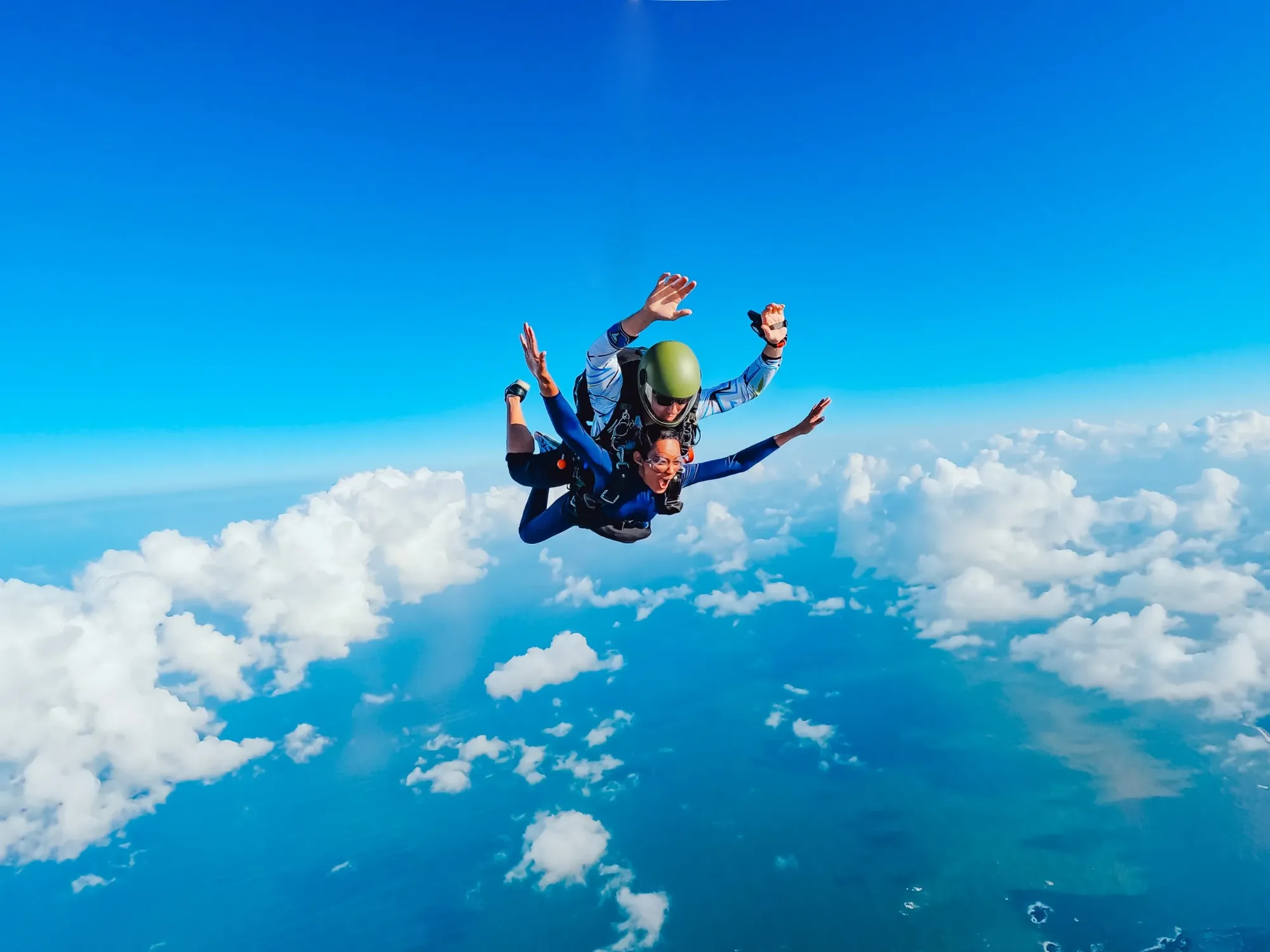
The shared element is real: the body sensation of freefall is genuinely the same. The wind speed in the AltitudeX tunnel is calibrated to terminal velocity — the speed your body would naturally fall at in a real skydive — which means the airflow on your skin, the feeling of the wind in your suit, the way your hair pulls back, the laminar push against your chest, are not approximations. They are the real thing. This is the whole point of why the world's military parachute units have used wind tunnels for training for sixty years. The body cannot tell the difference.
What is profoundly different is everything around the freefall.
Real skydiving is, first, an act of stepping out of an aircraft. You are flown to roughly 13,000 feet above the ground, the door opens at altitude, the temperature drops, the air thins, you can see the curvature of the horizon and the patchwork of farmland or coral reef below you, and at some point you and your tandem instructor pivot toward the open door and exit the plane. There is approximately 50 seconds of freefall. Then the parachute opens with a substantial deceleration, and you spend 5–7 minutes flying gently under canopy, with views you will remember for the rest of your life. You land in a field, or on a beach, or — at one of the world's spectacular dropzones — within sight of an island that you saw from 13,000 feet ten minutes earlier.
Indoor skydiving strips out the aircraft, the altitude, the canopy ride, and the landing. What it leaves you with is the freefall itself — and the freefall, alone, in isolation, on demand, with full instructor supervision, with no weather risk, with no aircraft risk, with no scheduling complexity, and at a fraction of the cost. It also adds something real skydiving cannot offer: repeatability and skill. You can fly the same column ten times in a single afternoon and learn body control in a way no real skydiver ever learns it on jumps alone.
The two activities live at completely different points on the fear-and-commitment curve.
| Dimension | Indoor (AltitudeX) | Real skydiving (tandem) |
|---|---|---|
| Fear level | Low to moderate | High |
| Adrenaline | Real but contained | Off-the-charts |
| Freefall sensation | Yes — same as real skydive | Yes |
| Aircraft involved | No | Yes (~13,000 ft climb) |
| Scenery factor | Glass walls, beach views | Landscape from altitude — defining |
| Canopy ride | None | 5–7 minutes under parachute |
| Skill development | High — real bodyflight technique | Low for tandem — you are a passenger |
| Weather dependent | No | Yes — heavy weather cancels |
| Cost | SGD 59 ≈ $46–SGD 250 ≈ $195 | Roughly S$300–S$600+ per jump |
| Repeatable in one afternoon | Yes | No |
| Best for | First-timers, families, training | Bucket-list moment, real altitude experience |
The right answer for most travellers in Asia is: do both, in this order. Fly the tunnel first. Find out whether your body falls in love with freefall. Then book the tandem skydive at altitude in Pattaya, Cebu, Bali, Chiang Mai, or Dubai with full confidence that you know what you are signing up for.
9. What Stands Out About the Experience
Across AltitudeX's published material, its Google reviews and the wider body of flyer accounts, the things that come up most often are not the things the brochure leans on.
It is beginner-friendly without being condescending. The briefing trusts you. The instructors trust you. They expect you to be nervous and do not make a thing of it.
The Sentosa setting is genuinely unusual. Walking out of a world-class wind tunnel in an unzipped flight suit and being on a beach fifteen minutes later is not something any other tunnel in the region offers.
The chamber is large enough to matter. At 16.5 ft wide and 56.5 ft tall — dimensions the operator confirmed to us — there is room to move around inside it, slide laterally and drift up and down, which creates a feeling of actual flight rather than the cramped suspension of a smaller tunnel.
It is unusually photogenic. The glass walls give friends and family a clean, unobstructed view of every flight, and the optional photo and video package is the most commonly recommended add-on in flyer reviews.
The emotional arc is the whole pitch. Walking into the lobby nervous and walking out grinning is what people describe most consistently, and few activities in Singapore deliver that in ninety minutes.
Everyone in the group flies. You watch your friends fly and they watch you. That shared structure is unusual — most Sentosa attractions split you up and give you a private moment alone. Here, flying is a social act.
10. Things Visitors Should Know Before Booking
We promised honesty in this guide, and that means flagging the things first-timers consistently get caught out by.
Each flight is shorter than you expect. You buy a 90-minute package, but actual airtime is measured in 60-second flights. That is not a flaw — 60 seconds in the tunnel is the equivalent of a full freefall on a real skydive — but if you are budgeting your day around it, plan for the full 90 minutes on site (briefing, gear-up, queueing for your turn, your flights, debrief) and the airtime separately.
The body position is harder than the videos make it look. You will see flyers on Instagram doing perfect arches and elegant turns. Those flyers have spent serious time in the tunnel. On your first flight, you will probably get pushed around. Your shoulders will tense. Your legs will straighten when they should bend. The instructor will physically reposition you, possibly several times. This is normal, not a sign of failure. Almost no first-time flyer gets the perfect arch on flight one.
Your forearms will be sore the next day. The instinctive thing to do, the first time the wind hits you, is to try to push against it with your arms. You should not, and the instructor will signal you to relax, but you will do it anyway, because everyone does. Your forearms will know about this twelve hours later.
- Long hair must be tied back. If you have long hair, bring a hair tie. They will give you one if you forget, but it is one less thing to think about.
- No loose items in pockets. Phones, keys, wallets, jewellery — all into the lockers. The wind will take anything that is not strapped down.
- Booking windows matter. Weekend and Singapore school-holiday slots fill quickly, so book online ahead of your visit. Their terms allow rescheduling before the day of your flight for a fee of SGD 30 per flyer; rescheduling on the day is not permitted, and a no-show — which their terms define as including late check-in — forfeits the full amount.
- Group size affects experience. A group of up to 20 can be in the chamber together, but each flyer gets individual flight slots. Larger groups mean longer waits between your flights.
- Personal cameras are not permitted inside the chamber. The tunnel is filmed by the AltitudeX system, and you can purchase a digital photo and video package after your flight.
- Glasses are fine — the goggles fit over standard glasses. Contact lenses also work. Do not try to fly in sunglasses.
Honest moment — the flight footage is humbling. The first time you see the video of your first flight, you will not look like the people on Instagram. You will look like a person who has never done this before — because you have not. By the third visit, the footage looks different. The journey is part of the appeal.
11. Who Should Try Indoor Tunnel Flying?
Some clear recommendations after watching many, many people fly.
For first-time flyers, AltitudeX is a near-perfect entry point. The briefing is thorough, the instructors are calm, the chamber is large enough to feel free rather than confined, and the location makes it an easy add-on to a Singapore itinerary.
For families, this is one of the strongest adventure activities in Sentosa. Children from age seven can fly. Watching your child fly, hands-off, suspended weightless three metres above the ground in a column of wind, is one of the more memorable parenting moments available in Asia. Our suggestion: Challenge package for the kids, Challenge Ultimate for the adults.
For couples, particularly couples on a Sentosa day or evening, this is a date that the more nervous partner will thank you for and the more adventurous partner will love. Both of you fly. Both of you watch the other fly. The dynamic of shared courage is romantic in a way most attractions are not.
For nervous travellers, this is the gentlest possible introduction to the body sensation of freefall. There is no plane. There is no altitude. There is no parachute deployment. The instructor is in the chamber with you for every second of the flight. The most common thread in first-timer accounts is that the nervousness in the lobby is gone by the second flight.
For aspiring skydivers, this is genuinely useful pre-training. The body position you learn in the tunnel is the same body position you will need to hold at altitude during a tandem skydive. Several real-skydiving instructors in the region recommend a tunnel session before a first jump for this reason.
For corporate teams, AltitudeX runs structured group experiences and the chamber's social architecture (everyone watches everyone fly) is unusually well-suited to team building. Far more memorable than a buffet.
Who might prefer a real skydive instead? People who specifically want the altitude experience — the climb to 13,000 feet, the door opening, the canopy ride, the landscape from the air. Indoor skydiving gives you the freefall. It does not give you the view.
12. AltitudeX Singapore vs Real Skydiving in Thailand, Bali, or Dubai
Many travellers planning a multi-country Asia trip ask the same question: if I have to pick one, do I do AltitudeX in Singapore or a real tandem in Thailand, Bali, or Dubai? Here is the honest answer.
Pick AltitudeX if: you have limited time on the ground, you are travelling with kids under 12, you are not sure you can handle the fear of a real skydive, you want the freefall sensation without the time and weather risk, or you are testing whether skydiving might be something you'd love.
Pick a real tandem skydive if: the bucket-list factor matters most, the photo from altitude over a real landscape is the memory you want, you are confident you can handle the fear, and you have time built into your trip for weather delays.
Honestly? Do both, in order. The strongest advice we give travellers planning a long Asia trip is to fly the AltitudeX tunnel early in the trip — first or second day in Singapore — and then book a tandem at altitude later in the trip with the confidence of knowing what freefall actually feels like.
| Experience | Type | Defining feature | Best for |
|---|---|---|---|
| AltitudeX Singapore | Indoor | World's largest themed wind tunnel, beach setting | Beginners, families, nervous flyers |
| Skydive Dubai (Palm) | Real | Iconic view of the Palm Jumeirah from 13,000 ft | Bucket-list photography |
| Thai Sky Adventures (Pattaya) | Real | Reliable Asian-tropics tandem dropzone | Convenience + warm weather |
| Skydive Thailand (Chiang Mai) | Real | Mountain skydiving in northern Thailand | Landscape + altitude |
| Skydive Cebu / Bantayan (Philippines) | Real | Beach-island tandem with white-sand landing | Tropical bucket list |
Different rooms of the same house. AltitudeX is the way in.
13. Tips Before You Go
A few practical notes from people who have done this more than once.
- Wear comfortable, close-fitting athletic clothing under your flight suit — t-shirt and shorts or leggings work best. Avoid loose dresses, baggy pants, or anything with hoods or strings. Trainers with a secure fit; sandals and flip-flops are not permitted in the chamber.
- Eat lightly beforehand. A heavy meal in the hour before your flight can be uncomfortable in the body position. A normal meal two hours before is ideal. Hydrate.
- Arrive early. Aim for 45 minutes before your booked slot. The check-in, briefing, and gear-up take real time, and being rushed before your first flight adds unnecessary nervousness.
- Bring your friends to watch. Even if they are not flying, the viewing gallery is open and the experience is meaningfully better when you have people behind the glass cheering you on.
- Buy the photo and video package. Your nervous system will not retain accurate footage of your first flight, and the official video is a permanent reminder.
- Plan post-flight time. You will come out grinning and slightly disoriented. Sentosa is the perfect place to land. Walk to Siloso Beach. Sit at one of the beach bars. Order something cold.
- Consider the time of day. Late afternoon (4pm–6pm) gives you the best natural light through the glass walls and the smoothest exit into a Sentosa sunset.
Yes. Indoor skydiving is one of the safest adventure activities globally. At AltitudeX, every flight takes place with a certified instructor inside the chamber with you. The wind speed is controlled in real time. The chamber is enclosed, padded, and weather-independent. There is no aircraft, no parachute, and no altitude.
The fear is anticipatory and almost entirely lives in the lobby and the briefing room. Inside the wind column, the dominant sensation is exhilaration, not fear. Most first-timers report that nervousness is replaced by focus by the second flight.
AltitudeX packages start from S$59 (Teaser, one flight) and rise to S$250 (Trial Training, six flights). The standard two-flight Challenge package starts from S$89 and is the recommended option for most first-time visitors.
Yes. The vast majority of AltitudeX flyers on any given day are first-timers. The briefing teaches you everything you need to know in roughly fifteen minutes, and the instructor is in the chamber with you for every second of the flight.
It feels like flying. The airflow is calibrated to terminal velocity — the speed your body would naturally fall at in a real skydive — so once you are in stable position, you simply float. The dominant sensations are airflow on the skin, weightlessness, and the slightly unreal feeling of being suspended in mid-air with nothing holding you up.
For first-timers and families: clearly yes. For repeat flyers: the multi-flight packages (especially the Trial Training) offer strong per-flight value. As a Singapore attraction on a per-experience basis, it is one of the most distinctive things to do on Sentosa.
Yes. The minimum age at AltitudeX is 7. Children fly with the same instructor supervision as adults and the same body position requirements. Watching a young child fly hands-off in the chamber is one of the more memorable family moments available in Asia.
Yes. This is the single most consistent piece of feedback from first-time flyers. The combination of laminar airflow, the size of the chamber (large enough to actually move), and the absence of any harness or rope means the experience reads to your nervous system as flight, not as suspension.
The instructor physically corrects you. They are in the chamber for the entire flight, and they will reposition your body, slow you down if you start drifting, and bring you back to centre. There is no version of the experience where you fail — only versions where you progress faster or slower.
Yes. The goggles fit over standard glasses. Contact lenses are also fine.
Yes. Under 1.8 m tall, the weight limit is 120 kg. Over 1.8 m tall, the limit is 140 kg. You must also fit comfortably into the flight gear and helmet.
The tunnel is fully enclosed and indoor. Weather does not affect operation. This is one of AltitudeX's structural advantages over real skydiving in tropical Asia, where weather cancellations are routine.
You can absolutely fly solo. Many visitors do.
14. The Conclusion
There is a moment, somewhere around the second flight at AltitudeX, when the wind catches your suit cleanly, your hips drop into position, the instructor steps back, and you realise you are flying. Not being held up. Not being suspended. Flying. Sliding through the column with shoulder shifts you did not know you knew how to make. Three metres above a steel grate. Suspended by nothing but air. In a transparent tower, on a beach island, watching your friends watching you through the glass.
Most people do not get to feel that, ever.
The thing AltitudeX gets right — and the reason we keep recommending it as a first stop for any traveller curious about the world of skydiving and bodyflight in Asia — is that it removes every obstacle that normally sits between a person and the sensation of freefall. The plane. The altitude. The weather. The fear. The cost. The scheduling. The country. It strips them all away and leaves you with the pure physical fact of flight, in a controlled environment, on a beach, in a city you can fly into for a long weekend.
For some travellers, AltitudeX will be the whole story. The flight, the photos, the grin in the lobby, the beach afterwards. That is more than enough.
For others — and you may not know which kind you are until you are in the chamber — it will be the beginning of something. The first ninety seconds in a wind tunnel are the moment a non-trivial number of people in Asia have realised, quietly, that they want to spend more of their lives in the air. Some of them go back the next weekend for the Trial Training package. Some of them book a real tandem skydive in Pattaya or Bali or Cebu the following month. Some of them, eventually, learn to skydive solo.
We built Skydive In Asia to be the trusted home for all of those people, at every stage — the curious first-timer in a Sentosa lobby, the confident traveller booking their first tandem at altitude, and the bodyflight athlete hunting for the next great chamber and the next great dropzone across the region. Asia has the most extraordinary skydiving and bodyflight scene in the world right now, and most of it is invisible to the average traveller. We are building the map.
AltitudeX is one of the best places on it to begin.
Step into the column. Trust the air. Fly.
See AltitudeX Singapore on Skydive In Asia
Operating hours, packages, and the full operator profile — alongside every other dropzone and tunnel we track across Asia.
The editorial team behind Asia's dedicated skydiving discovery platform — working directly with dropzones and federations across the region to keep listings accurate.