On this page
- 01Why Skydive Dubai Became One of the World's Most Famous Skydives
- 02Skydive Dubai Overview
- 03Palm Dropzone vs Desert Campus: The Core Comparison
- 04How Much Does Skydive Dubai Cost in 2026?
- 05Is Skydive Dubai Worth It?
- 06What It Actually Feels Like to Skydive Over Dubai
- 07Is Skydiving in Dubai Safe?
- 08Best Time of Year to Skydive in Dubai
- 09Skydive Dubai vs Bali vs Thailand vs Australia
- 10Tips for Booking Skydive Dubai
- 11Frequently Asked Questions
- 12The Sky Above the Palm
The air at thirteen thousand feet above the Persian Gulf is colder than you expect. Cleaner. The aircraft is climbing in a long, slow spiral, and through the open door you can see the Palm Jumeirah unfurling beneath you like something a giant child arranged on the water — sixteen perfect fronds reaching out toward the horizon, each one ringed with a thin white seam of villa rooftops and turquoise. To the east, the Marina glitters. The Burj Al Arab looks like a small white sail. The Burj Khalifa is a needle in the haze.
Then your tandem instructor taps your shoulder, and the world stops being a map.
This is the skydive that broke the internet. The one your friend made you watch from her phone when she got back from Dubai. The one you saved on Instagram three years ago and forgot about until last month, when the idea returned uninvited, the way bucket-list ideas do. Skydive Dubai is not the cheapest skydive in the world. It is not the longest, or the highest. But there is no skydive on Earth that looks like this one. And that is why, in 2026, it remains one of the few adventure experiences that genuinely lives up to the way it is photographed.
This is the most complete guide we could write about it. Two dropzones. One iconic city. Honest pricing. Insider context. And the reassuring details first-time jumpers actually need before booking.
Let's go up.
Quick answer: Skydive Dubai operates two dropzones — the iconic Palm Dropzone above Palm Jumeirah and the more affordable Desert Campus inland. 2026 tandem prices on the operator's official site (skydivedubai.ae): Palm AED 2,199 ≈ $599 tandem-only, AED 2,499 ≈ $680 with standard video and photos; Desert Campus AED 1,899 ≈ $517 tandem-only, AED 2,199 ≈ $599 with media. Best season is October to April. Currently operating Friday to Sunday. Book early; Palm slots in peak season sell out weeks ahead.
Why Skydive Dubai Became One of the World's Most Famous Skydives
Most adventure activities earn fame slowly, through word of mouth and bucket-list inertia. Skydive Dubai earned it almost overnight.
It is hard to overstate how much the Palm Jumeirah changed skydiving as a tourist pursuit. Before 2010, the world's iconic skydives were earned with effort: glaciers in New Zealand, fjords in Norway, the Hawaiian coastline at sunset. They were difficult to reach, and the photographs that came back from them looked like serious adventure. Then Skydive Dubai opened a coastal dropzone directly above an artificial archipelago shaped like a palm tree — visible from space, and absurdly photogenic from twelve thousand feet — and gave every visitor a 4K video they could post to social media within hours of landing.
The result was a feedback loop the marketing world dreams about. Influencers came. Honeymooners came. Footballers, F1 drivers, A-list actors, and the constant rotating cast of luxury-travel content creators all came. Each piece of content sent more bookings into a queue that was already long. By the late 2010s, dubai skydiving was no longer just a popular dropzone activity — it had become a category-defining experience, the way the Eiffel Tower at sunset is for proposals or Bali rice terraces are for yoga.
What sets Dubai apart, though, is not just exposure. It is the way the city's identity aligns with the experience. Dubai's whole tourism brand is built around scale, ambition, and the clean spectacle of human design. A skydive over the Palm is the perfect distillation of that promise — a five-minute experience that contains, in compressed form, almost everything Dubai wants visitors to feel about Dubai.
That alignment is part of why the experience commands premium pricing without flinching, and why first-time skydivers are willing to make Dubai the place they finally do it. For many of them, this is not just a skydive. It is the skydive.
Skydive Dubai Overview
Skydive Dubai operates two distinct dropzones, and the difference between them is the single most important decision a visiting jumper will make. They are run by the same operator and use the same aircraft, instructors, and equipment standards. But the experience of jumping over each is so different that we strongly recommend treating them as two separate products, evaluated on their own merits.
The Two Campuses at a Glance
| Palm Dropzone | Desert Campus | |
|---|---|---|
| Location | Coastal Dubai, near JBR & The Walk | ~45 minutes inland, Margham area |
| Scenery | Palm Jumeirah, Marina, Gulf coastline | Open desert, dunes, occasional camel tracks |
| Vibe | Iconic, photogenic, premium-tourism | Quieter, more sport-focused, traditional dropzone feel |
| Price tier | Higher | Standard |
| Demand | Often books out weeks–months ahead in peak season | Generally more available |
| Best for | Bucket-list first-time jumpers, social media, couples | Adventurous travelers wanting a real dropzone feel, AFF students, repeat jumpers |
| Operating window | Heaviest in cooler months (Oct–Apr) | Operates more consistently year-round |
Quick Answers
Best for first-time tandem jumpers who want the iconic photo: Palm Dropzone, no contest. The view is the product.
Best for travelers on a tighter budget who still want a world-class skydive: Desert Campus. You give up the postcard, but you keep the adrenaline, the same operator standards, and you save meaningfully on price.
Best for solo skydivers and AFF students: Desert Campus. It functions more like a true sport dropzone, and the operating rhythm there is better suited to learning.
Best for couples, honeymoons and proposals: Palm. Despite the higher price tag, it is the experience people fly to Dubai for.
Pricing Position
Skydive Dubai positions firmly at the premium end of the global tandem market. It is more expensive than skydives in Bali, Thailand, the Philippines, or most of mainland Europe. It is broadly comparable to high-end coastal skydives in Australia and New Zealand. The pricing is not arbitrary — you are paying for the location, the production quality of the media package, and the operational sophistication of running tandems above one of the most controlled airspaces in the region.
We will break down 2026 pricing in detail further down this guide.
Booking Demand
Demand reality is important to understand before you arrive in Dubai. The Palm Dropzone, in particular, is one of the most consistently overbooked tandem operations in the world during peak season (roughly November through March). Walking up on the day rarely works. Same-week bookings are sometimes possible mid-week or in shoulder months, but if your trip is built around this skydive, you should book it as early as you book your flight.
The Desert Campus is generally easier. We still recommend reserving in advance.
Editor's tip: If you are visiting Dubai in December or January, treat the Palm Dropzone slot as fixed infrastructure for your trip — book it first, then plan the rest of your itinerary around it.
Palm Dropzone vs Desert Campus: The Core Comparison
This is the section most visitors actually need, and the one most other guides skim. We are going to give it the depth it deserves.
Palm Dropzone
Scenery. This is the headline. The Palm Dropzone exits aircraft over the coast adjacent to Palm Jumeirah, and the freefall view is unlike any other tandem in the world. The fronds of the Palm, the Atlantis hotel at the crown, the Marina skyline, the Burj Al Arab in the middle distance, and the Burj Khalifa rising from the inland haze all stack into a single frame. On a clear day, the Persian Gulf is a sheet of pale blue beneath you. The whole composition is, in the most literal sense, designed — and from altitude that is exactly what makes it photograph the way it does.
Atmosphere. Sleek. International. Resort-energy. The check-in area feels closer to a yacht-club lounge than a sport dropzone. You will share the waiting area with a global mix of honeymooners, GCC residents, footballers' wives, content creators, families on multi-week luxury holidays, and a steady current of solo travelers who saved up for this specific jump.
Experience style. Tandem-focused and highly polished. The choreography from arrival to landing has been refined over more than a decade of operating thousands of tandems a season. Briefings are clear, gear-up is unhurried, and the production of your media package — photos and video, shot by a camera-flyer jumping alongside you — is genuinely cinematic. The entire experience is engineered to deliver an emotional peak and a shareable artifact.
Ideal customer. First-time tandem skydivers who want the iconic experience. Couples and honeymooners. Visitors for whom the photo is part of the point. Bucket-list travelers. Anyone whose Dubai trip would feel incomplete without this.
Beginner friendliness. Very high. Tandem instructors are trained to manage nervous customers, and the team is genuinely good at it. Briefings are short and reassuring rather than technical. If you are anxious, this is a place that knows how to help.
Travel logistics. Excellent. The Palm Dropzone is closer to most central Dubai hotels than the Desert Campus, with shorter ride-share and taxi times. If you are staying along JBR, the Marina, Downtown, or Palm Jumeirah itself, you are within easy reach.
Pricing expectations. Premium. Expect tandem packages here to sit toward the upper end of the global market, with the standard tandem priced higher than Desert and additional spend on media packages effectively expected.
Best season. October through April. The cooler months bring better visibility, calmer mornings, and more reliable operating conditions. Summer operations exist but are weather-limited and uncomfortable on the ground.
Who should choose it. If you are a first-time jumper, if Dubai is the trip, or if you have ever saved a Skydive Dubai video and thought one day — this is the one. Choose the Palm.
Desert Campus
Scenery. Open desert, soft dunes, the long horizon line where the sand meets the sky. On winter mornings, fog sometimes pools in the low spots between dunes, giving you a freefall over a shifting sea of cloud. There is no skyline, no Palm, no glittering Marina. There is only space — the kind of space the Arabian Peninsula does best — and a quiet that you can almost feel under canopy.
Atmosphere. More traditional. More sport-focused. The Desert Campus runs as a serious dropzone alongside its tandem operation, which means you will see solo skydivers, AFF students, swooping practice, and the kind of unhurried ritual that defines drop zones around the world. The vibe is calmer, the crowd is smaller, and the energy is closer to what experienced jumpers will recognize from coastal DZs in Australia or California.
Experience style. Less choreographed than Palm. Briefings are straightforward, the team is friendly, and the rhythm of the day moves on aircraft load times rather than scheduled blocks. For some visitors, this is a feature.
Ideal customer. Adventurous travelers who care more about the jump than the postcard. Returning skydivers. AFF students looking for solid weather windows and a serious training environment. Visitors who already have plenty of Dubai photos and want a different texture of experience. Anyone for whom the Palm is too expensive or too booked.
Beginner friendliness. High. The team handles plenty of first-time tandems here as well, and the lower-stakes atmosphere can actually be calming for very nervous jumpers — there are fewer people watching, and the briefing-to-jump cadence is smoother on busy days.
Travel logistics. Forty to fifty minutes inland, depending on traffic and where you are staying. Most visitors take a ride-share. Plan for a half-day round trip from your hotel.
Pricing expectations. Moderate-to-premium by global standards, but consistently more affordable than Palm. Media packages cost less here as well.
Best season. Year-round, with the obvious caveat that midsummer is brutally hot. October through April is ideal.
Who should choose it. Travelers prioritizing experience over postcard, returning jumpers, AFF students, budget-aware adventurers, and anyone for whom the desert itself is a draw rather than a substitute.
So — which one?
If we had to give one piece of advice to first-time tandem visitors planning a Dubai trip in 2026: book the Palm if you can get a slot, and book it early. If you cannot, do not consider Desert a consolation prize. It is its own experience, and a very good one. We have met plenty of jumpers who did both on the same trip. They report no regrets.
How Much Does Skydive Dubai Cost in 2026?
Pricing at Skydive Dubai is unapologetically premium and largely transparent, but there are a few less-obvious line items first-time bookers should plan for.
Tandem Skydive Pricing (2026 Ranges)
Pricing is set in AED (United Arab Emirates Dirham) and may shift slightly by season and demand. Treat the numbers below as planning ranges rather than guaranteed quotes — always confirm at the time of booking.
| Package | Palm Dropzone | Desert Campus |
|---|---|---|
| Tandem skydive (no photos/video, includes medical insurance) | AED 2,199 ≈ $599 | AED 1,899 ≈ $517 |
| Tandem + standard video & photos (medical insurance included) | AED 2,499 ≈ $680 | AED 2,199 ≈ $599 |
| Tandem gift voucher (with video & photos) | AED 2,499 ≈ $680 | AED 2,199 ≈ $599 |
| Add-on: 1-minute Instagram highlight reel | AED 150 | AED 150 |
| Add-on: selfie-view camera | AED 250 | AED 250 |
The standard tandem includes the jump, gear, instructor, training, and parachute ride to landing. The freefall is from approximately 13,000 feet, and the canopy ride that follows is one of the underrated parts of the experience — five minutes or so of calm, scenic flight under a steerable wing.
Photo and Video Packages
Plan for these. Whatever your intentions when you book, very few visitors actually skip the media package once they are on site, and it is the single most-shared piece of content most travelers come home with. Production quality is high — instructor-shot footage, edited clips set to music, and a substantial photo set. At the Palm Dropzone, this is effectively a non-optional emotional purchase. At the Desert Campus, it is more genuinely optional but still strongly recommended.
Seasonal Pricing
Pricing does not swing wildly by season the way airfare does, but expect peak demand (December and January in particular) to come with stricter cancellation terms and fewer discount slots. Shoulder months — October, November, late February, March, early April — sometimes offer better availability and occasional package promotions.
Transportation Costs
Budget for ride-share to and from the dropzone. To the Palm Dropzone, this is typically modest from central Dubai. To the Desert Campus, plan for a higher fare given the distance — both ways, this can add a meaningful line item to the total.
Hidden and Additional Costs to Plan For
The total dubai skydive cost is more than the headline tandem price. Realistic budgeting should include:
- The base tandem fee.
- The media package (assume you will buy it).
- Round-trip ride-share or taxi, especially for Desert Campus.
- Any additional purchases on site (souvenir merchandise is genuinely good quality, but optional).
- Tips, which are appreciated though not required.
- Travel insurance, which we strongly recommend extending to cover skydiving — many standard policies exclude it.
A realistic all-in for a single tandem at the Palm — including the AED 2,499 ≈ $680 tandem-with-media package, transportation to and from the dropzone, and a tip for the videographer — typically lands around AED 2,800–3,200 ≈ $762–871. Adding the AED 700 priority-slot fee or the AED 300 walk-in fee pushes this higher. At the Desert Campus, the same calculation lands closer to AED 2,500–2,900 with media included.
Value Perception
Is it expensive? Yes. Is it overpriced? That is the real question, and it is one we tackle directly in the next section.
How much is Skydive Dubai? On the operator's 2026 site (skydivedubai.ae), a Palm Dropzone tandem is AED 2,199 ≈ $599 (no media) or AED 2,499 ≈ $680 with standard video and photos. The Desert Campus is AED 1,899 ≈ $517 tandem-only or AED 2,199 ≈ $599 with media. Add-ons: AED 150 Instagram highlight reel, AED 250 selfie-view camera. A AED 700 priority slot fee and AED 300 walk-in fee may also apply.
Is Skydive Dubai Worth It?
The honest answer: for most people who book it, yes. For some, no. Here is how to know which group you belong to.
Why People Pay Premium Pricing
Skydive Dubai charges a premium for three reasons, and they are all defensible.
The view. No other dropzone delivers this view. You are not paying for a generic skydive in an expensive city; you are paying for an experience that does not exist anywhere else on Earth. The Palm Jumeirah from twelve thousand feet is a scene with no equivalent.
The production. The media package you walk away with is genuinely cinematic. For a meaningful percentage of customers, the video is the keepsake of a lifetime.
The operation. Running tandems above complex airspace next to one of the world's busiest international airports requires a level of operational discipline that simpler dropzones do not need. You are paying for that infrastructure even when you do not see it.
Emotional Value
Skydiving is an experience economy at its purest. You do not bring home a product; you bring home a memory. For most first-time jumpers, that memory becomes one of the defining moments of a trip — the dinner-party story, the screensaver photo, the moment they reference for years afterward when someone asks what was the most adventurous thing they have ever done.
Pricing is best evaluated against this kind of value. A premium tandem in Dubai is more expensive than a budget tandem somewhere else, but the question is not which is cheaper. The question is which one you will still be talking about in ten years.
Bucket-List Psychology
There is a specific, well-documented behavioral pattern around bucket-list experiences: travelers who skip them rarely regret the saved money, but travelers who skip them and then encounter someone else's photos often experience a sharp spike of regret. This is what behavioral economists call anticipated regret, and Dubai skydiving is one of the most reliable triggers of it in tourism.
If you are visiting Dubai for the first time, and you have any inclination toward this experience, do it. The trip pays for itself emotionally.
When It Is Not Worth It
Not everyone should do this. Skydive Dubai is not worth it if:
- You are afraid of skydiving in a way that goes deeper than nervous excitement, and the experience would be traumatic rather than thrilling.
- You are visiting Dubai primarily for cultural or culinary reasons and the skydive does not align with the rest of your trip.
- You are already an experienced jumper looking for a challenging or technical jump — Dubai's tandem operation is built around tourism more than sport progression.
- You have an existing Asia or Australia trip planned in the next twelve months and would rather do your first jump somewhere cheaper, with similar safety standards, while saving the Palm for a future visit.
For most travelers, though — especially those reading a guide like this one — the answer is straightforward. Yes. It is worth it.
What It Actually Feels Like to Skydive Over Dubai
The morning of your jump starts earlier than you would like, and that is intentional.
Skydive Dubai schedules tandems early to take advantage of calm air, soft light, and uncrowded airspace. You arrive, check in, sign the consent paperwork, and meet the staff. The waiting area is comfortable; the atmosphere is calmer than you expect. People around you are nervous in the same way you are, and that is its own kind of company.
You meet your instructor — there is one assigned to your tandem, and they are the only person in the building who is not nervous. They are friendly, unhurried, and have done this thousands of times. The briefing is short. They explain how the harness works, where to put your hands during exit, what to do with your legs in freefall, and how to land. They tell you the things that you actually need to know, in the order you need to know them. Most of the technical anxiety you brought into the day evaporates here.
Then you gear up. The harness is heavier than you expect. You walk out to the aircraft. The propellers start, the engine roars up, and the doors close.
The climb takes between fifteen and twenty minutes. You watch Dubai shrink beneath you. The Palm appears first as scale, then as shape, then as the clearly-defined tree-on-water that it is. Your instructor connects your harness to theirs, checks the connections again, and starts a conversation that is half safety check and half distraction.
At thirteen thousand feet, the door opens.
The cold rushes in. The noise of the engine is suddenly drowned by the noise of the wind. You shuffle to the edge. You look down. There is no platform, no railing, no edge of a building — just the curve of the Earth and the city beneath you.
And then you go.
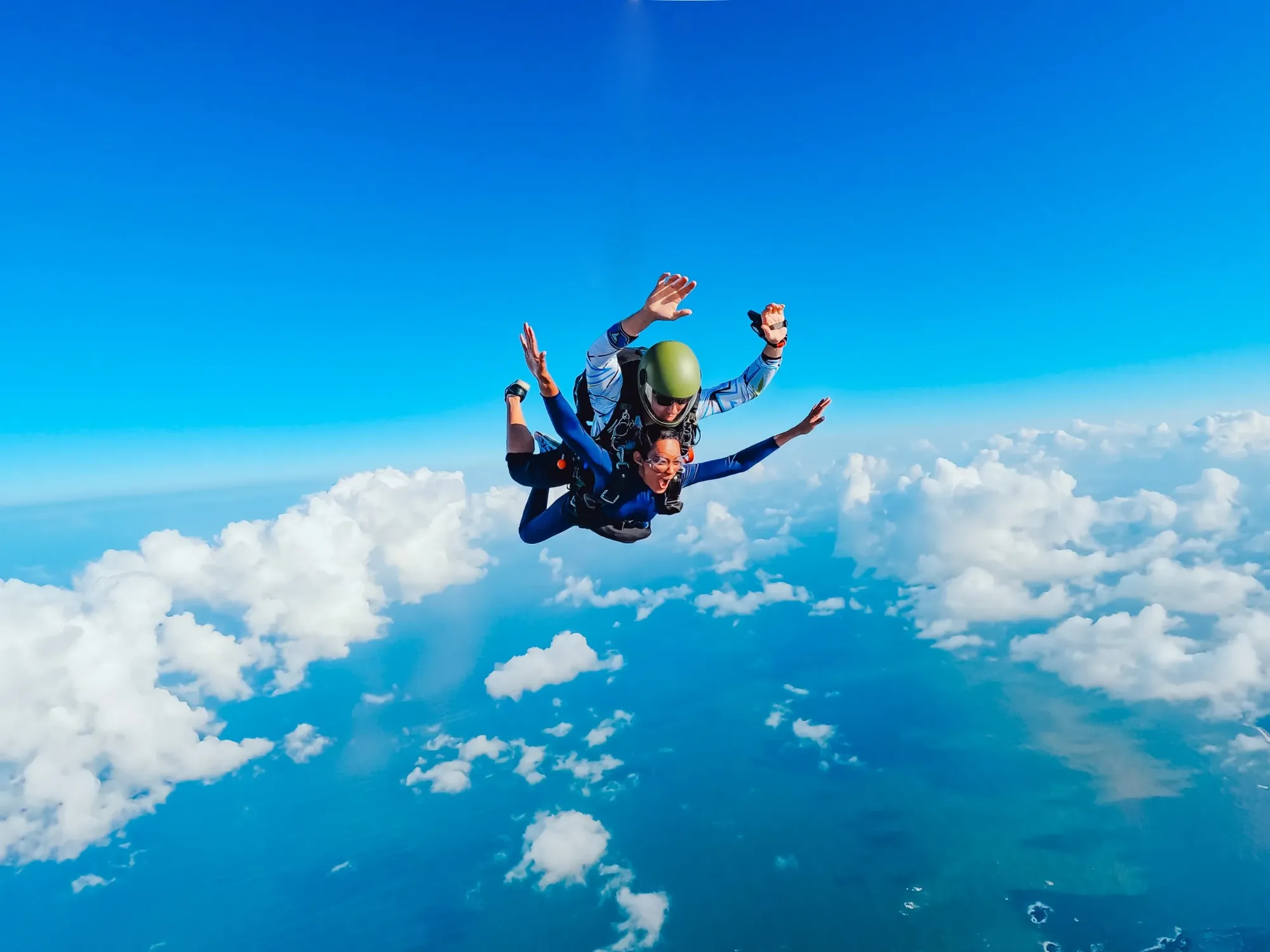
Freefall is not what films make it. There is no falling sensation. The air becomes a thick, screaming wall against your face, and your body floats on it. You fall at terminal velocity — about 200 km/h — and somehow, because you are surrounded by sky rather than passing scenery, it feels less like falling and more like flying. Your camera-flyer is in front of you, signaling thumbs up, the Palm spread beneath them like a postcard.
After about a minute, your instructor pulls. The canopy snaps open and the noise stops. The wind stops. Suddenly you are sitting in a sky-chair, two thousand feet above the Marina, drifting under a parachute the size of a small studio apartment. Your instructor will let you steer if you want. You can talk to each other now. The ground reappears, slowly, then quickly, and the canopy ride becomes a landing approach.
You touch down, usually softly, sometimes on your feet, sometimes on your bottom in a controlled slide. You stand up. Your legs are shaking and you cannot stop smiling.
For about an hour afterward, you are different. You are not the same person who got into the car this morning. The view of the world is changed by the literal view of the world. People who have skydived in many places will tell you that this aftermath is the same everywhere — but in Dubai, with the Palm at your back and the Marina glittering ahead, it lands a little harder.
That is what people are paying for.
Is Skydiving in Dubai Safe?
This is the question almost every first-time jumper asks, often anxiously, and it deserves a calm, honest answer.
Skydiving is a serious activity and not without risk. It also has, particularly in the tandem context with reputable operators, a very strong global safety record. Tandem skydiving is statistically far safer than solo skydiving and considerably safer than many activities first-time visitors do without thinking — including driving on highways and several common adventure sports.
Here is the substance behind that record.
The system. A tandem rig has two parachutes: a main canopy and a reserve. The reserve is packed by certified riggers under strict inspection and re-pack cycles. The harness connects you to a professional instructor who has typically completed thousands of jumps. You do not jump alone. You are clipped to a person whose entire career depends on this going well, every single time.
Equipment. Modern tandem rigs include an Automatic Activation Device (AAD), which is a small computer that monitors altitude and descent rate. If, for any reason, the canopy has not been deployed by a designated altitude and you are still in freefall, the AAD will fire the reserve automatically. This is industry-standard equipment and operates as a final layer of redundancy on top of the instructor and the reserve itself.
Instructor standards. Instructors at major dropzones carry international certifications and are required to maintain currency through ongoing jumps and recurring training. The tandem rating, in particular, is among the most demanding in the industry.
Weather procedures. Skydives are scrubbed for weather constantly and without apology. If you arrive on a day when conditions are not right — wind, visibility, cloud base — the jump will not happen. This is one of the genuinely reassuring features of working with a professional operation. They cancel jumps that look fine to a layperson because the standards above safe-enough are tighter than what looks safe-enough from the ground.
What happens if the parachute fails? This is the question everyone wants the answer to, and it is genuinely better than people imagine. Main canopies that do not open correctly are not relied on. The instructor cuts away the malfunctioning canopy and deploys the reserve. The reserve is a second, smaller, more conservatively designed parachute that has been packed by a certified rigger under strict regulatory standards. A double-canopy failure — both main and reserve failing — is so rare in modern tandem operations as to be statistically negligible.
Common Fears, Briefly Addressed
What if I freeze and forget what to do? You will not have to remember much. Your instructor controls the exit, the freefall, the deployment, and the landing. Your job is to bend your knees up at exit and listen to instructions on landing.
What if I cannot breathe in freefall? You can. Breathing in freefall feels different — the air is moving past you fast — but breathing through your mouth or making the slight 'aaah' sound your instructor will demonstrate works perfectly.
What if my harness slips? It will not. The harness has multiple connection points, all checked twice before you get on the aircraft, and once more before you reach the door.
The right framing is this: you are doing an activity with real, non-zero risk, with one of the most experienced operations in the world, on equipment that has multiple redundancies. The honest read is that it is dramatically safer than most people instinctively think, and the structural reasons for that are not based on luck.
Best Time of Year to Skydive in Dubai
Dubai's climate is the single biggest factor in when you should plan your skydive.
The Ideal Window: October – April
These are the cooler months, and they are the heart of Dubai's tourism season for good reason. Daytime temperatures range from the mid-20s to low-30s Celsius. Mornings are clear, calm, and visually crisp. Visibility is at its best, and the operating cadence is at its most reliable.
If your trip is flexible, target this window. December and January are peak — beautiful, but heavily booked. November, February, and March offer a near-identical experience with slightly better availability.
Summer (June – September)
Avoid summer skydiving in Dubai if you can. Daytime temperatures regularly exceed 40°C, with humidity that makes ground operations punishing. Visibility is reduced by haze. Many tourism activities scale back or relocate operations during this window. Skydive Dubai still operates in summer, but with constrained schedules and weather-dependent days. The Palm Dropzone, in particular, operates more limited hours.
If summer is when you have to come, you can still jump — just plan for early morning slots, expect possible weather scrubs, and budget more flexibility into your trip.
Shoulder Seasons (May, October)
May is hot and approaching summer. October is cooling and approaching peak. Both can deliver excellent jumping conditions, with October generally the safer bet for a first-time visit.
Visibility Matters More Than People Realise
This is the underrated factor. The view from altitude is the entire point of skydiving Dubai, and the view is meaningfully better on cool, clear days than hot, hazy ones. The difference between a cold-season jump and a summer jump is not just comfort; it is what you actually see and what your camera captures.
If your goal is the iconic Palm shot, optimize for visibility, and visibility means winter.
Skydive Dubai vs Bali vs Thailand vs Australia
Dubai is one of several iconic skydive destinations in this region. Here is how it compares.
| Skydive Dubai | Bali | Thailand | Australia (East Coast) | |
|---|---|---|---|---|
| Scenery | Palm + skyline + Gulf | Tropical coastline, volcanoes inland | Coastal beach or rural countryside | Beach + reef + coastal cliffs |
| Atmosphere | Premium, polished, urban | Warm, tropical, traveler-friendly | Casual, friendly, low-key | Sport-focused, professional |
| Price tier | Premium | Mid–upper mid | Mid | Premium |
| Tourism pairing | Luxury, shopping, dining | Yoga, surf, wellness, food | Beach holidays, food, nightlife | Beach, reef, road trip |
| Luxury factor | Very high | Moderate–high | Moderate | High |
| Beginner friendliness | Very high | High | High | Very high |
| Iconic photo factor | Highest in the region | High | Moderate | High |
Honest Take
Choose Dubai if you want the iconic photo, the premium production, and a skydive that aligns with a luxury-flavored Middle East trip. It will be the most expensive of the four and the most photogenic.
Choose Bali if you want a tropical-island skydive paired with a longer, slower trip — Bali's broader tourism rhythm (yoga, surf, food, ceremonial culture) is the real draw, and a coastal tandem is a perfect adrenaline counterpoint to that. Pricing is meaningfully lower than Dubai for an experience that, while less iconic visually, is genuinely good.
Choose Thailand if your priority is value for money on a still-stunning coastal or countryside skydive, paired with the easy hospitality of a Thai vacation. Pattaya and Chiang Mai both have well-established operations that earn excellent reviews.
Choose Australia if you want world-class sport skydiving infrastructure with beach-and-reef views, and a destination that treats skydiving as a serious activity rather than a tourism add-on. Premium pricing, but for very different reasons than Dubai.
If you can do two on the same long trip — for instance, Dubai on the way out and Bali or Thailand on the way back — you will end up with two completely different memories of skydiving, and you will be glad you did both.
Tips for Booking Skydive Dubai
A few practical things worth knowing before you reserve your slot.
Book Early
We have said this twice already, and we will say it again: book early. The Palm Dropzone in peak season can be sold out for weeks. As soon as your travel dates are firm, lock in your skydive. If you are traveling in December or January, book months ahead.
Book a Morning Slot
Conditions are calmest, visibility is freshest, and the chances of a weather scrub are lowest in the morning. Mid-morning slots (roughly 9:00 to 11:00) are usually the sweet spot — past first-light operational ramp-up, before midday heat builds.
Build in a Buffer Day
Weather can scrub a jump even in peak season. If you have only one day for the jump and the weather goes against you, you may not get a make-up slot. Where possible, plan two possible days for the skydive in your itinerary. This is the single biggest piece of advice we give to travelers who are flying internationally for this experience.
What to Wear
Comfortable athletic clothing. Sneakers, not sandals. Avoid loose hats, scarves, or anything that will not survive 200 km/h wind. Glasses are fine — you will be given goggles to wear over them. Sunscreen is wise on the ground. Dress for the temperature in Dubai, not the temperature at altitude — although it is cooler at jump altitude, you are only at altitude briefly.
Logistics on the Day
Arrive at the dropzone at the time on your booking confirmation, not earlier. There is a structured check-in flow and arriving very early can sometimes mean you wait longer rather than less. Bring ID, your booking confirmation, and a credit or debit card for any add-ons (especially the media package). Hydrate.
Tourist Season Awareness
Dubai's high tourism season aligns perfectly with the skydive's high season. This means hotels, restaurants, and tourist activities are also at their busiest from December through February. If you are price-sensitive and timing-flexible, late October, November, and March can deliver near-peak weather with shoulder-season prices on the rest of your trip.
Avoid Disappointment
A few small ways to make sure your skydive day goes well:
Eat a normal-sized breakfast, not too heavy and not too light. Avoid alcohol the night before. Get a real night of sleep. Do not bring a friend whose nervousness will become yours. If you are very anxious, tell your instructor at the start; they will calibrate the briefing accordingly.
If you can, jump in the morning, then plan a relaxed afternoon — you will not feel like doing anything else high-energy, and the post-skydive emotional glow is best enjoyed sitting somewhere with a view of the city.
Insider note: A common mistake is treating the skydive as the closing act of a Dubai trip. Treat it as the opener. If weather scrubs your day, you have a buffer day to come back; if it does not, you spend the rest of your trip riding the high.
Frequently Asked Questions
As of May 2026, on the operator's site (skydivedubai.ae): the Palm Dropzone tandem is AED 2,199 without media or AED 2,499 with standard video and photos. The Desert Campus is AED 1,899 tandem-only or AED 2,199 with video and photos. Add-on options include a AED 150 Instagram highlight reel and a AED 250 selfie-view camera. A walk-in fee of AED 300 and an optional priority slot fee of AED 700 may apply at the Palm. Confirm current rates at the time of booking.
For most first-time tandem skydivers visiting Dubai, yes. The view is iconic and unique, the production is high quality, and the experience is one of the most reliably memorable adventure activities in the city. It is more expensive than most other skydives in the region, but the cost reflects what you are paying for: a view and a memento that simply do not exist anywhere else.
It depends on what you want. Palm is iconic, polished, and built for the postcard moment — book it for the famous skyline-and-Palm experience. Desert Campus is calmer, more affordable, and has a more traditional sport-dropzone atmosphere with stunning open-desert scenery. First-time tandem visitors who want the famous photo should choose Palm. Travelers prioritizing experience over postcard, or with budget in mind, will be very happy at Desert.
Tandem skydiving with a reputable operator is one of the safer adventure activities available, with multiple layers of redundancy: a main canopy, a reserve canopy, an automatic activation device (AAD), and a certified instructor with thousands of jumps. Jumps are scrubbed proactively for weather. While skydiving carries non-zero risk, the structural safety standards at major dropzones make it dramatically safer than most first-time jumpers instinctively assume.
Yes. Tandem skydiving is specifically designed for first-time jumpers. You do not need experience, training beyond a short briefing, or any special preparation. Your instructor manages the exit, freefall, parachute deployment, and landing. Your job is to enjoy the ride and follow a few simple instructions.
In the rare event that the main canopy does not open correctly, your instructor will cut it away and deploy the reserve canopy, which is packed by a certified rigger under strict regulatory standards. As an additional safety layer, an Automatic Activation Device (AAD) will trigger the reserve automatically if certain altitude and descent-rate conditions are met. The combination of these systems is why double-canopy failures in modern tandem operations are statistically negligible.
The most accurate answer is: scary in anticipation, exhilarating in practice. The strongest fear typically peaks in the aircraft on the way up. The actual freefall, paradoxically, often feels less terrifying than the moments before exit, because once you are in the air the sensation is more like flying than falling. Most first-time jumpers report that their fear was significantly worse than the experience itself.
Minimum age requirements vary by operator and jurisdiction. For Skydive Dubai, the standard minimum age for tandem is generally 18, although some operators offer 16+ with parental consent — confirm at the time of booking. Maximum age is more flexible than people expect, with skydivers in their 70s and 80s tandem-jumping regularly, often subject to a brief health declaration.
Tandem skydiving has weight limits, primarily for safety reasons related to the harness and canopy. Limits vary by operator and equipment but are commonly in the 100 kg / 220 lb range, sometimes higher with conditions. If weight is a question, contact the dropzone directly before booking — they will give you a clear answer and, if needed, may apply a small surcharge or require a fitness check.
Athletic, comfortable clothing — what you would wear to a gym. Sneakers, not sandals or open shoes. Avoid loose accessories. You will be given goggles, and your instructor will manage gear-up. Dress for warm weather on the ground; the altitude chill is brief and not unpleasant.
The Sky Above the Palm
Some experiences are worth the money because they are rare. Some are worth it because they are unforgettable. Skydive Dubai, in 2026, is one of the few that is both.
The Palm Jumeirah will not look any less spectacular from twelve thousand feet next year, or the year after. The desert will not stop being beautiful. The instructors at both dropzones will keep doing the careful, unglamorous work of making thousands of strangers feel safe enough to step out of an aircraft with a smile on their face. The video your camera-flyer hands you in a few hours will keep playing on your phone, on long flights and at dinner parties and on the worst days of next year, as a small private reminder that you once did something brave and the world was bigger than you remembered.
This is what bucket-list adventure travel is supposed to feel like.
The editorial team behind Asia's dedicated skydiving discovery platform — working directly with dropzones and federations across the region to keep listings accurate.