On this page
- 01Is it normal to be terrified before a skydive?
- 02Why skydiving triggers such powerful fear
- 03The emotional timeline most first-time jumpers go through
- 04What people are actually afraid of (and what is really going on)
- 05The difference between fear and danger
- 06What actually happens to your brain in the hours before a skydive
- 07The most common moments people want to back out
- 08How experienced instructors handle nervous first-timers
- 09What freefall actually feels like (emotionally)
- 10Real psychological strategies that actually help
- 11Should you cancel if you are extremely nervous?
- 12What people say after their first tandem
- 13Why skydiving so often becomes a core memory
- 14Practical tips for nervous first-time jumpers
- 15If you are still awake at two in the morning
It is two in the morning and the ceiling fan is the only thing in the room that feels honest. You booked the skydive a month ago — back when it was an idea, abstract and shiny, the kind of thing you mentioned at dinner because it sounded like the version of yourself you wanted to become. Now it is tomorrow. And your stomach has been doing slow, theatrical somersaults for the last six hours.
You have watched too many videos. You have read too many forums. Somewhere around midnight you typed "is it normal to be this scared of skydiving" into a search bar and then closed the tab before the results loaded, because part of you is afraid of the answer and part of you is afraid of how reassuring the answer might be — because reassurance, at this hour, feels like a trick.
You picture the aircraft door opening. You picture wind. You picture the part of yourself that wants to back out, and then the part of yourself that wants to do it anyway, and you cannot tell which of the two is louder.
If any of that sounds familiar — congratulations, you are not broken, you are not a coward, and you are not unusually fragile. You are a human being doing a thing that humans were not built to do, and your nervous system is responding exactly the way a healthy nervous system responds to the prospect of voluntarily exiting an aircraft at altitude.
This guide is for the version of you that is awake at two in the morning. It is not a pep talk. It is not a list of life-coach platitudes about "feeling the fear and doing it anyway." It is a calm, honest, slightly long walk through what skydiving anxiety actually is, why it shows up so loudly, what most first-timers feel and when they feel it, and the small, real, decidedly unglamorous things that help.
By the end of it you will probably still be nervous. That is fine. Nervous is the correct emotional posture for someone about to do something genuinely remarkable. The goal is not to delete the fear — it is to stop being afraid of the fear itself.
Quick answer: Yes, what you are feeling is normal. Almost every first-time tandem jumper experiences some combination of dread, second-guessing, sleeplessness, and last-minute regret in the days before their skydive — including the people who land grinning ear to ear and immediately ask when they can go again.
Is it normal to be terrified before a skydive?
Short answer: yes, and the people who claim otherwise are usually either lying, performing for an audience, or compensating for something. Skydiving anxiety is not a character flaw. It is a feature of the experience.
A useful way to frame it: every single human who has ever done a tandem skydive has, at some point on the day of the jump, looked at the closed door of the aircraft and thought a version of "what on earth am I doing here." Excited people think it. Calm people think it. Adrenaline junkies on their fortieth jump still think it. The thought is not evidence that something is wrong. It is evidence that you are paying attention.
The other thing worth knowing up front: fear and excitement are biochemically almost identical. Your body cannot really tell the difference between "I am about to do something amazing" and "I am about to die." Both produce the same racing heart, the same shallow breath, the same buzzing limbs. The only thing that separates them is the story your mind is telling about what is happening in your body. We will come back to that.
What "normal" actually looks like
Normal, in the run-up to a skydive, looks like: trouble sleeping the night before, mild nausea on the morning of, a sudden urge to cancel during the drive to the dropzone, frequent bathroom trips during the briefing, and a long quiet stretch on the aircraft climb where you go pale and stop talking. None of that is a warning sign. All of it is the standard pre-flight cocktail.
Less normal — and worth listening to — is sustained, paralyzing dread that does not lift even after you arrive at the dropzone, meet your instructor, and watch other people land safely. We will talk about how to tell the difference between healthy nerves and the kind of fear that is asking you to wait, in a section near the end of this guide.
Reassurance, in plain English: If you are scared, you are doing this correctly. Your body is treating the experience with the seriousness it deserves. The trick is not to suppress the fear — it is to stop interpreting the fear as a verdict.
Why skydiving triggers such powerful fear
To understand why a perfectly rational adult can be reduced to tears at the sight of a parachute harness, it helps to start with what your brain is actually doing. Skydiving sets off not one fear but a small constellation of them, all firing at once, most of them ancient.
Fear of falling — and we mean the literal, hardwired one
Of all the fears humans are born with, fear of falling is one of the few that does not need to be taught. You can lay a six-month-old baby on a glass table over a deep visual drop and they will refuse to crawl across it. The fear of suddenly losing height is older than language, older than us, threaded into the parts of your nervous system that do not negotiate.
Skydiving, of course, is the purest possible expression of falling. So the fact that your body is screaming at you to get away from the aircraft door is not a personal failing. It is a four-hundred-million-year-old reflex doing exactly what evolution sharpened it to do.
Fear of heights, which is a different thing
Fear of heights — acrophobia or its milder cousins — is technically distinct from fear of falling, although the two get tangled. Many people who are terrified of standing on a tall balcony are surprisingly fine in an aircraft. The reason is that real altitude looks abstract. At twelve or thirteen thousand feet the ground stops looking like a thing you can fall onto and starts looking like a map. Several first-time jumpers report that the moment of looking out of the aircraft door is less vertiginous than the moment of looking off a tenth-floor hotel balcony, because the brain genuinely cannot make sense of the scale.
Fear of losing control
Skydiving asks you to do something deeply unnatural: hand control of your body to another person, in a domain where mistakes are visible and irreversible, and trust them entirely. For people whose general life strategy is "stay in control of variables I can influence," this is often the single hardest part. Not the height. Not the speed. The surrender.
A useful reframe: tandem skydiving is one of the few extreme sports where the person doing the work is licensed, certified, and has done this thousands of times. You are not a passenger in a car driven by a teenager. You are a passenger in a vehicle piloted by someone whose entire profession is keeping passengers alive. The control you are giving up is being handed to someone who knows what to do with it.
Fear of death
Underneath all the smaller fears is the big one. Skydiving directly confronts the mind with mortality in a way that most modern life carefully avoids. Most adults can go years without genuinely contemplating their own death. A skydive collapses that distance — suddenly, you are forced to look at the fact that you are mortal, and that an aircraft door, one parachute, and a stranger named Marco are the things standing between you and the end.
This is uncomfortable. It is also, paradoxically, why so many first-time jumpers describe the experience as life-changing. You don't get to do something that intimately confronts mortality very often. Most people go their whole lives without it. Doing it on purpose, in a controlled environment, with professionals — that is not a small thing.
Anticipation anxiety, which does most of the damage
Here is a quietly important fact: most of the fear you experience before a skydive is not fear of the skydive. It is fear of imagining the skydive. Anticipation does roughly ninety percent of the work. The actual jump — the moment your feet leave the aircraft — typically lasts around five to seven seconds of true freefall acceleration before the body adapts. The waiting can last for weeks.
This is why almost every experienced jumper will tell you the same thing: the worst part of skydiving is the climb to altitude. Not the exit. Not the freefall. Not the canopy ride. The climb. Because the climb is where anticipation lives, and anticipation is where the mind has time to do its work.
Reassurance, in plain English: Anticipation is louder than reality. Almost everyone who has ever jumped reports the same odd discovery — the actual experience is less frightening than the imagined version. Your imagination is doing a worse, scarier movie than your eyes will.
The emotional timeline most first-time jumpers go through
If you are deep enough into the pre-jump anxiety spiral that you are reading guides like this one, it can feel like your particular flavor of dread is uniquely intense. It is almost certainly not. There is a remarkably consistent emotional arc that most first-time tandem skydivers ride, and recognizing where you are on it can be quietly steadying.
The booking high
It usually starts with a flash of confidence. Maybe a friend mentioned it. Maybe you saw a video. Maybe you are on a trip and the mountain or the coastline looked too good to pass up. You book. You put it on the calendar. You feel briefly, gloriously brave. The version of you that booked is brave. Hold onto that — they were right.
The week before
Around five to seven days out, the abstraction starts to thin. The skydive stops being a story you tell at dinner and starts being a thing on Tuesday. You start checking the weather. You start, without quite realizing it, watching skydiving videos. Then accident videos. Then forum posts about accident videos. The feedback loop here is almost universal and almost universally regretted. Try not to do it. We will come back to this.
The night before
Sleep gets weird. People report dreams about doors that won't close, about parachutes shaped like grocery bags, about being unable to find the dropzone in the dark. Some people sleep fine and wake up at five with a heart rate of one hundred. Some people lie awake until three. Eat a real dinner, hydrate, put your phone down by ten o'clock, and accept that the sleep you get is the sleep you get. One bad night does not impair a tandem skydive.
The drive in
This is, for many people, the single most uncomfortable hour of the entire experience. You are committed but not yet doing it. The dropzone is real now, on the GPS, getting closer. Conversation tends to go quiet. Some people listen to music and stare out the window. Some people make terrible jokes. Both are fine. Both are normal. The drive is bad. Then it ends.
Arrival and check-in
Something shifts when you walk into a real dropzone. The fluorescent lighting, the laminated waiver, the people in jumpsuits casually drinking coffee, the music playing too loudly from a Bluetooth speaker — it is mundane. Almost insultingly mundane. And the mundanity is, surprisingly, calming. These people do this every day. They are not nervous. The aircraft outside is not a portal to oblivion. It is a Cessna with a slightly worn paint job.
The briefing
Briefings vary by operator, but they are usually short — twenty to forty minutes — and structured around three things: how to position your body on exit, how to position your body in freefall, and how to position your legs for landing. There is almost nothing for you to do. You will be physically attached to a professional whose job is to do all of the work. The briefing is mostly there to keep your body from accidentally getting in their way.
Gearing up
Then there is harness check, helmet, goggles, possibly a jumpsuit if it is cold or if the operator just runs them. This is a quietly significant moment. You will feel taller, heavier, and slightly more abstract. You are now physically wearing the thing. Some people get very chatty here. Some people go silent. Both reactions are normal.
The aircraft climb
This is, for most people, the apex of the fear curve. The aircraft climb to altitude takes anywhere from twelve to twenty-five minutes depending on aircraft type, and during that climb you will likely be sitting on the floor strapped to your instructor, looking out a small window at a landscape that gets steadily, ridiculously smaller. This is the part where most people go very quiet. This is also the part where most experienced instructors quietly start cracking jokes.
The door
The door opens. Wind comes in. The horizon shows up where the wall used to be. Almost every first-time jumper has, at this exact moment, an internal voice that says some version of "oh no, oh no, I am not ready, I have changed my mind." This voice is normal. This voice is not in charge. Your instructor will move you to the door, position your feet, count down, and exit.
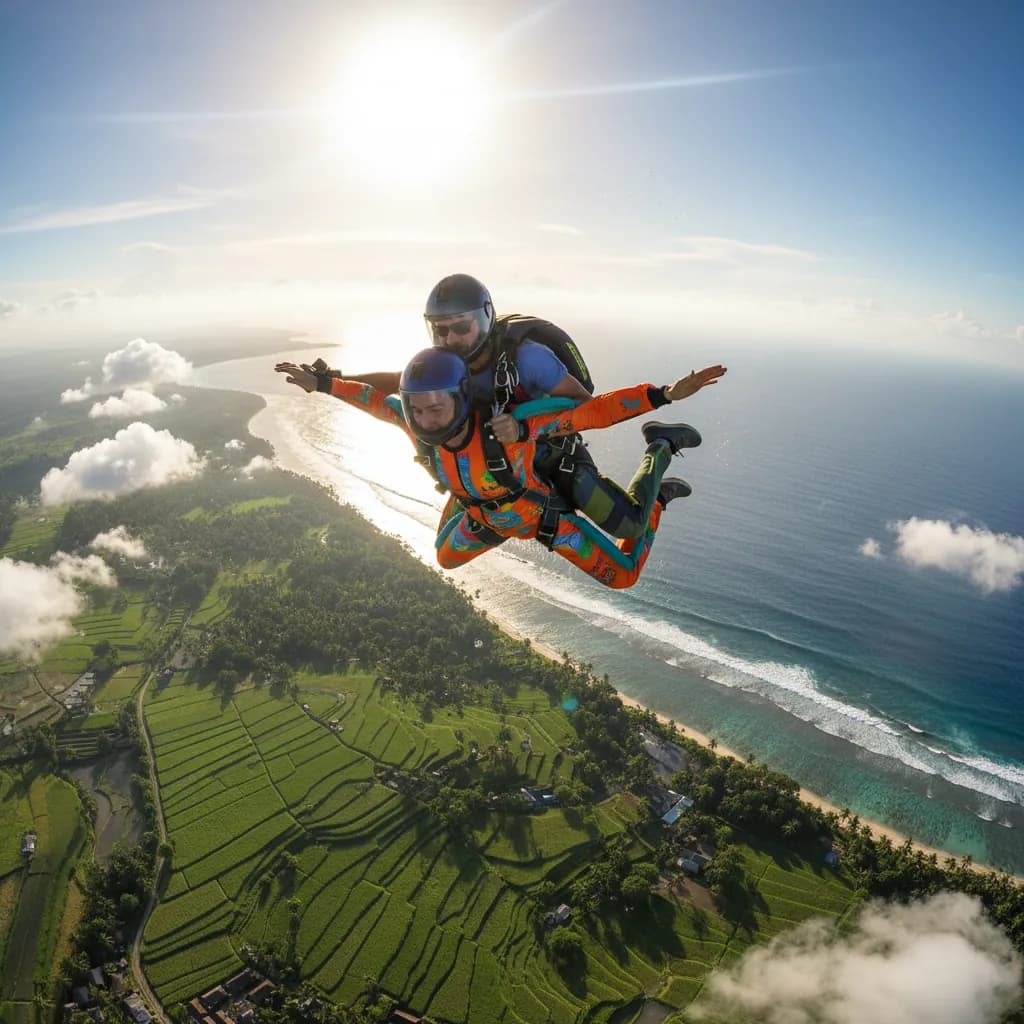
Freefall
Then the strangest thing happens. The fear, almost universally, evaporates. We will spend a whole section on why later in this guide, but the consistent first-timer report is that the moment of leaving the aircraft is followed not by terror but by a kind of bewildered, wide-eyed, oxygen-rich euphoria. You scream not because you are scared but because the alternative is exploding.
Canopy and landing
After freefall comes the canopy ride — five to seven minutes of unexpectedly quiet floating, often described by first-timers as the most surprising part of the whole experience. This is when the smile usually arrives. By the time your feet touch the ground, the version of you that almost cancelled the night before feels like a different person. You will hug a stranger. You may cry. You may laugh in a way you have not laughed in years.
Author's note: The most consistent thing first-time jumpers report afterwards is not the freefall, the views, or the speed. It is the feeling of having been wrong about themselves. The fear was so loud, the dread was so total, and then they did it anyway — and the world kept turning. A small but durable shift happens in the calculus of "things I am capable of."
What people are actually afraid of (and what is really going on)
Pre-jump anxiety tends to cluster around a small, predictable set of fears. Naming them is not a cure, but it is a step. It is harder for the worry to spin freely once it has been put on the table and given a name.
"The parachute will fail"
This is the fear that gets the most airtime, partly because it is dramatic and partly because the imagination has plenty of footage to play with. In reality, modern tandem rigs carry two parachutes — a main canopy and a reserve — and are equipped with an automatic activation device, a small computer that will deploy the reserve if it detects that you are still in freefall below a safe altitude. The redundancy is not a marketing gimmick. It is the architectural assumption of the entire sport.
This does not mean nothing can ever go wrong. Skydiving is not risk-free, and any honest treatment of the topic has to acknowledge that. We have a separate guide that walks through how the safety architecture actually works at a real-numbers level — see our piece on whether skydiving is safe for the longer treatment.
"I will panic at the door"
Almost everyone is afraid they will be the person who freezes. Almost no one actually is. Tandem skydiving is structured precisely so that this fear cannot really come true. You are not asked to jump. You are not asked to make a decision at the door. You are physically harnessed to your instructor, and your instructor moves both of you out of the aircraft as a single unit. The decision is made on the ground. The exit is just the consequence.
This is, for many people, the single biggest reframe in the entire pre-jump experience. The door is not a moment of choice. The choice was made at the dropzone, when you signed the waiver and got harnessed up. Everything after that is just gravity doing its job.
"I won't be able to breathe"
This is a real, specific fear, often phrased exactly like this — "I have heard you can't breathe in freefall." It is wrong. You can breathe. Most people simply forget to, because the exit is overwhelming and the brain has bigger things on its mind for a moment. Once you remember to inhale, breathing in freefall is straightforward. The wind pushes air at you, not away from you. If anything, the issue is that there is too much air, not too little.
Some people find it helpful to do a deliberate, theatrical first breath — an open-mouth scream is a perfectly good way to remind your body that breathing is still on the menu.
"I will embarrass myself"
This one shows up unexpectedly often, and it is one of the more painful fears because it is rooted not in physical danger but in social danger. You are afraid of being the person who cries. The person who throws up. The person who has to be talked through the door. The person whose fear is visible on the video.
Two things about this. One: instructors and ground crew see every conceivable reaction to skydiving, every weekend, all season. There is nothing you can do that will surprise them, embarrass them, or earn their judgment. Two: the version of you the camera catches grinning at the bottom of the canopy ride is the version that gets remembered. Almost no one rewatches the parts where they were nervous. That is not the part of the story they tell.
"I will regret it"
Most people who skydive don't regret it. A small minority do regret it, almost always because they pushed through fear that was asking to be heard. We will talk in a later section about how to tell the difference. For now, the more important version of this fear is the inverse: the regret of not doing it. That regret tends to outlast the regret of doing it badly.
"I will lose control of myself"
This one is harder to articulate but very common. It is the fear of being so overwhelmed by sensation, fear, and adrenaline that you essentially cease to be yourself for a moment. That you will not be the person you usually are. That you will become panicked, primal, undignified.
The honest answer: yes, this might happen. Some people do scream. Some people do cry. Some people do go non-verbal for a few minutes. None of this is a problem. The skydive is not a performance review. The point is not to remain composed. The point is to do the thing. The composure can come back later, on the ground, with a coffee in your hand.
Reassurance, in plain English: Almost every fear you can articulate before a skydive has been articulated by tens of thousands of first-timers before you. You are not the first person to have this specific worry. Whatever it is, the dropzone has already seen it.
The difference between fear and danger
This is, in some ways, the most important section of this guide. Most of the suffering before a skydive comes from a single conflated mistake — treating the intensity of fear as evidence about the level of danger. They are not the same thing. They are not even strongly correlated.
Perceived risk vs. actual risk
Humans are famously terrible at calibrating risk. We are afraid of sharks and not afraid of cars, despite cars killing roughly fifty thousand more people per year. We are afraid of plane crashes and unafraid of staircases, despite staircases winning that contest comfortably. We are afraid of skydiving and not afraid of driving to the dropzone, despite the drive being statistically the most dangerous part of most jump days.
This is not because humans are stupid. It is because the brain's fear architecture was optimized for an environment in which falling from height was a real and common cause of death. It was not optimized to differentiate "controlled descent under a redundant parachute system flown by a licensed professional" from "falling out of a tree while picking fruit." To the deepest layer of your nervous system, those are the same event.
None of this means skydiving is risk-free. It is not. Any treatment of the sport that pretends otherwise is doing you a disservice. What it means is that the screaming alarm bell you are hearing inside your head is not a precise instrument. It is a smoke detector. It tells you something is happening. It does not tell you what.
Why fear is loud
Adrenaline distorts perception. Things look bigger, brighter, more vivid. Time slows. Heart rate doubles. The body is preparing to run from a predator that does not exist, and the volume on every signal is being turned up. This is not a malfunction — it is the system working as designed. But the system was designed for a different environment, and the volume it produces is wildly out of proportion to the actual threat in front of you.
The point of bringing this up is not to dismiss the fear. The fear is real. The point is to give you something to hold onto when the fear is shouting that something is wrong. It is shouting because that is what it does. The shouting is not, by itself, evidence.
How to tell whether the fear is signal or noise
Honest framing: there are situations in which fear is genuinely informative. If you arrive at a dropzone and the equipment looks shoddy, the staff seem rushed, the briefing is incoherent, or the operator has no apparent licensing or oversight — that fear is signal. Listen to it. Walk away. There are reputable operators in every market we cover.
If you arrive at a dropzone with current licensing, well-maintained equipment, a clean briefing, friendly staff, and visible operational discipline, and your fear is still loud — that fear is noise. It is not telling you anything that is actually true about the day in front of you. It is just doing its old, ancient job a little too enthusiastically.
Quick answer: Fear measures how your nervous system feels about an imagined event. It does not measure the actual safety of that event. Loud fear and low danger can — and routinely do — coexist. So can quiet fear and high danger. The two systems are independent.
What actually happens to your brain in the hours before a skydive
Some of this you will already feel, even if you have not put names to it. Knowing what is happening can be helpful, not because the labels make the sensations go away but because they make the sensations less weird.
Adrenaline
In the hours before a skydive — sometimes longer — your adrenal glands begin a slow, steady release of adrenaline and noradrenaline. This is the body preparing for a fight-or-flight situation that has not yet happened. You will notice a faster pulse, slightly shallow breathing, a buzzing or tingling in the limbs, and a heightened, restless alertness. You may not be able to sit still. You may not be able to eat much. Both are normal.
Cortisol
Underneath the adrenaline, cortisol is also rising — a slower-acting stress hormone that affects sleep, digestion, and emotional regulation. This is why people often have trouble sleeping the night before, lose their appetite, get irritable with the people around them, and find themselves crying or laughing at small things. Your emotional baseline is being temporarily recalibrated. You are not turning into a different person. You are just running a different chemistry.
Tunnel vision and hyper-awareness
As the day approaches and especially during the drive in and the briefing, attention narrows. Peripheral details start to drop away. The world feels louder, the colors brighter, the ambient noise sharper. This is sensory tunneling — the brain triaging cognitive resources for what it perceives as a high-threat event. It is uncomfortable, and it can feel like dissociation, but it is not pathological. It will subside once the event is over.
Why waiting is the worst part
Here is the strange and important fact about pre-jump anxiety: the body is built to handle the actual jump, but it is poorly built to handle the wait. Adrenaline is meant to fire and discharge — fight, flee, recover. What the modern skydiver is asked to do is hold the chemistry in suspension for hours, sometimes days, while they drive and brief and gear up and climb. The wait is what wears people down. Not the jump.
This is part of why so many experienced jumpers say the freefall feels like relief. The body finally gets to do something with all that chemistry, instead of just sitting in it.
The most common moments people want to back out
There is no single "point of maximum fear" — there are several, and they tend to come in a predictable order. Knowing where they are can make them less ambushing.
Gearing up
The first wave often hits during harnessing. There is something about the physical reality of the equipment — the weight of the rig, the snug bite of the leg straps, the small click of metal — that suddenly makes the experience real in a way it has not been before. Some people get quiet here. Some people get tearful. Some people make a joke and then immediately regret making the joke. All of this is normal.
Hearing the aircraft
The sound of the aircraft engines starting up, especially if you are sitting in a hangar or near the runway, is a significantly underrated emotional trigger. The sound is not particularly threatening — it is just an aircraft engine — but it announces the imminence of the thing. Many first-timers report that the sound of the engine is when their stomach actually drops.
The climb
During the climb to altitude, especially in the last few minutes, almost everyone has an internal moment of "I would really, genuinely, like to not do this." This thought is so universal that experienced instructors expect it. They will often start joking around at exactly this moment, not because they are bored, but because they know this is when their passenger needs to hear another human voice that is calm and unbothered.
The door opening
And of course the door. The first rush of cold, fast air, the appearance of the horizon, the unfiltered sound of the wind — this is the sensory peak of the entire pre-jump sequence. The thought "what have I done" is, for most people, never louder than at this moment.
And then — almost always — it stops. We will explain why in the next section.
Author's note: I have never met a first-time tandem jumper who did not, at some point, want to back out. I have met many who did want to back out and chose not to, and zero of them regretted choosing not to. Whatever shape the urge to bail takes for you, you are not the only person in that aircraft having that thought.
How experienced instructors handle nervous first-timers
One of the quietly comforting things about modern tandem skydiving is that you are not the first nervous person your instructor has met today. You are probably not even in the top five. Working tandem instructors will fly with thousands of passengers in their career, and the overwhelming majority of those passengers are first-timers in various flavors of mild to severe anxiety. The fear in the room is not an anomaly. It is the job.
They are calibrated
Experienced instructors read nervousness like weather. They watch how you walk, how you talk, how you laugh, where your eyes go when the door of the aircraft is mentioned. They are not judging you. They are sizing you up the way a guide reads a hiker — figuring out which kind of reassurance you need, how much you want to know, how much of a joker you are, how much steadiness you need from them.
If you are a chatterer, they will chat. If you are a quiet ruminator, they will go quiet with you and then make exactly one well-timed remark that lands sideways and makes you laugh. If you are wide-eyed and frozen, they will move you through the steps with a hand on your shoulder and a voice that is quiet and certain. None of this is improvised. It is craft.
Humor is a tool, not a personality flaw
The dark, deadpan humor that runs through most dropzones can be jarring at first. People joke about parachutes opening and not opening, about gravity, about how good the food is at the hospital. None of this is callousness. It is how a community that lives close to risk metabolizes risk. The humor is a sign that the people around you are comfortable in the environment. That is something you want.
They have a script for the climb
In the aircraft, on the way up, your instructor is likely to talk you through the next few minutes. They will remind you of body position. They will tell you what they want you to do at the door. They will sometimes ask about your job, your trip, where you are from — small talk that doubles as a quiet check on your cognitive state. If you can answer questions, you are present and oriented. If you have gone non-verbal, they will adjust their plan.
Reassurance, in plain English: You are not being trusted to do anything difficult on this jump. The difficult things are being done by someone whose entire profession is doing them. Your only job is to be present, breathe, and let them work.
What freefall actually feels like (emotionally)
If you have spent any time in pre-jump forums or YouTube comments, you will already have seen the universal first-timer report: "the moment we left the plane, the fear just disappeared." People say this so often that it can sound like a cliche. It is not. It is one of the strangest and most reliably true things about the experience.
The fear breaks
The exit itself is so overwhelming sensorially — the wind, the speed, the sudden flip of the horizon, the noise — that there is simply no cognitive bandwidth left for fear. The mind, which has spent the last twelve hours running every possible catastrophe scenario, abruptly runs out of inputs. The thing it was afraid of is now the thing that is happening. There is nothing left to imagine.
Different people describe this differently. Some say it feels like calm. Some say it feels like ecstasy. Some say it feels like nothing — a strange neutral clarity, where they are simply present in their body in a way they have not been in months. A few report a kind of laughter that is not quite under their control, the sound the body makes when it has been holding too much for too long and finally lets go.
It does not feel like falling
This is one of the most counterintuitive things about freefall. Despite the name, despite the entire premise of the sport, freefall does not really feel like falling. Falling, in the everyday sense — tripping, dropping, losing your footing — comes with a stomach-flip and a lurch. Freefall, after the first second or two, feels much more like floating in extremely fast wind. The sensation of dropping disappears. What remains is the sensation of being supported by air.
This single fact, more than any other, is what surprises first-timers most. The thing you were afraid of — the falling — is not really the thing that is happening. What is happening is closer to flying.
Sensory overload, then a strange calm
The first six or seven seconds are a flood. The wind is loud. The cold is sudden. The cheeks flap. The hands are cold. The eyes water. After that — and this is important — the body adapts very quickly. By around ten seconds in, most first-timers report being able to breathe normally, look around, and even smile for the camera. The wide eyes in the early footage become a real grin in the later footage.
The canopy ride
And then, after roughly forty-five to sixty seconds of freefall, the canopy opens. The deceleration is sharp but not violent. The wind dies. The world goes quiet. You are now hanging under a piece of fabric the size of a small parking lot, drifting at the speed of a slow bicycle, watching the landscape rotate around you. Most first-timers report this as the most surprising part of the entire jump, because it is the part the videos cannot really convey. The freefall is what people imagine. The canopy ride is what people remember.
Author's note: I have asked many first-time skydivers what their last thought was before exit. The most common answer is some version of "I am about to die." The most common answer to what their first thought was after exit is some version of "oh." Just "oh." The fear and the reality are simply not built out of the same material.
Real psychological strategies that actually help
This section is intentionally short on motivational fluff. Most of what gets written about "overcoming the fear of skydiving" online is recycled inspirational content that does not survive contact with three in the morning. What follows is a smaller list of things that actually help.
Stop watching accident videos
This is the single most useful piece of advice in this entire guide. The pre-jump anxiety spiral almost always starts with a search for reassurance and ends in a YouTube rabbit hole of malfunctions, near-misses, and worst-case footage. This is not research. It is self-harm dressed as preparation. Your brain cannot distinguish a vivid video from a memory. By the time you arrive at the dropzone, you will be carrying around emotional impressions that have nothing to do with your actual day.
If you must research, research operators, not accidents. Look at how long they have been operating. Look at their training credentials. Look at their licensing. Look at their reviews. That research is useful. The accident videos are not.
Focus on process, not outcome
"Will I be okay" is a useless question because it is unanswerable from where you are sitting. "What is the next thing I need to do" is a useful question because it always has an answer. Pack the bag. Drink the water. Do the briefing. Walk to the aircraft. Sit down. Breathe. Each of these is a small, completable task. The skydive itself is the sum of these tasks. There is no separate, larger thing to fear.
Let your body have the chemistry
Trying to suppress fear in the hours before a skydive almost never works and usually makes things worse. The chemistry is happening. The shaking, the racing heart, the shallow breath — these are real and they are not under your conscious control. Pretending you are calm when your body is loudly telling you it is not calm just adds a layer of self-judgment to an already loud signal.
It is much more useful to let the chemistry exist and label it accurately. "I am extremely activated right now" is a more accurate sentence than "I shouldn't be feeling this way." The first sentence is descriptive. The second is judgmental. Descriptive sentences are easier for the nervous system to settle around.
Breathe, but specifically
General "just breathe" advice is mostly useless. What is more useful is the specific technique of making your exhale longer than your inhale. The body reads a long exhale as a signal that the threat is over. A four-count inhale and a six-count exhale, repeated for two or three minutes, will measurably lower your heart rate and shift your nervous system slightly out of fight-or-flight. This works on the drive in. This works in the briefing. This works in the aircraft on the way up.
Eat and hydrate, even if you don't feel like it
Pre-jump anxiety often kills appetite. Eat anyway. A small, neutral meal — toast, a banana, a sandwich — about ninety minutes before the jump will keep your blood sugar stable and reduce the likelihood of feeling shaky or nauseous on the climb. Hydrate steadily through the morning. Avoid alcohol the night before. Coffee is fine in moderation if you normally drink it; this is not the day to suddenly start.
Choose the operator carefully
This is genuinely important. The single biggest input on whether your fear is well-placed or not is the quality of the operation you are jumping with. Look for current national federation membership where applicable, instructors with thousands of jumps, well-maintained equipment, and clear, calm pre-jump procedure. Our country guides are written specifically to help you make this evaluation — see our pieces on Thailand, the Philippines, Dubai, and the broader cost-and-operator overview for cross-Asia comparisons.
Accept the fear instead of fighting it
This is the meta-strategy underneath all the others. The fear is going to come. It is going to be loud. The trick is not to fight it into submission. The trick is to let it sit in the seat next to you, like a nervous passenger, and to do the thing anyway. Fear is not consent. Fear is also not refusal. Fear is just the body being awake.
Reassurance, in plain English: You don't have to be calm to skydive. You just have to get into the aircraft. The calm — surprisingly — comes after, not before.
Should you cancel if you are extremely nervous?
This is a question worth taking seriously, because it has two possible right answers and one common wrong answer.
The two right answers
The first right answer is: yes, sometimes you should. If your fear is so total that you cannot sleep for several nights running, cannot keep food down, are having panic attacks, or feel a deep certainty that this is not your day — that is information. Listen to it. Reschedule. The dropzone will take a deposit; the deposit is the price of taking your own internal weather seriously. Skydiving is not going anywhere. It will be there next month. It will be there next year.
The second right answer is: no, push through. If your fear is the standard pre-jump cocktail — restless sleep, queasy stomach, intrusive thoughts, persistent urge to bail — then on the morning of the jump, almost everyone in your shoes is fighting the same urge. The vast majority of those people will go anyway, and almost none of them will regret it. You are very likely one of those people.
The common wrong answer
The wrong answer is to cancel out of shame. To not show up because you are afraid that, in showing up, you will be the person who cries, or the person who has to be talked through the door, or the person who is visibly more frightened than the others. None of those things are problems. None of them are reasons to cancel. The dropzone has seen all of it. They will take care of you regardless.
How to tell which version you are in
Some rough heuristics. If your fear has a specific shape — "I am afraid of something I read about online," "I am afraid because my friend who jumped told me a scary story," "I am afraid because of a video I watched last week" — that is anticipation anxiety, and it is the kind that almost always melts in the actual experience.
If your fear has no specific shape — just a deep, wordless, full-body certainty that you should not be doing this — that is harder to read, and worth taking more seriously. Sometimes that signal is real. Sometimes it is just the volume of the chemistry. You are the only person who can tell the difference, and even you may only be able to tell after a long, honest conversation with yourself, ideally in a room without an internet connection.
There is no shame in either choice
Some people are not going to skydive in this lifetime, and that is a perfectly fine life to have. Some people will skydive once, terrified, and then never again, and that is also fine. Some people will skydive once, fall in love with it, and end up with their own license and a closet full of jumpsuits. None of these outcomes are better than the others. The only outcome that is genuinely sad is the one where someone wanted to do it, almost did it, and let shame talk them out of even trying.
Quick answer: Cancel if your gut is screaming a wordless no. Push through if your gut is just nervous. The hardest part is being honest with yourself about which one you are hearing.
What people say after their first tandem
If you talk to enough first-time tandem jumpers, the same handful of phrases come up over and over. They are remarkably consistent across cultures, ages, and personality types. Here is the rough chorus.
"I can't believe I almost cancelled"
Possibly the single most common thing first-timers say in the first hour after landing. They will replay the morning. They will replay the previous night. They will think about the texts they sent friends saying "I think I might bail." And they will say, very quietly, with a slightly stunned expression, "I can't believe I almost cancelled." This phrase is so common it is almost a cliche.
"It wasn't what I thought it would be"
Variations: "It was completely different from what I imagined." "It wasn't scary at all once we left the plane." "The worst part was the climb." Almost no first-timer says "it was exactly as bad as I thought." The thing they were afraid of and the thing they actually experienced were not the same thing. Often by a wide margin.
"I want to do it again"
This one is sometimes said five minutes after landing. The body has just discharged hours of accumulated chemistry, the smile reflex is still firing, and the prevailing feeling is one of profound, slightly delirious well-being. Whether the person actually does it again is a separate question. The instinct to want to is universal.
"I cried"
Often delivered with surprise, sometimes with apology. People cry on skydives. Mostly after, sometimes during. Tears are not a sign of trauma; they are a sign of release. The body has been holding a great deal of stress chemistry for a long time, and tears are one of the cleanest ways to dump it. There is nothing wrong with crying. It is one of the most honest reactions to the experience.
"I feel like I can do anything"
This sounds like a slogan and it is — but it is also, briefly, true. There is a window of roughly twenty-four to seventy-two hours after a first skydive in which the everyday calculus of "things I am capable of" gets quietly recalibrated. People text long-postponed messages. People apply for jobs they had been putting off. People book the next thing — sometimes another skydive, sometimes something completely unrelated. The afterglow is real, and it can be productively pointed at things.
Why skydiving so often becomes a core memory
Most adult experiences blur. The weeks of your life run together, the months even more so, and entire years can pass without producing a single moment that you can recall in vivid sensory detail. Skydiving, for almost everyone who does it, is not one of those experiences. It is one of the few experiences that adults retain with the clarity of childhood memories.
Emotional intensity makes memory
There is a body of research on something called "flashbulb memory" — the unusually high-resolution memory the brain forms around emotionally intense events. The mechanism is partly chemical (adrenaline and cortisol increase memory consolidation) and partly attentional (we encode the details we are paying close attention to). A skydive provides both ingredients in extreme quantities. Almost every first-timer can recall, years later, the exact face of their instructor, the temperature of the air in the climb, what the first half-second of freefall felt like.
The fear-to-achievement pivot
Memorability is amplified when the experience also involves a significant emotional shift mid-event. Skydiving has one of the cleanest fear-to-achievement pivots available in adult life: maximum dread on one side of a thirty-second window, maximum joy on the other. The contrast itself is what burns the memory in. People remember moments where their inner narrative changed. The skydive is one big narrative change, compressed into about a minute.
Identity shift
People often describe themselves slightly differently after a skydive. "I jumped out of a plane" becomes a sentence they can say about themselves, and they cannot unsay it. The shift is small but durable. Things they previously believed they could not do become slightly more negotiable. The category of "things I do not do" shrinks by one item, and other items in that category sometimes follow.
Vulnerability and trust
There is also something about trusting another human with your physical existence — really trusting them, with no fallback — that creates an unusual emotional residue. People remember the instructor. They remember the way the instructor's hand felt on their shoulder before exit. They remember the hug at landing. The skydive is, paradoxically for an extreme sport, an intimate experience. That intimacy is part of why it stays with people.
Author's note: I have spoken with people who skydived twenty years ago and have never gone back, and they can still describe the climb in detail. Whatever you are about to do, you are about to do it on purpose, and the version of you that goes through it gets to keep the memory of it for a long, long time. That is a thing worth being afraid of, and a thing worth being excited about, in roughly equal measure.
Practical tips for nervous first-time jumpers
Most of this guide has been about psychology. This section is the practical sibling — the small operational decisions that, made well, will quietly reduce your overall anxiety load.
Book with someone
Book with a friend, a partner, or a family member if you can. Not because you want them to talk you into it — they shouldn't have to — but because the entire pre-jump arc is significantly easier to ride with someone else next to you. The drive is shorter. The wait is shorter. The post-jump euphoria is meaningfully better when shared. If you cannot find someone, that is also fine; the dropzone will adopt you for the day.
Pick the operator before you pick the day
Many first-timers reverse this — they pick a day, then look for the closest dropzone. It is much better to pick the operator first, with care, and then schedule around their availability. Reputation matters. Equipment matters. Procedure matters. We have written extensively about how to evaluate operators across the region; see our country and city pillars for the specifics.
Arrive early
Get to the dropzone earlier than you have to. Walk around. Watch a load take off. Watch a load come back. Notice how the people who just landed look. Drink some water. Use the bathroom twice. The longer you spend in the environment before being asked to do something, the less alien it feels when you are asked to do it.
Ask questions
If something the briefing covers doesn't make sense, ask. If you don't know what a piece of equipment does, ask. Instructors would rather answer questions than work with a passenger who is silently confused. There is no such thing as an embarrassing question on a dropzone. The embarrassing thing would be guessing.
Eat something neutral
Toast. A banana. A small sandwich. About ninety minutes out. Avoid heavy, greasy meals. Avoid caffeine if it makes you jittery. Avoid alcohol the night before — even one drink is more disruptive to sleep than people realize, and sleep is one of the few things you genuinely benefit from going into a skydive.
Hydrate steadily
Not gallons. Steadily. A bottle of water through the morning. Mild dehydration amplifies anxiety symptoms substantially — racing pulse, light-headedness, shaky hands — so a baseline level of hydration is a quiet but real input on how the day feels.
Trust the harness
This sounds obvious but it is worth saying. The harness is going to feel weird. It is going to feel tight in places you are not used to feeling tight. Resist the temptation to constantly check it. Once your instructor has done the harness check, the harness is done. It is not going anywhere. Stop fiddling with it. Trust the process.
Stop rehearsing
Rehearsing the skydive in your head is not preparation. It is anticipation anxiety with a costume on. You are already going to do it. You do not need to do it in advance, twenty times, in your imagination. If you catch yourself running the simulation, gently change the channel — talk to whoever is with you, listen to a podcast, look at the landscape outside the car. The skydive will be there when you arrive.
Accept that the nerves are part of the experience
This is the meta-tip. The nerves are not an obstacle to the experience. They are the experience. Without the nerves, the skydive would just be an aerial sightseeing tour. The nerves are the part that makes the achievement feel like an achievement. Let them happen. They are not damaging anything. They are doing exactly what they are supposed to do, and they will be over by lunchtime.
- Book with someone if you can — the drive in is much easier shared.
- Pick a reputable operator first, then pick a date.
- Arrive early — at least an hour before your slot.
- Eat something neutral about 90 minutes before.
- Hydrate steadily through the morning.
- Skip alcohol the night before.
- Avoid accident videos. They are not research.
- Ask questions during the briefing — instructors prefer it.
- Don't fiddle with the harness once it has been checked.
- Stop running the jump in your head. You will do it once, in person.
Yes — almost universally. Pre-jump anxiety is so common that experienced instructors expect it from every first-time tandem jumper, and the people who claim they were not nervous are usually performing for an audience. Fear before a skydive is the standard, healthy response of a nervous system that is paying attention. It is not a sign you should not jump.
For most first-timers, the scariest part is not the freefall — it is the climb to altitude. The fifteen to twenty minutes between takeoff and exit is when anticipation peaks and when the mind has the most time to imagine the worst. The exit itself, paradoxically, is often when fear breaks. By the time the canopy opens, most people are smiling.
Outright panic during a tandem is rare, partly because the entire experience is designed to take decision-making out of the passenger's hands. You are not asked to jump — you are physically attached to a professional who handles the exit, freefall, and canopy. The thing many first-timers fear most ("I will freeze at the door") is structurally difficult to actually do.
Yes, technically — until you are at the door of the aircraft. Most reputable operators will not force a passenger to exit; tandem instructors are trained to read the cues and will land with the aircraft if a passenger genuinely cannot continue. That said, the vast majority of first-timers who consider backing out at altitude do not, and almost none of them regret pushing through.
For most first-timers, yes — and remarkably quickly. The exit itself is so sensorially overwhelming that there is no cognitive space left for fear. By six or seven seconds in, the body has adapted, breathing normalizes, and the dominant feeling shifts from fear to a kind of bewildered exhilaration. This is one of the most consistent reports across thousands of first-time jumps.
Yes. This is one of the most common myths first-timers carry into the experience. You can breathe normally in freefall — the wind moves air toward your face, not away from it. Some people instinctively hold their breath for the first few seconds out of pure overwhelm, but breathing comes back online almost immediately. An open-mouth scream on exit is a perfectly good way to remind your body that breathing is still available.
It almost never happens, because the door is not actually a moment of decision. You are physically harnessed to your instructor, and the instructor moves both of you out of the aircraft as a unit. There is no individual jump action you have to perform. The decision was made on the ground; the door is just where gravity takes over.
It can be — especially the build-up. The hours and days before a skydive often feel emotionally heavy, with poor sleep, lost appetite, and intrusive thoughts. Most first-timers describe the actual jump as much less overwhelming than the anticipation. The body is built to handle the event itself; what wears people down is the wait.
Most people who cancel out of fear say they regret it later. Most people who push through fear and jump say it became a core memory. There is a small minority who push through fear that was genuinely asking to be heard and wish they had listened — but for the standard first-timer cocktail of nerves, the regret of not jumping tends to outlast the regret of jumping.
For most people, yes — significantly. The unknown is what makes the first jump so heavy. By the second time, the body has a memory of what freefall actually feels like (which is almost never what was imagined the first time), and the fear is much more manageable. Many people who continue into AFF or sport skydiving describe their second jump as more enjoyable and less anxious than their first.
If you are still awake at two in the morning
Then you are in good company. Almost everyone who has ever stood at the door of a small aircraft, twelve thousand feet above a field somewhere in Asia, has spent at least one sleepless night before they got there. The fear is the price of admission. It is also part of the reason the experience matters.
Whatever you decide — to jump, to reschedule, to wait until the version of you that booked feels closer again — the decision is allowed to be yours. There is no version of this where you fail. The dropzone is not a test. The fear is not a verdict. The morning of the jump is not the morning your character gets graded.
If you do go — and most people who get this far do — there will come a moment, somewhere around forty seconds into freefall, when the wind is in your ears and the ground is moving up to meet you, and the version of yourself that lay awake at two in the morning will feel like a stranger you are remembering kindly. That version of you was scared because they cared about you. They wanted you to be okay. They were doing their job.
And so, in their own way, are the instructors who have done this thousands of times before. The ground crew who has watched ten thousand first-timers walk in white-faced and walk out grinning. The pilot who flies the same circuit, twice an hour, all summer. The whole quiet machine of a working dropzone is, fundamentally, an apparatus designed to take frightened people and return them, intact and improved, to the ground.
Skydive In Asia exists to point you at the parts of that machine that are worth pointing at — the operators in Asia who run the kind of disciplined, transparent, properly-licensed operation that earns the trust your nervous system is being asked to extend. We have walked through them in detail in our country pillars and our individual dropzone reviews. If you are picking the place where you are going to do this, those are the places we would recommend looking.
Take the jump if you want it. Don't take it if your gut is telling you to wait. Either way, the fear you are feeling tonight is not a problem to be solved. It is a thing you are allowed to be in. And, at some point, possibly tomorrow, possibly in a year, it will be quieter — not because you defeated it, but because you stopped needing it to mean anything about who you are.
Sleep if you can. We will see you in the morning.
The Skydive In Asia editorial team writes deeply researched, operator-verified, calmly-delivered guides for travelers planning their first or fortieth tandem skydive across Asia. We talk to instructors, dropzone owners, and recent first-timers to keep what we publish honest, useful, and free of recycled marketing copy.