On this page
- 01A 14,000-Foot Confession
- 02Why Asia Is Becoming One of the Best Places in the World to Skydive
- 03The Best Places to Skydive in Asia
- 04What It Actually Feels Like to Do a Tandem Skydive
- 05Is Skydiving Safe?
- 06How Much Does Skydiving in Asia Cost in 2026?
- 07Best Skydiving Destinations by Traveler Type
- 08How to Prepare for Your First Skydive
- 09The Future of Skydiving Tourism in Asia
- 10Frequently Asked Questions
- 11So — Are You Going to Jump?
Quick answer: Asia is now one of the most rewarding regions in the world to skydive. The continent combines tropical coastlines, volcanic islands, ancient temples, and Himalayan giants — often at a fraction of European or North American prices. This guide walks through every major destination, what a tandem actually feels like, real 2026 cost ranges, safety, and how to plan your first jump.
A 14,000-Foot Confession
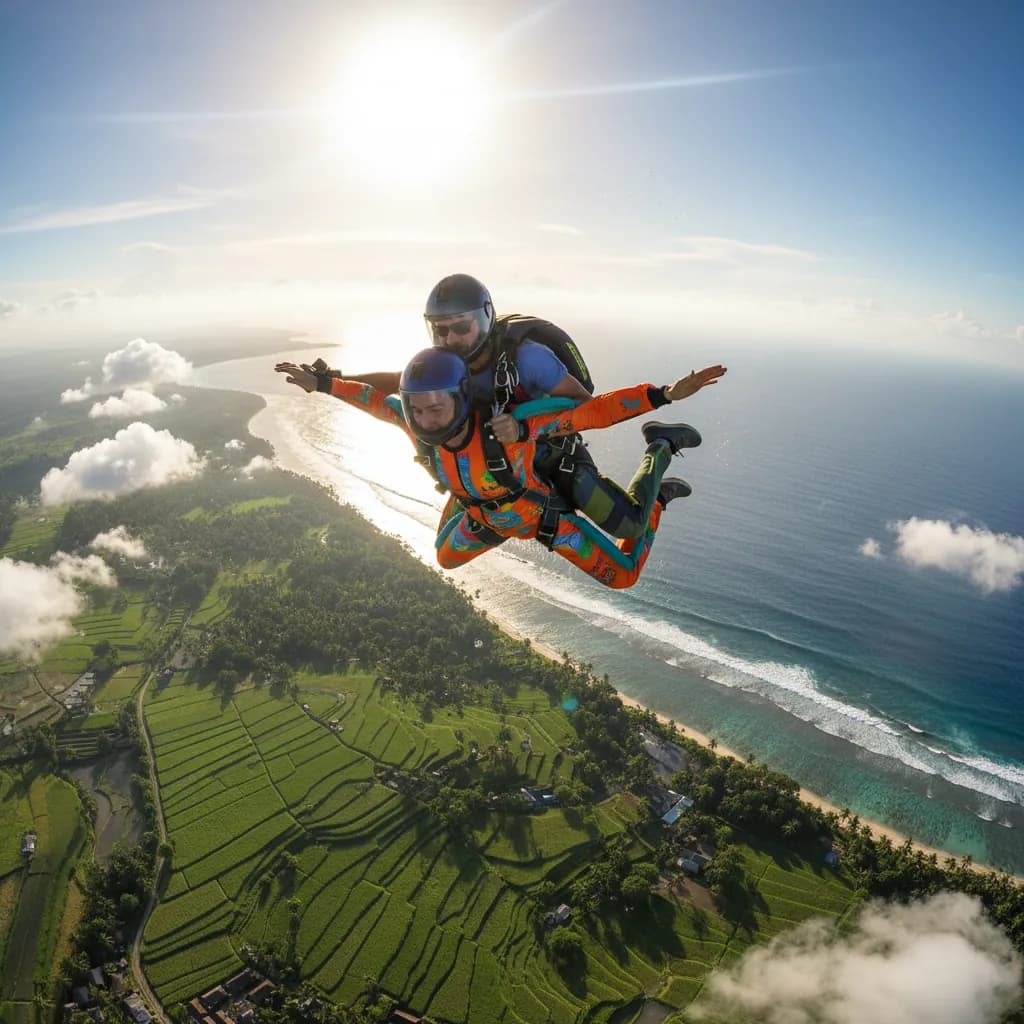
The door slides open and the noise hits you first. Not the wind — the sound of the world opening up, of the cabin going from "small plane" to "edge of something."
Below you: a coastline you've only ever seen in tourism reels. Reefs in shades of green you didn't know existed. Volcanoes pushing through cloud cover. Maybe rice terraces. Maybe a city skyline. Maybe nothing at all but a quilt of jungle and ocean stretching to the horizon.
Your instructor taps your shoulder. You shuffle forward. Your brain — the same brain that has spent the last twenty minutes trying to talk you out of this — goes very, very quiet.
And then you're falling.
This is what skydiving over Asia actually feels like. Not the cartoon version. The real one. The one where you discover that fear and joy can occupy the same body at the same time.
In 2026, more travelers are choosing Asia for this experience than ever before — and not by accident. The region has quietly become a global hub for tandem skydiving, with dropzones along Thai beaches, Filipino islands, Himalayan plateaus, and the world's most famous dropzone over the Palm in Dubai (which, while technically the Middle East, anchors a regional skydiving corridor most Asia-bound travelers consider).
If you've been circling this idea — book a trip, jump out of a plane, finally do the thing — this guide is the only one you'll need. We've broken down the destinations, the prices, the feeling, the safety story, and the questions you're too embarrassed to ask. We've done it the way we'd want it done if it were our own first jump.
Let's go.
Why trust this guide? Skydive In Asia is the region's dedicated skydiving discovery platform. Our editorial team works directly with dropzones, operators, and federations across Asia to keep listings accurate. We don't write to a model — we write from the ground.
Why Asia Is Becoming One of the Best Places in the World to Skydive
For decades, the global skydive map was lopsided. The United States, Australia, New Zealand, the Swiss Alps, Dubai. Asia was the place you visited between jumps — the temples, the food, the islands. Not the dropzone.
That's flipped.
A combination of forces is rewriting the geography of adventure travel, and skydiving sits squarely in the middle of it.
Affordability that doesn't sacrifice the experience
A tandem skydive in the United States routinely runs $300–$450 USD. In western Europe, €350–€500. In Asia — across most destinations — you're looking at roughly $200–$350 USD for a comparable experience, sometimes less. The aircraft are similar. The instructors are often international. The exit altitude is the same. What changes is your dollar's reach.
Scenery that simply does not exist anywhere else
You can jump over a coral atoll in the morning and trek into a rainforest in the afternoon. Few continents stack this kind of variety into a single trip:
- Tropical coastlines — the Andaman, the South China Sea, the Visayas
- Active volcanic landscapes — Java, Sumatra, parts of the Philippines
- Himalayan altitude jumps — the rarest and most coveted skydive on Earth
- Megacity coastlines — modern skylines pressed against tropical seas
- Ancient cultural backdrops — temples, terraces, fishing villages
A culture-and-adventure combination that feels effortless
Skydiving anywhere is unforgettable. Skydiving when your morning was a temple visit and your evening is a hawker market is something else entirely. Asia compresses contrast like nowhere else.
Tourism infrastructure that's finally caught up
Dropzones now sit beside resort corridors. Transfers from major airports are short. English-speaking instructors are standard. Booking is increasingly online. The friction that once made skydiving feel like a niche logistical project has largely melted.
Weather windows that work in your favor
Tropical Asia gives you year-round jump-ready conditions if you know where to look. Northern Asia adds spring and autumn windows that offer crisp, clear skies. We'll break this down destination by destination below.
The Best Places to Skydive in Asia
This is the section most readers come for — so we've made it the meatiest. Treat this as a short-list compendium. For each destination, we cover what makes it unique, who it suits, what it costs, and what to pair it with.
Editor's note: Operational details for individual dropzones change. We've kept this section focused on the destination itself — landscape, climate, traveler fit — and linked through to live, verified dropzone listings where they exist.
Before the country-by-country detail, here is every destination we currently track, ranked by the cheapest first-timer jump. Prices are what the operator charges in local currency; the USD column is indicative only, converted at rates pulled on 3 August 2026 and rounded to the nearest $10. The final column tells you how solid each figure is — where it says Verified, we have confirmed the price against the operator's own booking page on that date; where it says Operator-listed, the figure comes from the operator's published rates but we have not yet re-confirmed it directly. We publish the distinction because aggregator prices for skydiving are frequently out of date, and almost always too low.
| Destination | Dropzones | Cheapest first-timer jump | ≈ USD | Highest altitude offered | Price source |
|---|---|---|---|---|---|
| South Korea | 2 | KRW 760,000 | ~$537 | 3,800 m (12,467 ft) | Operator-confirmed 13 Aug 2026 |
| Thailand | 4 | THB 8,000 | ~$240 | 13,500 ft | Operator-listed |
| Sri Lanka | 2 | LKR 90,000 | ~$270 | 13,500 ft | Operator-listed |
| Israel | 2 | ILS 890 | ~$290 | 15,000 ft | Verified 3 Aug 2026 |
| China | 2 | CNY 1,980 | ~$290 | 13,000 ft | Operator-listed |
| Kuwait | 1 | KWD 99 | ~$320 | 13,000 ft | Operator-listed |
| Japan | 4 | JPY 56,000 | ~$350 | 12,500 ft | Operator-listed |
| India | 2 | INR 37,759 | ~$400 | 10,000 ft | Verified 3 Aug 2026 |
| Philippines | 3 | PHP 27,825 | ~$450 | 10,000 ft | Verified 3 Aug 2026 |
| Turkey | 1 | TRY 24,000 | ~$510 | 13,000 ft | Verified 3 Aug 2026 |
| United Arab Emirates | 4 | AED 1,899 | ~$520 | 13,000 ft | Verified 3 Aug 2026 |
| Maldives | 1 | USD 699 | ~$700 | 13,500 ft | Verified 3 Aug 2026 |
| Nepal | 2 | USD 850 | ~$850 | 23,000 ft (Everest expedition) | Operator-listed |
| Indonesia | 1 | IDR 350,000 (indoor) | ~$20 | Indoor wind tunnel | Operator-listed |
| Malaysia | 1 | MYR 108 (indoor) | ~$30 | Indoor wind tunnel | Verified 3 Aug 2026 |
| Singapore | 1 | SGD 59 (indoor) | ~$50 | Indoor wind tunnel | Verified 3 Aug 2026 |
| Bahrain | 1 | BHD 19 (indoor) | ~$50 | Indoor wind tunnel | Operator-listed |
Four of these destinations — Indonesia, Malaysia, Singapore and Bahrain — currently have no outdoor tandem operation we can vouch for, so the figure shown is for indoor wind-tunnel flying, which is a genuinely different experience rather than a cheaper version of the same one. Nepal's entry price buys a Pokhara-region tandem; the 23,000 ft figure refers to the Everest expedition jump, which is a separate product costing several thousand dollars. Everywhere else in the table, the price and the altitude describe the same kind of jump: a tandem skydive with a rated instructor.
🇮🇩 Bali, Indonesia — The Most Anticipated Emerging Destination
Bali doesn't yet have the operational depth of the verified Thai or Filipino dropzones. But it sits on every "where will skydiving happen next?" shortlist for a reason. The island combines volcanic skyline, world-class beach corridors, a rice-terrace interior, and one of the most travel-saturated airports in Southeast Asia. As infrastructure builds out, Bali is widely expected to become one of the region's most-booked skydive destinations.
- Best for: Bucket-list travelers, honeymoon couples, content-driven trips
- Scenery: Volcanoes (Agung, Batur), reef-fringed coast, terraced uplands
- Travel pairing: Ubud retreat, Nusa Penida day trip, Uluwatu surf
- Status in 2026: Discovery — track Bali developments via Skydive In Asia
🇹🇭 Thailand — Asia's Most Established Tandem Hub
Thailand has been hosting commercial tandem skydiving longer than most of the region. Dropzones across the Eastern Seaboard near Rayong and up north around Chiang Mai give travelers two very different jump experiences — coastal Gulf views or layered northern mountain country — both within an easy domestic flight of Bangkok. Expect short transfers, English-speaking briefings, and reliable dry-season conditions.
- Best for: First-time jumpers, short-trip travelers, couples on a Bangkok stopover
- Scenery: Gulf of Thailand coastline (Rayong) or northern mountain country (Chiang Mai)
- Best time: November–March (dry season, calmer winds)
- Estimated price: ~$300–$400 USD for tandem; video/photo packages typically add $80–$150
- Beginner friendly? Extremely
- Travel pairing: Bangkok food crawl, Koh Samet beach extension, northern temple loop
Currently closed. Phusanfah Airfield in Mae Taeng — the only skydiving dropzone near Chiang Mai, used by both Skydive Thailand and Skydive Chiang Mai — was ordered to halt operations by the Civil Aviation Authority of Thailand from 1 June 2026, and no reopening date had been announced as of 17 August 2026. The listing below is kept live so the status stays findable, and any prices shown are historic. Thai Sky Adventures near Pattaya and Dropzone Thailand in Rayong are both still flying.
Currently closed. Skydive Thailand is not taking bookings. Its listing is kept live so the status stays findable, and any prices shown are historic.
Browse every dropzone in Thailand
Compare locations, altitudes, and pricing across Thailand's verified skydive operators.
🇵🇭 Philippines — Skydive Over the Archipelago
The Philippines holds a quiet ace: more than 7,000 islands. Skydive operations around Cebu and Siquijor put you over white-sand crescents and crystalline reef channels that look fake in photos. If "ocean tandem skydive" is the dream, this is the ticket.
- Best for: Beach-obsessed travelers, divers stacking adventure activities, photographers
- Scenery: Reef atolls, Bantayan corridor, Siquijor coastlines, fishing villages
- Best time: December–May (dry, sunny, low typhoon risk)
- Estimated price: ~$250–$350 USD for tandem
- Travel pairing: Whale-shark encounters in Oslob, Bohol Chocolate Hills, Siargao surf
Browse every dropzone in the Philippines
Reef atolls, island chains, and verified tandem operators — all in one place.
🇲🇾 Malaysia — Quietly Capable
Malaysia's skydive scene blends seasonal coastal operations and active sport-skydiving clubs in the southern peninsula. It's a strong base for travelers stacking multiple Southeast Asian jumps in one trip — Langkawi for the island scenery, Segamat for the established sport-skydive community.
- Best for: Multi-stop adventure itineraries, sport-skydive travelers
- Scenery: Island coastlines (Langkawi), peninsular interior (Segamat)
- Best time: March–September
- Estimated price: Variable — confirm current operator listings
- Travel pairing: KL skyline, Cameron Highlands, Penang food
Currently closed. Skydive Langkawi is not taking bookings. Its listing is kept live so the status stays findable, and any prices shown are historic.
Currently closed. Helang Megah Tactical & Skydiving Club is not taking bookings. Its listing is kept live so the status stays findable, and any prices shown are historic.
Browse every dropzone in Malaysia
From Langkawi coastlines to KL sport-skydive clubs — verified, listed, ready.
🇮🇩 Indonesia (beyond Bali) — The Wildcard
Indonesia is a sleeping giant in skydive terms. The country's commercial outdoor skydive infrastructure is currently dormant — historic operations have not been consistently active in recent seasons. The most active facilities right now are the two iFly indoor wind tunnels — iFly Bali in Denpasar and iFly Jakarta at Cibubur, which is a genuinely useful pre-skydive primer for first-timers wanting to feel freefall before they jump.
- Best for: Off-the-map adventurers, travelers wanting an indoor freefall primer
- Outdoor status: Dormant in 2026 — verify before flying for a jump
- Indoor options: iFly Bali (Denpasar) and iFly Jakarta (Cibubur) — both active, year-round
- Travel pairing: Java overland route, Komodo cruising, Yogyakarta temples
Reality check (2026): Some Indonesian outdoor dropzones widely listed on travel sites are no longer operating consistently. Before flying for a jump, verify with the operator or use a current discovery platform like Skydive In Asia.
🇳🇵 Nepal — The Most Iconic Skydive on Earth
Few experiences in the entire sport approach the Everest skydive. Operations launch from one of the highest dropzones on Earth, with the Himalayan crown — Everest, Lhotse, Cho Oyu, Ama Dablam — visible from exit. It is expensive. It is weather-dependent. It is also, by most accounts, the single most surreal skydive available to civilians. Pokhara offers a more accessible, postcard-perfect Annapurna alternative.
- Best for: Bucket-list completists, experienced trekkers, photographers with savings
- Scenery: The Himalayas. There is no comparison piece.
- Best time: October–November (post-monsoon, clear skies)
- Estimated price: $25,000+ USD for full Everest programs; Pokhara starts considerably lower
- Beginner friendly? Yes for tandem — you'll be guided every step — but altitude prep matters
- Travel pairing: Kathmandu Valley heritage circuit, Annapurna foothill trek
Plan your Nepal skydive
From the Annapurna foothills to the Everest plateau — Asia's most spectacular jumps, all in one place.
🇻🇳 Vietnam — Watch This Space
Vietnam's commercial skydiving scene is in its earliest days. As of 2026 the country has not built a stable, year-round civilian dropzone, but appetite is there — and the landscape (Halong Bay, Phong Nha karst country, the Mekong Delta) reads like a skydiver's mood board.
- Best for: Travelers who want to be early to the next thing
- Status in 2026: Watchlist — track Vietnam developments via Skydive In Asia
🇯🇵 Japan — Precision Over Spectacle
Japan's skydiving culture is small, technical, and deeply considered. Operations exist across Hokkaido, Gunma, and the Kansai region, with views ranging from snow-capped mountain ranges to coastal farmland. The country's reputation for procedural rigor extends to its dropzones — expect crisp briefings, immaculate equipment, and a quieter, more reverent jump culture.
- Best for: Travelers who value execution over volume; off-season skydivers
- Scenery: Gunma countryside (Fujioka), Kansai coastlines (Toyooka), Hokkaido plains
- Best time: April–October for most operations
- Estimated price: ~$350–$500 USD for tandem
- Travel pairing: Tokyo, Kyoto, ski-season extension if jumping in shoulder months
Browse every dropzone in Japan
Precision, scenery, and quiet excellence — Japan's verified skydive operators in one place.
🇰🇷 South Korea — Underrated and Modern
South Korea offers tandem operations within day-trip reach of Seoul, with dropzones over rural patchwork and lake-country depending on the operator. The country is criminally underrated as a skydive destination — the infrastructure is excellent and the price point is competitive for the region.
- Best for: Seoul-based travelers and longer Korea itineraries
- Best time: May–October
- Estimated price: ~$300–$400 USD
- Travel pairing: Seoul food, Jeju Island, DMZ tour
Browse every dropzone in South Korea
Seoul-adjacent tandems and full AFF training — verified operators only.
🇹🇼 Taiwan — Watch This Space
Taiwan's geography — a mountain spine running through a tropical island — gives the country one of the highest-potential skydive landscapes in Asia. As of 2026, however, commercial tandem operations are not consistently active. We're tracking it.
- Best for: Future-looking adventure travelers tracking new openings
- Best time: October–April (avoiding typhoon season) when operations resume
- Status in 2026: Watchlist — track Taiwan developments via Skydive In Asia
🇦🇪 Dubai — The Global Anchor (Not Asia, But Adjacent)
Technically the Middle East — but Dubai functions, for many Asia-bound travelers, as the regional anchor. Skydive Dubai over the Palm Jumeirah is one of the most photographed dropzones on Earth, and many travelers route through DXB on the way into or out of Asia. If you want the most "I have arrived" tandem photos in your life, this is where they're made.
- Best for: Stopover travelers, photo-driven jumpers, luxury itineraries
- Best time: November–March
- Estimated price: ~$650–$700 USD for the Palm jump
- Travel pairing: Anywhere in Asia — DXB is the connecting hub
| Destination | Tandem price | Best Window | Standout Scenery |
|---|---|---|---|
| Thailand (Rayong + Chiang Mai) | THB 8,000–15,550 ≈ $238–463 | Nov–Mar | Gulf coast + northern mountains |
| Philippines (Cebu, Siquijor) | ₱27,850–41,475 ≈ $444–661 | Dec–May | Reef + islands |
| Japan (Ibaraki, Gunma, Saitama, Hyogo) | ¥56,000–99,000 ≈ $353–624 | Apr–Oct | Countryside + coast |
| South Korea (Chungju) | ₩760,000–1,750,000 ≈ $570–1,312 | May–Oct | Lake country + farmland |
| Malaysia (Langkawi, Segamat) | Paused — indoor only | Mar–Sep | Island + interior |
| Indonesia (indoor only — Jakarta + Bali) | IDR 750,000–1,600,000 ≈ $42–89 | Year-round | Wind tunnel primer |
| Bali | Emerging | TBD | Volcanoes + beaches (coming) |
| Vietnam | Watchlist | TBD | Karst + coastline (coming) |
| Taiwan | Watchlist | TBD | Mountain–sea (coming back) |
| Nepal (Everest) | $22,000–25,000 | Oct–Nov | The Himalayas |
| Dubai (anchor — Palm DZ) | AED 2,199–2,499 ≈ $599–680 | Nov–Mar | The Palm |
See every dropzone in Asia
The full directory — countries, cities, altitudes, pricing, season windows. Updated continuously.
What It Actually Feels Like to Do a Tandem Skydive
This is the section everyone reads twice. We've kept it honest.
The drive in
You'll be quieter than usual. That's normal. Your brain is doing math you didn't ask it to do.
The briefing
Your instructor walks you through the body position — chin up, hips forward, arms in a specific arch. You'll practice on the ground. You'll try to memorize it. You won't, fully, and that's fine. The instructor is the one flying. You are the one feeling.
The aircraft ride
The plane climbs for ten to fifteen minutes. The temperature drops. You see the landscape unfold in a way you've never seen it. The reefs from earlier look like brushstrokes. The roads look like thread.
This is the part nobody talks about. The climb — not the freefall — is where most people make peace with what they're about to do. You stop fighting it. You start watching it.
The exit
The door opens. The noise jumps a register. Your instructor moves you forward. You won't have time to negotiate.
You exit.
Freefall
The first three seconds are sensory chaos. The brain expects falling to feel like falling. It doesn't — it feels like floating on a hurricane. There is no "stomach drop." Terminal velocity arrives within seconds. After that, it's stable. It's loud. It's a physical wall of air against your face.
Most jumpers report the same thing: they were terrified for ninety minutes leading up to it, and within five seconds of exiting, they were laughing.
You're in freefall for roughly 45 to 60 seconds depending on exit altitude.
Canopy
Your instructor pulls. The parachute opens above you. The world goes silent.
This is the part of skydiving nobody preps you for. After all that noise, you're suddenly hanging in the sky in near-total quiet, looking at one of the most spectacular landscapes in Asia. People cry here. A lot of people. It's that good.
The canopy ride is four to six minutes. Long enough to talk. Long enough to stop shaking. Long enough to look around and understand, in a way that didn't fit into your body before, what you just did.
Landing
Your instructor lands you on your feet or a controlled slide. Either way, you are fine. You stand up. You look around. You realize people are taking pictures of you and your face is doing something it doesn't usually do.
You'll text someone within four minutes.
Almost nobody talks about the canopy ride. They prepare you for the freefall, but the silence afterward is what people remember a year later. It rewires something.
— SKYDIVE IN ASIA EDITORIAL TEAM, AFTER WORKING WITH HUNDREDS OF FIRST-TIME JUMPERS ACROSS THE REGION
Is Skydiving Safe?
Short answer: tandem skydiving is one of the most procedurally controlled high-adventure activities in the world. It is not zero-risk. Nothing physical is. But the system around it is engineered to a degree that surprises most first-timers.
The tandem system
A tandem rig is a fundamentally different machine from a sport rig. You are strapped to a licensed instructor whose entire job — their training, their certification, their daily practice — is the safe descent of one passenger. They control the deployment. They control the canopy. They control the landing.
Instructor standards
Tandem instructors are certified by national federations (in much of Asia, USPA, APF, BPA, or local equivalents like FASI in Indonesia or JPA in Japan). Certification requires hundreds to thousands of jumps before a tandem rating is even considered.
Equipment
- Main parachute — packed by certified riggers
- Reserve parachute — completely independent backup canopy
- Automatic Activation Device (AAD) — a small computer that will deploy the reserve automatically if specific altitude/speed conditions are met without manual deployment
This last one matters. Even if something incapacitated your instructor mid-freefall, the AAD is designed to fire the reserve before you reach the ground. Multiple redundancies, all running in parallel.
Weather procedures
Reputable dropzones do not jump in marginal weather. If you've ever been weathered-off, that is the system working. Frustrating, yes. Better than the alternative.
Common fears, addressed honestly
- "What if the parachute doesn't open?" — That's what the reserve is for, and what the AAD is for behind that. Total double-canopy failures on tandems are vanishingly rare in modern operations.
- "What if I freeze in the door?" — You're attached to your instructor. They've planned for this. Most people who think they'll freeze, don't.
- "What if I forget the body position?" — Your instructor is doing the flying. Your body position is a comfort/aerodynamics thing, not a survival thing.
Statistical framing
Tandem skydiving fatality rates have hovered around 0.003 per 1,000 tandem jumps in well-regulated jurisdictions over the past decade — orders of magnitude safer than recreational scuba diving fatality rates and comparable to other carefully managed adventure activities. (Always check the latest published data from the relevant federation in the country you're jumping in.)
The honest version: Skydiving is not as dangerous as the movies have trained you to think. The people doing it are professionals. The equipment is engineered with redundancy. The risk is real but managed. If you've ever driven a motorbike in Bali, you've taken on more daily risk than your tandem instructor will accept on your jump.
How Much Does Skydiving in Asia Cost in 2026?
Asia is — broadly — the most affordable major skydive region on Earth.
| Tier | Typical price | Examples |
|---|---|---|
| Budget | THB 8,000–8,850 ≈ $238–263 | Dropzone Thailand (Rayong); Skydive Thailand (Chiang Mai), jump only |
| Standard | THB 9,450–15,550 ≈ $281–463 | Thai Sky Adventures (Pattaya); Skydive Thailand with full media |
| Standard+ | ¥56,000–99,000 ≈ $353–624 | Skydive Azul, Fujioka, Nippon, Kansai (Japan, year-round) |
| Premium — islands | ₱27,850–44,100 ≈ $444–702 | Skydive Cebu, Skydive Siquijor, Skydive Palawan |
| Premium — South Korea | ₩760,000–1,750,000 ≈ $570–1,312 | Skydive Korea (Chungju), six-package ladder |
| Iconic | AED 2,199–2,499 ≈ $599–680 | Skydive Dubai (Palm DZ) |
| Once-in-a-lifetime | $22,000–25,000 | Everest Skydive expeditions |
Add-ons
- Handcam (instructor-shot video and photos) — typically $80–$150
- Outside videographer (separate jumper filming you) — $150–$250+
- Higher-altitude tandem (15,000–18,000 ft) — typically +$50–$100
- Repeat-jump discounts — common; ask the dropzone
- Group pricing — common for parties of 4+
Tourist pricing differences
A small number of operations price slightly higher for international tourists than locals. This is most often a function of currency listing rather than two-tier pricing, but it's worth confirming when booking.
Where you save
The biggest savings in Asia aren't on the jump itself — they're on everything around it. Hotels, transfers, meals, video upgrades, repeat jumps. A first-time jumper in Thailand can do their tandem, get the video, and have a beach dinner for the price of a tandem alone in much of Europe.
Where you don't
Premium operations in Japan, the Everest Skydive expedition, and Skydive Dubai are not "cheap Asia." They are global-tier experiences priced accordingly. Don't expect Bangkok pricing in Hokkaido.
Best Skydiving Destinations by Traveler Type
A short, scannable reference for anyone trying to match destination to mood.
| If you are… | Go to… |
|---|---|
| A first-time jumper | Thailand — most established beginner pipeline |
| A scenery purist | Nepal (Everest) or Philippines (Siquijor) |
| Chasing the best beach view | Philippines (Cebu, Siquijor) |
| Doing a luxury trip | Japan or Dubai |
| Backpacking on a budget | Philippines, Malaysia |
| A couple / honeymoon | Bali (when bookable) or Philippines |
| An adrenaline maximalist | Nepal (altitude) or repeat jumps in Thailand |
| On a tight time budget | Thailand (short transfer from Bangkok) |
| Stopping over en route | Dubai (DXB hub) |
| A photographer | Philippines, Nepal, Japan |
Quick answer: The single best country for a first-time skydive in Asia is Thailand — established tandem operations, English-language instruction, year-round dry-season window (November–March), and short transfers from Bangkok. Travelers prioritizing scenery over convenience should consider the Philippines for beach views or Nepal for the Himalayas.
How to Prepare for Your First Skydive
Most preparation is mental. Some of it is logistical. Here is the version we'd give a friend.
24 hours before
- Sleep. A bad night isn't a deal-breaker, but a good one helps with motion sensitivity.
- Hydrate. Tropical heat plus nerves plus a small aircraft is a dehydration cocktail.
- Don't drink heavily. A glass of wine the night before is fine. A bender is not.
- Confirm your booking and check weather — most dropzones will message you if there's a delay.
Morning of
- Eat a normal meal. People who skip breakfast almost always feel worse on the climb. A light, balanced meal is the right move. Fasted skydiving is bad skydiving.
- Hydrate, don't caffeinate beyond your normal levels.
- Use the bathroom before the briefing. The freefall does not care about your bladder.
What to wear
- Athletic clothing — leggings, sport shorts, breathable t-shirts
- Closed-toe shoes — sneakers ideal. No sandals, no flip-flops, ever.
- Hair tied back — long hair becomes a freefall problem otherwise
- No jewelry, no watches, no loose accessories
Fitness
You do not need to be an athlete to tandem skydive. Most operators have weight limits (commonly 220–250 lbs / 100–115 kg, but this varies — confirm with the dropzone). Mobility matters more than strength. If you can lift your knees on cue, you can land.
Nerves
The worst part of skydiving — by a long margin — is the four hours before it. The actual skydive is shorter than the wait. Remember this. Tell yourself this. Then walk to the plane.
What NOT to do
- Don't watch fail compilations on YouTube the night before. We promise.
- Don't skip the briefing. Listen carefully even if it feels theatrical.
- Don't lie about weight, health conditions, or recent injuries. The system works because it has accurate inputs.
The Future of Skydiving Tourism in Asia
Three forces are about to reshape this corner of the adventure industry.
Adventure tourism is the fastest-growing travel segment in Asia. Post-pandemic travelers want experiences over things, and skydiving sits at the perceived peak of that pyramid. Expect more dropzones, more aircraft, more capacity.
Social media has changed which sights matter. A skydive over a coral atoll generates more attention than a skydive over a soybean field — and this has quietly redirected operator investment toward Asia's coastal and volcanic geographies. The next decade will see new dropzones open in places that, ten years ago, were considered unbookable.
Booking is finally going digital. Historically, most Asian dropzones operated via WhatsApp, walk-in, or third-party agents. That's changing. Discovery platforms — like Skydive In Asia — are consolidating the region's listings, making it possible to compare destinations, see real seasonality, and reserve a slot the way you would a flight or a hotel.
The combined effect: in 2026, a first-time skydiver researching their bucket-list jump can sit in a coffee shop in Bangkok or Berlin and plan a coast-to-mountain skydive itinerary across Asia in twenty minutes. That wasn't possible five years ago.
We expect the next major shifts to come from Bali opening as a fully bookable commercial destination, Vietnam entering the market with at least one stable year-round operation, more frequent boogies and tourism-focused jump events across the region, and better media packages as drone and handcam tech keeps improving.
If you're reading this in 2026 wondering if it's the right time — yes. Right now is one of the best windows in the region's history.
Frequently Asked Questions
You can skydive across Asia at established tandem dropzones in Thailand (Pattaya, Rayong and Chiang Mai), the Philippines (Cebu, Siquijor and Palawan), Japan (Ibaraki, Gunma, Saitama and Hyogo), South Korea (Chungju) and Nepal (Pokhara, plus the once-a-year Everest skydive). Malaysia's outdoor dropzones are currently paused, leaving indoor tunnel flying near Kuala Lumpur; Indonesia offers indoor wind-tunnel flying in Jakarta, while Bali and Vietnam are emerging destinations. Dubai is the popular regional anchor just outside Asia. Skydive In Asia lists every active, verified dropzone across these countries in one place, so you can compare price, season and scenery before booking.
Tandem skydiving in Asia, with reputable operators, is comparable in safety to tandem skydiving anywhere else in the world. Equipment, redundancy systems, and instructor training follow international federation standards. The most important variable is the operator — choose dropzones with verified credentials and current operating status, which is exactly what platforms like Skydive In Asia exist to surface.
As of August 2026, the cheapest published tandem in Asia is Dropzone Thailand in Rayong at THB 8,000, just ahead of Skydive Thailand in Mae Taeng (Chiang Mai) at THB 8,850 and Thai Sky Adventures in Pattaya at THB 9,450 — Thailand holds the affordable tier outright. The Philippines sits materially higher: a standard tandem at Skydive Cebu or Skydive Siquijor starts at PHP 27,850, and Skydive Cebu's premium package with an outside camera flyer reaches PHP 41,475, which is more expensive than a Palm tandem in Dubai. Skydive Zambales is not currently taking bookings.
There is no single best — it depends on what you want. Best for first-timers: Thailand. Best for scenery: Nepal (Everest) or the Philippines. Best for value: Philippines. Best for precision and quality: Japan. Best for stopover travelers: Dubai (regional anchor).
Yes — that's exactly what tandem skydiving is for. Roughly 95% of first-time skydivers in Asia jump tandem, attached to a licensed instructor. No prior experience, training, or fitness certification is required.
Tandem rigs carry a fully independent reserve parachute packed by certified riggers, plus an Automatic Activation Device (AAD) that will deploy the reserve automatically under specific altitude and descent conditions. Total double-canopy failures on tandem rigs are exceptionally rare in modern operations.
Honest answer: yes, in the buildup. Almost universally less scary in the actual freefall. The hardest part is the door. Once you're out, biology takes over and most jumpers report a sudden flood of clarity rather than fear.
Most dropzones in Asia set the minimum age at 18, though some operate from 16 with parental consent. There is rarely an upper age limit — health and mobility matter more than birthdate. Confirm with the specific operator before booking.
Most Asian dropzones cap tandem passenger weight at around 220–250 lbs (100–115 kg), but this varies by operator and aircraft. Weight isn't a stigma — it's an aerodynamic and equipment limitation. Always confirm the limit at the time of booking, and never misrepresent your weight on the form.
Yes, strongly. Standard travel insurance often excludes "extreme sports." You'll need a policy that explicitly covers tandem skydiving. Many adventure-travel insurers offer this as a named add-on for under $20.
From arrival to departure, expect 3–4 hours. Of that, the actual freefall is around 45–60 seconds and the canopy ride is 4–6 minutes. The rest is briefing, gear-up, manifest, the climb, and post-jump celebration.
Tandem skydives are short climbs. Most people who get carsick in normal life still tolerate the climb fine. If you're highly motion-sensitive, eat a light meal, avoid alcohol the night before, and tell your instructor in the briefing.
So — Are You Going to Jump?
Skydiving in Asia is one of the few experiences left that genuinely does what travel is supposed to do. It rearranges you. It edits something on the inside. It gives you a memory that doesn't fade the way other vacation memories fade.
You will spend more on a forgettable dinner this year than you will on the most extraordinary 4 minutes of your life.
You'll come down. Your hands will shake. You'll text someone before you remember to take your jumpsuit off. The picture they take of your face on landing will be the one you keep on your phone until the next phone, and the one after that.
If you've gotten this far in the article, you already know.
We built Skydive In Asia to be the trusted starting line for that decision — a place to discover destinations, compare conditions, follow new dropzones as they come online, and eventually book the jump that's been sitting on your list for years. Some destinations are bookable today. Some are coming. All of them are tracked here, accurately, by a team that takes this seriously.
Your jump is somewhere on the map above. Go find it.
Find your jump
Browse every destination in Asia. Compare conditions, pricing, and seasonality. Get notified when new dropzones come online.
The editorial team behind Asia's dedicated skydiving discovery platform — working directly with dropzones and federations across the region to keep listings accurate.