
On this page
- 01Before You Even Arrive — The Night Before & the Morning Of
- 02Arriving at the Dropzone
- 03Check-In & Paperwork
- 04Meeting Your Tandem Instructor
- 05The Safety Briefing
- 06Gearing Up
- 07Boarding the Aircraft
- 08The Climb to Altitude — The Core Emotional Section
- 09The Door Opens
- 10The Exit — The Moment Everything Changes
- 11What Freefall Actually Feels Like
- 12The Parachute Opening
- 13The Canopy Ride
- 14The Landing
- 15The First Ten Minutes After Landing
- 16What Most First-Time Jumpers Get Wrong About Skydiving
- 17The Emotional Psychology of a First Tandem
- 18Tips to Make Your First Tandem Better
- 19The Person You Are About to Become
You wake up earlier than your alarm. There is no real reason for it. Your body just knew.
For a few seconds — that strange, suspended pocket of consciousness before memory floods back in — you don't remember why your stomach feels different. Then you do. Today is the day. Today, at some specific hour written on a confirmation email you have now opened forty times, you are going to be strapped to a stranger and walked to the open door of a small airplane two and a half miles above the Earth. And then you are going to step out.
You check the weather again. You checked it last night, and twice the night before that, and once at three in the morning when you woke up convinced the forecast might have changed while you slept. It hasn't. The little sun icon is still there. The wind speed is still in the green. The dropzone hasn't called. Nobody is going to rescue you from this.
You have probably been here in spirit for weeks. Maybe months. You booked the jump in a moment of bravery — laughing with a friend, half a glass of wine in, watching a video on your phone — and the brave version of you put down a deposit before the cautious version could veto it. Past-you handed present-you a problem, and now present-you has to solve it.
What past-you did not warn you about is the thinking. Nobody told you how much you would think about this. The intrusive flashes during dinner. The mental rehearsal in the shower. The thirty-eight YouTube videos. The way you have started clocking small heights — a balcony, a parking garage — and trying to multiply them in your head, as if 13,000 feet is something you can intuitively imagine. (It isn't. Stop.)
Here is what nobody tells you, and what we are going to spend the next several thousand words proving to you: everything you are feeling right now is not only normal, it is the experience. The overthinking, the weather refresh, the half-considered text to your instructor asking if you can move it to next week — all of it is the price of admission. It is also, almost universally, gone within twelve seconds of leaving the aircraft.
This is not a generic "what to expect" article. This is a minute-by-minute walk-through of your first tandem skydive — emotionally honest, sensorially specific, written by people who have stood next to thousands of first-timers in the door of an airplane. We are going to take you through every minute, every doorway, every conversation. By the end, you will not be unafraid. You will be prepared, which is better.
Take a breath. Let's begin.
Quick answer for the panicking reader: A first tandem skydive lasts about 4–7 minutes total — roughly 15 minutes climbing to altitude, 45–60 seconds of freefall, and 5–7 minutes of canopy flight before landing. The fear peaks just before the door opens and is almost completely gone within twelve seconds of exit. Most people describe their first jump as the calmest, most clarifying experience of their life — not the most terrifying.
Before You Even Arrive — The Night Before & the Morning Of
Let's start the night before, because that is when this experience actually begins.
You will not sleep well. We are going to put that out there now so you don't lie in bed at 1:47 a.m. interpreting your insomnia as some deep cosmic warning that you should not jump. You won't sleep well because your body is rehearsing. The mind doesn't have a category for "tomorrow I am leaving an airplane on purpose," so it cycles through every adjacent feeling it does have — first dates, exams, job interviews, surgery — looking for a pattern that fits. None of them fit. So it just keeps trying.
What helps
- Stop watching skydiving videos. You are past the research phase. What you are doing now is stress-feeding. Every video you watch tonight is a video you are watching to convince yourself that the people in it survived, which is not actually new information. Close the tab.
- Lay your kit out the night before. Not because it's logistically necessary, but because the act of laying it out gives the anxious part of your brain something productive to do. Comfortable clothes, layers (the air at altitude is cold even over a tropical dropzone), closed-toe athletic shoes, a hair tie if you need one, sunglasses for the canopy ride.
- Hydrate, but don't overdo it. A skydive is not the moment to discover that your bladder has a sense of comedic timing.
- Eat a real meal, even if you're not hungry. Low blood sugar amplifies anxiety and makes you more prone to motion sickness in the climb. A slice of toast at 5 a.m. is not a real meal. Eat something with protein and fat.
You will probably wake up before your alarm. There will be a moment in the kitchen, kettle going, where you genuinely consider sending a "something has come up" text. Don't. Make the coffee. Drink half of it. The other half will go cold while you stare at it.
The drive in
The drive to the dropzone is its own small chapter. Whether it's 25 minutes through tropical lowlands toward a Thai airfield, an hour up the coast in Australia, or a short transfer through the desert outside Dubai — the landscape stops feeling like landscape and starts feeling like approach. You will notice the sky. You have probably never paid this much attention to a sky in your life.
If you're going with a partner or a friend, here is some honest piece of advice: let yourselves be quiet. First-time jumpers often try to chatter through the drive to manage their nerves, and it almost always backfires. The body is doing real work in the background — flooding with adrenaline, regulating breath, prepping the system. Let it. You don't have to perform.
If you're going alone, even better. The solo drive to your first skydive is one of those rare modern experiences that has no analogue. Roll the windows down.
Reassurance, in plain English: Almost every first-time tandem jumper considers backing out. Operators see it daily. The thing you are calling fear is mostly anticipation, and anticipation is a finite resource — it runs out the moment you actually start moving.
Arriving at the Dropzone
The first thing you notice is that nothing about it feels dramatic.
Most dropzones in Asia look like working airfields rather than theme parks. There is a windsock. There is a sun-bleached hangar. There is a single-engine aircraft — usually a Cessna Caravan, a Pilatus Porter, or in some places an NZ Aero 750XL — sitting on the apron with its door open, looking smaller than you expected an airplane to look. Somewhere there is loud reggae playing, or maybe house music, or maybe nothing at all.
This is the first moment of recalibration: the place looks ordinary, and it looks ordinary because for the people who work here, today is a Tuesday. This is good news. You want to be in a place where the extraordinary is routine.
You'll see jumpers in the landing area folding canopies on long mats — packing their next jump while still in their gear, talking shop, occasionally laughing too loud. You'll see another tandem pair coming down under canopy as you walk in, gliding lazily across the field, the parachute a bright slash of color against the sky. You'll watch them land — feet up, a small skip, a hug from the instructor — and your whole nervous system will register the same thought: that just happened. They are fine. They are walking.
There will be other first-timers. You will recognize them instantly, the way you recognize people in a hospital waiting room. Slightly too quiet. Slightly too jokey. Eyes that keep flicking up to the sky.
You'll smell aviation fuel — sweet and chemical — and warm tarmac, and probably sunscreen. In Bali or Cebu you might also smell salt. In Dubai you'll smell desert. These small sensory anchors are worth noticing because memory consolidates around them later. People who jumped years ago can usually still tell you what the dropzone smelled like.
Take a beat at the entrance. Look at the windsock. It is gently fluttering. The wind is fine. The sky is fine. You are fine. You are just here earlier than usual, doing something extraordinary.
Author's note: If the dropzone feels chaotic, busy, or unprofessional in a way that makes you uncomfortable — trust that instinct. A reputable operator will feel calm, even on a busy day. Quiet competence is a feature.
Check-In & Paperwork
You'll be greeted by someone at a desk. They have done this 200 times this week. They know exactly what your face looks like.
The check-in is short and almost suspiciously casual. They'll confirm your booking, hand you a clipboard with a waiver — which we'll get to — and direct you toward a scale and a chair.
The waiver
The waiver is the part that scares people the most on paper and turns out to mean almost nothing in practice. You will read sentences about risk and assumption of responsibility and the limitations of medical care in remote landing scenarios, and you will think "oh god". Here is the truth: legal waivers are written for the worst-case scenario, not the likely one. They are required at every adventure activity on Earth — bungee jumps, scuba dives, ziplines, ATV tours. The reason skydiving's waiver feels heavier is because the activity is more famous, not because the actual numbers are worse. (For context, you are statistically more likely to be seriously injured driving home from the dropzone than during your tandem jump itself.)
Sign it. Don't read every clause. The clauses are not where the safety lives. The safety lives in the gear, the instructor, the rigorous packing protocols, and the regulatory frameworks (USPA, APF, BPA, FASI, GCAA, depending on which country you're in) that govern every minute of what's about to happen.
The weigh-in
This catches some people off guard. You will get on a scale, often in front of strangers. This is not vanity-protective behavior on the dropzone's part — it's load planning. Tandem rigs have weight limits (typically 100–115 kg / 220–253 lbs combined or per-passenger, depending on operator), and the instructor needs to choose the right harness, the right canopy, and sometimes the right tandem partner based on your weight. Be honest. Nobody cares. They have weighed everyone.
The wait
After paperwork, you'll usually be sent to a waiting area — a covered deck, a few benches, sometimes a small cafe. A screen plays a generic "what to expect" video on a loop. You will half-watch it.
This is the part where time slows down. The waiting is, for many first-timers, the hardest single chunk of the day. Your body has produced adrenaline and now has nowhere to put it. You will pace. You will go to the bathroom three times. You will text someone "I'm here!!!" with too many exclamation marks.
This is also the part where you'll have your first real conversation with another nervous first-timer. We recommend it. The mutual confession of "oh god, are you scared too?" is one of the small, human, lovely moments of the day. You will both laugh too hard. It will help.
Quick answer — Do I need to be a certain weight to skydive? Most operators in Asia accept tandem passengers between 40 kg and 100–115 kg (88–253 lbs). Limits exist for safety reasons — the tandem rig and reserve canopy are rated to a specific maximum load. Some operators apply a small surcharge for heavier passengers.
Meeting Your Tandem Instructor
This is the moment everything changes.
You'll be called by name. You'll stand up too quickly. And then a person will walk over to you — almost certainly tan, almost certainly in a slightly worn jumpsuit, almost certainly grinning — and shake your hand.
What you are not expecting is how normal they are.
In your head, your instructor was probably some lean ex-special-forces character with a thousand-yard stare. In reality, they are a person who chose this as a job because they love it. They have done thousands of jumps — most working tandem instructors have between 1,000 and 10,000+, plus the dual rating that makes them legal to take you with them. They have seen every kind of nervous first-timer. They have seen the criers, the over-talkers, the dead-silent ones, the "I changed my mind" ones (who almost always then change their mind back). They are unfazed by all of it.
The first 60 seconds with your instructor matters more than almost anything else in the day. Not because they are testing you, but because your nervous system is reading them. You will scan their face for whether they look stressed. You will scan their voice for whether they sound rushed. You will scan their movements for confidence.
What a good instructor does
A good instructor knows this and meets you there. They will:
- Ask your name and use it.
- Ask if you've jumped before, and not flinch when you say no.
- Ask one question about you — where you're from, what you do — that has nothing to do with skydiving. (This is psychology, not small talk. It locates you as a person in their day, not a number.)
- Joke a little. Not too much.
- Walk you through what's about to happen in the order it's going to happen. No surprises.
Within about three minutes of meeting them, you'll feel something shift. The fear doesn't go away — fear isn't the enemy here, fear is appropriate — but the isolation of the fear lifts. You are no longer the protagonist of a story you're terrified to be in. You are a passenger on a flight piloted by someone who does this every day.
Trust transfers fast under high adrenaline. This is one of the small psychological gifts of the experience: you will trust your instructor more in five minutes than you trust most people in five months. Let it happen.
Author's note: If your instructor seems distracted, dismissive, or rushes through the briefing, you are allowed to ask for more time. A good operator never rushes a tandem. The whole arc — from first hello to canopy ride — is choreographed for your comfort, not their schedule.
The Safety Briefing
The safety briefing is shorter than you think it will be. This surprises everyone.
Here is why: tandem skydiving was specifically designed so that the passenger has very little they need to do. Your instructor is responsible for everything that matters — pulling the parachute, navigating the canopy, controlling the landing. Your job is essentially to not interfere.
The briefing usually covers four things.
1. Body position at exit
Head back, chin up, hips forward, arms crossed over your chest at the door. The idea is to present a clean shape to the wind so you and your instructor leave the aircraft as one unit, not as two flapping rag dolls. Some operators teach a "banana" position: belly out, legs back, head looking up at the wing. You will practice this on the ground, often against a wall, until it feels almost silly.
2. Body position in freefall
Once you're stable, you'll uncross your arms and put them out wide in the classic skydiver's "box" — elbows soft, palms down, slight arch in your lower back. Your instructor will tap your shoulders to signal when. You will probably forget at first. That's fine. They will tap again.
3. The canopy ride
Once the parachute opens, you'll loosen your leg straps slightly for comfort and shift to a more upright "seated" position in the harness. Your instructor will narrate this.
4. The landing
Legs up, straight out in front of you, like you're sitting in an invisible chair. You will hear the words "feet up" and you will lift your feet. That is the entire landing protocol for you. Your instructor lands the canopy.
That's it. That's the whole briefing.
What it does not cover, because it doesn't need to:
- Operating the parachute
- Reading altitude
- Reserve procedures
- Communications with the pilot
- Emergency scenarios
Your instructor handles all of it. You can ask about any of it — they'll answer cheerfully — but none of it is your responsibility. A tandem skydive is the only adventure activity in the world where the level of skill required of the participant is essentially zero. That's by design. That's why first-timers can do it.
Quick answer — What do I have to do during a tandem skydive? Almost nothing. You'll learn three positions on the ground: a tucked exit position, an arched freefall position, and a "feet up" landing position. Your instructor handles everything else — the parachute, navigation, and landing.
Gearing Up
Now it gets real.
The harness comes out. It is heavier than you expected. It smells of salt, sun, and old nylon — that distinctive smell of well-used jumping gear that you'll never forget. Your instructor walks you through it strap by strap.
Legs first. Two padded loops go around your upper thighs, snug. (You will be asked to do a small squat. This is to make sure they're tight enough that you won't slide down in the harness when the canopy opens. Lean into it — a too-loose leg strap is the only part of the rig that hurts.)
Then the chest strap, across your sternum. Then the lateral straps, which connect your harness to your instructor's. Each connection point is double-checked. Most instructors will say what they're checking out loud, both for you and for the muscle memory of their own habit. "Lateral, lateral. Chest. Legs. Goggles."
You will be handed a frap hat — a soft leather skullcap, not a rigid helmet — and goggles. The frap hat looks slightly absurd. You will not care. You will be too busy noticing that the harness fits like a hug from a complete stranger and that you are now, technically, dressed for skydiving.
This is the moment, for many first-timers, when the experience tips from abstract to real. Up until now, this was a thing that was going to happen at some point today. Now you are wearing the equipment that is going to do it. Some people get giggly here. Some people get very quiet. Both are normal.
The walk from the gear-up area to the aircraft is short. You'll cross the apron in a small group — usually two to four tandem pairs, plus a few sport jumpers heading up for their own work. Everyone walks deliberately. The walk has a rhythm to it. You will feel briefly cinematic, like you are in a montage, which is because you are.
If a friend is filming you on their phone from the deck, give them a thumbs up. You will want this footage later. You will not believe how calm you look in it.
Reassurance, in plain English: The harness, the rig, and the reserve are all certified, inspected, and packed by licensed riggers under regulatory oversight. The reserve canopy alone is repacked every 180 days regardless of whether it has been used. The gear on your body is one of the most overengineered systems in adventure sport.
Boarding the Aircraft
The plane is, as we mentioned, smaller than you expected.
A typical Asian tandem jumpship is a Cessna Caravan or a Pilatus Porter — single-engine turboprop, configured for jumping (which means: most of the seats removed, a long bench down each side, and a roll-up door instead of a hinged one). You will board by climbing in through the door. There are no flight attendants. There is no aisle. There is no "please ensure your tray table is upright."
You will be loaded in a specific order. This isn't bureaucracy — it's exit choreography. The pairs jumping last get on first, so the pairs jumping first are nearest the door at altitude. Sport jumpers and freefliers usually exit before tandems. You will likely be one of the last out. Mentally prepare for this. You will watch other people leave the aircraft before you do. We're going to talk about that more in a minute.
You'll sit on the bench, often straddling it like a horse, with your back against your instructor's chest. They will already be hooking the four lateral connectors that join your harness to theirs — but loosely, for now. The full tightening happens at altitude.
The door rolls down. The engine starts. It is loud.
There is no other word for the sound of a turboprop's startup from inside the fuselage. It vibrates your sternum. Your instructor will lean in close to your ear to talk to you, because that's the only way conversation works now. The aircraft taxis. You feel the wheels bump over the seams in the apron. You taxi to the threshold. There is a small pause. The pilot pushes the throttle forward, and the whole airframe pulls hard, and you are airborne in less time than you expect.
The takeoff is the easiest part of the flight, emotionally. It's the most familiar — every commercial flight you've ever taken started this way. There is a small psychological balm in that. The unfamiliar part is what comes next.
Author's note: If the engine noise overwhelms you, look at your instructor. They will be calm, often joking, sometimes pointing things out the window. Co-regulation is real. Borrow their nervous system.
The Climb to Altitude — The Core Emotional Section
Here is where the experience becomes yours.
The climb to jump altitude takes about 12 to 18 minutes, depending on aircraft and altitude. In that time, the airframe rises from sea level (or wherever the dropzone sits) to roughly 13,000–14,000 feet. The world below shrinks at a rate that is hard to describe in words. The first three minutes feel normal. By minute six, you stop being able to identify cars. By minute ten, the coastline below you has rearranged itself into a map.
This is the longest, strangest, most beautiful chunk of the day.
Different people experience the climb differently, but the emotional arc tends to follow a pattern.
Minutes 0–3 (post-takeoff): relief
The plane is in the air. You haven't backed out. You exhale for what feels like the first time in an hour. You look out the window and notice clouds.
Minutes 3–7: curiosity
You stare at the ground. You realize how far up you are. You note, almost academically, that you are now too high to be saved by any conventional means if something happens — and then you note, with a little shock, that you don't actually find this thought as upsetting as you expected to. The brain does something interesting at altitude: as the height becomes ridiculous, fear of height becomes irrelevant. (More on this later.)
Minutes 7–11: a thick, syrupy quiet
Even with the engines roaring, the cabin gets emotionally quieter. People stop joking. Everyone is somewhere inside themselves. You will probably catch the eye of another first-timer across the bench. You'll exchange a silent half-smile. It will be one of the most honest interactions you've had with a stranger in your life.
Minutes 11–13: "Two minutes"
The pilot's voice over the intercom: "Two minutes." This is the moment your stomach does its first true flip. The instructor behind you starts tightening the lateral straps, locking your harness firmly to theirs — every cinch suddenly feels meaningful. You feel them check your goggles. You hear the click of cameras switching on.
Minute 13: "Door"
The door rolls up. We're going to slow down for that one. It deserves its own section.
Two things to know about the climb
Before we get there, two things to know about the climb that almost nobody tells you.
First, adrenaline plateaus. The body cannot actually maintain peak fight-or-flight for fifteen minutes. Around minute eight, your nervous system gives up trying. You drop into a strange, glassy calm. People often describe this as "weirdly fine." It is not bravery. It is biology. Use it.
Second, watching others exit before you is the secret weapon. When the sport jumpers — sometimes a small group of friends doing a formation, sometimes a freeflier who exits with a backflip — peel out of the door before you, your brain gets a piece of evidence it has never had before: humans can leave aircraft at altitude and survive. You will see them disappear with a single, dropped lurch. You will see them be gone, the way you'd see a feather pulled into a vacuum. Your nervous system files this away. It helps.
Then the door opens for you.
Reassurance, in plain English: The fear is highest before exit. The fear is essentially gone within twelve seconds of leaving the aircraft. Almost every first-time tandem jumper — including ones who almost backed out at the door — describes the freefall itself as calm, not terrifying. The terror is in the anticipation. The exit deletes it.
The Door Opens
The door opens. Everything changes.
The first thing is the sound. It is louder than you expect — a roaring, thrumming, full-body wash of moving air. The cabin you were sitting in two seconds ago was loud; the cabin with the door open is something else entirely. It is no longer a cabin. It is a moving piece of sky.
The second thing is the cold. At 13,000 feet, the ambient temperature is roughly 15°C (27°F) cooler than the ground, often more in tropical Asia where the surface is 32°C and the upper air is closer to freezing. The wind that pours through the open door is glacial. It knifes through your jumpsuit. Your goggles immediately fog and unfog.
The third thing is the light. Unfiltered by glass, the sun is suddenly enormous. The sky is bigger than any sky you have ever stood under. You can see the curve of the Earth — not in some dramatic spaceflight way, but in a faint, real, undeniable arc along the horizon. (Pilots and skydivers see it routinely. You're about to.)
The fourth thing — and this is the one nobody can describe to you in advance — is the psychological scale. The open door is not like looking out a window. It is not like standing on a balcony. It is not like any "high place" you have ever been. It is something completely new. Your brain has no template for it. For a moment, it stops trying to find one.
This is the moment that almost every first-time tandem jumper later identifies as the peak of fear. Not the exit. Not the freefall. The open door, looked at for the first time.
If you are going to think "I can't do this", this is when you'll think it.
Here is what to do with that thought: let it pass through. Don't fight it. Don't try to argue with it. Just notice it. Oh, there's the thought. Your instructor knows it's happening. They have felt your body tense behind them in the harness. They will say something like "You're doing great, just breathe, we're going on three", and the small ordinary kindness of those words is almost embarrassingly disarming.
You will scoot toward the door. You will follow your instructor's lead because they are physically attached to you and you couldn't not follow them if you tried. You will get to the threshold. You will see the wing, the strut, the air, and then the patchwork ground 13,000 feet below, and you will think — and this is, in our experience, the most universal thought first-timers have at the door — "oh."
Just oh.
And then you go.
The Exit — The Moment Everything Changes
There is a countdown. Sometimes it's three, two, one. Sometimes it's a tap on the shoulder. Sometimes — and this is what most operators in Asia actually do — your instructor just rocks you gently forward, back, and on the third rock, out.
The exit is the single weirdest moment of the day, and the single shortest.
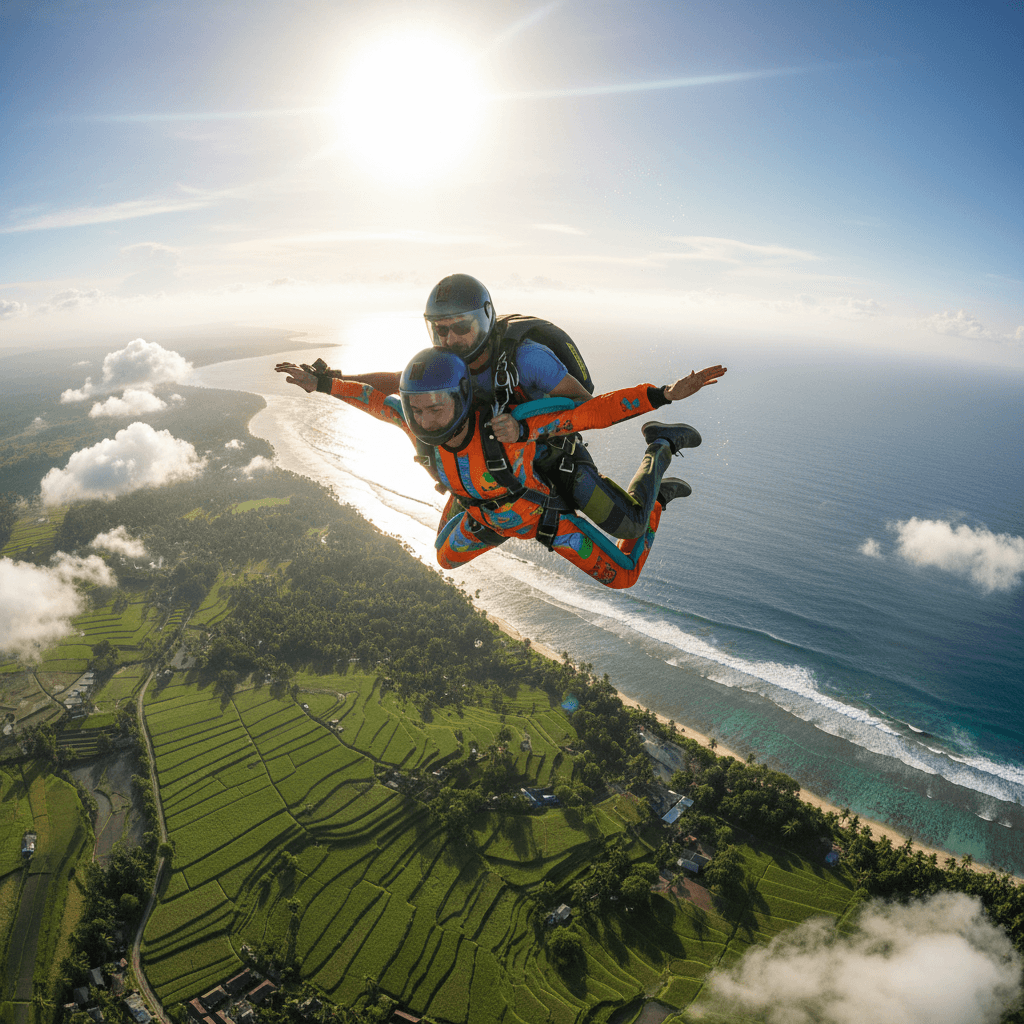
For about half a second, your brain experiences something like a small system error. The expected sensations of "falling" — the stomach lurch, the panicked grab — do not arrive. Because you have not jumped down. You have entered a four-dimensional column of moving air at 130 km/h, in which your body has no reference frame for "down" anymore. There is no falling sensation. There is no rollercoaster drop. There is just — and we mean this literally — flying.
This catches everyone off guard.
For maybe two seconds, you tumble. The horizon spins. You see plane, then sky, then plane again, then ground, then sky. Your instructor's job in those two seconds is to throw a small drogue parachute (the size of a beach umbrella) which both stabilizes you and slows your fall to a normal terminal velocity of around 200 km/h (120 mph). You will not see this happen. You will only feel the moment when the spinning stops and you are belly-down to the Earth, riding a column of wind so dense it feels solid.
This transition — from spinning chaos to stable flight — happens within four to six seconds of exit. The first time you can really think again, you are already a thousand feet below the aircraft, moving roughly the speed of a car on a highway, and your face is being pressed flat by air.
The fear is gone.
Read that again. The fear is gone.
It does not slowly fade. It does not gradually subside. It vanishes the moment the wind hits you, because the part of your brain that was afraid was afraid of the unknown — and the unknown has been replaced by the most absolute physical fact you have ever experienced. You are no longer wondering what skydiving will feel like. You are skydiving.
In its place, almost immediately, comes something else. Something you may not have a word for. People reach for "exhilaration" or "joy" or "ecstasy", and none of those quite cover it. It is closer to a kind of clarity. A great quiet under all the noise.
Your instructor taps your shoulders. You uncross your arms. You arch. You start to fly.
Quick answer — Do you feel like you're falling when you skydive? No. Most first-time tandem skydivers report no falling sensation at all during freefall. The constant column of wind beneath your body removes the "stomach drop" feeling that people associate with rollercoasters or elevators. It feels much more like flying than falling.
What Freefall Actually Feels Like
This is the part where we have to gently tell you that all the videos lied a little.
Not maliciously. Just inevitably. Because freefall is one of the few experiences in life where the recording fundamentally cannot transmit the reality. You cannot film the air pressure on your cheeks. You cannot film the temperature differential between your wrists and your collarbone. You cannot film the way your peripheral vision floods with sky. You cannot film the strange, almost amniotic sense of being held by the air.
Here is what freefall actually feels like.
It does not feel like falling
We've already said this, but it bears repeating because it is the most counterintuitive fact about skydiving. There is no down. There is only here. The wind below you is so strong (you are pushing roughly two atmospheres of pressure into your chest) that it acts like a soft, very loud mattress. You are not falling onto anything. You are being held against air.
It is loud
The wind in freefall is one of the loudest natural sounds you will ever hear. Around 100 dB — comparable to a chainsaw. Conversation is impossible. You can barely hear yourself breathe. This is part of why the experience feels so meditative: the noise is so absolute that it becomes silence. Your inner monologue can't compete. It just stops.
It is fast and it is slow
Forty-five seconds is the most subjectively variable measurement of time you will ever experience. At one moment you'll think this has been forever; the next, you'll wonder if it's already ending. Most first-timers later guess that their freefall was 90 seconds or longer. It almost never is.
You can breathe
This is the single most common first-time fear and it is almost always unfounded. The wind pressure on your face does not prevent breathing. You can inhale and exhale normally, though most first-timers find it easier to breathe through the mouth (open it slightly — the wind keeps it that way) rather than the nose. If you find yourself not breathing, it's because adrenaline has temporarily overridden the autonomic prompt, not because you can't. Smile. The act of smiling forces a small breath through your teeth and resets the cycle.
The view is not what you'll remember
First-time tandem jumpers, almost universally, do not remember the view. They remember the feeling. Photos taken in freefall often surprise the jumper — "I didn't even see that down there" — because attention narrows under high arousal. Your eyes are open. Your gaze is on the horizon. But your processing is internal. This is normal. Don't try to force the view. The view is not the point. The being-there is the point.
Your instructor is doing things behind you
They are checking altitude with a wrist altimeter. They are signaling to a videographer if there is one. They are flying — making subtle inputs with their hands and feet to keep you stable. They are timing the freefall against the planned deployment altitude, which in most Asian operations is between 5,000 and 6,000 feet. You won't feel any of this. From your perspective, you are simply flying.
Then, somewhere around the 50-second mark, you'll feel a small deliberate pressure as your instructor reaches for the deployment handle.
A pause. A pull. And the world goes silent.
Reassurance, in plain English: The "falling" sensation people fear in skydiving comes from acceleration — and you only accelerate for the first 8–10 seconds, until you reach terminal velocity. After that, you are flying at constant speed. Constant speed feels like nothing in the body. Once you're at terminal, your nervous system stops producing the falling alarm.
The Parachute Opening
The parachute opens, and the universe re-tunes.
For about a second and a half, there is a soft pull in the harness — like being slowly lifted by a giant invisible hand. (It is, on a well-packed canopy, much gentler than you expect. The "yank" you've heard about is a relic of older equipment. Modern tandem mains open progressively over a 200- to 300-foot snivel before fully inflating.)
Then the noise stops.
This is — and almost every first-timer says this — the most beautiful part of the whole experience.
One second you were in a 200-km/h wind tunnel with 100 dB of roar in your ears. The next, you are floating. The wind drops to a soft hush. You can hear yourself breathe again. You can hear your instructor's voice in your ear, completely normal, completely conversational, asking "How was that?"
If you are going to cry at any point, it will be here.
It is okay. Many people do. It is one of the most common emotional responses among first-time jumpers and one of the least talked about. The contrast between the previous 60 seconds and this moment is so stark, the relief and joy so total, that the body simply offloads it. Tears, laughter, a kind of stunned silence — they're all on the table. None of them are wrong.
You'll look down. The world looks different now. You can see how far you've come. The aircraft is a tiny dot in the sky above you, almost out of view. The dropzone is a small green-and-tan rectangle below you, with a windsock you can barely make out. Beyond it, in tropical Asia, you might see ocean — turquoise from this height, with the texture of brushed metal. In the desert outside Dubai, you might see the Palm. In Cebu, you might see Bantayan's pale beaches. In Bali, the rice terraces unfold in geometric staircases below you.
Take it in. You have about five to seven minutes of canopy time before you land.
Author's note: If your eyes well up here, just let them. There is no ceremony or self-consciousness needed. Your body has just done something it has never done before, and it needs a moment to file it. Your instructor has seen it many times. They will quietly hand you the ride.
The Canopy Ride
The canopy ride is the part nobody warns you about, because the marketing is all about freefall. But for many jumpers, this is the section they remember most fondly.
Your instructor will loosen your leg straps slightly so you can sit comfortably in the harness rather than dangling. They'll hand you the steering toggles, if you want them, and let you do a few gentle turns. Pull the right toggle, you turn right. Pull both, you flare. Pull hard on one, you spiral.
(They keep one hand on the spare set of toggles. You are not actually piloting the canopy. You are being given a small safe taste of canopy flight, which is one of the most satisfying small thrills of the day.)
The conversation under canopy is, in our experience, one of the loveliest interactions of the entire skydive day. Your instructor — five minutes ago a stranger — is now floating with you above a coastline, pointing out landmarks. "That's the airport over there. That's the ridge we drove past on the way in. You can see Lombok if you look east."
Some instructors stay quiet here, sensing that you need it. Some chat. Read the cues. If you want to be alone with it, you can simply say "I just want to take it in" and they will go quiet immediately.
What you'll feel
- Cold, then warmth. As you descend through the layers of atmosphere, the air rises in temperature. By 3,000 feet you are warm again. By 1,500 feet you can feel the ground.
- Calm at a depth you didn't know was possible. This is not the calm of a meditation app. It is the calm of having just done the thing your nervous system was most afraid of and discovering that it was, in fact, beautiful.
- An urge to laugh. Quiet, reflexive, slightly disbelieving. You will probably laugh out loud at least once under canopy. Don't suppress it.
- Awareness of your body. Heart rate slowing. Breath returning. The strange, faintly ticklish sensation of the harness seat under your thighs. You are very alive in this moment. Pay attention to it. Memory likes specifics.
The canopy ride is also when most people first start to understand what just happened. During the climb, you were too anxious. During the freefall, you were too overwhelmed. Under canopy, with a heart rate dropping back into normal range, you finally have the bandwidth to process. I left an airplane. I left an airplane. I am floating above the earth under a parachute. I left an airplane.
This is when the smile starts. Not the polite one. The other one.
The Landing
Around 1,000 feet above the ground, your instructor will take the toggles back and start setting up the landing pattern.
You'll feel the canopy turn into the wind. You'll see the landing area clearly now — the windsock, the pea gravel pit, the staff member watching from the side of the field. The ground is approaching. Slowly. Then suddenly.
This is the only part of the day where a small, late spike of nerves can return. Wait, am I going to hit the ground? It is brief. It is normal. Trust the process.
At about 100 feet, your instructor will give you the cue: "Feet up!"
You lift your legs straight out in front of you, parallel to the ground. Your instructor pulls down hard on both toggles in a smooth, controlled flare. The canopy stalls. Your descent rate drops to almost zero. And you touch down — usually on your butt, or in a soft sliding skid, or on rare occasions on your feet like you've been doing it for years.
The landing is not what you imagined. It is gentle. Often it is sit-down soft. You will be on your feet within seconds, your instructor unclipping the laterals, the canopy collapsing behind you in a slow theatrical swoosh.
You stand up.
The ground feels strange under your shoes. Your legs are slightly wobbly. Your inner ears are still recalibrating. You walk a few steps. The world looks unreasonably crisp. The colors are too saturated. The air on your face has a texture you can suddenly notice.
Your instructor turns to you, grinning, hand out for a high-five.
You will return it without thinking. You will probably hug them next.
Reassurance, in plain English: Tandem landings under modern square canopies are usually so soft that first-timers often don't realize they've landed until they're already on the ground. The "rough landing" stories you've heard are almost always from old round-canopy jumps decades ago.
The First Ten Minutes After Landing
You will not be normal for ten minutes. Possibly longer.
What happens in those ten minutes:
Your hands shake
Not from fear. From adrenaline. The body just metabolized a tremendous chemical load and the residue is still in circulation. You will reach for your phone and find your fingers slightly clumsy. This is fine. It will pass within twenty minutes.
You smile uncontrollably
This is the most universal post-skydive symptom. Your face does it without permission. People sometimes describe it as feeling stuck — "I couldn't stop smiling" — and it's true. The endorphin release after a high-fear, high-arousal, successfully completed event is one of the largest natural drug experiences your body can produce. You are, briefly, very high.
You repeat yourself
"I can't believe I did that. I can't believe I did that. I can't believe I did that." Your friends will laugh at you. Your instructor will laugh at you. Other newly-landed first-timers will be doing the exact same thing across the field.
You want to do it again immediately
Almost universally. This is one of the great paradoxes of skydiving: the people who were most terrified beforehand are usually the ones most ready to climb back into the plane afterward. Some operators offer same-day repeat-jump discounts because they know.
You become evangelical
You will text everyone you know. You will overshare with strangers. You will, possibly, look up the cost of a license course on your phone before you've even taken your goggles off.
You also feel something quieter underneath
A kind of recalibration. A small sense that something has shifted in you. People who skydive once often describe a small but durable change in the months afterward — not a personality transformation, but a recalibrated relationship to fear. "If I did that, I can do this" becomes a thought you have when facing other things. This effect is real. It is documented. It is one of the unsung gifts of a first jump.
Don't try to make sense of it yet. Get yourself a cold drink. Sit down on a bench. Watch the next group come in.
Author's note: Take a quiet moment alone before you start broadcasting. The first version of the story you tell will become, for the rest of your life, the version you remember. Let it form before you spend it.
What Most First-Time Jumpers Get Wrong About Skydiving
A short, honest correction list, written from the experience of having watched thousands of first-timers misjudge the experience in the same predictable ways.
Wrong: "It's going to feel like the worst rollercoaster drop of my life."
Right: It does not feel like a drop. There is no stomach lurch. The terminal-velocity column of wind beneath you removes the falling sensation almost entirely. Most people describe it as flying.
Wrong: "I'll panic. I won't be able to think."
Right: The opposite is more common. Adrenaline narrows attention, but it also clarifies it. Most first-timers describe their freefall as quieter than the climb — the noise is loud but the inner monologue stops.
Wrong: "I won't be able to breathe."
Right: You can breathe normally. Through the mouth is easier than the nose. The wind pressure does not seal off your airway. If breathing feels hard, it is anxiety, not aerodynamics.
Wrong: "It's going to be unbearably scary."
Right: The scariest part is the anticipation, which peaks before the door opens. The actual freefall is overwhelmingly described by first-timers as exhilarating, not terrifying.
Wrong: "I'll feel sick."
Right: Tandem skydives almost never produce nausea, because the freefall isn't disorienting — you're stable, belly-down, with a constant horizon. The climb to altitude in a bumpy aircraft is the part more likely to make you queasy. If you're prone to motion sickness, eat lightly and consider non-drowsy ginger before the flight.
Wrong: "It's going to hurt — the opening, the landing."
Right: Modern tandem canopies open progressively over several hundred feet. The landing on a square canopy, flared correctly, is often softer than jumping off a low step. Neither hurts.
Wrong: "I'm too scared, so I shouldn't do it."
Right: The fear is the experience. People who arrive completely unafraid often have a flatter, less memorable jump. The terror you're feeling now is the entry fee for the part you'll never forget.
Quick answer — What is the hardest part of skydiving? For almost all first-timers, the hardest part is the moment the aircraft door opens at altitude — not the exit, not the freefall, not the landing. The fear peaks at the door and is largely gone within twelve seconds of leaving the plane.
The Emotional Psychology of a First Tandem
This section is for the readers who are obsessively trying to understand why this experience is supposed to "change" them. (We see you. We were you.)
Here's what's actually happening in your nervous system.
A first tandem skydive is, neurologically, one of a small handful of experiences modern life makes available that combines:
- Genuine, body-believed fear (your amygdala is not faking it — it really thinks you might die),
- Total inability to escape (once you're out the door, the situation has no exit ramp),
- A successful, survived outcome (you land. You stand up. You are intact),
- A massive, immediate dopamine and endorphin reward (the post-jump euphoria),
- And a witnessing other (your instructor — a calm, capable human who guided you through it).
This combination is rare. Most modern fear experiences are either fake (movies, theme parks) or have escape ramps (we can quit a hard meeting; we can leave a tough conversation). A first tandem has neither. Your brain is forced to update its model of what you can survive.
This update — sometimes called a corrective emotional experience in psychology — is durable. It's why people who skydive once often report being braver in unrelated areas of life afterward. They didn't learn something cognitively. They proved something experientially.
There is also the trust dimension. Tandem skydiving is one of the only adventure activities where you put your physical life in the hands of a stranger you met thirty minutes ago. The body registers this. It rewires, slightly, the felt sense that other humans are reliable. People who jump often describe a small, lingering warmth toward strangers in the days afterward. This is not coincidence. It is neurology.
And then there is the vulnerability dimension. Many adults go years without doing anything genuinely emotionally vulnerable in public. A first tandem strips that immediately. You are scared. People can see it. Your instructor sees it. The other first-timers see it. And nobody judges you. The collective acknowledgement that yes, this is hard, and yes, we are all here together is a small social healing.
Add up the survived fear, the trust, the vulnerability, the chemical reward, and the embodied proof of capability, and you have something close to a concentrated dose of growth experience. It is not magic. It is just biology and psychology meeting in an unusual configuration.
This is why people describe their first jump as life-changing. It usually isn't, in the dramatic sense. It rarely changes your career or your relationships or your geography. What it changes is your inner relationship to your own capacity. And that — quiet as it is — is sometimes the more valuable thing.
Author's note: You don't need to chase this effect. You don't need to "use" the jump for self-improvement. The change, if it comes, comes on its own. The best thing you can do is just show up, be honest about your fear, and let the experience do its work.
Tips to Make Your First Tandem Better
A short, practical list. We've earned the right to be terse here.
- Sleep the night before two nights ago. The night-before sleep almost always falls apart. Bank good sleep two nights out.
- Eat a real breakfast. Toast and coffee is not breakfast. Eggs, oats, something with protein and fat that buffers blood sugar.
- Hydrate, but stop drinking water ninety minutes before your scheduled load. Aircraft do not have bathrooms.
- Wear something you can move in. Athletic clothes, closed-toe shoes, layers if the dropzone is high-altitude or cool. No skirts, no flip-flops, no loose jewellery.
- Empty your pockets completely. Phones, keys, coins — anything in your pocket becomes a projectile in freefall. The dropzone has lockers.
- Tie your hair back. The wind will make a knot you can't believe.
- Take the videography package if you can afford it. We don't say this for the operator. We say it for you. You will not remember the freefall the way you think you will. You will want the footage.
- Don't drink the night before. Alcohol disrupts deep sleep and amplifies next-day adrenaline reactivity. Not the day for it.
- Tell your instructor exactly how you feel. If you are scared, say "I am scared." They will calibrate the briefing and the climb to that. Pretending to be fine makes their job harder, not easier.
- Stay off your phone in the climb. The instinct to film everything is strong. Resist it. Be present in the climb. Photos can come on the ground.
- Smile at exit. It tricks your nervous system into thinking you are okay, and it makes the photos look better.
- Don't try to plan what to feel. Whatever you feel will be the right thing. Tears, screams, silence, laughter — all of it is valid. None of it is wrong.
Reassurance, in plain English: The single most predictive variable in how good your first jump feels is not how brave you are. It is how reputable your operator is. Choose well. The rest takes care of itself.
Most first-time tandem jumpers describe it as flying, not falling. After about ten seconds of acceleration, you reach a terminal velocity of roughly 200 km/h (120 mph), at which point the column of wind beneath your body cancels the falling sensation. The dominant feelings are speed, pressure on the face, intense noise, and — surprisingly often — a deep calm.
Yes, before you exit. Almost no, after. The fear in tandem skydiving peaks at the door of the aircraft and is largely gone within twelve seconds of leaving it. The freefall itself is overwhelmingly described by first-timers as exhilarating rather than frightening. Most people are surprised by how calm it feels in the air.
Yes, easily. The wind pressure on your face does not prevent breathing. Most people find it easier to breathe through the mouth than the nose, but both work. If breathing feels hard, it is almost always anxiety, not aerodynamics — smiling helps reset the breath cycle.
The moment the aircraft door opens at altitude. Not the exit, not the freefall, not the landing. The visual of the open door — wind, cold, sky, and ground 13,000 feet below — is the single peak of fear for almost every first-time jumper. It passes within seconds of leaving the aircraft.
Rarely, and almost never in a meaningful way. The most common version of "panic" is freezing in the door for a few seconds before exit, which instructors are trained to handle. Mid-air panic is very uncommon — the experience itself tends to override panic responses, replacing them with focused awareness.
About 4 to 7 minutes from exit to landing. The freefall portion lasts roughly 45 to 60 seconds. The canopy ride lasts another 5 to 7 minutes. The total experience at the dropzone — from arrival to leaving — usually takes 3 to 5 hours, including paperwork, briefing, weather waits, and post-jump celebration.
Tandem rigs carry two parachutes: a main and a reserve. The reserve is repacked every 180 days by a licensed rigger regardless of whether it has been used. In the rare case of a malfunction with the main, the instructor cuts it away and deploys the reserve — a procedure they have rehearsed thousands of times. Modern tandem rigs also include an Automatic Activation Device (AAD) that deploys the reserve automatically if certain altitude and descent-rate conditions are met. The system is layered, redundant, and one of the most engineered safety setups in adventure sport.
Almost always no. Modern square tandem canopies, flared correctly, produce landings so soft that first-timers often don't realize they've landed until they're already on the ground. Most landings are sit-down or sliding stand-up, both of which are gentle. The "rough landing" stories you've heard are usually from old round-canopy military jumps and don't apply to modern tandem.
The overwhelming majority of first-time tandem jumpers describe it as one of the best experiences of their life. Survey data and operator reports across global dropzones consistently show post-jump satisfaction in the 95%+ range. Regret is rare and usually correlates with poor operator choice, not the experience itself. The far more common post-jump regret is waiting so long to do it.
Tandem skydiving is one of the most regulated and gear-redundant activities in adventure sport. Statistically, you are more likely to be injured driving home from the dropzone than during the jump itself. Reputable operators in Asia work under USPA, APF, BPA, FASI, GCAA, or equivalent oversight; equipment is inspected and packed under strict protocols; and tandem instructors carry thousands of jumps and a separate dual rating beyond their standard license.
The Person You Are About to Become
Somewhere on the drive home, you will become very quiet.
You will look out the window at the same roads you drove in on, and they will not look the same. The world is exactly as it was six hours ago — the same trees, the same traffic, the same petrol stations — but something in your perception has been gently re-tuned. Colors are slightly more vivid. Edges are slightly sharper. There is a small, persistent, low-grade hum of being okay under your sternum that you are not used to feeling.
You will pull out your phone and look at the videos and photos. You will not look like the version of yourself you remember being. You will look braver in them than you remember feeling. (You were braver than you remember feeling. The memory of fear always overweights the moment; the photo just records the truth.)
In a week, the story of your first jump will start to settle into a clean shape. You will tell it at dinner. You will tell it badly the first three times. By the fifth telling, you will have figured out which beats land, and which sentences feel right in your mouth. By the tenth telling, the story will feel like it belongs to you.
And here is the small, slightly mystical truth that this article has been circling for several thousand words: the person who took off in that aircraft was not the same person who landed under the canopy. The change is not enormous. It is not Hollywood. It is just a quiet upgrade to your model of yourself. A small, durable piece of evidence that you can do hard things. That fear is survivable. That the door of the airplane was the worst part, and the door of the airplane was nothing.
You will carry that into other rooms. Job interviews. Difficult conversations. Decisions you've been putting off. You will not consciously connect them to the jump — but the small voice in your head that used to say "I don't think I can" will be a little quieter than it was. It has been overruled, once, in the most embodied way possible. It does not get to vote with the same weight anymore.
That is the gift of a first tandem skydive. Not the freefall. Not the views. Not even the canopy ride. The gift is the quiet evidence you carry home.
If you've read this far, you're probably not just researching. You're preparing. You're trying to mentally meet the experience halfway. So let us close with this:
You are going to be fine.
You are going to be more than fine. You are going to walk into a small dropzone in Bali, or Pattaya, or Cebu, or Dubai, or Chiang Mai, and meet a calm, tan, slightly grinning instructor who will buckle you into a hug-shaped piece of nylon and walk you, very gently, to the open door of an airplane two and a half miles above the Earth. And then, on the count of three, the two of you will step out together. And you will fly.
We will be here for the part where you book it.
Find your first tandem in Asia
Skydive In Asia is the discovery platform for tandem skydiving across the region — from the beaches of Bali, Cebu, and Sri Lanka to the deserts of Dubai and the mountains of Chiang Mai. Browse the dropzones, read the honest reviews, and start imagining the morning.
The Skydive In Asia editorial team writes evidence-based, operator-verified guides for skydivers across Asia.

