On this page
- 01Quick Answer: What Should You Wear for a Tandem Skydive?
- 02Why What You Wear Actually Matters
- 03The Best Clothing for a Tandem Skydive
- 04The Best Shoes for Skydiving
- 05What NOT to Wear
- 06What to Bring to the Dropzone
- 07What You DON'T Need to Bring
- 08What the Weather Feels Like During a Skydive
- 09What to Wear in Different Asian Destinations
- 10Hair, Glasses & Accessories
- 11What First-Time Jumpers Usually Get Wrong
- 12The Emotional Side of Preparation
- 13Tips From Experienced Tandem Jumpers
- 14Conclusion
- 15Keep Reading
You wake up before your alarm. The room is still dim. Outside, the air is already warm — it's somewhere in Asia, and the morning sounds different here, softer, like the whole island is still half asleep.
Then you remember why you're awake.
Today is the day you jump out of a plane.
For the next hour you do small, slightly irrational things. You drink water. You check the weather on three apps. You stand in front of your suitcase and try to remember the briefing email — what was it they said about clothing again? You hold up two t-shirts and ask them, quietly, which one is more aerodynamic. Then you laugh at yourself, because you don't actually know what aerodynamic means in this context, only that you are about to fall through the sky at 200 kilometres an hour and you don't want your shirt to do anything strange.
If any of this feels familiar, you're not alone. Almost every first-time tandem skydiver in Asia goes through some version of this morning. The excitement is real. The nerves are real. And underneath them sits a very specific, very small, very solvable question:
What am I supposed to wear, and what am I supposed to bring?
The good news is that the answer is far simpler than the internet makes it look. There is no special outfit. There is no skydiving uniform. There is no secret list of equipment you forgot to buy. Tandem skydiving was built around the assumption that you, the customer, would arrive at the dropzone in normal clothes, with a normal bag, having had a normal breakfast.
This guide is the version of that answer we wish every first-time jumper in Asia had access to the night before their jump. It covers what to wear, what to bring, what to leave behind, what the weather actually feels like at altitude, what experienced jumpers wish first-timers knew, and the small psychological rituals that turn nervous mornings into great memories.
Read it once tonight. Skim the checklist tomorrow morning. Then put your phone away and go enjoy one of the best things you will ever do.
Quick Answer: What Should You Wear for a Tandem Skydive?
If you only have ninety seconds before you head to the dropzone, here is the entire article in one breath.
Wear
- A fitted t-shirt or athletic top
- Comfortable leggings, joggers, or athletic shorts
- Lace-up sneakers or trainers
- A light layer if it's cooler or you're jumping at higher elevation
Bring
- Photo ID or passport
- Your booking confirmation
- A reusable water bottle
- Sunscreen
- A hair tie if your hair is long
- A small snack
- A change of clothes for after
- A charged phone
Avoid
- Sandals, flip-flops, Crocs, slip-ons, or heels
- Dresses or skirts
- Loose scarves, large earrings, necklaces, or dangling jewellery
- Anything baggy that can flap, ride up, or get tangled in the harness
- A heavy bag full of things you won't need
Best outfit, summarised: a fitted athletic t-shirt, joggers or leggings, snug lace-up sneakers, hair tied back. That's it. That's the outfit.
The three biggest first-timer mistakes: wearing the wrong shoes, overdressing for the weather on the ground, and bringing a backpack full of items the dropzone will store in a locker anyway.
If you want to understand why — and there are very real reasons — keep reading.
Why What You Wear Actually Matters
It's tempting to assume your outfit is irrelevant. The instructor is the one doing the work. The parachute does the falling-slowly part. You just have to show up and breathe.
That's mostly true. But your clothing has one quiet job, and it does it for the entire jump: it has to share space with the harness.
The tandem harness is the piece of equipment that connects you to your instructor. It wraps over your shoulders, around your chest, across your hips, and between your thighs. It is then tightened — properly tightened, the kind of tightened that surprises people the first time — until you and the instructor become, functionally, one person. Everything you wear underneath that harness has to live with it for the next forty-five minutes.
Here's what that means in practice.
Comfort
Bulky pockets, thick seams, hard waistbands, big buttons, and stiff zippers all become noticeable when a strap presses them into your skin for the duration of the climb. They don't ruin the experience, but they distract from it. The fewer things between you and the harness, the more present you can be.
Fit
Loose, oversized clothing bunches under the harness in ways that are difficult to readjust mid-flight. Once the harness is on, your instructor isn't going to ask you to take it off so you can pull your shirt down. Fitted clothing avoids this entirely.
Movement
During the jump itself you'll be asked to do small, specific things — arch your back, lift your legs on landing, tuck your feet up. Stretchy, athletic clothing makes this easy. Restrictive jeans or stiff fabrics make it harder.
Wind
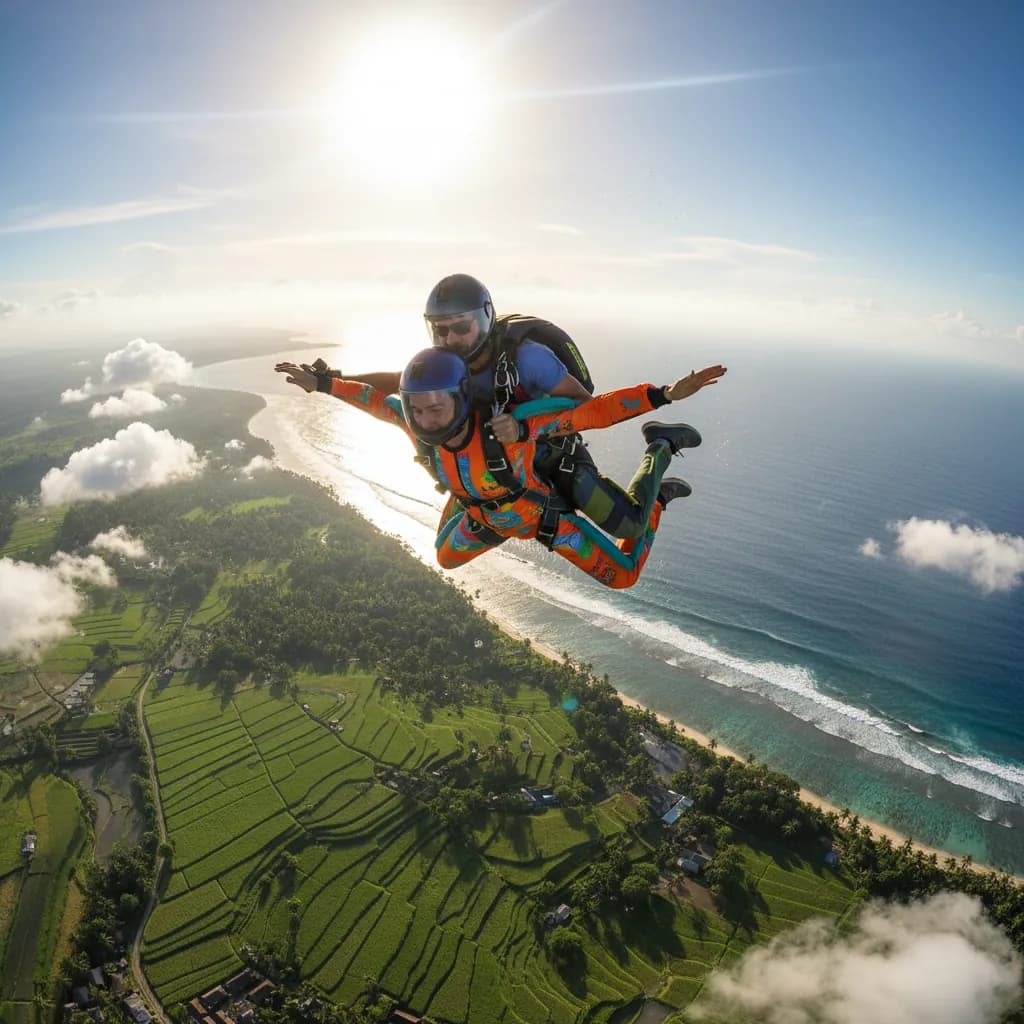
At terminal velocity — roughly 200 kilometres per hour during freefall — wind does interesting things to fabric. Loose sleeves, long shirts, and untucked layers flap, snap, and ride up. None of this is dangerous in tandem, but it is uncomfortable in a way that lingers in photos.
Temperature
Most Asian dropzones are warm to hot at ground level. At jump altitude (typically 10,000 to 15,000 feet, depending on the dropzone), it's noticeably cooler. Not freezing, but cooler. Freefall amplifies this for about 60 seconds. Then under canopy, the temperature climbs again as you descend. Your outfit should cover the difference, not commit to one extreme.
Landing
Tandem landings are often slides, especially on grass dropzones. Long bare legs, exposed ankles, and open shoes make those landings less pleasant than they need to be. Light coverage solves this.
The principle is simple: dress like you're going to a long workout in slightly variable weather. That's genuinely all this is.
The Best Clothing for a Tandem Skydive
Once you understand the harness, the rest of the wardrobe decisions almost make themselves. Here's how to think about each layer.
T-shirts and tops
A fitted cotton or athletic t-shirt is the right call almost everywhere in Asia. It sits flat under the harness, doesn't flap in freefall, and doesn't trap heat on the ground.
If you're somewhere a little cooler — Chiang Mai in the early morning, a mountain dropzone, a higher-altitude jump — a snug long-sleeve athletic top is even better. It protects your arms from the harness straps and from the cooler air at altitude.
Avoid anything cropped, oversized, off-the-shoulder, or with a deep neckline. The harness will pull these into positions you didn't sign up for.
Athletic wear
If your default outfit is leggings and a workout top, you're already dressed correctly for a tandem skydive. Athletic wear was designed for movement, fit, and breathability — exactly what this day asks of your clothes.
A simple athleisure outfit also photographs well, which matters more than people admit. Most dropzones offer a video or photo package, and you'll be looking at those frames for the rest of your life. Clean, fitted, uncomplicated clothes age better than novelty outfits.
Leggings and joggers
Leggings are the single most popular bottom-half choice for tandem jumpers, and for good reason. They're comfortable, they're stretchy, they don't bunch under the harness, and they protect your legs on landing.
Joggers — slim-fit, ankle-cuffed — are the next best thing. The cuff matters: loose-bottomed sweatpants will balloon in freefall and ride up your shins.
Avoid jeans. They're stiff, the seams sit awkwardly under the harness, and the waistband is rarely in the right place once everything is strapped on.
Shorts
Shorts are perfectly fine in hot weather, with one caveat: they need to be athletic shorts, not casual shorts. Mid-thigh, fitted, with a soft waistband. Think running shorts or training shorts, not denim shorts or board shorts.
The reason is the harness leg straps. They pass between your thighs, and a stiff or coarse fabric in that exact spot is uncomfortable in a way you'll remember longer than the jump itself. Soft, athletic shorts solve this.
If you're jumping somewhere genuinely hot — Cebu in May, Pattaya in April, Dubai in July — shorts plus a light long-sleeve top is often the most comfortable combination.
Lightweight layers
A thin athletic jacket or zip-up is worth bringing even in tropical climates. You won't wear it in the plane, but you might want it on the ride to the dropzone, during the briefing in an air-conditioned room, or after the jump when adrenaline finishes leaving your body and your temperature drops with it.
Avoid hoodies with drawstrings. The strings can flap, the hood can catch wind, and large hoods don't sit well under the harness shoulders.
Tropical vs. cooler climates
In tropical Asia — Bali, the Philippines, southern Thailand, Sri Lanka, Cambodia — a fitted t-shirt and athletic shorts or leggings is almost always right.
In cooler or higher-altitude regions — Chiang Mai in winter, certain mountain dropzones, dawn jumps in shoulder season — a long-sleeve athletic top and joggers is the safer call. You can always push sleeves up; you can't make a t-shirt warmer at altitude.
Dubai is its own category. The ground is hot, the aircraft is air-conditioned, and the freefall is brisk. A long-sleeve athletic top with leggings or joggers tends to be the sweet spot.
Fitted vs. loose
If you take only one rule from this entire section, take this one: fitted beats loose, every time, in every climate.
Loose isn't dangerous. Tandem skydiving is overwhelmingly safe and your instructor has seen every wardrobe decision a human can make. But loose is uncomfortable, distracting, and unflattering in the photos. Fitted is none of those things.
The Best Shoes for Skydiving
Footwear is the single most common thing first-timers get wrong, and it's worth its own section.
What to wear
Lace-up sneakers or trainers. Snug. Properly tied. The exact pair you'd wear to the gym.
That's the answer. Almost any closed-toe athletic shoe with laces is the right shoe for a tandem skydive. They stay on your feet at 200 kilometres per hour. They protect your ankles on landing. They give you something to push off from when the instructor asks you to lift your legs. They photograph normally.
If you're between options, choose the snugger pair. Sneakers that are slightly tight on the ground are perfect in the air.
Why other footwear is a problem
- Sandals, flip-flops, slides — these will not stay on your feet during freefall. There is no version of this where they do. Most dropzones won't even let you board the aircraft in them.
- Crocs — same reason, even with the strap.
- Slip-on shoes without laces — boat shoes, ballet flats, certain low-cut sneakers. They might survive the climb. They might not survive freefall. Most instructors will ask you to change.
- Heels, wedges, boots with high heels — almost every dropzone will refuse the jump.
- Hiking boots — technically fine, but overkill. They're heavy, hot, and can interfere with the harness leg straps if they're particularly tall.
If you arrived at the dropzone in the wrong shoes, don't panic. Most operators keep a small loaner stash for exactly this reason. Ask politely. Bring socks just in case.
Practical landing comfort
Tandem landings, especially in Asia, are often executed as a controlled slide on the dropzone's grass landing area. Your instructor will ask you to lift your legs straight in front of you and let them do the landing. Sneakers protect your heels, ankles, and shins through that motion in a way bare feet or sandals simply can't.
What NOT to Wear
A short, honest list. None of this is a moral judgement. It's just what fifty years of tandem skydiving has learned about the wardrobe choices that don't survive a parachute jump.
| Category | Wear | Avoid |
|---|---|---|
| Top | Fitted t-shirt or long-sleeve athletic top | Cropped, off-shoulder, oversized, hoodies with drawstrings |
| Bottom | Leggings, joggers, or athletic shorts | Jeans, denim shorts, skirts, dresses, loose sweatpants |
| Footwear | Lace-up sneakers, snug fit | Sandals, flip-flops, Crocs, heels, slip-ons |
| Accessories | Small studs, fixed rings, sports watch with snug strap | Hoop earrings, long necklaces, scarves, dangling bracelets |
| Hair | Low ponytail or braid, tied back | Loose long hair, high ponytails under the goggle strap |
Loose accessories
Scarves, bandanas not tied tightly, dangling belts, oversized hats. They will not return with you. Some of them can also tangle with equipment in ways the instructor would rather avoid.
Jewellery
Long necklaces, hoop earrings, dangling bracelets, large rings. The wind takes some of them. The harness pinches the rest. A small stud earring or fixed nose ring is fine. Wedding rings stay on. Anything that swings, comes off.
Watches
A small, secure sports watch with a tight strap is fine. A loose metal watch is not.
Restrictive clothing
Skinny jeans you can barely sit in, tight blouses, anything that limits your ability to lift your legs or arch your back.
Stiff or coarse fabrics
Denim, canvas, anything with hard seams. They sit poorly under the harness.
Dresses and skirts
Even with shorts underneath, the wind makes this an uncomfortable choice in freefall and an awkward one in photos. Most dropzones will ask you to change before they let you suit up.
Open footwear
Already covered, but worth repeating. No sandals. No flip-flops. No bare feet.
Anything you'd be sad to lose
Sunglasses without a strap. A favourite cap. An expensive scarf. The dropzone will offer to store these for you, which is genuinely the best place for them.
The pattern across all of this: if it's loose, decorative, fragile, or sentimental, leave it in the locker. If it's snug, athletic, simple, and replaceable, you're dressed.
What to Bring to the Dropzone
This is where most first-timers either over-pack or under-pack. The goldilocks answer is shorter than you'd think.
Photo ID or passport
Required almost everywhere. Many dropzones in Asia ask to see this when you check in, especially if you booked under your full legal name. Bring the actual document, not a photo of it.
Booking confirmation
Email or screenshot, either is fine. Have it accessible without needing wifi at the dropzone, which can be unreliable.
Reusable water bottle
You will be thirstier than you expect. Adrenaline dehydrates. The wait between briefing and jump can run longer than the schedule suggests, and you'll be standing in the sun for some of it. Drink steadily through the morning.
Sunscreen
Apply before you arrive, then bring a small bottle for the wait. Asian dropzones are sunny, exposed, and have very little shade in the boarding areas. Sunburn on jump day is an avoidable but extremely common souvenir.
A hair tie or two
If your hair is long, you will need to tie it back before the jump. Most dropzones have spares but they are not always nearby. Bring your own. A simple low ponytail or braid sits best under the goggles.
A light snack
Don't jump on an empty stomach. Don't jump on a full one either. A banana, a granola bar, a small sandwich an hour or two before the jump is the right calibration. Save the celebratory meal for after.
A change of clothes
Especially if it rains, especially if you sweat through your jump outfit, especially if you want to be dry and clean for whatever comes next. A small bag with a fresh t-shirt and a towel is enough.
Phone, charged, with storage available
You'll want photos of yourself before, of the aircraft, of the dropzone, and of the moment you land. Many dropzones will also airdrop or share your jump video on the spot. A phone with 5% battery and no storage is a tiny tragedy. Charge the night before.
Cash or a card
Some dropzones charge for video upgrades, group photos, t-shirts, or transport on the day. Most accept card, but small operators in remote areas occasionally don't.
A small towel
Useful in tropical climates. Useful after a hot landing. Useful if you cried a little in freefall, which is more common than you'd think.
That's the list. If your bag has more than this, you've over-packed.
What You DON'T Need to Bring
The flip side of the packing question. These are the things first-timers bring out of caution, then leave untouched in a locker all morning.
- A change of complete outfits — one spare t-shirt and a pair of underwear is plenty.
- Multiple pairs of shoes — the pair on your feet is the only pair you need.
- A bulky backpack — you'll be storing it the moment you arrive. Bring a small daypack at most.
- Action cameras you plan to wear — almost no operator in Asia will allow a customer-attached GoPro on their first tandem. The dropzone's video package is the camera.
- Your own helmet, goggles, gloves, or jumpsuit — all of this is provided.
- Valuables you'd be heartbroken to lose — expensive watches, designer sunglasses, family jewellery. Lockers are generally safe but the day involves more handoffs than you'd think.
- Large sums of cash — card is fine almost everywhere now.
- Reading material for the wait — you will not read it. You will check weather apps, retie your shoes, and stare at the aircraft. This is normal.
On personal cameras specifically: the rule isn't operator paranoia. The international skydiving safety standard (USPA Skydiver's Information Manual §6-8) sets a 200-jump minimum before anyone — student, tandem passenger, or licensed jumper — flies with a camera. Loose objects are the most common entanglement hazard during canopy deployment. Your dropzone's instructor-mounted or handcam package exists precisely so you don't need to bring one.
The mental model is: pack like you're going to a beach for half a day, not like you're going on a trip.
What the Weather Feels Like During a Skydive
This is the section nobody tells you, and it's the one most first-timers wish they'd known.
On the ground
Whatever the weather is, that's what you'll feel during check-in, harness fitting, and the briefing. Most Asian dropzones run hot during the day, so this part can feel sweaty. You'll be tempted to over-dress for the cooler air at altitude. Resist. The plane and the freefall handle that for you.
In the aircraft
Skydiving aircraft in Asia are usually small Cessnas, a Twin Otter, or a turbine like the Pacific Aerospace 750XL. They're rarely air-conditioned. The doors stay closed during the climb. With ten or twelve sweaty humans inside, the cabin warms quickly. By altitude, you'll be glad you didn't wear a hoodie.
At altitude, before the door opens
The temperature drops as you climb. The rule of thumb is roughly 2°C cooler for every 1,000 feet of altitude gain, which means a 13,000 ft jump puts you about 25°C colder than the ground. In tropical Asia that means you go from 32°C on the runway to around 7°C at the door. It sounds extreme on paper. In practice, you're inside the aircraft for almost all of it, and you'll only feel the real chill in the seconds between the door opening and the exit.
The door opening
This is the moment everyone talks about. The wind comes in. The aircraft floor seems to tilt. The view becomes enormous. Your brain forgets the temperature entirely.
Freefall
This is the part that surprises people. Freefall doesn't feel cold — it feels fast. The air pressure on your face is the dominant sensation. Wind noise replaces every other sound. You'll feel the cool air on any exposed skin, but adrenaline flattens it. Most jumpers describe freefall as 'windy' rather than 'cold,' even at altitude.
It also doesn't feel like falling, which is the strangest thing of all. Without a reference point above you, your brain interprets the sensation as flying through fast-moving air. There's no stomach drop. No rollercoaster sensation. Just an enormous, full-body wind.
This is why fitted clothing matters. Fabric flapping against your skin in a 200 km/h wind is the only part of freefall that can be uncomfortable, and it's entirely preventable.
Under canopy
When the parachute opens — about 60 seconds after you exit — everything changes. The wind disappears. Sound returns. You float. The temperature climbs back as you descend. Most jumpers describe this part as the most peaceful five minutes of their life, regardless of climate.
On landing
You're back in ground temperature. By now your adrenaline is at full volume. You will not feel cold. You may feel shaky, weepy, ecstatic, talkative, or completely silent. All of these are normal.
The point of all of this: dress for the ground, with one light layer for the air, and trust that freefall is a sensation, not a forecast.
What to Wear in Different Asian Destinations
Asia is not one climate, and skydiving conditions vary meaningfully across the region. Here's how to think about wardrobe by destination.
| Climate | Top | Bottom | Layer |
|---|---|---|---|
| Tropical coastal (Bali, southern Thailand, Cebu, Sri Lanka) | Fitted t-shirt | Athletic shorts or leggings | Optional light long-sleeve in bag |
| Equatorial humid (Pattaya, Malaysia) | Fitted t-shirt | Athletic shorts or leggings | Spare t-shirt for after |
| Desert (Dubai, Gulf) | Fitted long-sleeve athletic top | Leggings or joggers | Sunglasses + aggressive sunscreen |
| Mountain / higher elevation (Chiang Mai) | Long-sleeve athletic top | Joggers | Light jacket for the wait |
| Indoor wind tunnel (Sentosa, Cibubur) | Athletic t-shirt | Athletic shorts or leggings | Flight suit provided |
Tropical coastal — Bali, southern Thailand, Cebu, Siquijor, Sri Lanka
Hot, humid, often beachside. The default outfit is a fitted t-shirt, athletic shorts or leggings, and sneakers. A light long-sleeve top in your bag is useful for the cooler air at altitude but you may not need it.
Sunscreen is essential. So is the water bottle. Coastal dropzones often have very little shade in their pre-jump areas.
Equatorial humid — Pattaya, parts of Malaysia
Hot, humid, often hazy. Same outfit as tropical coastal. Expect to sweat through the briefing. A small towel and a change of t-shirt for after is the upgrade that pays for itself.
Desert — Dubai, parts of the wider Gulf
Hot ground, dramatic temperature drop at altitude, strong sun, low humidity. A fitted long-sleeve athletic top with leggings or joggers is the most comfortable combination. Sunglasses (with a strap if you want them on under canopy, which most dropzones won't allow during freefall but may permit afterwards). Aggressive sunscreen.
Mountain or higher elevation — Chiang Mai, certain inland dropzones
Cooler ground temperatures, especially at dawn. Sometimes mist. Long-sleeve top, joggers, sneakers, and a light jacket for the wait. The freefall feels meaningfully cooler here than at coastal sites, but still manageable.
Indoor wind tunnels — Sentosa, Cibubur, similar urban facilities
Different category, but worth covering. Indoor bodyflight uses the same wind speeds as freefall but in a controlled environment. Athletic clothing, lace-up sneakers, hair tied back. No jewellery. No loose layers. Most facilities provide a flight suit, helmet, and goggles. Wear what you'd wear to the gym underneath.
Seasonal considerations
In tropical Asia, rainy season can shut a jump day down with very little notice. Bring a light rain layer if you're travelling specifically for the jump and the forecast is unsettled. Most dropzones will reschedule for free if weather grounds the aircraft, but you'll still be standing around the dropzone hoping it clears.
Hair, Glasses & Accessories
The smaller decisions that have outsized impact on comfort.
Hair
If your hair is long enough to tie back, tie it back. A single low ponytail or a braid sits best under the goggles and helmet. High ponytails press against the goggle strap and can give you a tension headache during freefall. Buns work but can shift under the helmet.
Loose hair will tangle. There is no version of this where it doesn't.
Bring a spare hair tie. They snap, they fall, they vanish in the breeze.
Glasses
You can wear glasses for a tandem skydive. The dropzone will provide larger goggles that fit over them. They work fine for the vast majority of jumpers.
If your glasses are particularly large, particularly expensive, or you have a strong preference, contact lenses are the easier choice. Daily disposables are ideal — bring a spare set for after the jump in case one comes out.
You will not be able to wear sunglasses during freefall. The goggles handle UV. Bring sunglasses for the wait and for after the jump, with a strap if possible.
Contact lenses
Contacts are perfectly compatible with skydiving. The goggles seal well enough that wind doesn't reach your eyes. Daily disposables are recommended over monthly lenses simply because you have a fresh backup.
Long hair, short notice
If you've never tied your hair back and don't know how, ask a friend before you arrive. Most dropzone staff can also help, but it's a calmer morning if you've done it once already.
Jewellery
Already covered, but worth restating: small studs, a wedding ring, a snug fixed ring or piercing, all fine. Anything that swings, dangles, or could catch in the harness comes off. Lockers exist for exactly this.
Watches
Sports watches with a snug strap are fine. Smartwatches are fine. Loose metal watches are not. The wind has taken many watches.
Hats and caps
You can wear a cap to the dropzone. You will not wear it in the aircraft. The dropzone provides a helmet for the jump itself. Caps come off in freefall, so leave yours in the locker rather than on your head at boarding.
What First-Time Jumpers Usually Get Wrong
This is the section where we admit, gently, that almost everyone makes the same small mistakes.
Overdressing
'It'll be cold up there' is the most common pre-jump worry, and it leads people to wear thick hoodies, jeans, or layers that turn the briefing room into a sauna. The aircraft and freefall handle the cold. The ground does not.
Underestimating their nerves
Nerves are normal. Nerves are also dehydrating, distracting, and physically tiring. The jumpers who handle their nerves best are usually the ones who slept enough, ate something light, and arrived early enough not to feel rushed. The ones who arrive late, hungry, and over-caffeinated have a harder morning.
Bringing too much
A backpack full of 'what ifs' sits in the locker untouched. Pack like you're spending half a day at a friend's house, not like you're going on a trip.
Wearing the wrong shoes
Already covered three times in this guide, but it's worth a fourth. Sandals are the single most common reason a customer is turned away or asked to change at check-in. Lace-up sneakers, every time.
Skipping water
Adrenaline is dehydrating. The wait can be long. Heat compounds both. Drink steadily through the morning and you'll feel better through every part of the day.
Worrying about how they look
Tandem photos are not modelling shoots. The wind pulls cheeks back, eyes water, hair flies. This is the universal experience and it produces the universal expression of pure, unfiltered joy. Lean into it. The photos that try too hard to look composed are the ones that don't age well. The ones that look slightly chaotic and absolutely thrilled are the ones you'll frame.
Trying to be brave
You don't have to perform calmness for your instructor. They've seen tears, screams, silent stares, nervous laughter, and complete shutdowns. None of it is unusual. Tell them how you actually feel. They'll meet you there.
Skipping the instructor's briefing
It is short. It is genuinely useful. Listen to all of it.
The Emotional Side of Preparation
This is the section we wish more first-timers read the night before.
Preparing for a tandem skydive is partly a wardrobe question and partly a psychology question. Most of the rituals around this day — the obsessive outfit check, the third weather app, the bag re-pack — aren't really about the outfit, the weather, or the bag. They're about the brain looking for somewhere to put the nervous energy.
That's okay. That's a feature, not a bug.
Nervousness before a skydive is the same biological signal that has kept humans alive for a hundred thousand years. Your brain is doing exactly what it should do when faced with the prospect of jumping out of an aircraft: it is alert, it is mobilised, it is asking thoughtful questions. The job tonight isn't to silence that signal. It's to give it useful work to do.
Packing your bag is useful work. Picking your outfit is useful work. Drinking water and going to bed early is useful work. Reading this guide is useful work. Watching dramatic skydiving fail compilations on YouTube at midnight is not useful work.
The jumpers who arrive at the dropzone calmest are not the ones who suppressed their nerves. They are the ones who acknowledged them, prepared the small things, and then let the experience unfold.
A few small rituals that actually help
Decide the night before. Lay out your clothes, pack your bag, charge your phone. Make zero decisions on the morning of the jump. Decision fatigue is the enemy.
Eat something light, on time. Skipping breakfast doesn't help. Eating a heavy breakfast doesn't help either. Toast, fruit, a small omelette, a bowl of rice. Two hours before the jump.
Arrive early enough to settle. Rushing into a check-in five minutes before the briefing means starting the day with cortisol you can't shed. Aim to arrive 30 minutes before your slot. Sit. Breathe. Look at the aircraft.
Trust the people around you. Tandem instructors in Asia have completed thousands of jumps. The dropzones operate to international standards. Your job is to enjoy the experience. Their job is everything else.
Let the nerves come. They are not a sign you shouldn't jump. They are a sign you understand what you're about to do. Both can be true. Both will be true. Both are part of the memory.
The strange thing — the thing every experienced jumper says — is that the nerves never quite leave, and they never quite ruin anything either. The jumpers who keep coming back are the ones who learned to hold both.
Tips From Experienced Tandem Jumpers
A short list of advice from people who've done this many times. None of it is dramatic. All of it is true.
- Prioritise comfort over style. Your favourite outfit is not the right outfit. Your most comfortable athletic clothes are.
- Sleep well the night before. Adrenaline burns fuel. Tiredness amplifies nerves. A real night of sleep is the cheapest performance enhancer available.
- Eat lightly, but eat. A small meal an hour or two before is correct. An empty stomach makes nausea more likely on the climb. A heavy stomach makes everything else worse.
- Drink water steadily. Hydration genuinely affects how your body handles altitude, heat, and adrenaline.
- Trust your instructor. They will tell you exactly what to do, exactly when to do it. The jump itself involves almost no decisions on your part.
- Embrace the nerves. The jumpers who try to suppress their nerves often struggle more than the ones who say openly: I'm scared and I'm doing it anyway. The second sentence is the whole point.
- Open your eyes. First-timers often close their eyes for the first few seconds of freefall. This is normal. Open them as soon as you can. The view is the entire reason you came.
- Yell if you want to. Or don't. Both are fine. There's no right way to freefall.
- Don't filter the photos. The unfiltered ones are the best ones.
- Talk to other jumpers afterwards. The ten minutes after a tandem jump, sitting in the grass with strangers who just did the same thing, is one of the most underrated parts of the day. Stay for it.
Lace-up sneakers or trainers, snug, with the laces tied. The same pair you'd wear to the gym. Sandals, flip-flops, slip-ons, Crocs, and heels are not allowed at most dropzones.
Yes, in warm climates. Athletic shorts work best — fitted, mid-thigh, with a soft waistband. Avoid denim shorts or stiff casual shorts because the harness leg straps sit between your thighs and need a soft fabric there.
Yes. The dropzone will provide oversized goggles that fit over your glasses. If your glasses are particularly large or expensive, contact lenses (ideally daily disposables) are easier.
Yes — for the wait, the pre-jump photos, and to receive your jump video afterwards. You will not be allowed to hold your phone during the jump itself. Charge it the night before.
It depends on the destination and altitude. The ground is whatever the local climate is. The aircraft is warmer than expected because it's full of people. Altitude is around 25°C colder than the ground, but you're inside the cabin for most of it. Freefall feels windy more than cold. Under canopy, the temperature climbs as you descend. For most Asian dropzones, a fitted t-shirt and athletic bottoms is enough.
Sandals, flip-flops, dresses, skirts, jeans, baggy sweatpants, hoodies with drawstrings, scarves, dangling jewellery, large earrings, loose hats, anything with stiff seams or hard zippers under the harness areas.
No. Tandem skydiving in Asia rarely requires gloves, even in the cooler regions. The dropzone provides everything you need — harness, goggles, helmet, and any climate-specific layers if applicable. You arrive in normal clothes and leave in normal clothes.
Small studs, fixed rings, snug piercings, and wedding bands are fine. Anything that dangles, swings, or could catch in the harness or wind should come off. The dropzone has lockers.
Most dropzones in Asia will delay or reschedule jumps if the weather is unsafe. They generally won't charge you for the reschedule. Bring a light rain layer if your travel timing is tight and the forecast looks unsettled. If you're flying in specifically for the jump, build a buffer day into your trip.
Yes, and you should. Skip neither extreme — don't jump on an empty stomach, don't jump after a heavy meal. A small, simple breakfast or lunch one to two hours before the jump is the right calibration.
Most jumpers don't. Tandem skydiving feels less like a rollercoaster than people expect — there's no stomach drop because there's no reference point above you. If you're prone to motion sickness, eat lightly, hydrate, and skip caffeine on jump morning. The dropzone will have a bag in the cabin if you need it, and there is zero shame in using it.
Yes, and you should. Spectators are welcome at almost every dropzone in Asia, often for free. They make the photos better and the experience funnier.
Almost certainly not. The international skydiving safety standard sets a 200-jump minimum before anyone — including tandem passengers — flies with a camera, because loose objects are the most common entanglement hazard at canopy deployment. Use the dropzone's instructor-mounted or handcam package instead. It's better than what you'd film anyway.
You can. Tandem instructors will not push anyone out of an aircraft against their will. It's extremely rare, but it happens, and it's handled professionally. The aircraft lands, you go home, and most dropzones will let you reschedule.
Conclusion
If you've made it this far, you are now more prepared for your tandem skydive than 95% of the people who walk into a dropzone in Asia tomorrow morning.
You know what to wear: a fitted athletic top, leggings or joggers, snug lace-up sneakers, hair tied back. You know what to bring: ID, water, sunscreen, a snack, a charged phone, a change of clothes. You know what to avoid: sandals, dresses, jewellery, anything baggy or precious. You know what the weather will feel like, what your nerves will do, and what the experienced jumpers wish they'd told you.
More importantly, you know that none of this is as complicated as the morning makes it feel.
A tandem skydive is one of the simplest things you'll ever do. You arrive in normal clothes. A professional instructor straps to your back. An aircraft climbs to 13,000 feet. You step out. You fall through 60 seconds of pure, full-body wind. A parachute opens. You float for five minutes over some of the most beautiful coastline, mountain, or desert in Asia. You land. You stand in the grass shaking and laughing. You look at the photos. You text someone you love.
Then you spend the rest of your life being someone who has jumped out of a plane.
The outfit is just the small, calm, practical part of getting there.
Ready to pick your first jump?
Skydive In Asia is the discovery platform for tandem skydiving across the region — from the beaches of Bali, Cebu, and Sri Lanka to the deserts of Dubai and the mountains of Chiang Mai. Browse the dropzones, read the honest reviews, and start imagining the morning.
Keep Reading
If this guide helped, the next step depends on where you are in your planning.
Still deciding which country to jump in? The Skydive in Asia 2026 Definitive Guide maps every active dropzone from Bali to Dubai. Trying to pin down a date? Best Time to Skydive in Asia gives you the monthly weather calendar for every operating dropzone. Worried about the safety side specifically? Is Skydiving Safe? Real Numbers, Real Operators answers the questions most first-timers don't quite know how to ask.
And if you're trying to decide between a tandem and the AFF learn-to-skydive pathway, Tandem vs AFF: The Honest Beginner Comparison covers both.
The editorial team behind Asia's dedicated skydiving discovery platform — working directly with dropzones and federations across the region to keep listings accurate.