On this page
- 011. Quick Answer: What Is the AFF Course?
- 022. Tandem vs AFF: The Real Difference
- 033. What AFF Actually Feels Like Emotionally
- 044. How the AFF Progression System Works
- 055. AFF Level 1, Explained: The Most Important Day of Your Skydiving Life
- 066. AFF Level 2, Explained: The Emotional Shift
- 077. AFF Level 3, Explained: The Release
- 088. AFF Levels 4–5, Explained: One Instructor, More Independence
- 099. AFF Levels 6–7, Explained: From Student to Skydiver
- 1010. What Students Usually Struggle With
- 1111. What AFF Instructors Actually Look For
- 1212. How Scary Is AFF, Really?
- 1313. What Happens If You Fail a Level?
- 1414. How Much Does AFF Cost in Asia?
- 1515. The Best AFF Destinations in Asia
- 1616. What Happens After AFF?
- 1717. Common Beginner Misconceptions About AFF
- 1818. Tips for Succeeding in AFF
- 1920. The Conclusion You Can Carry With You
There is a moment, somewhere around 9,000 feet, when the door of the aircraft opens for the first time and the part of your brain that has been quietly cataloguing reasons-to-back-out finally goes silent. The two instructors who have been crouched on either side of you tighten their grips on your harness. The pilot dips a wing. The light at the door turns from amber to green. And the realisation hits you, in a single clean wave: nobody is strapped to your back. The parachute is yours. The pull is yours. Everything that happens in the next five minutes — the exit, the freefall, the deployment, the canopy ride, the landing flare — is yours.
This is not how a tandem skydive feels. A tandem skydive is borrowed adrenaline, professionally curated, with someone else handling every consequential decision. AFF is something else entirely. It is the first time most people meet the version of themselves that can do something difficult, terrifying, and technical, on their own, in three dimensions, while being watched by professionals whose entire job is to keep you alive.
AFF — accelerated freefall — is the most common path into the sport of skydiving anywhere in the world. It is also widely misunderstood. Online forums treat it like a hazing ritual. Bucket-list bloggers conflate it with tandem. YouTube vloggers compress it into ninety seconds of cinematic edits and miss the part most students remember most clearly: the pre-jump nausea, the relentless mental rehearsal, the exact moment your body figures out it can stay stable in 200 km/h of relative wind without you actively thinking about it.
This guide is for the person who has already done a tandem and felt the small, persistent itch of wanting more. It is for the traveller who flew over a coastline at sunset and started Googling 'how to learn to skydive' on the bus home. It is for the nervous beginner who wants to know — honestly, without sales-page gloss — what AFF actually involves before they commit. And it is for anyone who has read four other AFF guides and still has the uneasy feeling that nobody has told them what it really feels like.
Skydive In Asia exists to be the trustworthy, thorough, emotionally intelligent guide to skydiving across the continent. We are not the dropzone you book with. We are the people who walked you through the decision before you booked, and stuck around for the second jump, and the fiftieth, and the day you packed for your first wingsuit camp. This is the AFF guide we wish someone had handed us before our own Level 1.
It is long, on purpose. AFF deserves to be explained properly. Skim the headers if you only have ten minutes. Read the whole thing if you are about to commit a thousand dollars and an emotionally significant week of your life to learning a sport that, when it is done well, changes how you understand your own capacity.
If you only read one paragraph: AFF is a 7-level student progression that takes a complete beginner from their first solo exit out of an aircraft, with two instructors flying beside them, to flying their own body in three dimensions and landing their own parachute. It usually takes 5–10 days of dropzone time, costs roughly USD 2,500–4,500 across Asia, and is the entry point to becoming a licensed sport skydiver. It is not the same as tandem. It is harder, more rewarding, and almost always remembered as one of the most transformational experiences in the participant's life.
1. Quick Answer: What Is the AFF Course?
AFF stands for Accelerated Freefall. The 'accelerated' part is historical — the system was designed in the 1980s to replace the older static-line method, which sent students to their first solo jump at 3,500 feet under an automatically deployed canopy. AFF accelerates the learning by sending students out at full altitude (typically 12,500–14,000 feet) on day one, with two instructors flying with them in freefall to keep them stable while they perform a structured sequence of in-air tasks.
The course is built around levels. Most international dropzones run a 7-level AFF progression (the classic structure used across Asia, Europe, the UK, Australia, and most non-US federations) that takes you from your first solo exit through to flying advanced freefall maneuvers solo. The United States Parachute Association rebuilt this in 2003 into an 'Integrated Student Program' organised into Categories A through E across roughly 8 jumps; the operational reality is almost identical, and most American instructors still talk about levels colloquially. Your dropzone in Asia will tell you which version they run. The fundamentals do not change.
By the end of AFF, you have demonstrated that you can leave an aircraft on your own, fall stable in the prone (belly-to-earth) position, perform deliberate turns, recover from instability, track horizontally across the sky, deploy your own parachute at the correct altitude, navigate the canopy back to the landing area, and execute a controlled landing flare. AFF is, in other words, the moment you stop being a passenger and become a skydiver.
It is not a licence on its own. AFF graduates typically continue with another 10–18 'coach jumps' or 'consolidation jumps' to reach the minimum jump count required by their national federation (USPA A-licence: 25 jumps; APF A-licence: 18 jumps with proficiency tasks; UKPA A-licence: 18 jumps; comparable elsewhere). The licence is the formal end of the student phase. AFF is the part where you learn to fly.
- What 'AFF' stands for: Accelerated Freefall — a structured, instructor-supported student skydiving progression.
- How many levels: 7 in the classic international structure; 8 in the USPA Integrated Student Program. Same content, slightly different naming.
- Who can do it: medically fit adults aged 16–18+ (depending on country), under the operator's stated weight limit (usually 95–100 kg).
- Time required: most students complete the progression in 5–10 dropzone days, weather depending.
- What you actually learn: stable freefall body position, deliberate turns, altitude awareness, deployment, malfunction recognition, canopy piloting, and accuracy landing.
- What comes after: 10–18 post-AFF coach jumps to reach a national A-licence and become a self-supervising sport skydiver.
2. Tandem vs AFF: The Real Difference
On paper, the difference between tandem and AFF is operational: in a tandem skydive you are physically harnessed to a professional instructor who handles every consequential moment of the jump, while in AFF you wear your own rig, exit beside your instructors rather than attached to them, and pull your own parachute. In practice, the difference is psychological, and it is much larger than the operational description suggests.
On a tandem, your job is to surrender. You are a passenger on someone else's skydive. The fear, when it arrives, is the fear of the unknown — and the unknown collapses the second you are airborne, because your body is being looked after by someone whose entire profession is keeping people like you alive. Most tandem students describe the door as the worst moment, and everything after the door as a sensory experience they will remember for the rest of their lives, in a positive way, with no homework attached.
On AFF, your job is to learn. You are an active participant in your own skydive, with cognitive responsibilities running continuously from the moment you climb into the aircraft until your feet touch the ground. The fear, when it arrives, is the fear of responsibility — and that fear builds with anticipation, doesn't collapse on contact, and only fully resolves when you have performed a successful jump and walked back across the dropzone with the data: I did the thing. I can do the thing. The thing is real now.
| Decision factor | Tandem | AFF |
|---|---|---|
| Mindset | Passenger | Student |
| Pre-jump training | 20–30 minutes of safety briefing | 4–6 hours of ground school per level |
| Equipment | Strapped to instructor's rig | Wearing your own student rig |
| Exit | Attached to instructor | Solo exit with two instructors flying beside you |
| Decisions in freefall | None — instructor handles everything | Continuous — body position, altitude awareness, deployment |
| Who pulls the parachute? | The instructor | You do |
| Who lands the canopy? | The instructor | You do, with radio guidance from the ground |
| Mental load | Surrender + sensory experience | Active learning under pressure |
| Total dropzone time | Half a day | 5–10 days for the full course |
| Typical cost in Asia | ~USD 240–680 per jump | ~USD 2,500–4,500 for the full course |
| Best emotional fit | First-timers, travellers, couples, bucket-list jumpers | Future sport skydivers, people who want to fly |
| What it leaves you with | A finished memory and a great video | A skill, a peer group, and the start of a sport |
If your fear is anticipatory and your weak point is overthinking, AFF will hurt before it heals. The morning of Level 1 will be one of the harder mornings of your life. Make peace with that in advance. Pack your kit the night before. Eat something small. Show up early. The fear collapses the moment you are doing the thing — but you have to walk through the door of the aircraft to get there, and that is, by design, the part that asks the most of you.
3. What AFF Actually Feels Like Emotionally
Tandem feels like falling. AFF feels like learning to fly while falling. The two sensations are not the same.
The first emotional layer is information overload. In ground school you have spent four to six hours absorbing hand signals, exit positions, body-position rules, altitude check intervals, deployment procedure, malfunction types, decision altitudes, canopy controls, landing pattern direction, radio etiquette, and emergency procedures. Some of this is muscle memory. A lot of it is conscious cognition you have to perform under conditions specifically designed to overwhelm conscious cognition: 200 km/h of wind, 13,000 feet of altitude, two instructors yelling and signaling, and approximately 60 seconds to do everything correctly. Most Level 1 students describe the freefall as a blur. Some report not remembering the exit at all.
The second layer is adrenaline. Adrenaline does interesting things to time perception, fine motor control, peripheral vision, and short-term memory. Many AFF students perform a perfectly competent jump and then, on debrief, cannot remember whether they did one of the tasks. This is not a flaw. This is how human nervous systems behave under genuine stress, and your instructors are trained to work with it.
The third layer — and the one nobody warns you about clearly enough — is exhaustion. AFF is mentally exhausting in a way that surprises almost everyone. After a Level 1 jump most students want to lie down, eat something carbohydrate-heavy, and stare at a wall for about an hour before they can talk about it coherently. This is normal. The body has just been on a sustained alert it doesn't usually deliver. Plan for it. Don't book a Level 2 jump for the same afternoon unless you are very sure of yourself.
And then, around the time you are walking back from the landing area on Level 1, the fourth layer arrives. We do not have a clean word for this in English. It is part euphoria, part disbelief, part the very specific kind of pride that comes from having just done something you privately suspected you might not be capable of. Most students cry, or laugh, or sit in silence for a few minutes. A small minority feel nothing at all and only notice the emotional weight of it three days later. There is no wrong shape for this feeling. The fact that it shows up at all is the shape of AFF working.
AFF is genuinely transformational for many students, and the transformation is rarely the one they expected. People go in thinking they will become 'someone who does extreme sports'. They come out understanding that the limit they thought lived inside them was, in many cases, smaller than they assumed. That insight tends to outlast the sport.
4. How the AFF Progression System Works
AFF is structured around a series of jumps, each with a defined set of learning objectives. To progress to the next level you have to demonstrate the objectives of the current level — not just survive it. Progression is skill-based, not time-based, not jump-count-based, and not 'paid for'. If your instructors are not satisfied that you have met the standard for the level, they will sign you off to repeat it. This is how the system is meant to work.
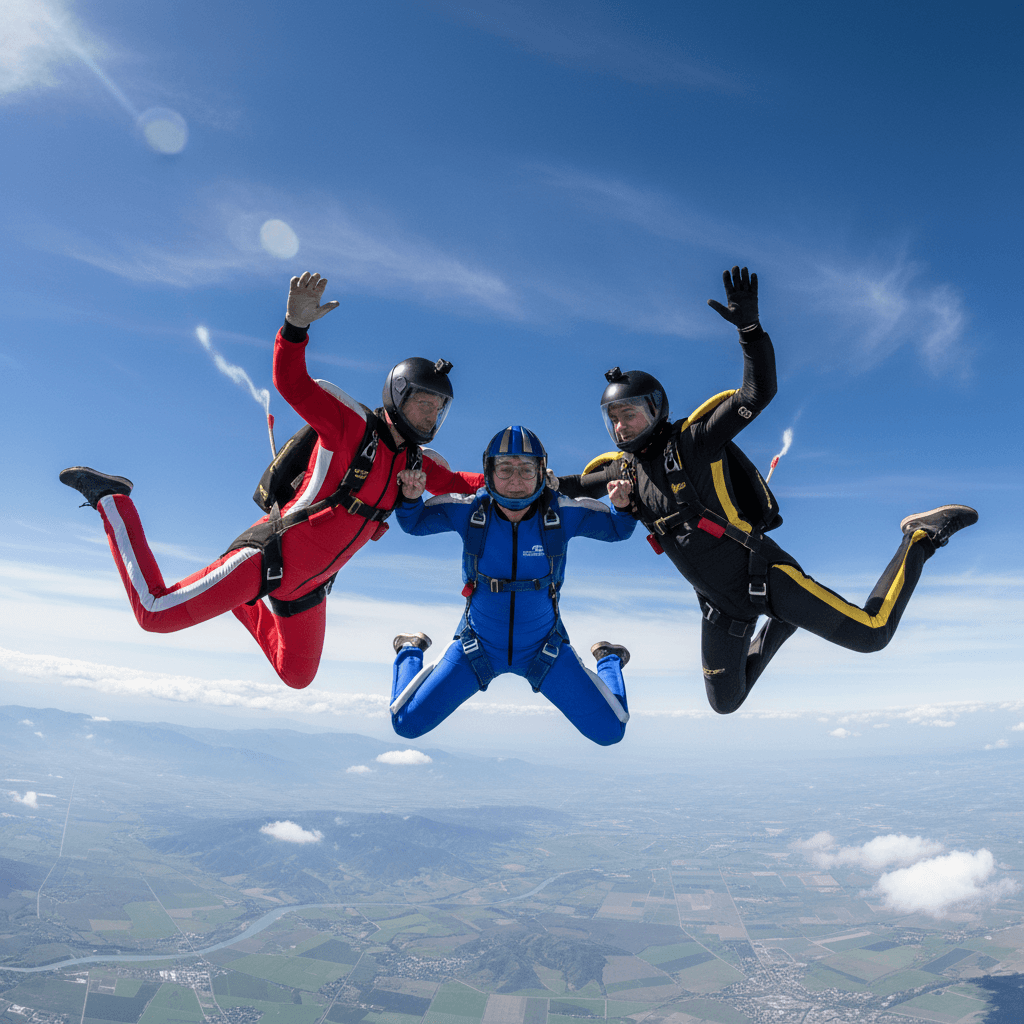
On the early levels, two instructors exit the aircraft beside you and physically hold onto your harness in freefall. Their grips give you stability while you focus on tasks: practice deployment touches, altitude checks, body-position adjustments. As you progress, they release one or both grips, then transition to flying near you rather than holding on, then eventually to filming you from above or below. By the final levels, the instructors are largely ground-based — debriefing you on video, not flying with you in person.
Each level has a specific structure: pre-jump dirt-dive (rehearsing the sequence on the ground), aircraft ride, exit, freefall sequence (typically 45–55 seconds), deployment at the assigned altitude, canopy pattern back to the dropzone, and a post-jump debrief watching the instructor's video. The debrief is where most learning happens. Watching your own body do something you didn't realise it was doing — a dropped knee, an arched back, a missed altitude check — tends to create faster correction than any verbal instruction.
Repeats are normal. Across most large dropzones, the average AFF student repeats at least one level on the way through. Some students sail through Level 1 and then hit a wall on Level 4 turns; others spend two attempts on Level 1 and then progress smoothly. The shape of your progression says nothing about whether you will end up a competent skydiver — it says only that learning curves are individual.
- Progression is skill-based: you advance when you demonstrate the level objectives, not when you've completed a fixed number of jumps.
- The instructor count drops as you progress: two instructors on the early levels, one on the middle levels, and solo on the final levels.
- Each level is a distinct skill-set — exit, stability, turns, release, recovery, tracking — built sequentially.
- Repeats are routine and don't require special permission. You and your instructor will discuss what to focus on, then re-jump.
- Operational details vary between dropzones and federations: USPA, APF, BPA, FASI, KPA, and CAAS all run slightly different versions of the same fundamental progression.
- The course typically takes 5–10 dropzone days; the spread is mostly weather, not student aptitude.
Worth saying clearly: dropzones are not interchangeable. The progression curriculum is similar, but the equipment, aircraft type, instructor culture, weather reliability, and post-jump debrief quality vary substantially between operators. We talk about which Asia dropzones we trust most for AFF in Section 15. Picking well matters.
5. AFF Level 1, Explained: The Most Important Day of Your Skydiving Life
Level 1 is the only AFF jump you will ever do for the first time. Every other level builds on something familiar; Level 1 builds on nothing. It is the jump where the abstract concept of 'I am going to learn to skydive' becomes the very concrete, very physical reality of stepping out of an aircraft door at 13,000 feet under your own power.
Almost every student reports that Level 1 is the most emotionally intense day of the course — and, for many, of their adult life. By Level 3 the emotional intensity has dropped. By Level 5 most students are walking onto the load casually. Level 1 is the one you remember in slow motion. We will walk through the whole day.
Ground school
Most operators schedule a 4–6 hour ground school the day before or the morning of Level 1. You will cover: equipment overview (main, reserve, AAD, three-ring release), exit procedure with the specific aircraft type, body position fundamentals (the 'arch'), in-air communication and instructor hand signals, altitude awareness intervals, the deployment sequence, malfunction recognition, decision altitudes, emergency procedures, canopy controls, the landing pattern at this specific dropzone, and radio coaching for landing. There will be a written quiz at the end. There will also be a practice harness — a hanging harness or 'mock-up rig' — where you will rehearse exit, body position, and deployment until your instructor is satisfied that the muscle memory is in place.
Take ground school seriously. Notes are not just permitted, they are common. Ask the question that you are afraid will sound stupid; the instructors are watching for confusion. The best Level 1 students are not the fearless ones — they are the ones who said, in ground school, 'wait, can you walk me through that one more time'.
The aircraft ride
Most AFF aircraft in Asia carry between 12 and 22 jumpers and climb to altitude in 12–18 minutes. You will be near the door, with your two instructors beside you, helmet on, goggles up, gloves on, altimeter visible. Adrenaline arrives somewhere between 4,000 and 7,000 feet. Most students describe it as a low, persistent hum — not a single spike — and many notice their hands shaking slightly. This is normal and means your body is correctly preparing for what is about to happen.
Your instructors will run you through the dive flow during the ride: spot-check your handles, ask you to point to your altimeter, get you to perform the practice deployment touch on your right hip. They are checking that your gear and your head are both intact. This is the last quality control before the door.
The door, the exit, the moment
The door opens around 12,500–14,000 feet. The cabin gets loud and cold. The instructor on your reserve side ('reserve-side') gives the spot — confirming you are over the correct ground reference — and the green light comes on. You shuffle to the door. Your two instructors take grips on your harness. The 'in-out-in-out' check happens.
And then, on a count or a head nod, you go.
The exit is the moment most students cite as the moment everything became real. The aircraft is moving forward at roughly 150 km/h relative wind; for a fraction of a second after you leave the door you are still moving forward with it before gravity wins. Your instructors are still on your harness. The horizon flips. The wind is loud, but not as loud as you expect — student helmets dampen most of it. Your job, in this first second and a half, is to arch: hips forward, head back, arms wide, feet up. The arch is what gives you stability. Your instructors are correcting your body position with their grips while you remember to do it.
The freefall sequence
Once stable, you have about 45–50 seconds of freefall to perform the Level 1 task list. Most curricula ask you to: confirm stability with a 'circle of awareness' (look left, look at your altimeter, look right), perform three practice deployment touches (reach to the pilot chute on your right hip, return to neutral), do a second altitude check, and stay relaxed and centered until the assigned deployment altitude. Your instructors are giving hand signals throughout — 'relax', 'arch more', 'legs out', 'altitude check', and finally the all-important 'pull' signal at deployment altitude.
If your sequence goes well, you will reach 5,500 feet (the standard student deployment altitude in most international curricula) and execute a deliberate, two-handed pull on your pilot chute. The opening shock is not painful — student canopies are designed to open softly — but it is sudden, and it is loud, and most students describe the moment of canopy open as the cleanest emotional shift they have ever experienced. From maximum sensory load to almost-silence in three seconds.
Canopy flight and the radio
Once your canopy is open, the dropzone radio team starts talking to you. They give you headings to fly, distance to the landing pattern, and pacing for your descent. Modern student canopies are very forgiving and fly slowly. You will be in the air, alone under your own canopy, for somewhere between five and seven minutes. This is the part of the jump that almost no Level 1 student expects to find as profoundly moving as they do.
The pattern is standard at most dropzones: a downwind leg parallel to the landing area, a base leg perpendicular to it, and a final approach into the wind. You will fly the pattern under radio guidance. At about 100 feet, you will be told to flare — pull both toggles smoothly down to your hips — and the canopy will translate forward speed into lift, slowing you to a walking-pace landing. Some Level 1 students stand it up; many slide in on their feet and shins. Both are fine. The flare is the only landing skill that takes meaningful practice, and it is normal to be inelegant at it for the first 5–15 jumps.
The first three minutes after landing
There is no good description of the first three minutes after a successful Level 1 landing. Many students describe it as the closest thing to euphoria they have ever experienced. Some sit on the grass for a while. Some shake. Some run, literally, back to the manifest building. Most cannot stop smiling for several hours. The phrase you will hear, over and over, in dropzone bars across Asia from people who did Level 1 a week or a decade ago, is: 'I had no idea I could do that.'
If you only do one AFF jump in your life, make it Level 1. The skill is not the point. What you are buying is the very specific, very rare experience of meeting a version of yourself you have never met before — the version that, alone, in 200 km/h of wind, did exactly what was asked of them. Most students never quite see themselves the same way again.
6. AFF Level 2, Explained: The Emotional Shift
Level 2 is, on paper, very similar to Level 1: two instructors, two grips, the same exit, similar dive flow. In practice, it is the level where most students stop performing skydiving as a survival exercise and start performing it as a skill they are deliberately learning. The shift is not always visible on video. It is unmistakable in the debrief.
Confidence growth
You walk into Level 2 ground school knowing you have already done the hardest emotional jump you will ever do. The fear is still real — adrenaline does not vanish overnight — but it is calibrated. You know the door does not kill you. You know the arch works. You know your canopy opens. The cognitive bandwidth that Level 1 spent on existential dread is now available for actual learning.
Stability and altitude awareness
Level 2 introduces small in-air maneuvers: deliberate forward movement, controlled body-position changes, and more rigorous altitude awareness intervals. The instructors are still holding your harness, but they are giving you more space to find your own stability. The first time you feel your own body holding the arch without the instructors' input is the moment most students describe as 'the moment it clicked'.
Turns introduced (operator-dependent)
Some curricula introduce small heading changes as early as Level 2; others wait for Level 3 or 4. The principle is the same: shift one shoulder very slightly toward the direction you want to turn, and the body rotates around its centerline. The first deliberate 90-degree turn of your skydiving life is a small moment, but it is a real one. You have just steered yourself in three dimensions, in freefall, alone, on purpose.
If Level 1 felt like a panic attack with a parachute attached, Level 2 will feel like a different sport. Most students are visibly more relaxed on the aircraft, more present in freefall, and more analytical in the debrief. This is not bravery. This is the brain doing what brains do — reducing the threat assessment of a known situation. Trust it.
7. AFF Level 3, Explained: The Release
Level 3 is the level where most students discover that they are skydiving, not being skydived with. Up to this point, your two instructors have been holding onto your harness for the entire freefall. On Level 3, the dive flow includes a planned release — your instructors let go of you in mid-air, fly nearby, and watch you fall stable, alone, for several seconds.
The release exercise
On the ground, this sounds like a small thing. In the air, it is enormous. The first time you feel the instructors release their grips — and you stay stable, in the same arch, with the same body position, completely on your own in freefall — there is a specific psychological click that is hard to describe to someone who has not felt it. Many students cite Level 3 as the most confidence-building level of the entire course. Tandem teaches you that you can fall. AFF Level 1 teaches you that you can step out of an aircraft. Level 3 teaches you that you can fly your own body.
Why the breakthrough lands here
There is a particular insight about Level 3 that we don't see written down enough: the release is not a test of your bravery. It is proof of a fact. Your body, by the third AFF jump, has already learned the shapes that produce stability. The release exercise simply confirms what your instructors already know. From your perspective, it feels like a graduation. From their perspective, it is a controlled validation of work you have already done. Both are true at the same time.
What it sets up
Level 3 is also where the instructors begin to assess you for solo flying. The next levels will introduce single-instructor configurations and solo body movement. Level 3 is the gate where the system says, 'this person can be in freefall on their own without a hand on their harness'. It is, in many ways, the level where you officially become a skydiver — even though you still have four levels to go.
Many students cry on the walk back from Level 3. This is a genuine pattern, not a stereotype. The release exercise tends to dislodge something — a story people have been telling themselves about what they cannot do — and the unraveling comes out as tears. There is no shame in this. There is also no obligation. Different people meet the moment differently, and the system does not care.
8. AFF Levels 4–5, Explained: One Instructor, More Independence
From Level 4 onwards, most curricula reduce the instructor count from two to one. This is the structural shift that lets you start performing more deliberate freefall maneuvers. Levels 4 and 5 are the levels where students transition from 'I can stay stable on my own' to 'I can move on purpose'.
Level 4: deliberate turns
The Level 4 dive flow typically introduces controlled 90-degree turns in both directions. The instructor flies near you, often slightly off to one side, ready to dock if your stability collapses. Your task is to turn 90 degrees left, stop on a heading, hold the arch, then turn 90 degrees right, stop on a heading, hold. It sounds simple on the ground. In freefall, with adrenaline running, your nervous system will absolutely turn 270 degrees the first time, or oscillate, or stop on the wrong heading. This is part of the curriculum. The instructor will debrief it on video.
Level 5: bigger turns and recovery
Level 5 typically introduces 360-degree turns and basic recovery from instability. Spinning is the thing every AFF student fears most, and Level 5 is where you confront it head-on, in a controlled way, with your instructor right there. The lesson is not 'don't ever spin'. The lesson is 'if you do spin, here is what you do to stop it' — bring the limbs back into a symmetric arch, look at the horizon, breathe. This is one of the most genuinely useful skills of the whole course, because it removes the largest fear most beginning skydivers carry into the first 50 jumps of their career.
Common struggles in this phase
Levels 4 and 5 are where the second wave of AFF repeats tend to happen. Common reasons: stopping a turn on the wrong heading, dropping a knee mid-turn (which spins you), forgetting an altitude check while concentrating on a maneuver, or low-key panic on a recovery exercise. None of this is unusual. None of it implies you are not cut out for the sport. Many of the strongest skydivers we know spent two attempts on Level 4. The repeats teach the lesson the first attempt almost-but-not-quite did.
9. AFF Levels 6–7, Explained: From Student to Skydiver
Levels 6 and 7 are the levels where the instructor stops flying with you in the same airspace and starts watching you from outside. By Level 7, in most curricula, you are exiting the aircraft solo, performing a planned freefall sequence, deploying on your own, and being filmed from above by your instructor. The experiential difference between Level 1 and Level 7 is enormous, and it usually compresses into about a week of dropzone time.
Level 6: tracking and dive exits
Level 6 introduces tracking — moving horizontally across the sky in a streamlined, head-low body position — and more advanced exit types, including 'dive exits' where you leave the aircraft head-first instead of belly-first. Tracking is a foundational skill for the rest of skydiving: it is how you separate from other jumpers before deployment, and it is the building block for swooping, freefly tracking, and wingsuiting later in the sport. Most students are surprised by how fast they can travel across the sky in a track. The first 200-meter ground track of your skydiving life is a moment.
Level 7: the graduation jump
Level 7 (or its USPA-ISP equivalent) is typically structured as a freestyle jump — you exit, perform a sequence of practiced maneuvers, deploy, and fly the canopy back home, with your instructor filming from above for debrief. By this point, the cognitive load of the jump has dropped substantially. You are no longer trying to remember how to skydive. You are trying to skydive well. The shift is enormous, and it is the moment most graduates point to as the moment they stopped feeling like a student.
The emotional transition
Somewhere between Level 5 and Level 7, most students cross a quiet line. They start using the word 'we' when talking about skydivers. They start understanding the language at the bonfire — the brand names, the canopy sizes, the conversation about wing loadings and exit orders. They become recognisable to the regulars. The transition does not happen at a single moment. But by the end of Level 7, the people who started AFF as a question — can I do this? — have an answer that lives in their bones. Yes. They can.
10. What Students Usually Struggle With
Almost every AFF student hits a wall somewhere in the course. Where the wall lands varies wildly between people. Knowing the common struggles in advance makes them less personal when they show up.
Sensory overload on the early levels
Wind, altitude, instructor signals, altimeter check, body position monitoring, dive flow execution — all at once, all in 50 seconds, on a body that has never done any of this before. Many Level 1 students report not remembering parts of the freefall. Many forget at least one in-air task. This is universal and resolves on its own by Level 3.
Altitude awareness
Beginners systematically lose altitude awareness when concentrating on body position or maneuvers. The fix is structural: instructors teach a fixed cadence of altitude checks built into every dive flow, and modern audible altimeters beep at preset altitudes. Mechanical altitude awareness backstops the cognitive failure that is normal in stress.
Spinning
Spinning is the most-feared and least-likely-to-actually-be-dangerous failure mode at the student level. Modern student rigs are designed to be stable; an asymmetric arch will produce a slow drift, not a violent spin. The recovery is taught early — return to a symmetric arch, look at the horizon, breathe. Most AFF graduates have spun at least once and resolved it on their own.
Body position consistency
Holding a clean arch under stress is harder than it looks. Common errors: dropped knees (which dump pressure asymmetrically), tight shoulders (which cause forward drift), tense hands. Most are debriefed on video and corrected within one or two jumps. The arch is a skill, not a posture.
Information retention between jumps
If you take more than a few days off mid-course, the procedural memory degrades faster than you expect. Most operators will run a refresher dive flow if you've been off the dropzone for more than 7–14 days. Don't be embarrassed by this — every instructor in the world has done it themselves.
Self-confidence
The single biggest struggle in AFF is psychological, not physical. Many students arrive on Level 1 with a quiet, unspoken belief that they personally are not really the kind of person who can do this. AFF dismantles that belief by making the person actually do the thing. There is no shortcut. The work is the answer.
- Take notes during ground school — even handwritten ones. Your future self thanks you on the way to altitude.
- Hydrate aggressively and eat something carbohydrate-heavy 60 minutes before the jump.
- Visualise the dive flow on the ride to altitude. Most instructors do this themselves and you should follow their lead.
- Watch the debrief video properly. The mistakes you can see on video do not need to be repeated.
- Sleep. Skydiving on poor sleep is meaningfully harder than skydiving on good sleep.
If you are struggling with a specific level, ask your instructor for an explicit fix-it plan. The good ones will hand you a list — three things to focus on, two body-position cues, one altitude routine. The plan is the asset. Repeating without a plan tends to repeat the same mistakes.
11. What AFF Instructors Actually Look For
AFF instructors are not just looking at whether you survived the jump. They are evaluating a specific set of attributes that, in their professional experience, predict whether a student will become a safe, capable, self-supervising skydiver. The signing-off decision is built on these attributes, not on whether the dive flow looked perfect.
Awareness
The first and most important attribute. Are you tracking altitude? Are you noticing your instructors' signals? Are you flying the canopy with awareness of where the landing area is? Awareness is the master skill of skydiving — it is what allows every other skill to be deployed at the right moment. An AFF student with clean awareness and sloppy body position will graduate. An AFF student with beautiful body position and zero awareness will not.
Stability under stress
Can you maintain a stable, symmetric arch when something unexpected happens? Can you return to stability after a deliberate disturbance? Stability is not the same as never being unstable. It is the ability to recover.
Calm decision-making
Are you executing the procedures you were taught, in the order you were taught them, even when adrenaline is high? Calm is a skill, not a personality trait, and the instructors are watching for it explicitly.
Consistency
One good jump is encouraging. Three good jumps in a row is evidence. The instructors are watching for consistency over the course, not heroics on a single level.
Safe canopy behavior
The freefall is the part students worry about. The canopy is the part instructors worry about. Are you flying a clean pattern? Are you flaring at the right altitude? Are you choosing safe landing areas? Most modern skydiving incidents happen under perfectly good canopies, not in freefall, and AFF instructors weight canopy behavior accordingly.
A learning attitude
This is the unspoken one. Are you coachable? Do you take debriefs seriously? Do you ask good questions? Do you internalize corrections rather than defending against them? The students who graduate fastest are not the most athletic ones. They are the ones who treat every debrief like the most useful 30 minutes of their week.
12. How Scary Is AFF, Really?
Honestly? On Level 1, very. After Level 1, much less than people expect. The fear curve in AFF has a specific shape, and understanding it in advance makes it easier to walk through.
The peak of the fear is not the freefall. It is the morning of Level 1 — the hours of anticipation between waking up and the aircraft door opening. Most students describe a slow, persistent unease that builds across breakfast, ground school, gear-up, and the climb to altitude. The freefall itself, paradoxically, is when the fear quiets. The brain has too much to do to maintain abstract dread, and the body's sympathetic nervous system, given an outlet, stops cycling on itself.
By Level 3, most students report that the morning fear has dropped to roughly half. By Level 5, it is a low hum. By Level 7, the dominant emotion at gear-up is anticipation, not fear. This compounding is the real story of AFF, and it is the reason so many students describe the course as the most psychologically interesting week of their lives. You do not stop being afraid of skydiving by becoming a different person. You stop being afraid by accumulating evidence that you can do the thing, and the evidence rewires the brain. The brain rewires faster than people expect.
There is one important caveat. AFF fear adapts; it does not vanish. Most active sport skydivers will tell you they still feel a small spike of nerves in the door on the first jump of the day, especially if they have been off the dropzone for a while. The healthy version of skydiving fear is not 'never afraid'. It is 'aware of the seriousness of the activity, calibrated by experience, and channelled into focus rather than freeze'. AFF, when done properly, builds exactly that.
13. What Happens If You Fail a Level?
You repeat it. That is the entire mechanic. There is no shame, no cost in dignity, and — across most operators — no special administrative process beyond your instructor signing you off for a re-jump. The next available slot, you go again, with a focused fix-it plan and the same equipment. Most AFF students do this at least once during their course. Many do it more than once.
There is a specific frustration that comes with a level repeat. You have just spent emotional capital on a jump, and the verdict at the debrief is: not yet. It is normal to feel disappointed. It is also normal, after about an hour, to want to try again. The frustration is part of the learning. Student skydivers who never feel frustrated tend not to be paying attention to their own performance.
Some specific reasons a level might be re-flown: you didn't perform a required task (missed a practice deployment touch, skipped an altitude check), your body position was below the standard, you were unstable on the release, you didn't make the dive flow on heading, you pulled high or low. None of these are dangerous in isolation; they are corrections, not strikes against your character.
The narrative that 'failing a level means I am not cut out for this sport' is not true. The narrative is, in fact, the single most counterproductive belief an AFF student can carry. Some of the best skydivers we know — coaches, demo jumpers, accuracy competitors — repeated levels in their course. The repeat is the curriculum. The students who never fail anything tend to be students who do not push themselves to the edge of the level. The edge is where the learning lives.
14. How Much Does AFF Cost in Asia?
AFF pricing in Asia varies more than tandem pricing, partly because course structures differ between operators and partly because some dropzones charge per level while others sell a discounted full-course package. As a rough guide, expect to spend USD 2,500–4,500 for a complete AFF course (Level 1 through Level 7 or 8) at a federation-affiliated operator. Dubai is the high end; Thailand and India are the value end; Saudi Arabia, Malaysia, and the Philippines sit in the middle.
Per-level pricing typically falls between USD 350–700 in Asia, with Skydive Dubai at the upper end and Thailand operators at the lower end. Repeat-jump pricing is sometimes the same as a regular level and sometimes discounted; ask your operator directly before you commit. Tunnel time, where available, is usually charged separately at USD 70–120 per 15-minute slot, and for many students it is the highest-value spend in the entire course (we explain why in Section 18).
Long-term cost matters more than course cost. Once you are A-licensed, sport jumps fall to roughly USD 25–45 per jump in most of Asia, depending on country. The total cost of becoming a competent recreational skydiver across the first year is dominated by the first 50 jumps, after which the per-jump cost drops sharply. AFF is the front-loaded investment; the rest of the sport is comparatively cheap.
| Operator | Per-level price | Full course | Repeat policy |
|---|---|---|---|
| Skydive Dubai (Desert) | AED 2,500 (~USD 680) | AED 18,000–22,000 (~USD 4,900–6,000) | Discounted re-jumps available |
| Thai Sky Adventures (Pattaya) | ฿14,500 (~USD 405) | ฿115,000–135,000 (~USD 3,200–3,800) | Per-jump repeat pricing |
| Skydive Thailand (Chiang Mai) | ฿14,500 (~USD 405) | ฿110,000–130,000 (~USD 3,100–3,650) | Per-jump repeat pricing |
| Dropzone Thailand (Rayong) | ฿15,500 (~USD 435) | ฿120,000–140,000 (~USD 3,400–3,950) | Per-jump repeat pricing |
| Hawk's Sports (Malaysia) | RM 3,200 (~USD 700) | RM 25,000–30,000 (~USD 5,500–6,600) | Per-jump repeat pricing |
| Skyhigh India (Narnaul) | ₹30,000 (~USD 360) | ₹230,000–260,000 (~USD 2,750–3,100) | Per-jump repeat pricing |
| Skyriders (Mysore) | Course pricing only | ₹250,000 (~USD 3,000) — full course | Re-jumps quoted on request |
| Unique Clouds (Saudi Arabia) | SAR 2,400 (~USD 640) | Course pricing on request | Operator-direct quote |
These prices are 2026-current at the time of writing. AFF pricing changes more often than tandem pricing, especially in countries with currency volatility (India, Saudi Arabia). Confirm directly with the operator before you book, and be cautious of any quote that feels significantly below the range here — the discount is almost always coming out of equipment age, instructor experience, or weather selectivity.
15. The Best AFF Destinations in Asia
Not every dropzone is a good fit for AFF. Some are better for tandem volume, some are better for sport jumpers, and some are excellent across the board. After a year of operator research, Chrome-verified site visits, and Asia-wide cross-referencing against federation registries, these are the operators we recommend most confidently for AFF in 2026.
Best weather reliability
Skydive Dubai (Desert Campus) and Skyhigh India (Narnaul) are the two operators in Asia where weather will almost never derail your course. Dubai has roughly 340 jumpable days per year. Narnaul has a long, dry, predictable dry season from October through April. If you are travelling specifically for AFF and cannot afford to lose days to weather, these are the operators to pick. Thailand is excellent in the dry season (November–March) but unreliable through monsoon (May–October).
Best for nervous beginners
Thai Sky Adventures (Pattaya) and Skydive Thailand (closed since June 2026) (Chiang Mai) consistently produce the most positive first-jump emotional reports we collect. The instructor cultures are calm, the ground schools are unhurried, and the operational pace is unhurried in a way that helps anxious students settle in. If your weak point is anticipation rather than aptitude, lean toward these operators.
Best value
Skyhigh India (Narnaul) and the Thai operators (TSA, Skydive Thailand (closed since June 2026), Dropzone Thailand) are the value end of Asia AFF. India in particular delivers AFF at roughly 60% of the Dubai price, with full federation backing and modern equipment. For students self-funding the course, India and Thailand are the rational starting point.
Best scenery
Skydive Thailand (closed since June 2026) (Chiang Mai) sits on the Phusanfah Airfield with a backdrop of forested foothills and rice fields, and the descent line on Levels 6–7 is genuinely cinematic. Skydive Dubai (Desert Campus) at Margham gives you the empty-quarter desert horizon — visually unlike anywhere else in Asia. For students for whom the view matters as much as the curriculum, both are exceptional.
Best community atmosphere
Hawk's Sports (Segamat) has a small, tightly-knit Malaysian sport community that absorbs new students into a real peer group across the course. Dropzone Thailand (Rayong) has a similar small-DZ feeling. If the community half of skydiving matters to you — and for most long-term jumpers it eventually does — these operators set you up well for the years after AFF.
Best luxury progression destination
Skydive Dubai (Desert Campus) is the highest-resourced AFF operation in Asia: turbine aircraft, modern student rigs, large landing area, and the Mondial freefly camp culture surrounding the regular operation. It is also the most expensive. For students for whom the AFF course is part of a broader skydiving holiday — including tunnel time, swooping demos, and the option to keep jumping at the same dropzone for the next decade — Dubai is unmatched.
Currently closed. Phusanfah Airfield in Mae Taeng — the only skydiving dropzone near Chiang Mai, used by both Skydive Thailand and Skydive Chiang Mai — was ordered to halt operations by the Civil Aviation Authority of Thailand from 1 June 2026, and no reopening date had been announced as of 17 August 2026. The listing below is kept live so the status stays findable, and any prices shown are historic. Thai Sky Adventures near Pattaya and Dropzone Thailand in Rayong are both still flying.
Currently closed. Skydive Thailand is not taking bookings. Its listing is kept live so the status stays findable, and any prices shown are historic.
Currently closed. Hawk's Sports Skydiving Club is not taking bookings. Its listing is kept live so the status stays findable, and any prices shown are historic.
Currently closed. Unique Clouds Skydiving is not taking bookings. Its listing is kept live so the status stays findable, and any prices shown are historic.
If you are travelling specifically for an AFF course, we recommend reaching out to two or three of these operators directly to compare available windows, weather forecasts, and exact pricing. Asia AFF schedules are flexible — most operators will let you start mid-week — but instructor availability is finite, and the best windows fill up 3–6 weeks ahead in peak season.
16. What Happens After AFF?
AFF graduation is not the end of the student phase. It is the gate where you stop being supervised on every jump. After your final AFF level, you will typically need another 10–18 jumps — coach jumps, consolidation jumps, or formation jumps with a coach — to reach the minimum jump count for your national federation's A-licence (the entry-level recreational licence). The A-licence is what makes you a self-supervising sport skydiver, allowed to plan your own jumps, jump with non-instructor friends, and travel to other dropzones without student-status gatekeeping.
After the A-licence, the sport opens up. You can jump with friends. You can join a formation skydiving (RW) group. You can start learning belly flying, sit flying, head-down freeflying, or canopy piloting. You can buy your own gear (typically a used main canopy and container for USD 3,000–5,000 to start) and stop paying gear rental on every jump. You can travel with your rig — the international skydiving community treats licensed jumpers as a small global club, and most dropzones in Asia welcome visiting USPA, APF, BPA, and equivalent licence-holders without significant friction.
Tunnel flying becomes a powerful tool here. A wind tunnel like AltitudeX in Singapore (the only large indoor tunnel in Southeast Asia) lets you compress hundreds of dollars of jump-cost learning into a single hour of structured practice. Most serious jumpers use tunnel time alongside outdoor jumping for the rest of their careers. Coaches and instructors in Asia regularly fly together at AltitudeX between weekend dropzone trips.
And then, somewhere around your 50th to 100th jump, you become someone the sport recognises. The bonfire conversations stop being mostly about your progression and start being mostly about plans — the next demo, the next camp, the next country. The travel-skydiving culture across Asia is small, friendly, and genuinely international. The people you meet on the manifest at Pattaya in March will turn up at Narnaul in November and at Ras Al Khaimah for New Year's. AFF is the price of entry to that world.
- Coach jumps to A-licence: 10–18 supervised jumps after AFF graduation (federation-dependent).
- A-licence: USPA 25 total jumps; APF 18 jumps + proficiency tasks; UKPA 18 jumps + tasks; FAI baseline elsewhere.
- First gear purchase: typically a used main + container in the USD 3,000–5,000 range.
- Tunnel time: powerful for body-flight progression — AltitudeX Singapore is the regional benchmark.
- Disciplines that open up post-AFF: belly flying, sit flying, head-down freeflying, canopy piloting, accuracy, wingsuit, demo jumping.
- Travel skydiving: most international dropzones accept federation-licensed jumpers without re-training.
17. Common Beginner Misconceptions About AFF
Myth: 'You jump completely alone immediately.'
Reality: on Level 1, two professional instructors exit the aircraft beside you and physically hold onto your harness in freefall. They give you stability, signal corrections, and stay with you through the early levels. You are not alone in the way the word 'AFF' implies. You are working alongside professionals whose only job for those 50 seconds is making sure you complete the dive flow correctly. The structure is designed for normal-fear humans, not fearless ones.
Myth: 'Only fearless people do AFF.'
Reality: almost every AFF student is afraid at the door of Level 1. The system assumes this. Fear, in calibrated form, is part of the curriculum — it is what gives the experience its weight, and it is what the brain rewires through over the course of the week. The fearless students are not the ones who graduate fastest. The honest, well-prepared, slightly nervous ones are.
Myth: 'You can't panic in AFF — if you panic, you die.'
Reality: AFF is built on the assumption that humans under stress will, occasionally, lose composure. That is why there are two instructors on the early levels, an automatic activation device on every rig, a reserve parachute on every rig, and a radio coach for canopy landing. The system is a defense-in-depth structure. Brief, contained panic moments are normal, recoverable, and frequently debriefed afterward as a learning point — not as a near-miss.
Myth: 'You need to be athletic.'
Reality: AFF is an awareness sport, not an athletic one. The physical demands are modest — moderate cardiovascular fitness, the ability to hold a body shape, and reasonable flexibility in the hips and shoulders. Plenty of AFF graduates are in their 50s and 60s. Many are not athletic by any conventional measure. The skill that matters most is the ability to stay mentally present and coachable, not the ability to run a fast 5k.
Myth: 'One bad jump means I'm not capable.'
Reality: a bad jump is a bad jump. It is data. Your instructors will debrief it, design a fix-it plan, and re-fly the level with you. Every good skydiver has had at least one debrief that landed badly emotionally. The students who become great are the ones who absorbed the debrief, walked back out onto the next load, and re-flew the level cleanly. The repeat is the lesson.
18. Tips for Succeeding in AFF
There are no secrets. There are practices. Most of these are quietly recommended by coaches at every dropzone in Asia, but rarely written down in one place. Here is what we tell our friends.
- Get tunnel time before Level 1, even just 30 minutes. A wind tunnel like AltitudeX in Singapore lets you build the muscle memory for the arch in a controlled environment, with no altitude pressure and immediate coach feedback. Students who arrive at AFF with even one tunnel session under their belt typically progress 1–2 levels faster.
- Sleep, properly, the night before. Skydiving on poor sleep makes the cognitive load 30–40% harder. Do not party on the eve of Level 1.
- Eat something carbohydrate-heavy 60–90 minutes before the load. Empty-stomach skydives produce poor altitude tolerance and shaky landings.
- Visualise the dive flow on the aircraft ride. Run through the sequence — exit, arch, circle of awareness, practice touches, altitude check, deployment — three or four times in your head. This is what your instructors are doing in their seats. Follow their lead.
- Accept the fear. Trying to suppress fear is more cognitively expensive than acknowledging it. Tell your instructor honestly how you're feeling. They have seen every variant of pre-jump nerves. They will calibrate the briefing accordingly.
- Stay coachable. The students who graduate fastest are the ones who treat every debrief like the most useful 20 minutes of their day. Defending against feedback is the single biggest predictor of slow progression.
- Do not bring ego. Ego makes students hide difficulty, skip altitude checks because they 'feel fine', and resist debrief feedback. Skydiving sees through ego instantly. The humble students are also, almost without exception, the best students.
- Focus on process, not the level. A clean exit, clean arch, clean altitude awareness, clean deployment. Process produces the level. Chasing the level produces sloppy process.
- Treat your instructors as collaborators, not graders. Their professional incentive is your progression, not your failure. Ask the question that feels stupid. Surface the doubt that feels embarrassing. They have heard it before, this morning, from another student.
- Don't compare. Some students float through the course; some grind. The rate of progression is statistically uncorrelated with the eventual quality of the skydiver. Run your own race.
If you only do one thing differently from the average student: book tunnel time before Level 1. The AltitudeX tunnel in Singapore, in particular, is set up for AFF prep — coaches there design 30-minute sessions specifically for first-time AFF students. The cost is roughly one AFF level. The compounding effect on the rest of the course is, in our experience, dramatic.
See tunnel packages, flight times and eligibility for Southeast Asia's largest wind tunnel, and send one inquiry.
Hard, but in a specific way. The cognitive load is high in the first 1–2 levels, and most students underestimate how mentally exhausting that is. By Level 3 the load has dropped to manageable, and by Level 7 most students are walking onto the load with normal pre-jump nerves rather than dread. The hardest part is not physical — it is the willingness to stay coachable for 5–10 days while your nervous system rewires itself.
Yes. The 'A' in AFF stands for accelerated, not advanced. The course is explicitly designed for first-time skydivers, with no prior experience required. The prerequisites are an age of 16–18+ (varies by country), reasonable cardiovascular health, and a body weight under the operator's stated limit (typically 95–100 kg).
Honestly, yes, especially Level 1. The fear shape is anticipatory — most of it lives in the morning before the jump and at the door of the aircraft. Once you are airborne, the cognitive load of the dive flow displaces most of the fear. By Level 3, the fear has dropped substantially. By Level 7, most students describe the dominant emotion as anticipation rather than dread.
Seven in the classic international structure used across Asia, the UK, Australia, and most non-US federations. Eight in the United States Parachute Association's Integrated Student Program. The content is functionally the same; the difference is mostly nomenclature.
You repeat it. There is no shame, no special administrative process, and no career consequence. Most AFF students repeat at least one level during the course. The repeat comes with a focused fix-it plan from your instructor. It is the curriculum, not a strike.
Not on the early levels. On Level 1 through Level 3, two instructors exit the aircraft beside you and physically hold your harness in freefall. They release before deployment. From Level 4 onwards, you progress to one instructor. By Level 6–7, you are exiting solo and the instructor films you from above. So 'alone' is true by Level 7, but heavily supported through the early levels where it matters most.
Both are safe at federation-affiliated, properly run dropzones. Tandem fatality rates are slightly lower historically, partly because the tandem master is the most experienced jumper at the dropzone and the rig is large and conservative. AFF rates are higher, but still very low in absolute terms, and the system (two instructors, AAD, radio guidance) is built to compensate for the additional decisions a student is making. The bigger safety variable is which dropzone you choose, not which format.
Most students complete the seven-level progression in 5–10 dropzone days, weather depending. Some complete it in a single intensive week at a high-reliability dropzone like Skydive Dubai or Skyhigh India. Others spread it across two trips. The variable is mostly weather, not student aptitude.
Yes, at any of the federation-affiliated AFF operators we cover in Section 15: Skydive Dubai, the three Thailand dropzones, Skyhigh India, Skyriders Mysore, Hawk's Sports Malaysia, and Unique Clouds in Saudi Arabia. The training quality is internationally recognised. AFF graduates from any of these operators can transfer their licence to any country in the world without re-training.
It is optional, but useful for many students. A tandem lets you experience the sensory arc of a skydive — door, freefall, canopy, landing — without the cognitive load of doing it on your own. That sensory familiarisation can meaningfully reduce Level 1 overwhelm. Some operators discount AFF if you've completed a tandem with them first. It is not required, but it is one of the highest-leverage low-cost decisions a nervous beginner can make.
There is no formal upper age limit at most operators. The decision is medical, not chronological. Students in their 50s, 60s, and occasionally 70s complete AFF every year. The relevant questions are cardiovascular health, joint flexibility (especially hips and shoulders for the arch), and the absence of certain medical conditions. Operators will ask for a medical declaration, and in some countries a doctor's clearance, before signing you off.
Moderately fit, yes — the physical demands are manageable for any healthy adult, but skydiving on poor cardiovascular health or with significant joint problems is harder than it needs to be. Most operators require students to be under 95–100 kg (210–220 lb) for safe equipment compatibility. Beyond that, the skill that matters is mental presence, not athletic capability.
It depends on your fear shape. If your barrier is anticipatory dread and you suspect the skydiving experience itself will resolve the fear, a single tandem is the cheaper, simpler, more emotionally proportionate way to test that. If your barrier is wanting more agency than tandem provides — wanting to fly your own body and pull your own parachute — then yes, AFF Level 1 alone is a worthwhile experience even if you stop after one jump. Just know that the up-front investment for a single solo experience is meaningfully larger than for tandem.
Loud, fast, and over before your conscious mind can fully process it. Most students remember the door, fragments of the freefall, the opening shock of the canopy, and the first 30 seconds of canopy ride very clearly — and the rest as a blur. The integration of the experience tends to happen on the walk back from the landing area, not in the freefall itself. Almost every Level 1 student describes it as one of the most psychologically vivid days of their life.
20. The Conclusion You Can Carry With You
Most people who consider AFF never start it. The barrier is rarely physical, rarely financial, and rarely about logistics. It is almost always about a quiet, internal sentence — some version of 'I am not really the kind of person who does that' — that has been forming since childhood, in a mind that has never been given evidence to the contrary.
AFF is an evidence factory. By the end of Level 1, you have data. By Level 3, you have a pattern. By Level 7, you have a story you can tell yourself for the rest of your life: there was a week, in my late twenties (or early forties, or mid-fifties), when I learned to fly my own body at 13,000 feet, in a country I had not visited before, in a sport that 99% of the people I know will never try. The story is not about bravery. It is about capability. And capability, once you have it, becomes the lens through which the rest of your decisions are made.
If you have read this far, you are not the kind of person we worry about. You are the kind of person who reads things properly before committing. Whether you do your AFF in Pattaya or Chiang Mai or Margham or Narnaul or Mysore, what matters is that you choose a federation-affiliated operator, give the course the time it deserves, stay coachable, and be honest with your instructors when something feels off. The system is excellent. The instructors are excellent. The aircraft are excellent. The only variable left is you, and the version of you that booked the course is, in our experience, almost always the version that finishes it.
Skydive In Asia exists to help with the part that comes before the booking — the comparison, the question-asking, the operator research, the calibration of expectations against reality. We are skydivers writing for skydivers-to-be. Use us. Cross-reference us with the operators directly. Take notes. Then book the course, and meet the version of yourself that, until you actually do this, you will only ever read about.
Ready to find your AFF dropzone?
Browse every active AFF-capable operator in Asia, with verified pricing, federation affiliations, and the operational details that actually matter when you're choosing where to learn to skydive.
The Skydive In Asia Editorial Team produces expert guides, destination spotlights, and first-timer resources for adventure travellers across Asia.