On this page
- 011. Quick Answer: Which Skydiving License System Should You Choose?
- 022. What a Skydiving License Actually Means
- 033. The Main Skydiving Organizations Explained
- 044. USPA Explained
- 055. APF Explained
- 066. FAI Explained
- 077. The Real Difference Between USPA, APF & FAI
- 088. Which License Is Best for Traveling Skydivers?
- 099. How the AFF Course Connects to Licensing
- 1010. How Long Does It Usually Take to Get Licensed?
- 1111. How Much Does a Skydiving License Cost in Asia?
- 1212. Best Places in Asia to Learn Skydiving
- 1313. What Becoming a Licensed Skydiver Actually Feels Like
- 1414. Common Beginner Misconceptions About Licensing
- 1515. Should You Get Licensed While Traveling in Asia?
- 1616. Tips for Choosing the Right AFF School & Progression Path
- 1717. Frequently Asked Questions
- 1818. Conclusion: The Licence Is the Permission, Not the Point
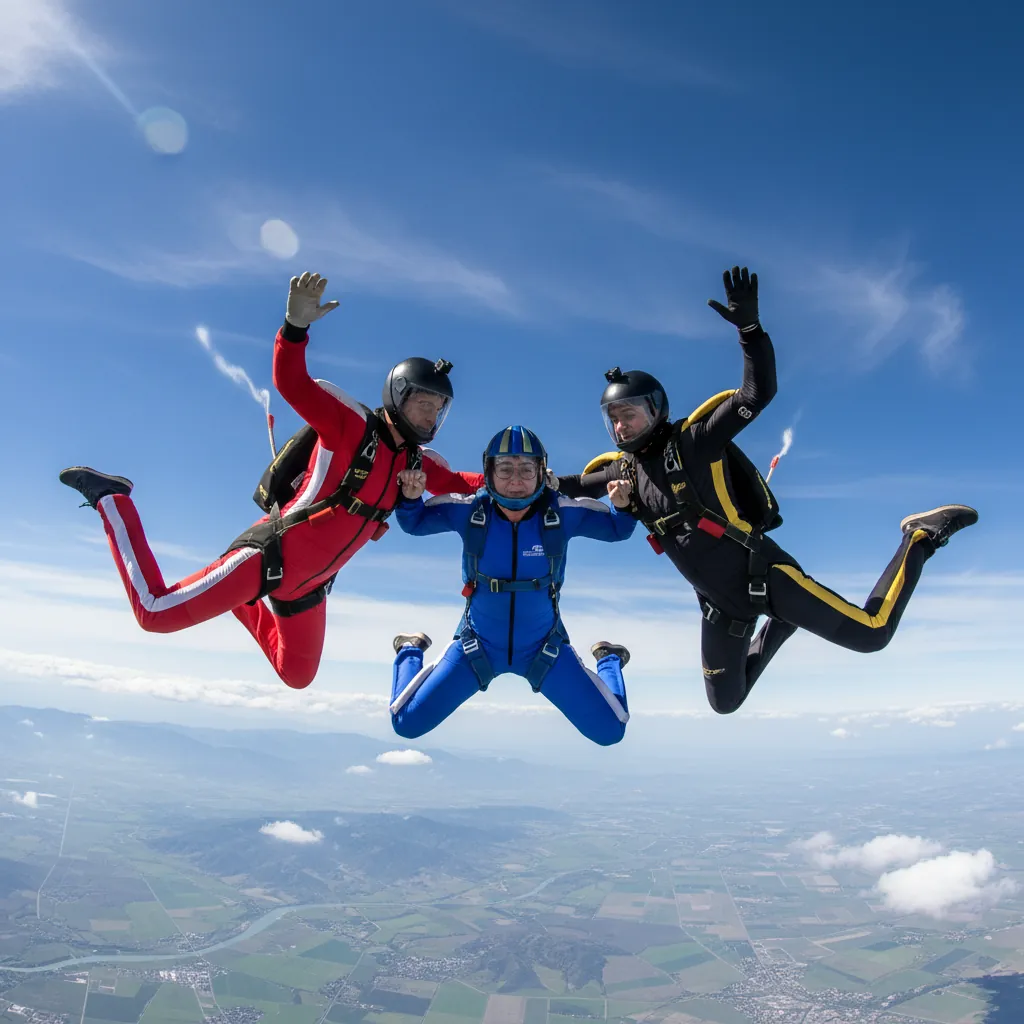
There is a particular kind of silence that arrives somewhere around 12,000 feet, after the engine note has flattened into a steady drone and the conversation in the cabin has trailed off, and the strangers around you have stopped looking like strangers and started looking like classmates. You glance down at your wrist altimeter — your altimeter, on your wrist, on your rig — and the number reads back honestly. Twelve thousand. Three thousand to door check. The instructor across from you catches your eye and taps her chest, twice, the universal sign to do a hardware check. You touch your handles in sequence. Cutaway. Reserve. Main. Everything where it should be. The light at the door turns amber. And it occurs to you, quietly, that you are no longer a passenger on a tandem skydive. You are a student skydiver, on a load, with a logbook, a rig, and an emerging sense of yourself as someone who is becoming part of a sport.
This is the moment most people are quietly aiming for when they start Googling 'how to get a skydiving license'. Not the document. Not the wallet card. Not the laminated letter that arrives in the mail two weeks after you complete the qualifying jumps. The moment of arriving inside the sport — of being a person who shows up to a dropzone with their own gear, packs their own parachute, files their own jump tickets, and walks back across the landing area with a coach instead of an instructor, debriefing the jump in the language of people who do this for a living.
Getting a skydiving license is, in that sense, less about passing a test and more about a slow change in identity. You start as a passenger on someone else's skydive. You do an Accelerated Freefall course and become a student. Somewhere between jump 18 and jump 25 — depending on which national federation you chose — your instructor signs the final box on your proficiency card, and you walk into the manifest with your A-licence number in your hand, and the sport, in some quiet way, makes room for you.
And then, almost immediately, you run into the question this article exists to answer. Which licence? USPA, APF, FAI, BPA, FASI, KPA, CAAS, ParaCanada — the alphabet soup of national parachuting federations and international governing bodies is genuinely confusing, especially for travellers who plan to skydive in more than one country, or who learn in one part of the world and want to jump in another. The forum threads are dense and contradictory. The federation websites are written in the careful, internally-consistent voice of organisations that assume you already know how the system works. Even the people inside the sport sometimes get it wrong.
This guide exists to fix that. We are going to walk through what a skydiving licence actually is, what the major federations across Asia and the world really do, why USPA, APF, and FAI are not interchangeable in the way you have probably been told, and what it looks like — practically, financially, emotionally — to learn to skydive in Asia in 2026. We will name the trade-offs. We will quietly correct some of the most common pieces of bad advice circulating online. And we will frame the whole conversation in the way it deserves to be framed, which is not as a paperwork problem but as a progression decision that will quietly shape the next several years of your life inside the sport.
This is the licence guide we wish someone had handed us before we started. It is long, on purpose. Skim the headers if you only have ten minutes. Read the whole thing if you are about to commit a meaningful amount of money, time, and emotional bandwidth to a decision that, if you make it well, will pay you back for decades.
1. Quick Answer: Which Skydiving License System Should You Choose?
If you only read one paragraph: USPA, APF, and FAI are not three competing systems you choose between. USPA is the American national federation. APF is the Australian one. FAI is the international umbrella body that nearly every national federation belongs to. The licence you 'get' is almost always issued by a national federation (USPA, APF, BPA, FASI, KPA, etc.), and that licence is then internationally recognised through the FAI's reciprocity framework. For most travellers learning in Asia, the practical question is not 'which of the three' but 'which national federation does my chosen dropzone affiliate with' — because that is the federation whose A-licence you will earn, and from whom you will carry credentials onto every other dropzone you ever visit.
A lot of beginners arrive at this question expecting a clean three-way comparison, and walk away frustrated when the answer involves naming five other federations they had not heard of. The frustration is a feature, not a bug, of how the global parachuting governance system actually works. There is no single 'world skydiving licence'. There is a network of national federations, each issuing their own progression credentials, all of which are recognised at federation-affiliated dropzones in other countries through the FAI's umbrella framework. The system is decentralised on purpose, and it works.
With that out of the way, here is the practical orientation most beginners need:
| If you are… | The federation behind your licence will most likely be… | Why |
|---|---|---|
| Learning in Australia or New Zealand | APF (Australian Parachute Federation) or NZPF | All Australian and most New Zealand DZs are APF/NZPF affiliated; this is the dominant ANZ system. |
| Learning in the United States | USPA (United States Parachute Association) | Effectively all American Group Member dropzones operate the USPA Integrated Student Program. |
| Learning in the UK | British Skydiving (formerly BPA) | Single national federation; affiliated to FAI through the IPC. |
| Learning in Asia at a USPA-affiliated DZ | USPA — issued via the affiliated school | Several Asian DZs run USPA-aligned curricula and issue USPA student paperwork; you receive a USPA A-licence on completion. |
| Learning in Asia at a non-USPA DZ | The local national federation (FASI, KPA, CAAS, etc.) or APF | Each Asian country has its own federation; some Asian DZs partner with APF or USPA for international portability. |
| Learning in mainland Europe | Your country's national federation (FFP, DFV, etc.) | All FAI-affiliated and recognised reciprocally at most other federation DZs. |
| A traveller who plans to jump globally | Whichever national federation your school is affiliated with — all FAI-recognised systems are widely accepted | The 'most portable' question is largely a myth; most A-licences are honoured worldwide with reasonable paperwork. |
If you have time for one more sentence, this is probably the most useful thing we can tell you: most beginners overthink this decision because they assume the licence determines where they can jump. It does not, in any meaningful way. What determines where you can jump is the dropzone's willingness to accept your federation paperwork, your jump numbers, your recency, and the canopy you intend to fly. In our experience, almost every A-licence holder we know — USPA, APF, BPA, FASI, KPA, you name it — has been able to walk onto every reputable dropzone they have wanted to jump at in Asia, with twenty minutes of paperwork and a recency check.
The single biggest mistake we see beginners make is choosing a licence based on prestige rather than proximity. If you live in or are travelling through Asia and the closest, best-equipped, most reputable AFF school in your area is APF-affiliated, the right answer is to do APF. If it is USPA-affiliated, the right answer is USPA. The licence is the credential. The skill is the asset. Optimising for the wrong one will cost you months of your life.
2. What a Skydiving License Actually Means
A skydiving licence is not a permission slip. It is a verification — formal, standardised, internationally legible — that you have demonstrated the skills required to jump out of an aircraft, fly your own body in three dimensions, deploy your own parachute at the correct altitude, navigate the canopy back to the landing area, and execute a controlled landing flare without active supervision. The federations call this 'self-supervision' or 'unsupervised skydiving'. In practice, it is the line between being someone who comes to the dropzone for a lesson and someone who comes to the dropzone to skydive.
Every major national parachuting federation — USPA, APF, BPA, FFP, DFV, KPA, FASI, CAAS, ParaCanada, and the rest — issues licences in a similar four-tier structure: A, B, C, and D, in ascending order of jump numbers, skill demonstrations, and privileges. The thresholds and naming conventions vary slightly between federations, but the underlying logic is consistent: each tier unlocks new freedoms and new responsibilities.
The A-licence is the one that matters most to people reading this article. It is the moment you stop being a student. You can self-supervise. You can pack your own main parachute. You can jump at federation-affiliated dropzones around the world without an instructor signing you off jump-by-jump. You can join group jumps with other A-licence holders. The B, C, and D licences add additional privileges — night jumps, water jumps, demonstration jumps, instructor ratings, and so on — but the A is the one that opens the door to the sport.
Why licensing exists in the first place
Skydiving is a sport that punishes ambiguity. The federations exist, in part, to remove ambiguity from the question 'is this person safe to jump at our dropzone today?'. The licence is the answer. When you walk onto a federation-affiliated dropzone and present an A-licence card, the manifest knows, within thirty seconds, that you have completed a structured progression, demonstrated specific skills under instructor observation, and are operating within a recognised standard of care. The licence is, in this sense, a trust signal.
It is also, less obviously, a record-keeping system. Federations track jump numbers, recency, canopy progression, instructor ratings, and incident history. This data is used to update training standards, identify equipment problems, and run the sport. When you join a federation, you become part of this collective infrastructure. The membership fee — typically USD 60–150 per year — funds the safety and training apparatus that keeps the sport functional.
Skill verification, not paperwork
It is worth being clear about this: the licence is not a bureaucratic gate placed in front of skydiving by a sport that secretly wishes fewer people would do it. The licence is a skill verification, and the skills it verifies are the skills you need to have for self-supervised skydiving to be reasonably safe. People who treat the A-licence as a hoop to jump through rather than a milestone of capability tend to plateau quickly afterward. People who treat it as a real demonstration of skill tend to keep growing.
This is why federations require things like packing a main parachute under instructor observation, demonstrating canopy control patterns, executing controlled exits and tracking dives, and passing a written exam on emergency procedures. None of these requirements are arbitrary. Each is a specific failure mode that has, at some point in the sport's history, killed someone. The licence is, among other things, the codification of decades of accumulated lessons.
Community and travel implications
There is a quieter dimension to licensing that the federation websites do not advertise: a licence is also a passport into a community. Once you are A-licensed, you can drop into dropzones around the world — Skydive Dubai's desert campus on a winter weekend, a boogie in Empuriabrava, a small mountain DZ in Switzerland, your local club back home — and be welcomed as a fellow skydiver rather than a customer. The community is global, surprisingly small, and unreasonably warm. The licence is the introduction.
This matters more than people anticipate. The skydivers we know who have stuck with the sport for decades almost universally credit the community for keeping them in it. The flying is the reason you start. The people are the reason you stay. The licence is what gets you in the door.
3. The Main Skydiving Organizations Explained
To make sense of USPA, APF, and FAI, it helps to understand how the global parachuting governance system is layered. There are essentially three levels: international (FAI), national (USPA, APF, BPA, FASI, KPA, CAAS, etc.), and operational (the individual dropzones, schools, and instructors). Each level does a specific job, and the confusion most beginners encounter comes from conflating one with another.
FAI — the international umbrella
The FAI (Fédération Aéronautique Internationale) is the world governing body for air sports — skydiving, gliding, ballooning, aerobatics, paragliding, and so on. It is not a regulator in the legal sense; aviation regulation in any given country is the job of that country's civil aviation authority, not FAI. What FAI does is set international standards, sanction world records, organise world championships, and provide the framework through which national federations recognise one another's credentials.
Within FAI, skydiving sits under the IPC (International Parachuting Commission). The IPC sets the rules for international parachuting competitions, ratifies world records, and publishes the FAI Sporting Code, which defines the parachuting disciplines (formation skydiving, freeflying, canopy piloting, accuracy, style, wingsuit performance, and so on) and the rules under which they are judged.
Almost every national parachuting federation in the world is an FAI member through the IPC. This membership is what makes a USPA A-licence recognised at an APF-affiliated dropzone, an APF licence recognised at a BPA dropzone, and so on. The reciprocity is informal in some places and codified in others, but the FAI umbrella is what makes it possible.
National federations — where your licence actually comes from
The licence you earn is almost always issued by a national federation. For Americans, that is USPA. For Australians and New Zealanders, that is APF or NZPF. For Brits, British Skydiving (the rebranded BPA). For Indians, the Aero Club of India through its parachuting division, or sometimes USPA via affiliated schools. For Japanese skydivers, the Japan Parachuting Association. For Filipinos, the Philippine Skydiving Association. For Singaporeans, the CAAS-recognised local clubs. The list goes on.
National federations write their own student training programs, set their own licence requirements, certify their own instructors, and run their own incident reporting systems. The student progression at a USPA-affiliated DZ in California is structurally similar to the one at an APF-affiliated DZ in Sydney, but the documentation, the rating system, the pass/fail criteria, and the membership administration are all run independently.
Why beginners get confused by terminology
The confusion comes from three sources. First, several national federations use the same letter system (A/B/C/D), so people assume the licences are interchangeable in a way they are not. Second, the FAI also issues 'parachutist badges' (also called A/B/C/D, just to make life difficult), which are an entirely separate sporting recognition system from national licences and are largely vestigial in modern practice. Third, the language of 'getting your USPA' or 'getting your APF' is shorthand inside the sport that locals use without explanation, and it gets lost in translation when beginners encounter it online.
The cleanest mental model: FAI is the international umbrella. National federations are the licence issuers. Dropzones are the operators. You walk into a dropzone, train under their national federation's curriculum, earn that federation's licence, and — through FAI reciprocity — that licence is recognised at federation-affiliated dropzones around the world.
None of these federations is universally superior. They are all running mature student progressions, all certify competent instructors, and all produce A-licence holders capable of safe self-supervised skydiving. The differences come down to administrative style, jump-count thresholds, equipment culture, and — most relevantly for travellers — which federation your nearest reputable AFF school happens to be affiliated with.
4. USPA Explained
The United States Parachute Association is the largest national parachuting federation in the world by membership. It oversees skydiving in the United States, runs the most widely-used student progression curriculum on the planet, and — through the global popularity of American skydiving culture — has effectively become the lingua franca of student instruction at many international dropzones. If you have ever watched an AFF YouTube video, the chances are good that the curriculum on screen was USPA-aligned, even if the dropzone in question was outside the United States.
How the USPA progression works
USPA's student program is called the Integrated Student Program, or ISP. It restructured the older AFF system in 2003 into a category-based curriculum spanning roughly Categories A through E across approximately 25 jumps. In practice, most students experience the early levels as a 7- or 8-jump AFF progression, followed by a series of coach jumps that take them to the A-licence threshold. The instructor exits with the student on Categories A through C, releases on Category D, and supervises solo work from Category E onwards.
The USPA A-licence requires 25 logged jumps, a passed written exam, and demonstrated competency on a defined set of skill objectives — controlled exits, in-air heading control, deliberate turns, tracking, deployment at the correct altitude, canopy control patterns, accuracy landings, and packing a main parachute under instructor observation. Above the A, USPA issues the B (50 jumps), C (200 jumps), and D (500 jumps), each with additional skill demonstrations and privileges.
| Licence | Minimum jumps | Key privileges |
|---|---|---|
| A-licence | 25 | Self-supervised skydiving; pack own main; group jumps with other A+ holders; access to most international dropzones. |
| B-licence | 50 | Night jumps with appropriate gear; water training jumps; eligibility for some coach ratings. |
| C-licence | 200 | Demonstration jumps into open areas; eligibility for instructor ratings (AFF, tandem, coach). |
| D-licence | 500 | Demonstration jumps into restricted areas; eligibility for the highest instructor and judge ratings. |
Why USPA travels well
USPA's global reach comes from three things. First, the United States produces a huge volume of new skydivers every year, and many of them travel; this means that almost every reputable international DZ has dealt with USPA paperwork before and knows how to verify it. Second, USPA's documentation is digital, well-organised, and easy to confirm — the USPA membership card has a verifiable number, and dropzones can call USPA directly to confirm a licence in case of doubt. Third, the USPA Skydiver's Information Manual (the SIM) is freely available online and is, in practice, the most-cited training document in the sport.
All of this means a USPA A-licence is very widely accepted. We have walked USPA-licensed friends onto dropzones across Asia, Europe, the Middle East, and Australia with minimal friction. The A-licence is rarely the bottleneck. Recency, jump numbers, and the canopy you intend to fly are usually more relevant questions than the federation that issued your card.
The honest limitations
USPA's main limitation, for travellers, is not the licence itself but the cost of doing the course in the United States. AFF in California, Florida, or Arizona is meaningfully more expensive than AFF in most of Asia, and the gear rental, packing fees, and jump tickets stack up quickly. Many international students who could have gone USPA at a US dropzone end up doing their progression at an Asian DZ instead, sometimes under a USPA-affiliated curriculum and sometimes under a different national federation. The licence reaches them in either case.
The other limitation is more philosophical. USPA, by virtue of its scale and the regulatory environment in the United States, runs a more defensively-structured progression than some smaller federations. Some students experience this as 'thorough'. Others experience it as 'paperwork-heavy'. Both readings are fair.
5. APF Explained
The Australian Parachute Federation is the national governing body for skydiving in Australia. It oversees every commercial dropzone on the continent, runs a tightly-controlled student progression, and is widely respected internationally for the rigour of its instructor rating system and the depth of its safety culture. New Zealand operates a parallel system through NZPF, and the two federations share many operational standards.
How the APF progression works
APF's student progression spans either AFF (Accelerated Freefall) or static-line, depending on the school and the student's preference, and converges on a structured set of stages and proficiency tasks that culminate in the APF A-licence. The threshold for APF A is 18 logged jumps with all proficiency tasks completed, which is meaningfully fewer jumps than USPA's 25, but the proficiency tasks themselves are more granular and the instructor sign-offs more prescriptive.
The APF system uses certificate stages — Certificate A, B, C, and D — analogous to the USPA letter system but with somewhat different skill demonstrations and privileges. Certificate A holders can self-supervise at APF-affiliated DZs in Australia. Certificate B unlocks night jumps and additional canopy privileges. C and D unlock demonstration jumps and instructor pathways respectively.
| Certificate | Minimum jumps (indicative) | Key privileges |
|---|---|---|
| Certificate A | 18 with proficiency tasks | Self-supervised skydiving at APF DZs; pack own main; group jumps with other certified jumpers. |
| Certificate B | ~50 with additional tasks | Night jumps; expanded canopy privileges; eligibility for some coach pathways. |
| Certificate C | ~200 with task-based requirements | Demonstration jumps; eligibility for advanced instructor ratings. |
| Certificate D | ~500 with extensive task list | Highest privileges including most demonstration and instructor ratings. |
APF jump-count thresholds are indicative, not absolute. The federation has updated requirements multiple times over the years and emphasises proficiency tasks alongside raw jump numbers. Always verify current requirements with your APF-affiliated school or the federation directly before assuming a specific number applies to your progression.
Why APF is respected internationally
APF's reputation rests on three things. First, the federation operates in a highly-regulated aviation environment under CASA (Civil Aviation Safety Authority) oversight, which has shaped a culture of meticulous documentation, conservative equipment standards, and methodical instructor training. Second, the APF instructor rating pathway is widely regarded as one of the most rigorous in the world, which means APF-trained instructors travel well — many work at dropzones across Asia, the Middle East, and Europe. Third, the operational style is unusually professional and unusually warm at the same time; visiting jumpers consistently describe APF DZs as some of the friendliest and best-run in the sport.
How APF travels for non-Australian jumpers
APF licences are widely recognised internationally through FAI reciprocity. Australian jumpers travelling abroad rarely encounter friction at federation-affiliated DZs. For non-Australian jumpers, the question of whether to do APF specifically is usually moot — most non-Australians are not in Australia and will train under whichever federation their nearest reputable school is affiliated with. But for travellers who do find themselves choosing between APF and another system in Asia, the APF curriculum and instructor culture are more than competitive.
Some Asian dropzones, particularly those with strong Australian operational ties, have run APF-affiliated curricula at various points. The specifics change over time, so always confirm with the operator before assuming a school's federation alignment.
6. FAI Explained
FAI — the Fédération Aéronautique Internationale — is the international umbrella body for all air sports, and the parent organisation under which most national parachuting federations operate. It is founded in 1905, headquartered in Lausanne, and counts national aero clubs from over a hundred countries among its members. Skydiving sits under FAI's International Parachuting Commission (IPC), which writes the rules for international parachuting competition and ratifies world records.
What FAI actually does
FAI does several specific things, none of which involve issuing your A-licence. It sets international competition rules. It sanctions world records (highest, longest, most participants in a formation, fastest, etc.). It runs the FAI World Air Games and the various world championships in formation skydiving, freeflying, canopy piloting, and the other parachuting disciplines. It issues FAI Sporting Licences, which are required for international competition. And it provides the framework under which national federations recognise one another's credentials.
The FAI also issues 'parachutist badges' — A, B, C, and D — which historically corresponded to specific jump numbers and skill demonstrations and were once a meaningful international standard. In modern practice, FAI parachutist badges are largely vestigial and are not the credential that gets you onto a dropzone; that role is filled by your national federation's licence. Most active skydivers, ourselves included, have never bothered to formally apply for FAI badges. They are a recognition system from an earlier era of the sport.
How FAI overlaps with national organisations
Every major national parachuting federation in the world is an FAI member. USPA, APF, BPA (now British Skydiving), FFP (France), DFV (Germany), JPA (Japan), KPF (Korea), and many others all sit under the FAI/IPC umbrella. This membership is what allows national licences to be reciprocally recognised at federation-affiliated dropzones around the world. When you walk onto a Spanish DZ with a USPA A-licence in your pocket, the operational mechanism that makes that licence valid there is FAI reciprocity, even though most jumpers never think of it that way.
It is worth being clear: 'FAI licence' as commonly used by beginners is almost always a misunderstanding. People mean either an FAI Sporting Licence (which is for international competition, not regular skydiving) or a national federation A/B/C/D licence operating under FAI reciprocity. There is no general-purpose 'FAI skydiving licence' that you can earn instead of USPA or APF.
If a website or YouTube video tells you to 'get your FAI licence' instead of a national federation licence, treat the source with suspicion. The phrase reflects a common misunderstanding of how FAI relates to national systems. The licence you earn will always be a national federation credential; FAI provides the umbrella that makes it portable.
7. The Real Difference Between USPA, APF & FAI
With the basics established, the practical comparison becomes clearer. USPA and APF are both national federations with their own student progressions, instructor pathways, and licence tiers. FAI is the international umbrella that makes national licences portable. The three are not parallel options; they sit at different layers of the same governance stack.
| Dimension | USPA (United States) | APF (Australia) | FAI (International) |
|---|---|---|---|
| What it is | National federation | National federation | International umbrella body |
| Issues your A-licence? | Yes, the USPA A | Yes, the APF Certificate A | No (issues sporting licences and parachutist badges, not student licences) |
| A-licence jump threshold | 25 jumps | 18 jumps with proficiency tasks | N/A — does not issue A-licences in the operational sense |
| Curriculum style | Integrated Student Program (ISP); structured 7–8 AFF jumps + coach jumps | AFF or static-line progression; stage-based with detailed proficiency tasks | N/A |
| Instructor culture | Large, mature, well-documented; widely-replicated curriculum | Small, rigorous, highly-regarded internationally | N/A |
| Documentation style | Digital, easy to verify; SIM is the public-facing manual | Detailed paperwork; respected for thoroughness | Sets international competition rules; sanctions records |
| Best for travellers from… | The US; anyone training at a USPA-affiliated school internationally | Australia, NZ; anyone training at an APF-affiliated school | Anyone competing internationally — required for IPC events |
| Global recognition | Very high; widely accepted at federation DZs worldwide | Very high; widely accepted at federation DZs worldwide | Underlies the reciprocity that makes national licences portable |
| Beginner-friendliness | Mature curriculum; large support network | Mature curriculum; tight instructor culture | N/A — not a beginner credential |
Where the practical differences actually live
Setting aside the licence-versus-umbrella confusion, the real day-to-day differences between USPA and APF show up in three places. The first is jump-count thresholds. APF's 18-jump A is famously lower than USPA's 25-jump A, but that gap closes when you account for APF's heavier proficiency-task requirements; the practical training time is more similar than the headline numbers suggest. The second is documentation style. USPA leans digital and self-service; APF leans paperwork-heavy and instructor-mediated. Neither approach is wrong; they reflect different regulatory environments. The third is instructor culture. USPA's instructor pool is huge and varied; APF's is smaller and more uniformly-trained.
None of these differences is a deal-breaker. We have flown with skydivers from every major federation and never noticed a meaningful difference in skill at the A-licence level. The federations all produce competent self-supervised jumpers. Past the A, the differences become even less relevant — the sport rewards hours and intentional practice far more than the colour of your card.
Travel compatibility, in plain terms
Both USPA and APF travel almost everywhere. We have personally walked friends with USPA, APF, BPA, FFP, and SLPF (Sri Lanka) credentials onto dropzones in Thailand, Dubai, Malaysia, the Philippines, Singapore (for tunnel time), Saudi Arabia, India, Indonesia, Japan, and across Europe. The friction is almost always recency-related (when did you last jump, what is your currency status) rather than federation-related (which body issued your card). Treat the global recognition question as essentially solved if you are jumping at federation-affiliated, properly-run dropzones.
If your A-licence is from a less commonly-encountered federation — Sri Lanka, Saudi Arabia, Kuwait, Maldives, smaller European countries — be prepared to email the visiting DZ in advance with your licence number, recency, and federation contact. This is normal. Most visiting DZs will happily verify with your home federation if needed. The reciprocity is real; it just sometimes needs a phone call.
Realistic scenarios
Three scenarios cover most readers of this article. If you are an Asia-based traveller learning to skydive at a USPA-affiliated DZ — for example, several of the Thailand and Dubai operators run USPA-aligned curricula — you will earn a USPA A-licence, and that licence will work effectively everywhere you might want to jump in the future. If you are learning at an APF-affiliated school or one of the local national federations in Asia, the same principle applies — your licence is recognised through FAI reciprocity at almost every reputable DZ globally. If you are competing internationally and want to log records or compete in IPC events, you will additionally need an FAI Sporting Licence, which your national federation can sponsor and issue.
8. Which License Is Best for Traveling Skydivers?
If you intend to be the kind of skydiver who travels with their rig — and most of us, eventually, become this — the licence question deserves a slightly different framing. The question is not 'which licence is most prestigious' but 'which licence will create the least friction at the dropzones I am most likely to visit'.
The honest answer, after a decade of travelling and jumping at dozens of DZs across multiple federations, is that almost any FAI-recognised national federation A-licence works almost everywhere. The federations that travel best in our experience — meaning the ones where reception staff at visiting DZs immediately recognise the credential and process it without friction — are USPA, APF, British Skydiving, FFP (France), and DFV (Germany), in roughly that order. But the gap between these and other reputable national federations is small, and shrinking.
If your priority is Asia travel
For travellers focused on Asia, the network of federation-affiliated dropzones is well-connected. We have not encountered an active, federation-affiliated AFF-capable dropzone in Asia that refuses A-licence holders from major foreign federations. The friction is recency, currency, and equipment, not the country code on your card.
Specifically, dropzones we have personally jumped at or vetted across the region — Thai Sky Adventures, Skydive Thailand (closed since June 2026), Dropzone Thailand, Skydive Dubai (both campuses), Skyhigh India, Hawk's Sports Malaysia, Unique Clouds in Saudi Arabia, Skydive Maldives, Skydive Korea, Skydive Cebu — all welcome appropriately-licensed visitors. The expected paperwork is usually a logbook, a federation membership card, an FAI-affiliated A-licence or higher, an in-date reserve repack, and a recency declaration.
Boogies, events, and international meets
Boogies — multi-day skydiving events that draw jumpers from across a region — operate on national federation paperwork supplemented, occasionally, by an event-specific waiver. The big Asian boogies (Dubai's annual events, Malaysian and Philippine national meets, Thailand's seasonal gatherings) operate on this model. If you have an A-licence from any major federation, you are eligible. If you do not have an A-licence, you are not — boogies are explicitly for licensed jumpers.
Moving countries permanently
If you move countries permanently, most national federations will accept reciprocal membership transfers from other FAI-affiliated federations with minimal friction. You may need to do a short conversion process (a verbal exam, a check-out jump, sometimes a written test on local rules) but you will not need to redo your A-licence from scratch. This is the most underrated benefit of FAI reciprocity: licence credentials carry across borders the way passports do, with administrative friction but without the loss of standing.
9. How the AFF Course Connects to Licensing
AFF is the entry point. Licensing is the milestone. The two are not the same thing, and conflating them is one of the most common beginner misconceptions in the sport.
AFF (Accelerated Freefall) is the structured 7–8 jump student progression that takes you from your first solo exit to flying your own body and landing your own canopy. AFF graduates are not yet licensed. They are cleared to make solo jumps under continued instructor supervision, and they typically need another 10–18 'consolidation' or 'coach' jumps to reach the A-licence threshold. The exact number depends on the federation: USPA A requires 25 total jumps, APF Certificate A requires 18 with proficiency tasks, BPA's equivalent sits in a similar range. The consolidation jumps are where you actually internalise the skills AFF taught you.
Within those consolidation jumps, you will demonstrate canopy patterns, accuracy landings, deliberate freefall manoeuvres, and (usually) pack a main parachute under instructor observation. You will pass a written exam on emergency procedures, federation rules, and basic meteorology. And then, at the end, your instructor will sign the final box on your proficiency card and you will become a licensed skydiver.
Skipping the AFF course is not, in any reputable federation, an option. There is no 'fast-track' to a skydiving licence that bypasses structured student instruction. Anyone offering one should be treated with extreme suspicion. AFF — or, in some federations, a static-line progression — is the path. The licence sits at the end of it.
We cover the AFF course in granular depth — all 7 levels, what each level teaches, what to expect emotionally and operationally, the equipment, the costs, the timeline — in a dedicated companion guide. Read it before booking your first AFF day. Most of the questions beginners have about the licensing process are actually questions about AFF.
10. How Long Does It Usually Take to Get Licensed?
The honest answer is: it depends, and the dependency is mostly weather. Most students who start AFF on a Monday at a high-reliability dropzone in good season can be A-licensed within 2–3 weeks of dropzone time, assuming they are jumping daily and not getting weathered out. Spread across longer trips, with weather delays and travel logistics, the same progression often takes 2–6 months.
The variables that actually move the timeline
Five things determine how quickly you finish.
- Weather reliability at your chosen dropzone. The Dubai winter season (November–March) and the dry seasons in Thailand (December–March) and the Philippines (January–April) typically run consistent jump days. The monsoon and shoulder seasons are slower. Weather delay is the single biggest determinant of total course time.
- Aircraft availability and load capacity. A dropzone running a turbine Caravan or PAC will get students to altitude faster than one running a Cessna 182. More loads per day equals more jumps per student equals faster progression.
- Tunnel training before AFF. Even 30–60 minutes of indoor wind tunnel time (at AltitudeX Singapore, iFly Dubai, or Inflight Dubai) before AFF can meaningfully accelerate Levels 1–4 by getting your body position locked in before you have to perform it under cognitive load.
- Consistency. Students who jump on consecutive days retain more between jumps and progress faster than students who jump weekly. The first hour at altitude after a two-week gap is, in our experience, almost always a step backward.
- Your own readiness. Some students are ready for the next level after one solid debrief; others benefit from a repeat. There is no shame and no premium in the timeline; the licence is the destination, not the race.
Travel-course formats
Many international travellers choose an intensive travel-course format: fly to a high-reliability dropzone, stay for 2–3 weeks, jump every flyable day, finish AFF and consolidation jumps in a single concentrated push. Skydive Dubai's desert campus is the canonical example; the consistent winter weather, large turbine fleet, and on-site accommodation make a 3-week intensive realistic for most students. Skyhigh India's Narnaul operation runs in similar fashion during the November–February window. Several Thailand operators can also accommodate fast-track progressions during the dry season, though weather variability there is higher than in the desert.
The opposite pattern — spreading AFF across 6–12 months of weekend trips — is also valid and is how most students who learn near home actually do it. The downside is the time-decay between jumps; the upside is that the financial and emotional load is more manageable. There is no objectively correct format.
If you are choosing between an intensive travel course and a spread-out local progression, the intensive almost always finishes faster but the spread-out version often produces more confident A-licence holders, simply because the longer timeline forces deeper integration of each level. There are skydivers who breeze through AFF in 10 days and then plateau for a year. There are also skydivers who take 9 months to finish and never look back. Both paths are valid.
11. How Much Does a Skydiving License Cost in Asia?
The total cost of getting from zero to A-licence in Asia is, in our experience, roughly USD 3,500–6,500 depending on the dropzone, the country, the equipment you rent versus buy, and how many repeat jumps you need. This is meaningfully cheaper than the equivalent in the United States, Australia, or most of Europe, which is one of the reasons international students increasingly choose to do their progression in Asia.
A few honest caveats before we get into ranges. Pricing changes — federations adjust membership fees, dropzones adjust jump tickets, currencies move, and seasonal promotions shift the picture. The numbers below are realistic ranges as of early 2026, drawn from operator pages we have personally verified. Always confirm current pricing directly with the operator before budgeting; we link to our cost guide below for the live, country-by-country picture.
What you are actually paying for
A typical AFF + consolidation budget breaks into seven cost buckets:
- AFF course tuition. Usually quoted as a package covering Levels 1–7 (or Categories A–E depending on the curriculum). Ranges from roughly USD 1,500 in Asia to USD 3,000+ at premium operators. Often discounted slightly if you commit to the full package upfront.
- Consolidation/coach jumps. The 10–18 additional jumps required to reach the A-licence threshold. Quoted per jump, usually USD 60–150 in Asia depending on operator and jump altitude.
- Gear rental. Student rigs cost USD 30–60 per jump on top of the jump ticket at most operators. Some package the rental into the AFF tuition; some bill separately. Always ask.
- Packing fees. Either you pay a packer (USD 5–15 per pack) or you learn to pack yourself (the operator will teach you, usually for free or as part of a B-licence requirement).
- Federation membership. USD 60–150 per year depending on federation. Required to be a federation member to qualify for an A-licence at most affiliated DZs.
- Tunnel training (optional but recommended). USD 100–250 for 30–60 minutes of indoor wind tunnel time at AltitudeX Singapore, iFly Dubai, or Inflight Dubai. Pays for itself in faster AFF progression.
- Accommodation, food, transport. The non-skydiving costs of being at a dropzone for 2–3 weeks. Highly variable by destination.
Realistic country-level ranges
| Country / Operator | AFF course (Levels 1–7) | Consolidation jumps (10–18) | Indicative all-in cost |
|---|---|---|---|
| UAE — Skydive Dubai | ~USD 3,000 | USD 600 jump tickets + gear | ~USD 4,500–6,000 |
| Thailand — major operators | ~USD 2,400–2,800 | USD 800–1,200 + gear | ~USD 3,500–5,000 |
| India — Skyhigh | ~USD 2,000–2,500 | USD 700–1,100 + gear | ~USD 3,200–4,500 |
| Malaysia — Hawk's Sports | Quoted on enquiry | Per-jump tickets + gear | Indicative ~USD 3,500–5,500 |
| Saudi Arabia — Unique Clouds | Quoted on enquiry | Per-jump tickets + gear | Indicative ~USD 3,500–5,500 |
These ranges are indicative and built from operator-published pricing as of early 2026. Currencies, federation fees, and per-jump rates change frequently. We maintain a live, operator-verified pricing guide for skydiving in Asia — see the link at the end of this section. Always confirm directly with the operator before committing.
For a much deeper, country-by-country, operator-by-operator pricing breakdown — including tandem prices, AFF prices, and the realistic total cost of getting from beginner to A-licence in each major Asian destination — see our cost-of-skydiving-in-Asia guide.
12. Best Places in Asia to Learn Skydiving
There is no single 'best' place in Asia to learn to skydive. There is, however, a reasonably small list of operators that consistently produce well-prepared A-licence holders, run reliable weather windows, operate appropriate aircraft, and sit within a reasonable price band. We cover the operators in granular depth in our dedicated AFF guide — what follows is a short orientation organised by what you might be optimising for.
Best for weather reliability
Skydive Dubai's desert campus during the November–March winter season is the most weather-reliable AFF training environment in Asia. Days of cancelled jumping are rare. The turbine fleet keeps loads moving. The desert location keeps wind patterns predictable. If you need to compress AFF into 2–3 weeks of guaranteed jumping, this is the operator.
Best for beginner culture
Several Thailand operators run notably warm, beginner-friendly AFF programs. Thai Sky Adventures (Pattaya) has a long-established reputation for patient, structured beginner progression. Skydive Thailand (closed since June 2026) (now operating from Chiang Mai's Phusanfah Airfield) and Dropzone Thailand (Rayong) round out the active Thai AFF ecosystem.
Currently closed. Phusanfah Airfield in Mae Taeng — the only skydiving dropzone near Chiang Mai, used by both Skydive Thailand and Skydive Chiang Mai — was ordered to halt operations by the Civil Aviation Authority of Thailand from 1 June 2026, and no reopening date had been announced as of 17 August 2026. The listing below is kept live so the status stays findable, and any prices shown are historic. Thai Sky Adventures near Pattaya and Dropzone Thailand in Rayong are both still flying.
Currently closed. Skydive Thailand is not taking bookings. Its listing is kept live so the status stays findable, and any prices shown are historic.
Best for value
Skyhigh India at Narnaul Airstrip operates an AFF-capable progression at notably lower per-jump rates than the regional average, and the Narnaul winter season (November–February) offers consistent jumping weather. Best for budget-conscious students who can travel to northern India.
Best for community atmosphere
Hawk's Sports Skydiving Club in Segamat, Malaysia, built a small, tight-knit operation with a club atmosphere that visiting students consistently described as one of the most welcoming in the region; it now runs its programmes through partner dropzones rather than its own aircraft. Unique Clouds Skydiving in Buraydah, Saudi Arabia, developed a similarly close-knit jumper culture in the Middle East, and is currently paused.
Currently closed. Hawk's Sports Skydiving Club is not taking bookings. Its listing is kept live so the status stays findable, and any prices shown are historic.
Currently closed. Unique Clouds Skydiving is not taking bookings. Its listing is kept live so the status stays findable, and any prices shown are historic.
Best for digital nomads
Pattaya (Thai Sky Adventures), Dubai (Skydive Dubai), and Chiang Mai (Skydive Thailand (closed since June 2026)) all sit within established digital-nomad ecosystems with reliable internet, decent coworking, accessible accommodation, and a critical mass of long-stay travellers. Spreading AFF across a 1–3 month nomad stint is realistic in any of these locations.
For a deeper look at every active AFF-capable operator in Asia — including aircraft types, instructor culture, exact pricing, and the operational details that actually matter — see our dedicated AFF course guide and our destination index. The list above is an orientation, not a ranking.
13. What Becoming a Licensed Skydiver Actually Feels Like
There is a moment — usually somewhere around jump 20, give or take — when you realise that you are no longer translating skydiving into a story you tell other people. You are just doing it. The sport has stopped being an event in your life and started being part of your life. The shift is quiet and almost impossible to notice from inside it.
Most newly-licensed skydivers describe a similar pattern. The AFF course was an emotional event of high intensity. The consolidation jumps were a slower, quieter consolidation of skill. Somewhere in there, the fear shape changed — from anticipatory dread before each jump, to focused attention during the jump, to a kind of practised calm that holds up at altitude in a way it couldn't have ten jumps earlier. By the time you get the A-licence card, the version of you that did Level 1 feels like a different person.
Identity shifts
The most surprising thing, for most new A-licence holders, is how much of the identity shift is community-driven rather than skill-driven. You become a skydiver not because you jumped 25 times but because you started showing up at the dropzone for reasons other than logging jumps. You started staying late for the bonfire. You started knowing the manifest staff by name. You started recognising the regular jumpers at the next DZ over from the boogie photos. The licence is the credential. The community is the actual transformation.
People we know who have stuck with the sport for a decade or more all describe the A-licence not as the end of a phase but as the start of one. The phase before the licence is acquisition. The phase after is residence. They are different in kind, not degree.
Confidence and the recalibrated relationship with fear
Skydiving recalibrates your relationship with fear in a specific way. It does not eliminate fear; competent skydivers are not fearless and tend to be wary of jumpers who claim to be. What it does is teach you that fear can be present, acknowledged, and navigated through, while you continue to make good decisions. Over enough repetitions, this becomes a transferable skill. Almost every long-term skydiver we know reports that something in their non-skydiving life — a job change, a difficult conversation, a creative risk — got easier after they started jumping. The mechanism is not bravado. The mechanism is practice with a particular kind of attention.
Independence
The shift from 'student under instruction' to 'skydiver under your own supervision' is, for most people, the most significant operational change the licence brings. You manifest yourself onto loads. You decide which winds are within your tolerance. You pack your own canopy. You manage your own gear. You debrief your own jumps. The accountability returns to you, in full, for the first time. This is, for most A-licence holders, both terrifying and clarifying.
The licence does not, contrary to a myth that circulates online, suddenly make you a confident skydiver. Confidence is built across the next 100–300 jumps, through deliberate practice and exposure to a widening range of conditions. The A-licence makes you legally and operationally capable of self-supervised skydiving. The wisdom and instinct that allows you to actually do that well — knowing when not to jump, knowing when a winds call should change your decision, knowing when your gear feels off — comes only with time.
Community belonging
This is the dimension we suspect most pre-licence readers underestimate. Skydiving is a global community of perhaps 600,000 active sport jumpers — small enough that you start running into the same people across continents, large enough that there is always somewhere to jump and someone to jump with. The licence is the introduction. The community is the long-term gift. Almost every skydiver we know counts a meaningful percentage of their closest friendships as friendships forged at dropzones. The sport is, in this quiet way, an exceptional venue for adult friendship.
14. Common Beginner Misconceptions About Licensing
A handful of myths circulate widely enough in the sport's adjacent media — YouTube comment sections, travel forums, bucket-list blogs — that we want to address them directly before they shape your decision-making.
'You need to be fearless'
False, and almost a warning sign. Fearless skydivers are a tiny minority and not, on the whole, a population that produces good outcomes in the sport. The skill that matters in skydiving is not the absence of fear but the ability to make good decisions while fear is present. Almost every competent A-licence holder we know was scared on Level 1, scared at multiple points during the consolidation jumps, and continues to feel a measured pre-jump nervousness on certain loads to this day. That is the appropriate emotional shape. If you feel fear in advance of your first AFF jump, you are normal.
'Licensing is only for professionals'
False. The A-licence is, by design, the entry-level credential for amateur sport skydivers. The vast majority of A-licence holders worldwide are not professionals; they are people with regular jobs who jump on weekends and the occasional travel week. Professional skydiving — instructor work, demonstration jumps, world-record attempts, paid stunt work — is a tiny fraction of the licensed population. The licence is for everyone who wants to keep jumping.
'USPA means you can jump anywhere automatically'
Mostly true with caveats. A USPA A-licence is widely accepted at federation-affiliated DZs around the world through FAI reciprocity. But 'anywhere' is too strong. Some dropzones require recency checks before letting visitors jump (typically: minimum number of jumps in the last 30, 90, or 180 days, depending on the operator). Some require a check-out jump with their staff. Some have canopy size or wing-loading restrictions for visitors. The licence is the necessary condition, not always the sufficient one. Email visiting DZs in advance and ask their visitor policy.
'AFF instantly makes you licensed'
False. This is one of the most common and most damaging beginner misconceptions. AFF graduates are not licensed; they have completed the structured student progression but still need 10–18 consolidation/coach jumps (depending on federation) to reach the A-licence threshold. Treating AFF as 'getting your licence' rather than 'starting your licence path' tends to leave students stranded after the formal AFF curriculum ends, unsure of what comes next.
'Only elite athletes become skydivers'
False, and one of the more counterproductive myths in the sport's adjacent media. The skydiving population is unusually heterogeneous in terms of age, fitness, profession, and athletic background. Software engineers, teachers, retirees, parents, accountants, doctors, and tradespeople all sit on the loads. The relevant athletic profile is 'reasonable cardiovascular health, joint flexibility, body weight under the operator's stated limit, and a willingness to remain coachable for 5–10 days'. That is a much wider population than 'elite athlete' implies.
'You need to buy gear before you start'
False. AFF and consolidation jumps are made on rented student gear at every reputable AFF-capable dropzone in Asia. Most A-licence holders do not buy their first complete rig until somewhere between jump 50 and jump 200, when the equipment progression catches up with their skill progression. Buying gear too early — particularly buying a canopy that is too small for your skill level — is one of the most common rookie mistakes and one of the most expensive to undo.
'The licence makes you a safe skydiver'
Half-true. The licence verifies that you have demonstrated the skills required for self-supervised skydiving. It does not, on its own, produce the years of accumulated judgment that make a long-term skydiver actually safe. The licence is a starting line. The real safety margin is built across the next 200–500 jumps through deliberate practice, mentorship, and willingness to keep learning. Skydivers who treat the licence as the finish line tend to have shorter careers in the sport than skydivers who treat it as the beginning.
15. Should You Get Licensed While Traveling in Asia?
For a meaningful number of people, the answer is yes — Asia has emerged in the last decade as one of the most attractive places in the world to learn to skydive, and the case for doing your AFF and consolidation jumps here while travelling has gotten progressively stronger.
The cost case
Asia is, broadly, less expensive than the United States, Australia, or most of Europe for AFF and per-jump pricing. The gap has narrowed in recent years as Asian operators have professionalised and adjusted pricing upward, but at most active AFF operators across the region, the total all-in cost of zero-to-A-licence sits comfortably below what the same progression would cost in the US or Australia. For students who would otherwise have to spread the financial load across many months of weekends at home, an intensive 2–4 week travel course in Asia can be both cheaper and faster.
The weather case
Several Asian destinations offer notably more reliable jumping weather during their dry seasons than equivalent latitudes in many other parts of the world. Dubai's winter (November–March) is famously consistent. Thailand's dry season runs roughly December–March. The Philippines runs January–April. These weather windows are, for AFF students who can time their trip, a meaningful operational advantage.
The travel-lifestyle case
If you are already a digital nomad, a long-term traveller, or someone who works remotely and has the flexibility to base in Pattaya or Dubai or Chiang Mai for a month, the lifestyle compatibility is unusually good. AFF progression slots cleanly into a slow-travel itinerary. The accommodation infrastructure around the major operators is well-developed. The ability to fold a skydiving licence into a longer travel arc, rather than carving out a dedicated trip just for it, is one of the underrated quality-of-life benefits of learning in Asia.
The immersion case
There is a quieter argument that travel-based AFF tends to produce slightly more focused, slightly more committed students. When you have flown across continents to do this, blocked off three weeks of your life, and disconnected from the daily routine that would otherwise dilute your attention, the quality of attention you bring to the curriculum tends to be higher. We have seen this consistently in students who choose Asia for AFF: the immersion is a feature.
The honest counter-case
There are reasons not to do AFF in Asia, and we want to be even-handed. If you have a strong local AFF school within a reasonable drive of where you live, doing your progression at home — with the ability to spread it across many weekends, jump with the same instructors repeatedly, and stay embedded in your local skydiving community — has its own significant advantages. The post-licence community matters a lot, and a licence earned in Asia and then carried home to a local DZ can sometimes leave you starting from scratch socially. There is no objectively right answer; both paths produce great skydivers.
If you do choose Asia, our strong recommendation is to do meaningful research on the specific operator before committing. Within Asia, the operational quality between AFF schools varies more than the brochures suggest. Aircraft type, instructor experience, weather reliability, equipment condition, and post-jump debrief quality are all things that genuinely differ between dropzones. Pick deliberately. We try to surface these operational details, where verifiable, in our dropzone pages.
16. Tips for Choosing the Right AFF School & Progression Path
AFF schools are not interchangeable, even within the same federation. The variation between operators in instructor culture, equipment condition, weather reliability, and progression support is meaningfully larger than the federation affiliation alone would suggest. Here is what to actually look for, in roughly the order it should weight your decision.
- Federation affiliation that produces a portable A-licence. USPA, APF, BPA, FFP, DFV, JPA, KPF, FASI, KPA, CAAS-recognised local clubs, and similar national federations are all FAI-affiliated and produce A-licences that travel well. If a school is not affiliated with any recognised national federation, treat that as a serious red flag.
- Instructor experience and culture. The two questions worth asking explicitly: how many AFF jumps has the lead instructor logged, and how long has the school been running its current AFF curriculum? Both numbers should be comfortably in the thousands and the years respectively.
- Aircraft type and load capacity. A turbine aircraft (Caravan, PAC, Twin Otter, King Air) gets students to altitude faster, more comfortably, and from a higher exit altitude than a Cessna 182. More loads per day = faster progression = better student outcomes.
- Weather reliability in your intended training window. Ask the operator directly: what percentage of jump days actually fly during the season you are planning to come? Reputable operators will give you a straight answer.
- Equipment condition. Student rigs should be modern, well-maintained, and appropriately sized for student use. Walk the gear shed if you can. If the instructor will not show you the rig you will be jumping, look elsewhere.
- Post-jump debrief quality. Ask current or past students what the debriefs were like. A good debrief is structured, honest, and includes specific corrections. A bad debrief is 'great job, see you tomorrow'. The debrief is where the learning consolidates.
- Communication quality before you book. The way an operator communicates by email or message before you commit money is, in our experience, an unusually reliable proxy for the quality of their on-the-ground operation. Vague, slow, or evasive responses to direct questions are a warning sign.
- Avoiding rushed environments. If a school is pushing you to compress your progression faster than feels comfortable, slow down. Skydiving rewards careful instruction; it punishes corner-cutting. The right pace is the pace at which you are genuinely retaining the previous level before moving to the next.
The single best filter for an AFF school, in our experience, is whether the lead instructor is willing to spend twenty minutes on a video call with you before you book. The schools that are confident in their operation are happy to do this. The schools that are not, are not. The signal is unusually clean.
For the granular, school-by-school operational detail — aircraft types, AFF curriculum specifics, federation affiliations, exact pricing, weather windows, and the operator-verified pre-booking information you actually need — see our companion AFF guide and our destination index. We try to keep both updated as operators change their offerings.
17. Frequently Asked Questions
There is no single 'best' skydiving licence. USPA, APF, British Skydiving, FFP, DFV, JPA, and the other major national federation A-licences are all FAI-recognised and travel well internationally. The right licence is the one issued by a reputable, FAI-affiliated school within reasonable travel distance of where you actually live or are willing to spend 2–4 weeks training. Optimising for prestige over proximity is the most common beginner mistake.
Yes, broadly. USPA A-licences are accepted at federation-affiliated dropzones around the world through FAI reciprocity. We have personally walked USPA-licensed friends onto dropzones across Asia, the Middle East, Europe, and Australia with minimal friction. The friction that does occur is almost always recency-related (when did you last jump, what is your currency status) rather than federation-related.
USPA is the national parachuting federation of the United States and issues actual A/B/C/D licences. FAI is the international umbrella body that USPA (and most other national federations) belongs to. FAI does not issue student licences. It sets international competition rules, sanctions records, and provides the framework through which national licences are reciprocally recognised across borders. People who talk about 'getting an FAI licence' are usually misunderstanding the system; what they actually mean is 'a national federation A-licence operating under FAI reciprocity'.
Both are major national parachuting federations — USPA in the United States, APF in Australia. Both issue A/B/C/D-equivalent licences. The headline differences: USPA's A requires 25 jumps; APF's Certificate A requires 18 jumps with proficiency tasks. USPA's documentation is digital and self-service; APF's leans more paperwork-mediated. Both produce competent, internationally-recognised A-licence holders. Neither is universally superior.
Yes, at any of the FAI-affiliated AFF-capable operators across the region — Skydive Dubai, the major Thailand operators, Skyhigh India, Hawk's Sports Malaysia, Unique Clouds in Saudi Arabia, and several others. The training quality at these operators is internationally recognised, and the A-licence you earn will travel with you to dropzones around the world. Several Asian operators run USPA-aligned curricula and issue USPA A-licences specifically; others issue licences through APF or local national federations. All are FAI-recognised.
Most AFF programs are designed to be completed in 5–10 dropzone days, with a further 10–18 consolidation jumps required to reach the A-licence threshold. In practice, intensive students at high-reliability dropzones (Skydive Dubai during winter, for example) can finish AFF in a single concentrated week and reach A-licence within 2–3 weeks total. Students spreading the progression across weekends typically take 2–6 months. The variable is mostly weather, not student aptitude.
In Asia, the all-in cost of zero-to-A-licence is typically USD 3,500–6,500 depending on the operator, the country, gear rental, and how many repeat jumps you need. AFF tuition packages run roughly USD 1,500–3,000; consolidation jumps add USD 60–150 per jump; gear rental, packing, federation membership, and tunnel time add further. The same progression in the United States, Australia, or Western Europe typically costs meaningfully more. See our cost-of-skydiving guide for live, country-by-country, operator-by-operator pricing.
Yes. AFF — Accelerated Freefall — is explicitly designed as a complete-beginner curriculum. No prior skydiving experience is required, though many students do a tandem jump first to familiarise themselves with the sensory arc of a skydive before adding the cognitive load of solo work. The prerequisites are typically: minimum age (usually 16–18 depending on country), reasonable cardiovascular health, body weight under the operator's stated limit (usually 95–100 kg), and the ability to follow instruction in the operator's working language.
Honestly, yes — particularly Level 1. The fear shape is anticipatory: most of the fear lives in the morning before the jump and at the door of the aircraft, and collapses substantially the moment the jump is happening. By Level 3, most students report the fear has dropped to manageable. By Level 7, most students describe pre-jump nerves rather than dread. The fear is normal, expected, and not, on its own, a reason to back out. Almost every licensed skydiver we know was scared during AFF and pushed through anyway.
Yes. An A-licence from any major national federation — USPA, APF, BPA, FFP, DFV, JPA, and others — is recognised at FAI-affiliated dropzones around the world. The administrative process at a visiting DZ typically involves showing your licence card, federation membership, recency declaration, and (for your own gear) an in-date reserve repack card. Most reputable visiting DZs process this in 20–30 minutes. Recency, currency, and equipment are usually more relevant than which federation issued your licence.
Yes, at almost every reputable dropzone. Federation membership funds the safety infrastructure, training standards, and incident reporting systems that keep the sport functional. Annual fees are typically USD 60–150 depending on federation. Some dropzones will allow visiting jumpers from other recognised federations to jump on a guest basis without joining the local federation, but ongoing jumping at a given DZ usually requires membership in either the local federation or another FAI-affiliated body.
The licence itself does not 'expire' in most federations, but your currency status will. After a period of inactivity (typically 90, 180, or 365 days depending on federation), you will be required to do a check-out jump with an instructor before being cleared to jump unsupervised again. After much longer absences (multiple years), some federations require a more substantial recurrent training package. The licence persists; the currency lapses and recovers.
Optional but strongly recommended. Even 30–60 minutes of indoor wind tunnel time (at AltitudeX Singapore, iFly Dubai, or Inflight Dubai) before AFF can meaningfully accelerate Levels 1–4 by getting your body position locked in before you have to perform it under cognitive load at altitude. The dollar-for-dollar leverage on faster AFF progression is, for most students, very high. See our dedicated guide to AltitudeX Singapore for one of the most accessible tunnel options in Asia.
Yes. There is no formal upper age limit at most operators. The decision is medical, not chronological. Students in their 50s, 60s, and occasionally 70s complete AFF and earn A-licences every year. The relevant questions are cardiovascular health, joint flexibility (especially hips and shoulders for the freefall body position), and the absence of certain medical conditions. Operators will ask for a medical declaration and, in some countries, a doctor's clearance before signing you off.
An FAI Sporting Licence is a separate credential from your national federation A/B/C/D licence and is required for international competition under IPC rules — world championships, world record attempts, and certain international events. Your national federation can sponsor and issue an FAI Sporting Licence to you on application. Most recreational sport skydivers never need one. If you compete internationally, you will know.
18. Conclusion: The Licence Is the Permission, Not the Point
Here is the thing nobody tells you when you are reading licensing comparisons online: the licence itself is the smallest part of what you get. The card in your wallet, the membership number, the federation's annual handbook — all of that matters operationally, but none of it is the actual transformation. The transformation is becoming the kind of person who shows up at a dropzone for reasons other than logging jumps. Who knows the manifest staff by name. Who packs their own canopy. Who can read a winds report and make a call about whether to go up. Who walks back from the landing area with the next-load students and recognises the look on their faces, because it was your face, not so long ago.
The licence is the permission slip the sport gives you to start becoming that person. USPA, APF, BPA, FFP, FASI, KPA — the federation that issues the slip is much less important than what you do with it after. Every reputable national federation is producing competent A-licence holders. Every FAI-affiliated dropzone in Asia will accept yours. The question is not which credential is most prestigious. The question is whether you are going to use it.
If you are reading this article because you have done a tandem jump and the small persistent itch of wanting more has stayed with you for weeks, that is the version of yourself you came here to listen to. Trust it. Book the AFF course. Do the consolidation jumps. Get the card. And then, more importantly, keep showing up. The licence is the permission. The sport is the gift. Most of the people we know who started this journey have not regretted a single jump.
Skydive In Asia exists to be the trusted, thorough, emotionally intelligent guide to skydiving across the continent — for tandem first-timers, for AFF students, for newly-licensed sport jumpers, and for everyone in between. We are not a dropzone. We are the people who walked you through the decision before you booked, stuck around for the second jump, and will be here when you decide to go for the B-licence in a year. Browse our destinations to find the AFF-capable operators that fit your timeline. Read our companion AFF guide for the granular curriculum detail. Use our cost guide to budget realistically. And then, when you are ready, go.
Find your AFF-capable dropzone in Asia
Browse every active AFF-capable operator in Asia, with verified federation affiliations, aircraft details, and the operational specifics that matter when you're choosing where to learn to skydive and earn your A-licence.
Skydive In Asia editorial team is an adventure travel writer covering skydiving destinations, first-time jump guides, and bucket-list experiences across Asia.