On this page
- 01The short version
- 02Is this still iFly Singapore?
- 03Who can fly
- 04How AltitudeX compares across Asia
- 05What the place actually is
- 06Opening hours, getting there, and the booking detail that catches people out
- 07What happens in the tunnel
- 08What it costs, and which package to pick
- 09Tunnel or tandem?
- 10Who it suits
- 11If it is not the right fit
- 12The last word
The short version
Of the nine indoor wind tunnels we list across Asia, AltitudeX has the most room for adult flyers of any size. Its 140 kg ceiling is the highest in the region, and their published criteria pair that number with a simpler test: you need to fit comfortably into the flight gear and helmet. For anyone who has been quietly ruled out of something by a line on a website, that combination is worth knowing about.
It sits on Siloso Beach Walk at the western end of Sentosa, in a chamber with glass walls looking out over the sea, and it flies in any weather — which is not something a single outdoor dropzone in tropical Asia can offer.
Flying starts at age seven here, later than the rest of the region. The operator told us that comes from a Singapore government regulation rather than a decision of theirs, so it is worth planning around if you are travelling with younger children.
Entry is SGD 59 ≈ $46 for a single flight, though most first-timers are better served by the SGD 89 ≈ $69 two-flight package. Allow about ninety minutes, and check in a full hour before your flight time — that last detail matters more here than at most attractions, for reasons in the booking section below.
| Strength | Detail |
|---|---|
| The most generous weight ceiling in the region | 140 kg for taller flyers — no other tunnel we list reaches past 135 kg, and none currently operating goes beyond 130 kg |
| Fit is a published criterion, not just a number | Their flight criteria require you to fit comfortably into the gear and helmet, alongside the weight cap |
| A genuinely large chamber | 16.5 ft wide by 56.5 ft tall, confirmed to us directly — wide enough to move around in rather than simply hang |
| A real accessibility policy | Their published position is that where a disability is physical, flying is almost always possible |
| No paperwork to chase | No medical certificate required |
| It fits inside a bigger day | Walkable from Beach Station, in the middle of Sentosa''s attraction cluster |
| Consideration | Detail |
|---|---|
| Flying starts at seven | Later than elsewhere in the region, and set by regulation rather than house policy |
| The headline price is one flight | SGD 59 ≈ $46 covers a single flight; the SGD 89 ≈ $69 two-flight package is the one most first-timers actually want |
| Late check-in counts as a no-show | Their terms define it that way, and a no-show forfeits the full amount |
| Several conditions rule flying out | Pregnancy, hard casts, and any history of shoulder dislocation, back or neck injury |
| It is freefall, not a jump | No aircraft, no parachute, no canopy ride — the sensation without the altitude |
Is this still iFly Singapore?
Yes. Same building, same chamber, same island — only the name has changed.
This turns out to be the most common question about the venue, largely because so much of the internet still carries the old branding. AltitudeX rebranded from iFly Singapore in late 2025, a date the operator gave us directly, and one that corrects the widely repeated claim that it happened in early 2026. Their own flight-criteria page still sits on the old iflysingapore.com domain and redirects across, which tells you how recent the change is.
Nothing structural moved with the name. The tunnel on Siloso Beach Walk is the same tunnel, the flight products are the same products, and if a friend recommended iFly Singapore to you a few years ago, they were recommending this place.
The practical consequence is that a lot of third-party listings and older articles still show the old name alongside old pricing and old opening hours — the hours in particular changed on 1 June 2026. Check the current details on the operator''s own site before you build a day around them.
Who can fly
This is where AltitudeX differs most from its neighbours, and it is worth understanding properly rather than reading off a table.
Age starts at seven. Most tunnels in the region take children from three or four. AltitudeX starts at seven, and the reason is more interesting than the number: the operator told us directly that this comes from a regulation set by a Singapore government agency, not a policy of their own. It is not something the team at the desk has discretion over, so there is no version of the day where asking nicely changes it.
If you are travelling with a five-year-old who has their heart set on flying, the region is well supplied. Windlab in Malaysia and iFly Bali both take children from three, and iFly Jakarta from four — all a short flight from Singapore and all worth building a day around.
The weight ceiling is the highest in the region. The published cap is tiered by height: 120 kg for flyers under 1.8 m, and 140 kg above it. That upper figure is the most generous of any tunnel in our Asia index.
What makes it more useful than a bare number is how the operator talks about it. Andrea Han, Head of Marketing at AltitudeX, told us: “The weight cap is correct, however, if they can fit into our suits, we will be able to fly them.”
That turns a hard gate into a fit test, and their published flight criteria back it up — alongside the weight cap they require that you be able to fit comfortably into the flight gear and safety helmets. So the practical question is as much about gear fit as about the reading on the scale.
It is not a blank cheque, and nobody should turn up at 145 kg assuming it will be fine. What it does mean is that if you are close to the line, the sensible move is to ask them rather than write the day off. It is the most useful thing any indoor operator in the region has told us.
What will stop you flying: no medical certificate is required — the operator confirmed that to us, and their published criteria work from a clear exclusion list instead.
- A history of shoulder dislocation, or any back or neck injury
- Pregnancy
- Wearing a hard cast
- Being under the influence of alcohol or non-prescribed drugs
- Heart problems
The shoulder exclusion is strictly applied, and the reason is mechanical rather than bureaucratic. The neutral flight position holds your arms out against sustained wind load at shoulder height, which asks a previously dislocated joint to do precisely the thing that dislocated it.
Everyone signs a waiver, and flyers under 18 need a parent or guardian''s signed permission. If you have a condition that is not on the list and you are unsure, declare it when you book.
Accessibility is handled better here than at most attractions, and their published position is worth quoting directly: “If your disability is physical, flying is almost always possible.” They ask that you book on a weekday where possible, excluding public holidays, so the team can give you extra preparation time, and that you mention your needs at booking or check-in. They are careful not to over-promise — their wording is that they cannot guarantee you will fly, but will try their best to get you airborne. For an activity that often quietly excludes people, that is an unusually clear and unusually honest policy.
How AltitudeX compares across Asia
We list nine indoor wind tunnels across Asia, and eight of them publish enough detail for a fair comparison. As far as we can tell, this table does not exist anywhere else.
| Tunnel | Country | Min age | Max weight | Entry price |
|---|---|---|---|---|
| AltitudeX Singapore | Singapore | 7 | 140 kg | SGD 59 ≈ $46 |
| Windlab | Malaysia | 3 | 130 kg | MYR 108 |
| FlyStation Korea | South Korea | 3 | 120 kg | KRW 66,000 |
| iFly Dubai | UAE | 3 | 120 kg | AED 179 |
| Inflight Dubai | UAE | 3 | 120 kg | AED 220 |
| iFly Shenzhen | China | 4 | 130 kg | CNY 588 |
| iFly Bali | Indonesia | 3 | 115 kg | IDR 750,000 |
| iFly Jakarta | Indonesia | 4 | 130 kg | IDR 350,000 |
| Gravity Indoor (closed) | Bahrain | 4 | 135 kg | BHD 19 |
The ninth, AERODIUM Superfly Riyadh in Saudi Arabia, runs seasonally and publishes no age, weight or price criteria, so we have left it out rather than show a row of blanks. Gravity Indoor in Bahrain is included for completeness but is currently listed as closed — treat its figures as historical.
Read down the middle columns and the shape is clear. Among tunnels currently operating, the next-best weight ceiling anywhere in the region is 130 kg, which puts AltitudeX a full 10 kg clear of the field and 20 kg above the three running a flat 120 kg cap.
Prices are each operator''s entry tier in local currency and are not like-for-like — entry tiers differ in how many flights they include, so read that column as a floor rather than a comparison.
What the place actually is
A vertical wind tunnel is a sealed chamber with a column of air driven upward fast enough to hold a human body in the freefall position. Here, two fans generate wind speeds of up to 270 km/h, and AltitudeX describes each flight as simulating the conditions and duration of a real freefall from around 12,000 feet.
The chamber is 16.5 ft wide and 56.5 ft tall, dimensions the operator confirmed to us directly. They describe it as the world''s largest themed indoor skydiving wind tunnel; that superlative is their own published claim rather than something we have independently checked, though it is unambiguously large by regional standards.
Width matters more than it sounds. In a wide chamber you have room to drift, slide across and move up and down the column, and that reads to your nervous system as flight. In a narrow one you are held in place, which reads as suspension. It is the difference between flying and being blown at.
What really distinguishes the site, though, is where it is. Most wind tunnels in the world sit in business parks and retail complexes. This one is on a beach island, with glass walls facing the South China Sea and the sand five minutes'' walk away. The address is 43 Siloso Beach Walk, #01-01, Singapore 099010.
Opening hours, getting there, and the booking detail that catches people out
AltitudeX updated its hours on 1 June 2026, so anything you read predating that is out of date.
| Day | Open | First flight | Last flight |
|---|---|---|---|
| Mon–Fri | 10am – 9pm | 11am | 8:30pm |
| Sat, Sun & public holidays | 10am – 9pm | 11am | — |
Getting there is straightforward. By train, take the MRT to HarbourFront, transfer to the Sentosa Express at VivoCity level 3, and get off at Beach Station, which is a short walk away. Bus 123 runs to the Beach Station bus terminal. By car or taxi, drop off or park at the Beach Station carpark. The Singapore Cable Car from Mount Faber is slower and pricier but a considerably better arrival if you have never been to Sentosa before.
The detail worth the price of this page. Their terms require you to check in one hour before your flight time, because the safety briefing and training are built into the session. And their cancellation policy defines a no-show as including being late for check-in — with a 100% cancellation fee and no refund. Rescheduling before the day of your flight costs SGD 30 ≈ $23 per flyer; rescheduling on the day is not permitted at all. In practice that means an hour of Sentosa traffic on a Saturday can cost you the entire booking.
Build in more margin than you think you need, and if your plans are uncertain, move the booking the day before rather than gambling on the morning. Refunds are not offered as a rule. Packages can sometimes be transferred to a friend or family member, but that is case-by-case and carries an admin fee.
What happens in the tunnel
The following is drawn from AltitudeX''s published description of their sessions. We have not flown at this facility, and nothing here is a first-hand account.
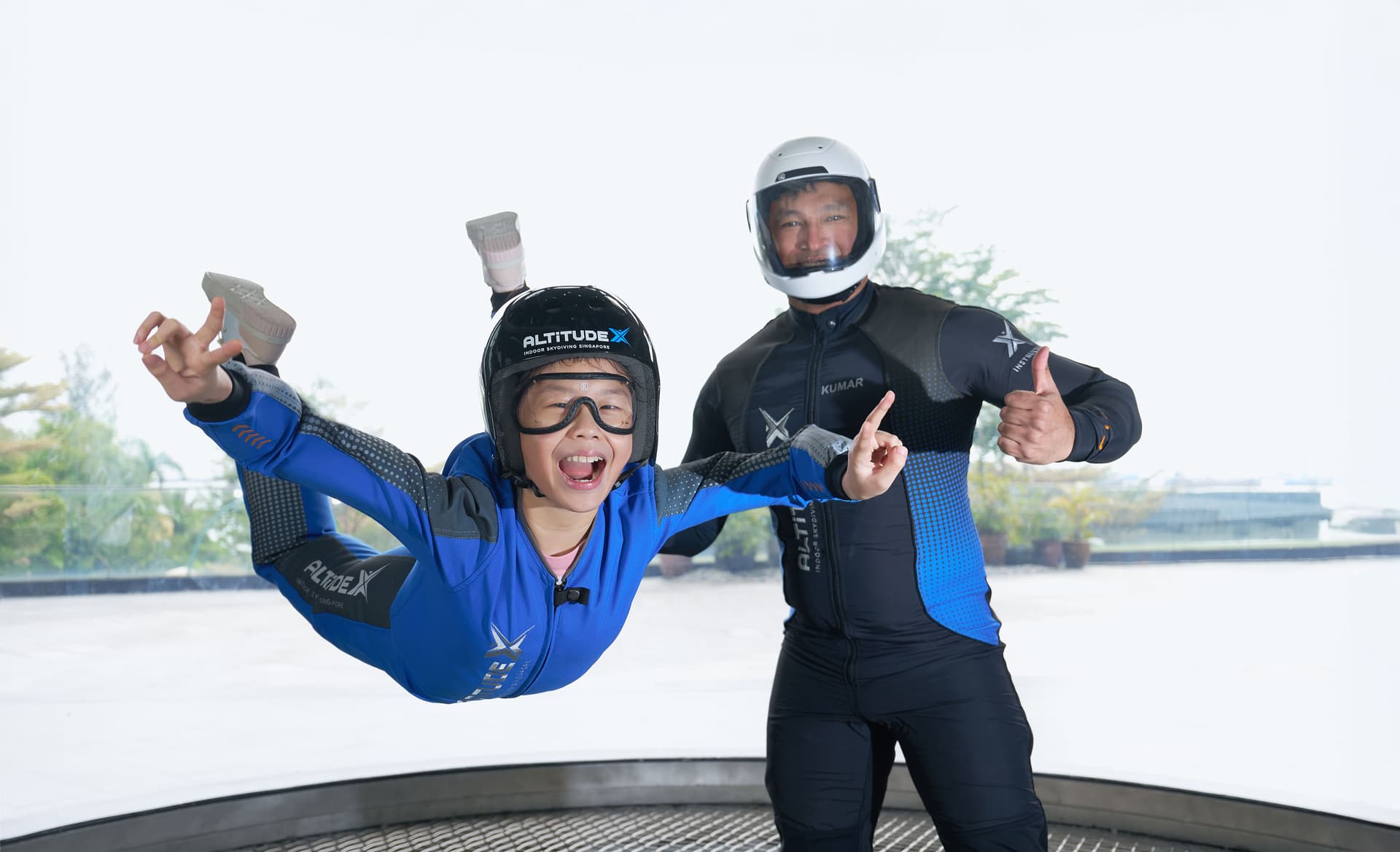
Sessions run in groups and take about ninety minutes end to end. You check in, then go to the training room for a safety briefing and flight training with a certified instructor, who teaches you the freefall body position and the hand signals used inside the chamber. The airflow is far too loud for speech, so the signals do all the communicating — straighten your legs, bend your legs, relax, chin up, hips down.
From there you head up to the second level to collect and fit your gear: flight suit, helmet and goggles, all provided. If you have not brought suitable shoes, they can be rented on site.
Then the instructor takes the group into the tunnel and everyone flies one at a time, with the instructor in the chamber alongside them for the whole flight. That is standard practice rather than an upgrade — they are there to correct your position and manage you in the column, while the wind speed is adjusted to your body. You get a flight certificate at the end.
The pattern that comes up again and again in first-timer accounts is that the first flight is mostly involuntary. The body fights the air, shoulders tense, legs straighten, and the instructor spends much of the minute putting you back where you should be. Somewhere in the second flight it clicks, and the wind starts doing the work instead. Which is the honest argument for booking two flights rather than one.
What it costs, and which package to pick
| Package | Flights | From | Their usual price |
|---|---|---|---|
| Teaser | 1 | SGD 59 ≈ $46 | SGD 99 ≈ $77 |
| Challenge | 2 | SGD 89 ≈ $69 | SGD 109 ≈ $85 |
| Challenge Ultimate | 2 + elevated flight | SGD 119 ≈ $93 | SGD 139 ≈ $109 |
| Trial Training | 6 | SGD 250 ≈ $195 | SGD 467 ≈ $365 |
The Teaser is a taste. One flight is enough to say you did it and to feel the air properly, though on the evidence of how first flights tend to go, it finishes at roughly the moment most people stop fighting the wind. It makes sense if budget is tight or you are working through several Sentosa attractions in a day.
The Challenge is the one to book, for the reason above: the first flight teaches your body the position and the second is where you actually fly. For most first-time visitors this is the right purchase.
Challenge Ultimate adds an elevated flight, where the instructor takes you higher up the chamber with the airflow increased. It is a SGD 30 ≈ $23 step up and comfortably the most photogenic option on the menu.
Trial Training is six flights with structured coaching, and it is the sharpest discount on the menu — SGD 250 ≈ $195 against a published usual price of SGD 467 ≈ $365, and roughly SGD 42 ≈ $33 a flight against SGD 59 ≈ $46 for a single Teaser. One important restriction: their terms limit it to new flyers who are Singapore residents, it must be booked online in advance, and all six flights are used in a single session. If you are visiting from overseas, this one is not available to you, and the Challenge tiers are where to look instead.
The "from" prices above are promotional and the usual prices are AltitudeX's own published figures, so treat the gap as real but temporary — check their site for what is running when you book. Against the rest of the region, SGD 59 ≈ $46 sits mid-field for an entry tier, and Singapore's cost of living does not push it far in either direction. Price is not really what AltitudeX competes on. Who it can take is.
Singapore residents — check their promotions before you book. As of August 2026 AltitudeX is running a SGD 50 ≈ $39 Teaser until 31 October 2026, and free Teaser flights for anyone aged 61 and over every Saturday and Sunday through August, capped at 61 redemptions each weekend. Both are limited to Singapore residents, so the SGD 59 ≈ $46 entry price above remains the number for visitors — but if you hold a Singapore address, or you are taking a parent or grandparent, it is worth a look.
Tunnel or tandem?
These two get talked about together, and they are not the same thing. The overlap is real, and it is the important part: the physical sensation of freefall is genuinely the same. Tunnel airflow is calibrated to terminal velocity, which is why military parachute units have trained in wind tunnels for decades. The wind on your skin, the pressure through the suit, the effort of holding shape against it — none of that is an approximation.
| Indoor (AltitudeX) | Tandem skydive | |
|---|---|---|
| Aircraft | None | Climb to around 13,000 ft |
| Freefall sensation | Yes | Yes |
| Canopy ride | None | 5–7 minutes under parachute |
| Scenery | Glass walls, beach and sea | Landscape from altitude |
| Skill development | High — real body-flight technique | Low — you are a passenger |
| Weather risk | None | Cancellations are routine in tropical Asia |
| Repeatable same day | Yes | Rarely |
A tandem gives you the aircraft, the door, the altitude and the canopy ride, and those are the things people remember for years. A tunnel gives you the freefall on its own — indoors, on demand, weather-proof, and repeatable in a way that jumping never is.
For most travellers with a bit of time in the region, the useful order is tunnel first, tandem later. An hour in the column tells you what your body does with freefall before you find out at altitude, and the position you learn is the same one you will be asked to hold on the jump.
Who it suits
- Nervous first-timers. There is no aircraft and no altitude, an instructor is physically with you throughout, and the entry is a step forward rather than a step out of a door.
- Anyone a weight limit has ruled out before. If 120 or 130 kg has stopped you elsewhere, this is the tunnel in the region most likely to fly you, and gear fit is a published part of their criteria rather than an afterthought.
- Anyone who has been turned away for a physical disability. Their published policy is unusually direct about trying, and they will give you extra time on a weekday booking.
- Families with children from seven. Watching a child fly hands-off in a column of air is a genuinely memorable hour, and the viewing gallery is built for exactly that.
- Licensed jumpers wanting coached time. Tunnel time is how body-flight skill actually gets built, and their sports-flyer programme runs well beyond the first-timer packages.
- Anyone with one fixed day in Singapore. Nothing here depends on the weather, which cannot be said for a single outdoor dropzone in this part of the world.
If it is not the right fit
Travelling with children under seven? Windlab in Malaysia and iFly Bali take them from three, iFly Jakarta from four — all a short flight away, and all worth a day of their own.
Carrying a shoulder, neck or back injury? These are published exclusions and they are not negotiable at the desk. Worth knowing before you build a day around it.
Really after the jump itself? If what you want is the door opening at altitude and the canopy ride down, a tunnel will not scratch that particular itch. Book a tandem instead — and consider flying the tunnel first anyway, because it will make the jump better.
Yes — same facility on Sentosa, same chamber. The operator rebranded from iFly Singapore to AltitudeX in late 2025, a date they confirmed to us directly, correcting the widely repeated claim that it happened in early 2026.
Seven years old. AltitudeX told us this comes from a regulation set by a Singapore government agency rather than a policy of their own. It is later than the rest of our Asia index, where tunnels generally admit children from three or four.
120 kg for flyers under 1.8 m tall, and 140 kg above that — the most generous ceiling of any tunnel in our Asia index. The operator''s own position, given to us directly, is that if they can fit into our suits, we will be able to fly them — so if you are near the line it is worth contacting them rather than ruling yourself out.
No. Instead they publish an exclusion list: no flying with a history of shoulder dislocation, back or neck injury, while pregnant, in a hard cast, under the influence of alcohol or non-prescribed drugs, or with heart problems.
From S$59 for the single-flight Teaser. The two-flight Challenge is S$89 and suits most first-timers best. Challenge Ultimate is S$119. Trial Training, six flights with coaching, is S$250 but is restricted to new flyers who are Singapore residents.
10am to 9pm daily, with the first flight at 11am and the last weekday flight at 8:30pm. These hours changed on 1 June 2026, so older listings may be wrong.
One hour before your flight time. Their terms treat late check-in as a no-show, which forfeits the full amount, so this is not a soft recommendation.
Before the day of your flight, yes, for S$30 per flyer. On the day of the flight, no — that is treated as a cancellation at 100%. Refunds are not offered as a rule.
About ninety minutes on site, run in groups. Airtime itself is short — one, two or six flights depending on the package — with the rest given over to check-in, briefing, training, gear-up and the rotation.
It is among the more controlled adventure activities available anywhere. An instructor is inside the chamber with you for the whole flight, wind speed is adjusted from outside, the chamber is enclosed, and there is no aircraft, parachute or altitude involved.
The freefall does. The airflow is calibrated to terminal velocity, and AltitudeX describes each flight as simulating the conditions and duration of a real freefall from around 12,000 feet. What it does not give you is the aircraft, the altitude, the view or the canopy ride.
From seven, with the same instructor supervision as adults. Under-18s need a parent or guardian''s signed permission.
A T-shirt with shorts, jeans or trousers, and closed-toe shoes with laces — trainers are ideal, and can be rented on site if you have not brought any. Avoid skirts, dresses, and loose jewellery. Flight suit, helmet and goggles are provided.
It makes no difference at all. The tunnel is fully enclosed, which is its main structural advantage over any outdoor dropzone in tropical Asia.
The last word
Most indoor tunnels sell much the same ninety seconds. What separates them, once you have decided you want to fly, is who they can actually get into the air.
By that measure AltitudeX is unusually straightforward. It has the most generous weight ceiling of any tunnel we list in Asia, and rather than treat the scale as the final word, the operator''s position is simply that if you fit the suit, they can fly you. Its accessibility policy says, in writing, that where a disability is physical, flying is almost always possible. Neither of those is standard in this industry, and both are the kind of thing you only find by reading the small print — which is presumably why so few people know about them.
Flying starts at seven here, which is later than elsewhere in the region and comes from Singapore regulation rather than anything the operator chose. They told us so directly rather than leaving us to work it out, which is its own kind of useful.
So if you are travelling with younger children, there are better-suited tunnels a short flight away, and Sentosa will still give you a very good day. And if you are an adult who has been quietly turned down before — by a weight limit, or by a venue that decided your body was too much trouble — this is the most accommodating tunnel we list anywhere on the continent, with the sea through the glass and the beach five minutes from the door.
Just check in an hour early.
See AltitudeX Singapore on Skydive In Asia
Opening hours, packages, flight criteria and the full operator profile — alongside every other dropzone and wind tunnel we track across Asia.
About this review: we have not flown at AltitudeX. This review is researched from the operator''s published material — their flight criteria, terms and conditions, FAQ and opening hours pages, all fetched on 14 August 2026 — from Google review data, and from our own catalogue of nine indoor wind tunnels across Asia. Five facts were confirmed to us directly by Andrea Han, Head of Marketing at AltitudeX, in August 2026: the late-2025 rebrand, the regulatory basis of the minimum age, that no medical certificate is required and what replaces it, the chamber dimensions, and the operator''s position on the weight cap, which is quoted here with her permission. This review was written independently and was not submitted to the operator for approval. Prices are the operator''s published rates, checked against our catalogue. Policies change; confirm current pricing, hours and terms when you book.
Skydive In Asia is the regional discovery and booking platform for tandem skydiving experiences across Asia, working directly with vetted dropzone operators and tracking conditions, equipment standards, and traveller feedback in real time.