On this page
- 01How Much Does a Skydive Cost in Asia in 2026? (Quick Answer)
- 02What Actually Determines the Price of a Skydive?
- 03Country-by-Country Skydive Price Comparison
- 04Cheapest Places to Skydive in Asia
- 05The Most Expensive Skydives in Asia — and Why People Still Pay
- 06What's Usually Included in a Tandem Skydive Price?
- 07Are Photo and Video Packages Worth It?
- 08Hidden Costs Travelers Forget About
- 09Is Skydiving Worth the Money?
- 10Best Skydive Destinations by Budget Type
- 11How to Save Money on Skydiving in Asia
- 12Buying a Memory in the Sky
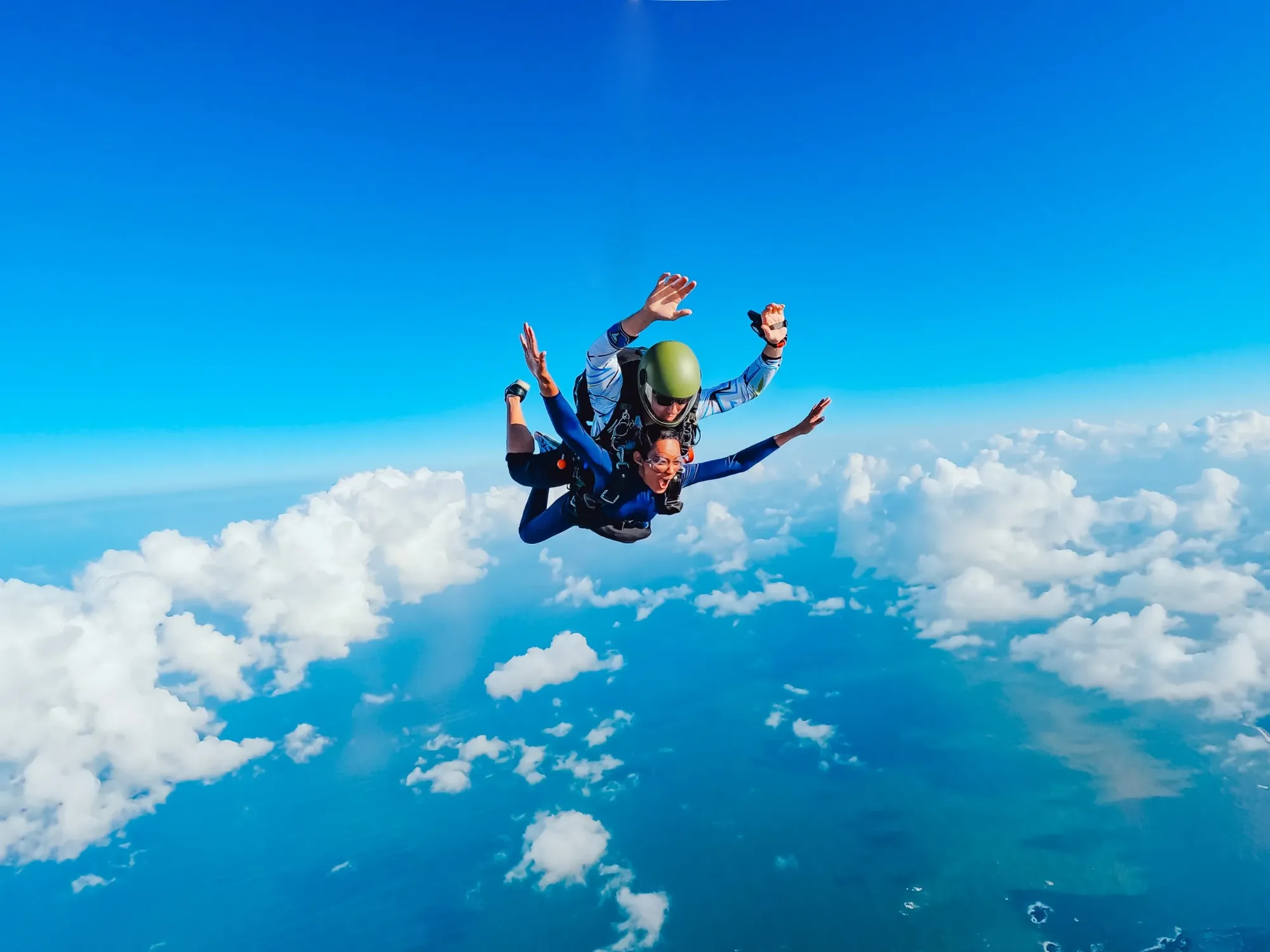
Somewhere over the Andaman, a turbine-engine Cessna is climbing through 9,000 feet. The door is closed but the air still cuts through the fuselage, cold and clean, edged with the smell of avgas. A first-timer is strapped to the front of an instructor she met forty minutes ago. She is thinking about three things: the green water below, the canopy on the instructor's back, and a number on a receipt.
This is the part nobody tells you about skydiving — that the most honest moment of the experience often happens before you board the plane. It happens in front of a price list. It happens when you reconcile what you can spend with what you might feel.
Asia is the most pricing-volatile skydive region in the world. A single jump in Pattaya costs less than a beach dinner in Dubai. A premium drop over Palm Jumeirah costs more than three weeks of backpacking in Vietnam. The same five-minute experience — one parachute, one instructor, one freefall — swings from roughly 245 USD to over 800 USD depending on which side of a coastline you're standing on.
That volatility isn't random. It's a story about aircraft economics, beach real estate, tourism demand curves, brand reputation, and the strange luxury physics of doing something terrifying in a beautiful place. This guide unpacks all of it. We walk country by country, range by range, and cover the questions most travelers are too embarrassed to ask out loud — is it worth it, is the cheaper one safe, should I pay for the video, will I regret skipping the photos. Every operator price quoted below was verified directly against the operator's own site at the time of publication.
By the end you will have a framework — not a price tag — for deciding where, when, and how to spend your one Asia skydive.
How Much Does a Skydive Cost in Asia in 2026? (Quick Answer)
A tandem skydive in Asia in 2026 costs roughly 240 USD to 815 USD, with most mainstream tropical destinations between 280 USD and 450 USD. Dubai sits at the premium end. Thailand is the clearest budget winner. The Philippines (Bantayan Island) wins on scenery-per-dollar. Singapore offers indoor wind-tunnel experiences only — no outdoor commercial tandem.
| Destination | Tandem Range (USD est.) | Operator-verified Local Price | Tier |
|---|---|---|---|
| Chiang Mai, Thailand | ~245–430 | ฿8,850–฿15,550 (Skydive Thailand) | Mid-range |
| Pattaya, Thailand | ~265–425 | ฿9,450–฿15,250 (Thai Sky Adventures) | Mid-range |
| Bantayan Island, Philippines | ~461–675 | ₱28,350–₱41,475 (Skydive Cebu) | Premium-tropical |
| Siquijor, Philippines | ~453–666 | ₱27,850–₱40,950 (Skydive Siquijor) | Premium-tropical |
| Koggala, Sri Lanka | ~285–330 | LKR 90,000–LKR 105,000 (Eagles' Skydive) | Best-value scenic |
| Palm Jumeirah, Dubai | ~600–680 | AED 2,199–AED 2,499 (Skydive Dubai) | Premium / bucket-list |
| Desert Campus, Dubai | ~515–600 | AED 1,899–AED 2,199 (Skydive Dubai) | Premium-accessible |
| Kanto & Kansai, Japan | ~355–520 | ¥56,000–¥81,500 (Azul, Kansai, Fujioka, Nippon) | Strong value |
| Niseko, Japan | ~1,265 | ¥200,000 (Skydive Hokkaido) | Premium seasonal |
| Chungju, South Korea | ~537–1,237 | ₩760,000–₩1,750,000 (Skydive Korea) | Premium |
| Syangboche, Nepal (Everest) | Event-tier — 25,000+ | Expedition-pricing | Once-in-a-lifetime |
| Sentosa, Singapore (indoor) | ~45–190 SGD | SGD 59–SGD 250 (AltitudeX) | Indoor / training tier |
The cheapest verified entry-level outdoor tandem in Asia in 2026 that you can actually book is at Dropzone Thailand in Rayong (฿8,000, around 240 USD, from 13,000 ft). Chiang Mai used to hold this spot at ฿8,850, but Phusanfah Airfield has been closed since June 2026. The most expensive verified mainstream tandem is the Skydive Dubai Palm Jumeirah package with standard video and photos (AED 2,499, around 680 USD). Almost everything else falls between those two reference points.
What the table can't tell you is why. That's the next section.
What Actually Determines the Price of a Skydive?
Skydive pricing looks arbitrary until you know what you're looking at. Then it looks almost rational. Eight factors do most of the work.
Aircraft type
A turbine aircraft — the NZ Aero 750XL flown at Phusanfah, the Cessna Caravans flown by Skydive Dubai — costs an operator several times more per hour than a piston Cessna 182. Turbine dropzones climb to higher altitudes, faster, and in larger groups, but every minute of engine time lands on the customer's bill. Operators flying turbines almost always price 20–40% above piston-only operations.
Location and scenery
A jump over Palm Jumeirah is partly a real-estate transaction. Operators near iconic photographable terrain — Dubai's coastline, Bantayan's reef, the Chiang Mai mountain corridor — pay premium leases, navigate tourist-zone regulation, and capture customers who arrived already willing to spend. The view is genuinely worth something. So is the customer's willingness to pay for it.
Tourism demand and altitude tiers
Pattaya, Cebu, and Dubai operate inside dense visitor economies — demand allows premium pricing. Less-touristed dropzones price closer to the cost line because they have fewer impulse buyers. Within a single operator, altitude tiers add another layer: a 13,000-foot exit (around 50–60 seconds of freefall) costs more to deliver than a 10,000-foot exit (around 30–40 seconds) because the aircraft burns more fuel and time per lift.
Photo and video packages
The outside ticket price is one number. Once you add a hand-cam video, an outside videographer, edited cuts, or extras like Skydive Dubai's Instagram highlight reel (AED 150) or selfie-view add-on (AED 250), you can add 30–60% to the bill. We dedicate a full section to whether this is worth it. Short answer: usually yes, with caveats.
Brand reputation and accreditation
USPA-affiliated operators (Skydive Thailand (closed since June 2026) and Skydive Cebu in Asia) price higher because they participate in international training, gear-replacement, and audit cycles. Skydive Dubai operates under GCAA oversight. Skydive Cebu specifically uses FAA-approved parachute systems with regular FAA-certified rigger inspections. This isn't a luxury tax — it's the operational cost of being demonstrably safer.
Destination operating costs and luxury positioning
Dubai pays Dubai-tier wages, fuel, and ground-handling fees. Pattaya pays Pattaya wages. Two operators with identical aircraft can have 50% different cost bases simply because of the country they fly in. Some operators also deliberately price above the market because they want to attract a specific clientele — affluent travelers, honeymooners, social-media spenders. The actual jump may be technically identical to a cheaper option.
If you ever see two operators in the same country with a 3x price gap, the difference is almost always (1) aircraft, (2) altitude tier, or (3) brand positioning — rarely the actual experience in freefall.
Country-by-Country Skydive Price Comparison
This is the section to bookmark. Every operator price below was verified directly against the operator's own website at the time of publication.
Thailand — Best Mainstream Value in Asia
Thailand is the most-jumped tandem destination in Southeast Asia. Two distinct geographies are now operational: Pattaya on the eastern Gulf coast (Thai Sky Adventures) and Chiang Mai's Phusanfah Airfield (Skydive Thailand (closed since June 2026), recently relocated from Khao Yai). Both run real turbine aircraft. The NZ Aero 750XL out of Phusanfah lifts groups to 13,000 feet routinely, and Skydive Thailand is a USPA International Affiliate.
Thai Sky Adventures (Pattaya) verified 2026 packages: Tandem Jump ฿9,450, Tandem with Video ฿13,250, Tandem with Video and Photos ฿14,250, Deluxe Package ฿15,250.
Skydive Thailand (closed since June 2026) (Chiang Mai) verified 2026 packages: Skydive Only ฿8,850, Silver Package (handcam) ฿12,750, Gold Package (personal cameraman with HD photos and videos) ฿15,550.
- Best for budget travelers — yes, the clearest value pick in Asia.
- Best for first-time jumpers — yes, English-language safety culture is a real advantage.
- Best overall value — Thailand wins this category in 2026.
- Most scenic for the price — the Chiang Mai mountain-and-paddy corridor is criminally underrated.
Currently closed. Phusanfah Airfield in Mae Taeng — the only skydiving dropzone near Chiang Mai, used by both Skydive Thailand and Skydive Chiang Mai — was ordered to halt operations by the Civil Aviation Authority of Thailand from 1 June 2026, and no reopening date had been announced as of 17 August 2026. The listing below is kept live so the status stays findable, and any prices shown are historic. Thai Sky Adventures near Pattaya and Dropzone Thailand in Rayong are both still flying.
Currently closed. Skydive Thailand is not taking bookings. Its listing is kept live so the status stays findable, and any prices shown are historic.
Currently closed. Phusanfah Airfield in Mae Taeng — the only skydiving dropzone near Chiang Mai, used by both Skydive Thailand and Skydive Chiang Mai — was ordered to halt operations by the Civil Aviation Authority of Thailand from 1 June 2026, and no reopening date had been announced as of 17 August 2026. The listing below is kept live so the status stays findable, and any prices shown are historic. Thai Sky Adventures near Pattaya and Dropzone Thailand in Rayong are both still flying.
Currently closed. Skydive Chiang Mai is not taking bookings. Its listing is kept live so the status stays findable, and any prices shown are historic.
Indonesia — The Emerging Coastline Drop
Indonesia is the most underdeveloped skydive market for its size. Lido has been closed since 2004; Pondok Cabe is shuttered; Nusawiru in West Java operates seasonally. Indoor bodyflight is available at iFly Bali in Denpasar and iFly Jakarta in Cibubur. A new generation of Bali-based operations is preparing to enter the market in late 2026 and early 2027 — when verified-status outdoor operators come online, Bali's volcano-and-ocean drop will instantly become one of Asia's most photographed jumps.
If you're researching a Bali skydive specifically, watch the platform for verified-status notice. For now, treat Indonesia as a market in transition: the operators are coming, but verify accreditation status before you book.
- Best for first-time jumpers — wait for verified-status outdoor operators.
- Best for couples and honeymooners — Bali, when fully operational, will be unmatched.
- Current options — indoor bodyflight at iFly Bali (Denpasar) or iFly Jakarta (Cibubur) is the most accessible flying experience in the country today.
Philippines — The Best-View-Per-Dollar Argument
The Philippines does something almost unique: it runs USPA and FAA-accredited tandem operations over an actual postcard. Skydive Cebu's jumps over Bantayan Island put you above white-sand atolls and turquoise reef, with a sister operation on Siquijor and a third at San Vicente on Palawan, flying the 14-kilometre sweep of Long Beach from January to May. Skydive Zambales on Luzon's western coast — for years the cheapest tandem in the country and the only one reachable from Manila by road — is currently paused and not taking bookings.
Skydive Cebu (Bantayan Island) verified 2026 packages: Group Jump (minimum 2 pax) ₱25,200, Standard ₱28,350, Premium (with outside camera flyer) ₱41,475. All packages include up to 10,000-foot exit, 20-minute sightseeing flight, handcam photos and video, edited reel, skydiving certificate. Skydive Siquijor, run by the same team, prices a shade below: ₱24,650, ₱27,850 and ₱40,950 for the equivalent tiers.
Skydive Cebu is the only USPA International Affiliate dropzone in the Philippines, using FAA-approved parachute systems with regular FAA-certified rigger inspections.
- Best for luxury feel without luxury pricing — yes.
- Most scenic for the price — competes only with Dubai on this axis, at half the cost.
- Best for solo travelers — note the group rate requires two pax; solo travelers default to standard pricing.
Malaysia — Indoor Only Right Now
Malaysia is the cautionary tale of this guide. On paper it has three dropzones; in practice, as of August 2026, none of the outdoor operations are flying. Skydive Langkawi — the 14,000 ft beach landing that made the country's reputation — has not run commercial jumps since the pandemic. Hawk's Sports Skydiving Club at Segamat now runs its tandem and AFF programmes through partner dropzones in Thailand rather than at home. Helang Megah near Kuala Lumpur is also not operating.
That leaves Windlab, the indoor wind tunnel at 1 Utama in Petaling Jaya, from RM 138 — genuinely good for a first taste of bodyflight, but not a skydive. If you are in Kuala Lumpur and want a real exit, the honest answer is a two-hour flight to Bangkok or Chiang Mai, where tandems start at ฿8,850. We keep the paused Malaysian listings live with their verified status and a reopening waitlist rather than quietly deleting them.
Sri Lanka — The Best-Value Scenic Jump in Asia
Sri Lanka is one of Asia's quietly compelling skydive destinations, and as of August 2026 it has one operator flying: Eagles' Skydive at Koggala on the southern coast, about an hour from Galle. The Bentota beach operation that used to be the country's headline product confirmed to us directly in August 2026 that it is not currently flying, so Koggala is the only way to jump in Sri Lanka right now.
Eagles' Skydive verified 2026 pricing: Silver Package at LKR 90,000 for a 10,000 ft exit, Gold Package at LKR 105,000 for 13,500 ft — roughly 285 to 330 USD. That makes it the cheapest coastal tandem in Asia outside Thailand, and the best scenery-per-dollar on this list. It is run by the Sri Lanka Air Force, every instructor is a serving SLAF officer, and it is the country's first USPA-affiliated dropzone.
Nepal — Two Tiers in One Country
Nepal is the strangest pricing market in Asia because it operates at two utterly separate tiers. Pokhara Skydive runs scenic-jump tandems above the Annapurna foothills — a tier roughly comparable to mid-range Asian operators on a per-jump basis. Everest Skydive is a different category entirely: an expedition-style event with jumps near the world's highest peak, structured pricing, supplementary oxygen, and a Syangboche / Everest View Hotel landing footprint. Counted in tens of thousands of dollars rather than hundreds.
- Pokhara — yes, especially if you're already trekking the Annapurna circuit.
- Everest — once-in-a-lifetime tier; a separate financial life-event from a normal tandem.
Japan — Five Dropzones, Strong Value
Japan has five bookable dropzones and they differ from each other more than any other country's set in the region. Three are within reach of Tokyo: Skydive Nippon at Kawajima in Saitama, the closest to the city at forty-five minutes from Tokyo Station and the highest exit in the country at 13,000 ft; Skydive Azul at Chikusei in Ibaraki, the only helicopter exit; and Skydive Fujioka in Tochigi, which claims Japan's longest freefall at close to 60 seconds. Skydiving Kansai at Toyooka in Hyogo serves the Osaka and Kyoto side, and Skydive Hokkaido runs a short premium season near Niseko.
Verified 2026 pricing: from ¥56,000 at Azul, ¥58,000 all-inclusive at Kansai, ¥61,000 at Fujioka and ¥61,500 at Nippon — roughly 355 to 390 USD, which is strong value for the aircraft quality and procedural rigour on offer. Skydive Hokkaido sits far above at ¥200,000 for its short summer season. Azul's Mount Fuji helicopter tandem is a separate product at ¥99,000 with a hard 175 cm and 80 kg cabin limit. Briefings are thorough, manifests run on time, and English support is available at most operators — Nippon runs a dedicated English phone line.
South Korea — Seasonal and Scenic
Korea has a small commercial tandem ecosystem operating seasonally out of Chungju. The pricing rewards travelers already on a Korea trip; as a standalone destination decision, fly to Thailand or the Philippines first.
Singapore — No Outdoor Tandem, World-Class Indoor
Singapore has no operational outdoor commercial tandem dropzone. AltitudeX (the Sentosa wind tunnel formerly branded iFly Singapore) is the world's largest themed indoor skydiving wind tunnel and offers indoor bodyflight at SGD 59 (Teaser, 1 skydive), SGD 89 (Challenge, 2 skydives), SGD 119 (Challenge Ultimate, 2 elevated skydives), or SGD 250 (Trial Training, 6 skydives — a significant package). All packages include flight gear and training over 90 minutes.
Indoor bodyflight isn't freefall — it's something else. But it's an exceptional pre-skydive primer, a rainy-day alternative, and a destination experience in its own right.
Dubai / UAE — The Premium Asia Skydive
Dubai is the most photographed skydive on earth. Two outdoor campuses operate continuously: Palm Jumeirah (the iconic island shoreline drop) and the Desert Campus (an inland aerial canvas of dunes and sky). Two indoor operations — Inflight Dubai and iFly Dubai — round out the city's bodyflight options.
Skydive Dubai verified 2026 packages: Palm Dropzone tandem with medical insurance only AED 2,199; Palm tandem with insurance, standard video and photos AED 2,499. Desert Campus tandem only AED 1,899; Desert tandem with insurance, standard video and photos AED 2,199. Add-ons across both campuses: Instagram highlight reel AED 150, selfie-view add-on AED 250.
Skydive Dubai is a member of the GCAA. Note the current operating-day window is Friday to Sunday — verify the calendar before booking.
- Best for luxury — yes.
- Best for honeymoon splurge — yes.
- Best bucket-list visual — Palm Jumeirah is one of the half-dozen most-recognized skydive shots ever taken.
Other Asia / Adjacent Markets — Briefly
Beyond the headliner countries, the SkydiveInAsia platform tracks operations across China (China Skydivers in Luoding, Guangdong; iFly Shenzhen indoor), India (Skyhigh India near Narnaul, Haryana), the Maldives (Skydive Maldives at Ifuru Island — one of the world's most enviable resort-paired drops), Kuwait (Kuwait Skydive and Fly at Al Khairan), Israel (SkyKef in the Negev; GoJump! Dead Sea), and Turkey (Skydive EFES at Selçuk near Izmir, an established European-bordering destination). Saudi Arabia's Unique Clouds Skydiving at Ar Rass is listed but currently paused.
Pricing in these markets varies meaningfully and operator schedules can be seasonal. Verify directly before planning a trip purely around them.
Cheapest Places to Skydive in Asia
The shortlist for budget-conscious jumpers in 2026 is short and unambiguous.
- Thailand (Pattaya and Rayong) — sub-300-USD entry-level tandems, real turbine aircraft, English-language instruction. The unambiguous winner of the budget category. Dropzone Thailand's ฿8,000 base price in Rayong is the cheapest verified outdoor tandem in Asia, and Thai Sky Adventures at ฿9,450 is the other open Thai option. The Chiang Mai pair are closed.
- Sri Lanka (Koggala) — Eagles' Skydive, run by the Sri Lanka Air Force, from LKR 90,000 (around 270 USD) for a 10,000 ft exit. The Bentota operator is closed.
- Malaysia (Langkawi, in season) — when operational, comparable to mid-range Thailand pricing.
- Status note: the two Mae Taeng operators outside Chiang Mai, Skydive Thailand and Skydive Chiang Mai, have been closed since the Civil Aviation Authority of Thailand halted operations at Phusanfah Airfield on 1 June 2026. Any prices shown for them are historic. Thai Sky Adventures (Pattaya) and Dropzone Thailand (Rayong) are still flying.
Where it gets interesting is the value conversation versus the cost conversation. The cheapest jump in Asia you can book today (Dropzone Thailand, on a private airstrip in Rayong) is also a genuinely good one, and the Chiang Mai jump that used to hold the title was a top-five experience on the continent before its airfield closed. That is rare in extreme-tourism economics. In most parts of the world, the budget option is a compromise. In Thailand, it isn't.
The tradeoffs to know:
- Manifest density. Cheaper destinations sometimes run busier manifests — you may wait longer in the briefing room.
- Aircraft age. Many budget operators run perfectly maintained but older airframes; ask before booking.
- Add-on pressure. Lower entry pricing sometimes correlates with stronger upsell on photo and video packages. Decide before you arrive.
The Most Expensive Skydives in Asia — and Why People Still Pay
Dubai. Always Dubai. With Everest as the ceiling.
There are operational reasons Dubai prices the way it does — fuel, wages, lease costs, multilingual staffing, regulatory overhead — and there are brand reasons. Dubai is a jump people pay for partly because of what it photographs as. The Palm Jumeirah image is, in 2026, one of the most-recognized skydive shots ever taken. Travelers buy the image as much as the experience.
Bucket-list compression
Most tandem skydivers will jump exactly once. If once is the budget, the calculus shifts: this is not a vacation activity, it is the skydive of my life. That reframes a 400-USD premium as a tiny rounding error.
Iconic scenery and social proof
Palm Jumeirah is one of perhaps a half-dozen views on earth that cannot be approximated from anywhere else. You're not paying for a skydive; you're paying for that image, of you, above that place. Premium skydives also ship well on social media — they generate the kind of post that gets several times the engagement of an unfamiliar location.
Premium operations
Dubai's premium price genuinely buys a more polished experience: shorter wait times, newer aircraft, multilingual instructors, better photography product, smoother ground operations. The infrastructure backs the marketing.
The Everest tier is its own conversation. Few people decide between Everest and Dubai. Everest is a separate financial life-event. If it's on your list, it's on your list for reasons that have nothing to do with this guide.
The luxury skydive question isn't 'is it worth 680 USD?' It's 'is the difference between this skydive and a verified 245-USD Skydive Thailand (closed since June 2026) jump worth 435 USD to me, today?' That reframes the decision honestly.
What's Usually Included in a Tandem Skydive Price?
Most reputable Asia tandem packages bundle the following.
- One-on-one instructor and harness. Your instructor is the most expensive line item on the operator's books.
- All gear — harness, jumpsuit, goggles, helmet, altimeter, primary and reserve canopies. You bring nothing but yourself.
- Pre-jump briefing and ground training, typically 20–40 minutes. If a dropzone tries to skip this, walk away.
- Aircraft lift to jump altitude. Usually 10,000 to 13,000 feet, depending on operator and altitude tier.
- The freefall (30–60 seconds) and canopy ride (4–6 minutes).
- Insurance / waiver paperwork. Standard at every reputable jurisdiction. Skydive Dubai bundles medical insurance into every package.
What's typically not included:
- Photo and video packages — almost always upsold separately, with named tiers.
- Transport to the dropzone — many Asian operators are 60 to 120 minutes from major tourist hubs.
- Higher altitude tiers — usually a tiered upcharge.
- Same-day rebooking after a weather hold — practices vary.
The honest framing: when you're comparing two operators and one looks 80 USD cheaper, check what's included before declaring a winner. The cheaper operator may simply have unbundled the same package.
Are Photo and Video Packages Worth It?
Yes. Probably. Here's the honest framing.
The economics of regret are not symmetrical. The downside of paying for video and not loving it is roughly 80 to 120 USD. The downside of not paying for video and discovering, six months later, that you have no record of the most extreme thing you've ever done — that downside is permanent. That asymmetry is why almost every experienced traveler in this category buys the package on their first jump.
Hand-cam-only video
Filmed by your instructor on a wrist-mounted camera. Intimate, close-up, slightly limited in framing. Standard at Skydive Cebu's entire package range; the Silver tier at Skydive Thailand (closed since June 2026) (฿12,750); the Tandem with Video tier at TSA (฿13,250).
Outside videographer
A separate jumper filming you in freefall. Dramatically better cinematic footage — wide shots, multiple angles, professional framing. The Premium tier at Skydive Cebu (₱39,500); the Gold Package at Skydive Thailand (closed since June 2026) (฿15,550). Worth the upgrade if you intend to share the video.
Edited cuts and add-ons
Skydive Dubai sells the Instagram highlight reel separately at AED 150 and a selfie-view add-on at AED 250 — both layered on top of the standard video package. Quality varies wildly across operators; ask for a sample reel before booking.
If you can't decide on the spot, default to the package. The cost of a 'no' that turns into a 'yes' too late is far higher than the cost of a 'yes' that turns into 'meh.'
Hidden Costs Travelers Forget About
The sticker price isn't the trip price. Five quiet costs to factor in.
- Transportation. A return taxi from Pattaya hotels to Thai Sky Adventures, or from Cebu City to the Bantayan ferry and onward, can add 40 to 120 USD to your day.
- Tourist taxes. A handful of jurisdictions add small visitor levies. Rarely material, occasionally present.
- Weather delays. Build in at least a one-day buffer — ideally two. Tropical Asia has weather, and many travelers lose their only window to thunderstorms or high winds.
- Accommodation extension. A weather hold sometimes means an extra hotel night, sometimes a flight change. This can dwarf the skydive cost itself.
- Tourist-area pricing. Food, drinks, and amenities at a coastal dropzone often run 30 to 80% above local averages. Budget the day, not just the jump.
The seasoned-traveler rule: add 25 to 35% to the jump price to estimate the realistic day cost.
Is Skydiving Worth the Money?
This is the question every first-time jumper actually wants answered.
The fear-versus-achievement transaction is real. Tandem skydiving is one of the few experiences in modern adult life that genuinely tests your willingness to do something your nervous system disagrees with. The achievement payoff after the canopy opens is unlike most other tourist activities. People remember it for decades.
The memory math is favorable. A great dinner in Bangkok might run 80 USD and last two hours. A great hotel night in Bali might run 250 USD and last twelve. A skydive in Pattaya might run 350 USD and last six minutes — but ten years from now, you'll remember the skydive in higher resolution than the dinner. Tourist economics are dominated by peak experiences. Your brain stores them differently. They become the trip.
The 'life-changing' claim is half-true. Most skydives don't change your life. But almost every first-timer reports a quiet shift in how they think about courage, mortality, and self-trust for weeks afterward. That isn't marketing language. It's the consistent feedback in instructor logbooks across the region.
The honest answer: yes, for almost everyone in the target audience reading this guide. The risk isn't that you'll regret jumping. The risk is that you'll regret not jumping.
Every tandem first-timer says some version of the same thing on the ground after landing: 'I can''t believe I did that.' The price stops being the conversation almost immediately.
— EDITORIAL TEAM INTERVIEW NOTES, MAY 2026
Best Skydive Destinations by Budget Type
A quick recommendation matrix — every recommendation here is anchored to verified 2026 operator pricing.
- Best under 300 USD — Dropzone Thailand (Rayong) at ฿8,000 or Thai Sky Adventures (Pattaya) at ฿9,450. The clearest budget winners in the region, and both are open.
- Best value scenic jump — Eagles' Skydive at Koggala, Sri Lanka, from LKR 90,000. Coastal scenery at roughly 285 USD.
- Best premium experience — Skydive Dubai Desert Campus at AED 1,899 to 2,199.
- Best bucket-list luxury — Skydive Dubai Palm Jumeirah at AED 2,199 to 2,499.
- Best for backpackers — Pattaya. Easy to reach, easy to integrate into a Southeast Asia trip, easy to afford.
- Best value in a high-cost country — Japan, from ¥56,000. Five dropzones, and the closest is forty-five minutes from Tokyo Station.
- Best for first-time experience — Skydive Thailand or Skydive Cebu, both USPA-affiliated.
- Best scenery per dollar — Skydive Cebu / Bantayan Island. Premium-tropical scenery at premium-tropical prices, but with USPA + FAA accreditation backing it.
- Most underrated — Skydive Thailand's Chiang Mai mountain corridor. Mountain-and-paddy scenery at sub-300-USD entry pricing.
- Status note: the two Mae Taeng operators outside Chiang Mai, Skydive Thailand and Skydive Chiang Mai, have been closed since the Civil Aviation Authority of Thailand halted operations at Phusanfah Airfield on 1 June 2026. Any prices shown for them are historic. Thai Sky Adventures (Pattaya) and Dropzone Thailand (Rayong) are still flying.
How to Save Money on Skydiving in Asia
Six honest tactics.
- Shoulder seasons — late April–early May (between Songkran and the rains) and late October–early November are quietly the best-value windows in much of Southeast Asia.
- Weekday timing. Saturday and Sunday manifests are the busiest and rarely discounted. Tuesday through Thursday lifts are sometimes 5 to 15% cheaper, with shorter waits.
- Compare full packages, not just sticker prices. Some operators bundle photo and video into their tiers; the 'more expensive' operator can end up cheaper for the full-day experience.
- Avoid resort-area middlemen. Tour desks in Phuket, Pattaya, and Bali resell skydive bookings at 15 to 25% markups. Booking direct, or via a verified marketplace, is almost always cheaper.
- Combine your trip intelligently. A Chiang Mai skydive integrates with the entire northern Thailand circuit. A Cebu skydive integrates with Bohol or Palawan. Treat the skydive as a chapter, not a destination.
- Set realistic expectations. A good Pattaya jump is not a worse jump than Dubai — it's a different one. Match your expectations to the destination, not to a competitor's advertising.
Thailand. Of the dropzones currently open, the cheapest verified entry-level outdoor tandem in 2026 is Dropzone Thailand's ฿8,000 jump from 13,000 ft on a private airstrip in Rayong, with Thai Sky Adventures in Pattaya close behind at ฿9,450. Both are real turbine operations with English-language instruction. Chiang Mai was cheaper still at ฿8,850, but Phusanfah Airfield has been closed since 1 June 2026.
Most mainstream Asia tandem skydives in 2026 cost between 280 and 450 USD when converted from local currency. Skydive Dubai's Palm Jumeirah package sits above this band at AED 2,199–2,499 (around 600–680 USD). Thailand sits at the lower edge, near 245–435 USD.
The cost is dominated by aircraft fuel and maintenance, instructor wages and certification, gear inspection and replacement cycles, and insurance. Dropzones don't have especially high margins; the cost line is real. USPA-affiliated operators (Skydive Thailand, Skydive Cebu) and GCAA-overseen operators (Skydive Dubai) also pay into international audit and training cycles, which adds operational cost.
For first-time jumpers in the target audience for this guide — almost universally yes. The peak-experience memory, the photograph, and the personal-courage payoff scale better than almost any other line item in a travel budget.
At most Asian operators, yes — photo and video packages are upsold separately. At Skydive Cebu, all packages already include handcam video. At Skydive Thailand and Thai Sky Adventures, video is a tiered upgrade. At Skydive Dubai, the Instagram highlight reel (AED 150) and selfie-view add-on (AED 250) layer on top of the standard video package.
Thailand, on a sticker-price basis. Sri Lanka, on a scenic-mid-tier basis. Philippines (Bantayan Island), on a scenery-per-dollar basis. Dubai if you specifically want the iconic Palm Jumeirah photograph.
For travelers who want the iconic Palm Jumeirah photograph, yes. For travelers who only want to skydive once and care more about the act than the backdrop, the premium is harder to justify against a verified Skydive Thailand or Skydive Cebu package.
Yes. A tandem skydive specifically requires no prior experience. Briefings cover everything you need; the instructor manages the parachute and the landing. Minimum age varies by country (typically 16 or 18); maximum weight limits typically range 95 to 110 kg.
Honestly: yes, for the 30 seconds before the door opens. After exit, most first-timers describe overwhelming euphoria rather than fear. The anticipation is worse than the experience.
Most operators will reschedule to the next available window. Skydive Dubai's current operating-day window is Friday to Sunday — verify the calendar before booking. Build at least a one-day buffer into any skydive trip regardless of operator.
Yes — indoor bodyflight wind tunnels operate at AltitudeX Singapore (SGD 59–250), Inflight Dubai, iFly Dubai, iFly Bali, iFly Jakarta, iFly Shenzhen, FlyStation Korea, and Windlab Indoor Skydiving in Kuala Lumpur. Indoor flying isn't freefall, but it's an excellent primer and a destination experience in its own right.
No. Photo and video packages are opt-in everywhere reputable in Asia. You will not be charged for footage you didn't agree to.
Status note: the two Mae Taeng operators outside Chiang Mai, Skydive Thailand and Skydive Chiang Mai, have been closed since the Civil Aviation Authority of Thailand halted operations at Phusanfah Airfield on 1 June 2026. Any prices shown for them are historic. Thai Sky Adventures (Pattaya) and Dropzone Thailand (Rayong) are still flying.
Buying a Memory in the Sky
Pricing a skydive isn't the same as pricing a flight or a hotel. You aren't paying for a service; you're paying for the moment you push your body out of an aircraft over a coastline you'll remember in unreasonable detail for the rest of your life. You're paying for a photograph that will outlive most of the things you own. You're paying for a story you'll tell people you haven't met yet.
Asia is the most pricing-volatile skydive region in the world because it contains both ends of that conversation. Thailand will sell you the act for ฿8,850 and let the freefall speak for itself. Dubai will sell you the photograph at AED 2,499 and let the photograph speak for the act. Sri Lanka and the Philippines sell you a quietly excellent middle path. Bali will, when verified-status operators come online, sell you something none of the others can — a volcano-and-ocean drop with the Indian Ocean stretching to the horizon.
The right skydive isn't the cheapest one or the most expensive one. It's the one that matches the part of you that's making the booking. If you're bucket-listing a once-in-a-lifetime image, pay for the image. If you're a budget-conscious traveler who's been wanting to try this for years, Thailand will not disappoint you. If you're a first-time jumper worried about the operation behind the price tag, choose accreditation over savings — Skydive Thailand (closed since June 2026), Skydive Cebu, and Skydive Dubai are the names to know.
Most travelers who finish reading a guide like this one don't book the same week. They book six weeks later, in a quieter moment, after the price stops feeling like a price and starts feeling like a deposit on a memory. That's the right way to do it.
The editorial team behind Asia's dedicated skydiving discovery platform — working directly with dropzones and federations across the region to keep listings accurate.